
You measure visibility in AI answers by running a fixed set of customer-style prompts on the AI platforms your buyers use, repeating them on a schedule, and recording how often your brand is mentioned, how often your pages are cited, what the answer says about you, and who appears next to you. Divide the answers that include your brand by the total answers you checked, and you have a baseline score you can compare month over month.
There is no single “rank” in an AI answer, so the work is sampling, not looking up a position. At Magic Logix, where our brand position is Digital Beyond Tomorrow, we treat this as a measurement discipline first and an optimization project second: you cannot improve what you have not baselined.
TL;DR
- Track 20 to 25 prompts that mirror how your customers actually ask questions, and run the same set every month.
- Score four things: mention rate, citation rate, share of voice against named competitors, and accuracy of what the AI says about you.
- Treat every AI answer as one sample, not a fact. Repeat runs, log the date and platform, and only call a change real if it holds across several runs.
- Pair prompt tracking with your own analytics, so you see visits that AI platforms send, and fix crawl access before you chase content tweaks.
- Report a trend and a gap list, not a single vanity number.
Table of Contents
- What “visibility in AI answers” actually means
- Why you measure samples, not rankings
- Step 1: Build a prompt set that mirrors real buying questions
- Step 2: Choose the platforms that matter to your buyers
- Step 3: Run the prompts and record each answer
- Step 4: Calculate the core metrics
- Step 5: Connect prompt tracking to your own analytics
- Step 6: Audit why you are or are not appearing
- Step 7: Build a monthly scorecard
- How to read changes without fooling yourself
- Turning measurement into a plan
- Where Magic Logix fits
- Perspective
- FAQ
- Sources
What “visibility in AI answers” actually means
When someone asks an AI assistant or Google’s AI features a question, the system writes an answer and may link to or name sources. Your visibility has several layers, and they are not the same thing:
- Mention: the answer names your brand, with or without a link.
- Citation: the answer links to or lists one of your pages as a source.
- Recommendation: the answer names you as a good option for the question.
- Accuracy: what the answer says about you is correct, current and in your own terms.
A brand can be mentioned and never cited, or cited for a page that does not help it sell. That is why a single number rarely tells you enough. If you are new to the practice of earning these placements, our overview of answer engine optimization explains how it differs from classic SEO.
Why you measure samples, not rankings
Google’s own guidance says that AI Overviews and AI Mode may use a “query fan-out” technique, issuing several related searches across subtopics before composing a response, as described in Google’s documentation on AI features and your website. In plain terms: the question you type is not always the question the system answers. It breaks it into narrower questions, and your page may be relevant to one of those pieces.
That has two consequences for measurement:
- The same prompt can produce different answers on different days, and different sources each time.
- You need enough runs to separate real movement from noise.
A published sampling standard from Barkhausen takes this seriously. Its sampling-protocol requirements call for a stated time window, sampling spread across that window, and at least three distinct days when the window spans several days. They also ask you to name the engine and version, and to treat a change as real only if it is statistically significant, sustained across consecutive windows, and not explained by an engine update. You do not need a research lab to apply the spirit of that: log the date and platform, repeat runs, and wait for a second month before you celebrate or panic.
Step 1: Build a prompt set that mirrors real buying questions
The prompt set is the foundation. A weak set makes every later number meaningless.
How many prompts. Start with a small, deliberate group. Published guidance from the practitioners ranking for this topic commonly suggests 20 to 25 prompts, which is manageable by hand and wide enough to show gaps. A small business can begin with 15.
Where they come from. Pull wording from places where real customers speak:
- Sales call notes and the questions prospects ask before they buy
- Your site search, support tickets and chat transcripts
- Reviews and forum threads in your industry
- Google Search Console queries, which show how people phrase problems
Which types to include. Mix these so you see the whole funnel:
| Prompt type | Example pattern | What it tells you |
|---|---|---|
| Category discovery | “best [service] for [type of business] in [city]” | Whether you are in the consideration set |
| Problem-led | “how do I fix [problem you solve]” | Whether your expertise is cited |
| Comparison | “[you] vs [alternative type]” | How you are framed against others |
| Brand check | “what is [your company] known for” | Accuracy and sentiment |
| Local or segment | “[service] near [location]” or “for startups” | Fit with your target audience |
Keep branded prompts (naming you) separate from unbranded ones in your reporting. Unbranded prompts measure discovery. Branded prompts measure reputation. Blending them inflates your score and hides the real gap.
Step 2: Choose the platforms that matter to your buyers
You do not need to track every assistant. Pick the three or four where your customers are most likely to ask:
- Google AI Overviews and AI Mode, because they sit on top of the search results most people already use
- ChatGPT, the assistant most business buyers mention
- Perplexity, which shows its sources prominently and is easy to audit
- Microsoft Copilot or Gemini, depending on whether your buyers work in Microsoft or Google environments
For each platform, note whether the web search feature was on, whether you were logged in, and the location. Answers can shift with these settings, so keep them identical from month to month.
Step 3: Run the prompts and record each answer
Use a simple sheet with one row per prompt, platform and run. Capture:
- Date and platform (and model name if shown)
- Prompt text, exactly as entered
- Whether your brand was mentioned (yes or no)
- Position in a list, if the answer is a list
- Which of your URLs were cited, if any
- Which competitors and which third-party sites were named or cited
- A short note on sentiment and any factual errors
Run each prompt at least three times across different days within the month. That is slower than a one-off check, but it is what turns an anecdote into data. Software exists for automated prompt tracking, and teams with large prompt sets often adopt it. The method below works either way, because the logic does not change: fixed prompts, repeated runs, consistent logging.
Step 4: Calculate the core metrics
Four calculations cover most of what a decision-maker needs.
Mention rate (brand visibility score)
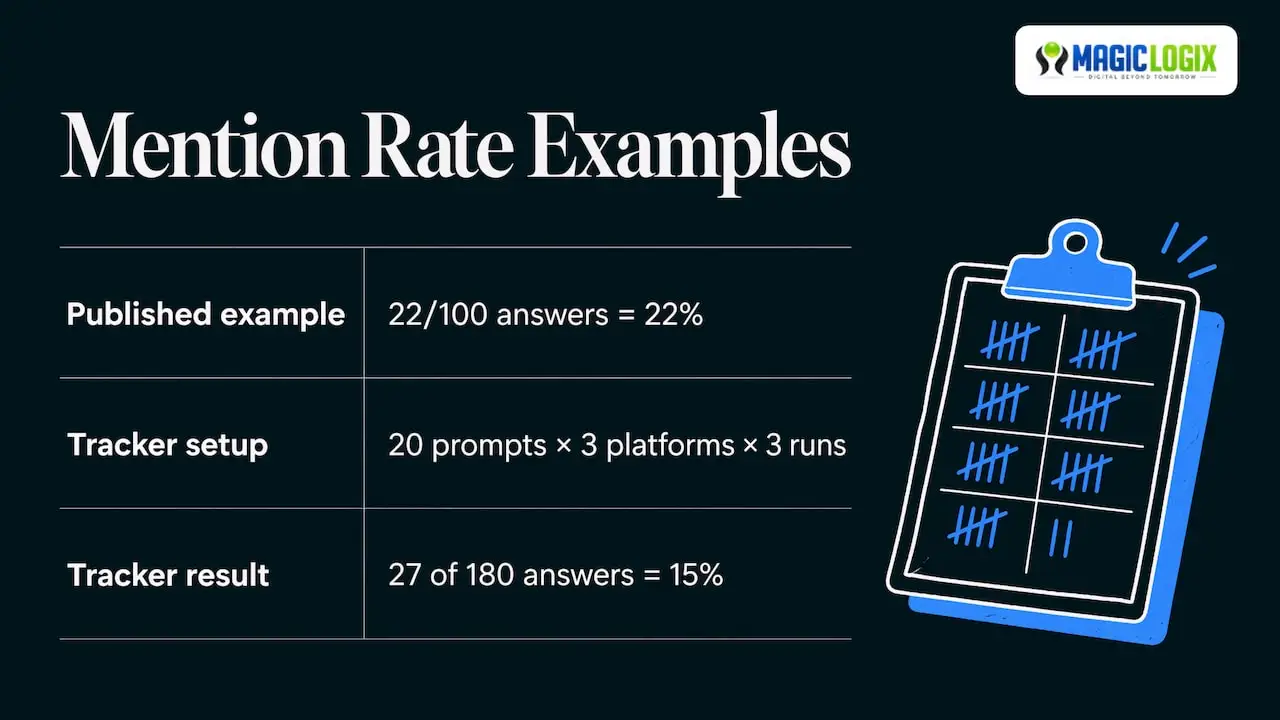
Search Engine Land defines a simple brand visibility score: answers mentioning your brand, divided by total answers for your space, times 100. Their example: if 22 of 100 high-intent prompts such as “best CRM software” mention the brand, the score is 22%.
Applied to a small tracker, 20 prompts on 3 platforms, run 3 times each, gives 180 answers. If your brand appears in 27 of them, your mention rate is 15%. That figure is an illustration of the arithmetic, not a benchmark for your industry.
Citation rate
Count the answers where a page on your domain appears as a source, divided by total answers. Then break it down by page: which URLs earn citations, and which pages you expected to see but did not. Citation rate tells you which content AI systems consider useful, which is often different from the pages you consider most important.
Share of voice
For each prompt, list every brand named. Your share of voice is your mentions divided by all brand mentions across the set. Track three to five direct competitors by name in your own sheet. This number matters most to marketing directors, because it frames visibility as competitive position, not an absolute.
Accuracy and sentiment
For each branded answer, ask: is the description correct, is pricing or location outdated, are services missing, is the tone favorable? Score each as accurate, partly accurate or inaccurate. Inaccurate answers are your fastest wins, because they usually point to a source page that needs updating.
Step 5: Connect prompt tracking to your own analytics
Prompt tracking shows what AI says. Analytics shows what people do afterward. You need both.
- Referral traffic. In your analytics platform, check traffic sources for visits from AI assistants and add them to a custom channel group so they are reported together. Some visits arrive with no referrer and land in direct traffic, so treat what you see as a floor, not a total.
- Landing pages. Note which pages AI-referred visitors land on, and whether they convert to forms, calls or purchases.
- Branded search. A rise in searches for your company name after you gain AI mentions is a useful secondary signal, though many factors move it.
- Search Console. Watch impressions and clicks for the pages you are trying to get cited.
Tie these to business outcomes: qualified leads, demo requests, or orders from the pages that AI answers reference. Visibility that never produces a visit or a lead is a number, not a result.
Step 6: Audit why you are or are not appearing
Once you have a baseline, use this checklist to explain the gaps. It is also the core of an AI search visibility audit.
- Crawl access. Can each platform’s search crawler reach your key pages? Check robots.txt, firewall rules and any bot protection that blocks assistants by accident. Capital & Compute’s review of GEO and AEO tactics lists being crawlable by each engine’s search bot as a first lever.
- Relevance to sub-questions. Because engines split queries into narrower searches, check that your page titles, headings and URLs match the specific sub-questions customers ask, as the same review recommends.
- Clear, quotable answers. Does each key page state its answer in the first lines, in plain language, with a descriptive heading above it?
- Entity clarity. Is your company name, location, services and leadership consistent across your site, business profiles and directories?
- Third-party presence. Which outside sites do AI answers cite for your category? Reviews, industry publications and directories often show up as sources, and being accurately described there matters.
- Freshness. Are dates, prices and facts on cited pages current?
- Structured data and technical health. Is your site fast, indexable and marked up where appropriate?
One practice to deprioritize: llms.txt files. An Ahrefs study reported by Capital & Compute of 137,210 domains found 28% publish one, yet 97% of those files received zero requests in May 2026. Google’s guidance states that Google Search ignores them. Put your effort into content and access instead.
Step 7: Build a monthly scorecard
A one-page scorecard keeps the work in front of decision-makers. A workable layout:
| Metric | Last month | This month | Note |
|---|---|---|---|
| Mention rate, unbranded prompts | Discovery | ||
| Mention rate, branded prompts | Reputation | ||
| Citation rate | Pages earning sources | ||
| Share of voice vs. named competitors | Competitive position | ||
| Accurate branded answers | Fix list | ||
| AI-referred sessions and leads | Business outcome |
Under the table, list the three biggest gaps and the single action planned for each. Keep the prompt set stable. If you must add prompts, add them as a new group so month-over-month comparisons stay clean.
How to read changes without fooling yourself
- One run is not a trend. A jump from 10% to 20% on a single day may be noise. Look for movement that holds in the next month’s runs.
- Watch for platform changes. If every brand in your set moves at once, an engine update is the likely cause, not your work.
- Do not compare across tools or methods. A score from one prompt set and a score from another are not the same measurement.
- Separate cause from correlation. If you published a guide and citations rose, that is encouraging. It is not proof, and platform behavior is still evolving.
- Never expect guarantees. No one can promise citations or placement in an AI answer. What you control is how crawlable, relevant, accurate and useful your content is.
Turning measurement into a plan
The gaps your scorecard reveals usually fall into a few buckets, each with a clear next move:
- Not mentioned at all on discovery prompts: your category and service pages need clearer answers, stronger third-party coverage and consistent entity details.
- Mentioned but not cited: your pages may not be the clearest source. Restructure them around direct answers and supporting evidence.
- Cited for the wrong pages: strengthen internal links and content on the pages that sell.
- Described inaccurately: update the source pages, profiles and listings the AI is drawing from.
- Competitors dominate a topic: build deeper content on that topic and earn mentions from sources the answers already cite.
For platform-specific tactics, our guides on how to rank in ChatGPT, AI Overviews optimization and getting cited by AI in 30, 90 and 180 days go deeper. For the broader discipline, see generative engine optimization.
Where Magic Logix fits
If you would rather not build the prompt library, logging routine and scorecard yourself, Magic Logix offers AI Search Visibility & Intelligence alongside AEO, GEO and SEO services, as part of a project-based or retainer engagement. You can explore the full Search & AI Visibility capabilities and see which combination fits your size and goals. Pricing is scoped to the engagement and is not published.
Perspective
Most businesses we talk to start with the wrong question. They ask where they rank in ChatGPT, as if there were a leaderboard. There is not one. There is a pattern of mentions, citations and descriptions that you can sample, trend and improve.
Our view is that AI visibility sits on the same foundation as good search work: a site machines can crawl, pages that answer real questions plainly, and a consistent identity across the web. Measurement is what keeps that work honest. A stable prompt set and a monthly scorecard turn a vague worry into a short list of fixes.
That is why we approach SEO, AEO and GEO together, with measurement built in from the first month, and why we are careful never to promise a placement. The platforms are evolving, and the businesses that do well are the ones that keep measuring and keep their content accurate.
Hassan Bawab
FAQ
How do I measure AI visibility?
Run a fixed set of 20 to 25 customer-style prompts across your chosen AI platforms each month, and record whether your brand is mentioned and whether your pages are cited. Divide answers that mention you by total answers checked to get a visibility score, then add citation rate, share of voice and accuracy.
How do I track AI search citations?
Log every cited URL for each prompt run in a sheet, or use automated tracking software for larger sets. Then count how often your domain appears and which specific pages earn the citations. Compare month over month, and confirm the trend holds across repeated runs before acting on it.
How do I get my business mentioned in ChatGPT?
There is no switch to flip, and no one can promise a mention. Make sure OpenAI’s search crawler can access your site, publish pages that answer customer questions directly, keep your business details consistent across the web, and earn accurate coverage on sites that AI answers already cite. Then measure with the prompt method above.
How often should I measure AI visibility?
Monthly is a sensible rhythm for most small and mid-sized businesses, with at least three runs per prompt spread across different days. Weekly checks add noise more than insight unless you are in a fast-moving category or a campaign window.
Is AI visibility the same as SEO?
They overlap but are not identical. Strong crawlability, clear content and authority help both. AI visibility adds mentions, citations and the accuracy of what an answer says about you, which classic rank tracking does not capture.
Sources
- How to measure your AI search brand visibility and prove ROI, Search Engine Land
- BA-C-3 Sampling-protocol requirements, Barkhausen
- GEO and AEO Tactics in 2026: Which Ones Actually Work, Capital & Compute
- AI features and your website, Google Search Central