
Optimize pages to be scannable, evidence-backed, and easily justified: that is how you get cited by generative AI. Treat generative engine optimization as an extension of SEO, not a replacement. Your two immediate moves: fix indexability and snippet eligibility on priority pages, then add explicit justification bullets and sourced facts so an AI system can quote you with confidence.
TL;DR:
- AI search eligibility still depends on standard search access: priority pages must be indexable, fully rendered for crawlers, canonicalized, and eligible for snippets.
- Give important claims a named source, publication date, and inline link, then organize pages around clear questions, decision factors, and quotable recommendations.
- Earned mentions from credible third party sites can strengthen citation prospects, but outreach should follow page revisions so visitors find quotable evidence and context.
- Use Bing AI Performance and Google Search Console to monitor page citations, grounding query matches, AI referral traffic, and conversions over time.
- During the first 30 days, audit indexability and improve highest converting pages; later, build evidence pages, pursue publisher mentions, and review citation trends monthly.
Table of Contents
- What generative engine optimization means for your website
- How AI search actually finds and qualifies your pages
- How to structure content so AI can extract and justify it
- Tracking citations: the tools and KPIs that prove GEO is working
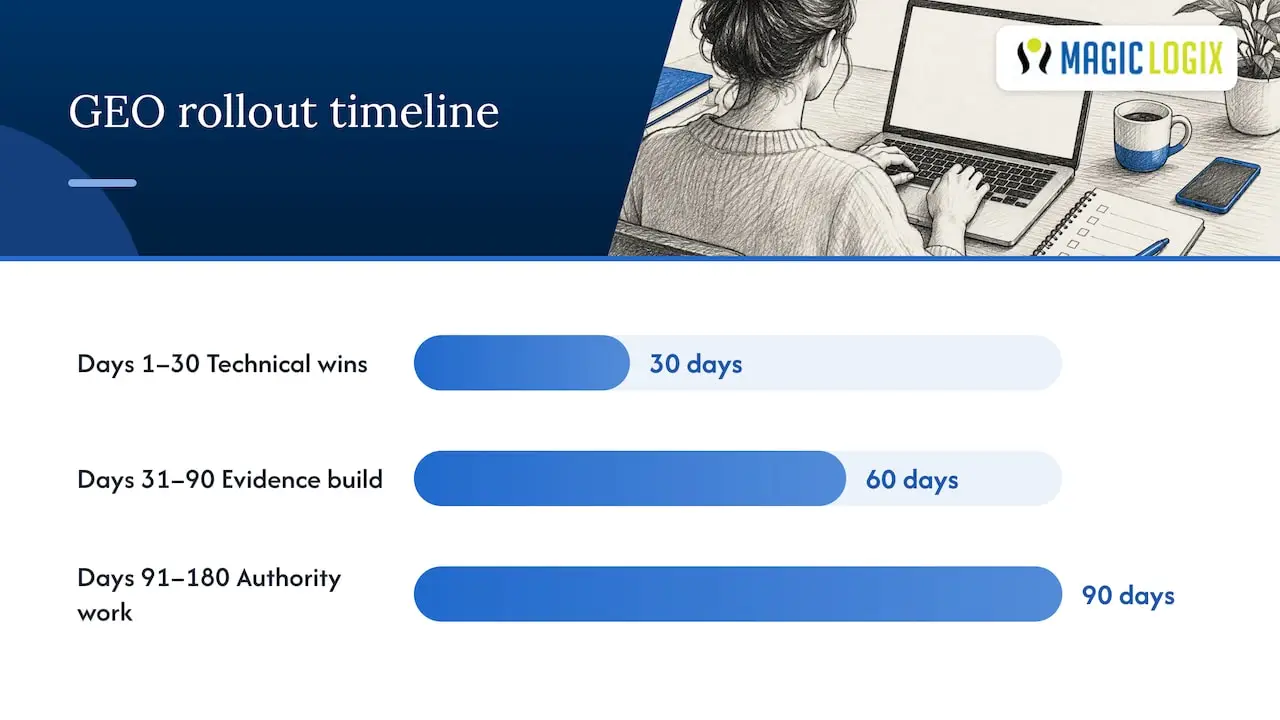
- Your 30/90/180-day GEO rollout
- What we have learned applying GEO to real client sites
- How we can help you build a GEO-ready website
- FAQ
- Sources
What generative engine optimization means for your website
Generative Engine Optimization, or GEO, is the practice of shaping content so AI search tools can find it, trust it, and quote it directly in an answer. Classic SEO chases a ranking position. GEO chases a citation: the moment an AI system pulls your sentence, stat, or recommendation into its generated response.
Most AI search features work through retrieval-augmented generation, meaning the system searches an index, pulls relevant passages, and synthesizes an answer while citing sources. That synthesis step rewards content that reads like a clear, well-supported argument rather than a wall of marketing copy.
This is why decision-support framing matters so much. Pages that spell out “best for X” scenarios, back claims with named sources, and organize information into obvious decision factors give the AI something concrete to lift and attribute. We think of it like handing a researcher a well-labeled filing cabinet instead of a shoebox of receipts:
- Clear “best for” framing helps an AI match your content to a specific user intent.
- Named sources and dates give the system something safe to cite without guessing.
- Scannable structure (headings, short paragraphs, bullets) mirrors how retrieval systems parse passages.
How AI search actually finds and qualifies your pages
There is no secret AI-only file to create. According to Google Search Central, eligibility for AI features follows the same indexing and snippet rules that have always governed classic search results. If a page cannot be indexed or cannot appear in a regular snippet, it will not show up in a generative answer either.
That means the technical basics still decide whether you are even in the running:
- Confirm robots.txt is not blocking the pages you want cited.
- Check that your content renders fully for crawlers, especially on JavaScript-heavy templates.
- Fix canonicalization so the AI indexes one clear version of each page.
- Keep structured data accurate and matched to visible on-page content.
- Use noindex or nosnippet deliberately, only on pages you genuinely want excluded.
Pro Tip: Run a rendered-HTML crawl (not just a source-code view) on your top pages; many JavaScript frameworks hide the exact text an AI system would need to quote.
How to structure content so AI can extract and justify it
Once the technical baseline is solid, the real GEO work is editorial. Empirical GEO research finds that AI search systems lean toward earned, third-party sources and that content engineered for scannability and justification earns more visibility than content that merely ranks well. In plain terms, you are writing to be quoted, not just read.
Start with structure. Break pages into clear headings that mirror real questions, then use decision-factor bullets that spell out who or what something is “best for.” A comparison table at the method or category level, kept factual and simple, gives an AI a ready-made block to summarize. Short quoted callouts, the kind a person might pull into a presentation, are exactly the kind of text a generative system tends to lift.
Evidence is the second pillar. Every claim that matters should carry a number, a date, or a named source, with the source linked inline. NIST’s Generative AI Profile recommends documenting content provenance and testing outputs for integrity, which is a governance-side argument for the same habit: clear source metadata and date stamps reduce the odds that an AI system hallucinates a fact or misattributes it. When you cite a statistic, name who published it and when.
Third, build earned media deliberately. Citations compound when other credible sites mention your work, because GEO research shows AI systems weight third-party validation heavily. A practical earned-media loop looks like this:
- Identify a genuine data point, case result, or expert opinion worth sharing externally.
- Pitch it to relevant publishers, trade sites, or collaborators as commentary or a guest contribution.
- Link back to the original page that contains the fuller evidence and context.
- Track which outside mentions get picked up and watch for downstream AI citations.
Structured data still matters as hygiene, not magic. Markup should describe facts that are already visible on the page; it is a clarity aid for machines, never a substitute for the evidence itself.
Pro Tip: Write one “quotable sentence” per section, under 30 words, that states a fact or recommendation cleanly enough to stand alone in someone else’s answer.
Tracking citations: the tools and KPIs that prove GEO is working
You cannot improve what you do not measure, and AI citation tracking now has real tooling behind it. Bing introduced AI Performance in Webmaster Tools, which surfaces how often your pages get cited in generative answers along with the specific grounding queries that triggered those citations.
Grounding queries often look nothing like typical search phrasing. They reveal how the AI system internally frames a topic, and Bing’s own documentation treats them as a high-value input for rewriting scannable justification text that matches how the model actually searches.
Pair that with Google Search Console’s generative AI and Performance signals to watch indexing health and snippet eligibility over time. Track these four KPIs together:
- Citation count per page, tracked over time rather than as a one-off snapshot.
- Grounding-query match rate between your target queries and the phrases actually triggering citations.
- Referral traffic specifically attributable to AI-cited pages.
- Conversion movement on pages once they start getting cited.
Your 30/90/180-day GEO rollout
Treat GEO like any other marketing investment: quick technical wins first, then evidence-building, then sustained authority work.
- Days 1 to 30: Run an indexability sweep across your site, then prioritize your highest-converting pages for GEO treatment. Add explicit justification bullets and sourced facts to those pages first, since they carry the most business weight if an AI system starts citing them.
- Days 31 to 90: Audit structured data against what is actually visible on the page. Build two or three cornerstone evidence pages that consolidate your best data and expert commentary. Start outreach to publishers for earned mentions, and test content variants against the grounding queries you have already found.
- Days 91 to 180: Shift toward topical authority: commission or compile original research, publish long-form evidence-led content, and review citation trends monthly to see which formats and sources the AI systems keep favoring.
Pro Tip: Prioritize pages by how much they matter to your revenue, not by raw traffic volume. A page with modest traffic but high conversion value is worth more GEO effort than a popular page that never converts.
For the technical groundwork behind step one, our guide to SEO site architecture covers the crawlability fundamentals that make indexability sweeps faster.
What we have learned applying GEO to real client sites
Our workflow usually starts with grounding-query analysis: we pull the actual phrases triggering AI citations, then rewrite priority pages around evidence-first structure before chasing outreach. That order matters. Chasing earned mentions before the page itself is quotable wastes the mention.
We have applied this thinking across the kinds of AI-driven marketing workflows we build for clients, and the pattern holds: scannable structure plus credible sourcing consistently outperforms keyword density alone.
— Hassan
How we can help you build a GEO-ready website
We handle the pieces that make GEO work in practice: technical SEO audits for indexability and structured data, content rewrites built around justification and evidence, and ongoing measurement so you can see which pages earn citations.
If you want a second set of eyes on where your site stands today, we offer:
- A technical audit covering indexability, crawlability, and structured data hygiene.
- An evidence-first content review of your highest-converting pages.
- Ongoing measurement setup tied to citation and referral signals.
Start with an SEO audit and strategy session to see exactly where your priority pages stand.
FAQ
How do I use AI in SEO?
Use generative AI to speed up research, draft outlines, and identify grounding queries, then have a person verify facts, add sources, and structure the final page for scannability. The technical side (indexability, structured data) still follows standard Google Search Central guidance with no special AI-only files required.
What is the best generative AI platform?
There is no single “best” platform; the right choice depends on whether you need content drafting, research synthesis, or customer-facing answers. Tools like Microsoft’s Copilot illustrate one major consumer-facing AI surface, while other platforms focus on internal content workflows.
Can a beginner do SEO?
Yes, a beginner can learn core SEO by starting with crawlability, keyword intent, and basic on-page structure before layering in more advanced tactics. Our guide to keyword research for SEM is a practical starting point for understanding intent before writing content.
What is search engine optimization?
Search engine optimization is the practice of structuring and promoting a website so it earns visibility in search results for relevant queries. It now extends into generative search, where the goal shifts from ranking alone to being cited directly inside AI-generated answers.
How do I keep AI-assisted content original and avoid penalties?
Keep a human editor verifying facts, adding unique analysis, and disclosing automation where it is used, since Google’s guidance on generative AI content warns that scaled, low-value AI content can violate spam policies. Original data, named sources, and clear editorial judgment are what separate safe AI-assisted content from risky mass production.
Sources
- AI features and your website | Google Search Central
- Artificial Intelligence Risk Management Framework: Generative Artificial Intelligence Profile
- Generative Engine Optimization: How to Dominate AI Search
- Introducing AI Performance in Bing Webmaster Tools — Public Preview