
You can’t earn a fixed “#1 spot” in ChatGPT, because answers are generated fresh each time. What you can do is raise the odds that ChatGPT names your business or cites your pages when people ask questions you should own. That takes four things: letting OpenAI’s search crawler reach your site, publishing pages that answer real buyer questions directly, building credible mentions beyond your own domain, and measuring results across repeated prompts instead of a single screenshot.
This guide walks through each step in plain language, shows where teams commonly go wrong, and separates what is established from what is still emerging. At Magic Logix, our brand positioning is “Digital Beyond Tomorrow,” and in practice that means treating AI search as an extension of solid search fundamentals, not a replacement for them.
TL;DR
- ChatGPT has no stable numbered ranking. “Ranking” means being mentioned, recommended, or cited in answers to relevant prompts.
- Start with access: make sure your important pages are crawlable, indexable, and readable in plain HTML.
- Answer buyer questions in the first sentences of a page, with specific facts and sources, and keep brand details consistent across the web.
- Measure with a repeated prompt set and referral analytics. Never promise yourself a citation, and never trust a provider who does.
Table of Contents
- What “ranking in ChatGPT” really means
- How ChatGPT finds and picks the pages it cites
- Step 1: Make your site reachable and readable
- Step 2: Map pages to real buyer questions
- Step 3: Write pages that are easy to quote
- Step 4: Build credible mentions beyond your own site
- Step 5: Claim your business profile and track results
- How fast can you rank in ChatGPT?
- Common misconceptions
- Our perspective
- Get a plan for AI search visibility
- FAQ
- Sources
What “ranking in ChatGPT” really means
In Google, a page holds a position you can look up. In ChatGPT, there is no equivalent list. When a question benefits from current information, ChatGPT may search the web automatically, and the answer may include citations and a Sources panel. OpenAI also notes that users should open sources, because results can be incomplete, outdated, or incorrect.
So visibility comes in three distinct forms:
- A mention: your brand is named in the answer text.
- A citation: your page is linked as a source.
- A description: how accurately and favorably the answer characterizes you.
These are different outcomes. A page can be linked without the brand being named, and a brand can be named without any link. Treat them as separate measures, and treat accuracy as seriously as frequency. Being mentioned often does you no good if the answer gets your services wrong.
Why no one can promise a position
Responses are probabilistic. The same prompt can produce different brand lists on different runs, and the way ChatGPT behaves changes as settings and models change. A 2026 academic study of ChatGPT citations in production is based on selected queries and specific ChatGPT web settings. It reports run-to-run variation and says GEO strategies should be reevaluated when settings or the serving environment change.
The practical conclusion: any agency, tool, or guide that guarantees a ChatGPT ranking is selling certainty that doesn’t exist. Aim to improve probability and quality of appearances, and verify progress over time.
How ChatGPT finds and picks the pages it cites
Understanding the pipeline tells you where to spend effort. The academic study above describes three stages: the system rewrites the user’s question into search queries, retrieves candidate pages, and then selects which sources to cite while writing the answer. It found that GPT-5.4 Thinking often runs several retrieval rounds, and that pages retrieved more often are more likely to be cited.
Two takeaways follow:
- You have to be retrievable first. If your page never enters the candidate pool, nothing about its writing quality matters.
- You have to match the rewritten queries, not just the original prompt. Someone asking “best CRM for a 10-person landscaping company” may trigger several narrower searches. A page that clearly covers the sub-questions has more chances to be retrieved.
OpenAI’s developer documentation on web search adds a useful detail: the model can open pages, the message contains URL annotations for inline citations, and the full list of consulted URLs is available in a sources field that can contain more URLs than the visible citations. In other words, your page can influence an answer without getting a visible link.
Step 1: Make your site reachable and readable
This is the established, low-risk part of the job. It is technical, and it is where many businesses lose before they start.
What to do
- Review your robots.txt and any firewall or CDN bot-protection settings. OpenAI documents separate crawlers for search and training, so decide deliberately which ones you allow. If you want to appear in ChatGPT search results, the search crawler, OAI-SearchBot, needs access to the pages you want surfaced.
- Confirm that important pages return a normal 200 status, are not marked noindex, and are not behind a login.
- Check that the answer text is present in the HTML your server delivers, not only injected late by JavaScript.
- Keep ordinary search discoverability healthy. Verify your site in Google Search Console and Bing Webmaster Tools, since AI answers draw on conventional web search indexes.
Where it goes wrong
- A security plugin or CDN rule blocks unfamiliar bots by default, and no one notices for months.
- A redesign moves product details into scripts or tabs that load after the page renders.
- Blocking a crawler to “protect content” and then wondering why the brand never appears.
Access is necessary but not sufficient. A crawler can read your page and the system can still choose another source. Technical fixes only earn you a place in the candidate pool. Pages that are clearer, more specific, and better supported win the citation. If you want a professional audit of crawl access and AI-readiness, our AI search visibility work covers it.
Step 2: Map pages to real buyer questions
Start from the questions customers actually ask, not from keywords alone. Pull them from sales calls, support tickets, reviews, and your site’s search data. Then group them by stage:
| Stage | Example question | Page type that fits |
|---|---|---|
| Problem-aware | Why is my website traffic flat? | Educational guide |
| Solution-aware | What does a local SEO retainer include? | Service explainer |
| Comparing | Retainer or project-based marketing? | Fair comparison page |
| Ready to act | How do I get a quote? | Service page with a clear next step |
For each question, decide which single page should be the best answer on the web. Pages that try to cover everything usually answer nothing well.
Step 3: Write pages that are easy to quote
AI answer engines extract passages. Write so a passage still makes sense on its own.
A page template that works
- Put the direct answer in the first two sentences under a heading phrased as the question.
- Follow with specifics: numbers, steps, named entities, and the conditions under which the answer changes.
- Link claims to primary sources such as official documentation or original research.
- Compare options fairly, so the passage reads as reference material and not a brochure.
- Show an updated date and the author, and actually update the page when facts change.
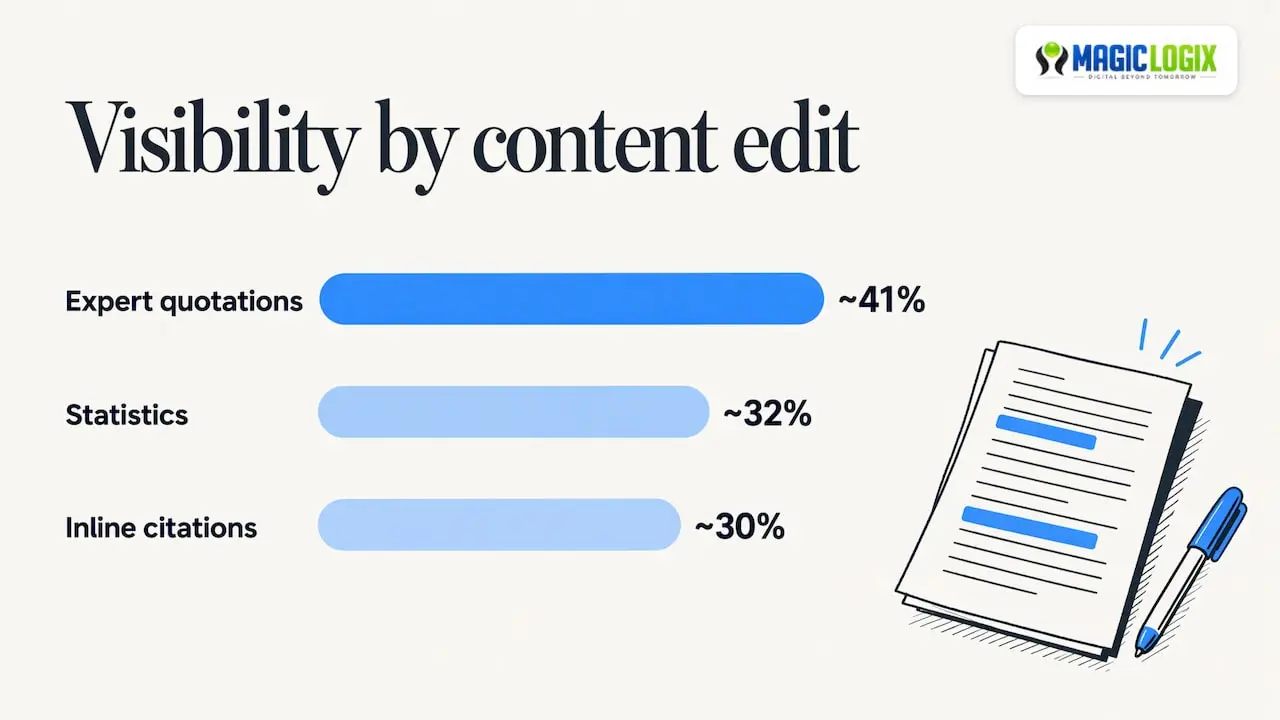
Research on generative engines from Princeton, Georgia Tech, and IIT Delhi tested which edits make content more visible. As reported, expert quotations, statistics, and inline citations improved visibility by roughly 41%, 32%, and 30% in the experiment, while keyword stuffing produced near-zero improvement. Treat those as directional lab results, not guaranteed effects in ChatGPT. The direction is still sensible: verifiable evidence beats repeated phrases.
Page-level checklist
- Does the first paragraph answer the question without a preamble?
- Is every number tied to a named, dated source?
- Are headings descriptive enough to stand alone as a snippet?
- Is there a natural-language URL that describes the topic?
- Is the date current, and does the content deserve it?
For a deeper look at structuring content to be cited, see our guide on generative AI for SEO, and note that the same habits help in Google’s AI Overviews.
Step 4: Build credible mentions beyond your own site
AI systems lean on consensus. If your brand appears consistently on trusted third-party pages, such as industry publications, review profiles, directories, and local media, answers have more to draw from than your own claims.
Moves that help
- Publish original data, a survey, or a clear framework that others have a reason to reference. Our piece on digital PR evidence pages explains how to build them.
- Keep your business name, address, services, and descriptions identical across your website, social profiles, and listings. Contradictory facts make it harder for any system to describe you correctly.
- Collect genuine reviews and put testimonials on your own pages.
- For local businesses, complete and verify your Bing Places profile alongside your Google profile, since consistent listings feed both search ecosystems.
Where it goes wrong: buying low-quality mentions at volume. Mentions that no editor or customer would trust rarely help, and they can leave inaccurate descriptions of your business floating around the web.
A note on paid ads
Do not treat advertising as a shortcut. OpenAI’s stated policy is that ads do not influence ChatGPT’s responses and are labeled separately. Paid campaigns can still build demand and branded search, which supports the mentions above, but they are not a method for earning an organic recommendation.
Step 5: Claim your business profile and track results
Measurement is where most “how to rank” advice falls apart, because there is no rank tracker equivalent to a Google position report. Combine three sources.
OpenAI’s business tools
OpenAI’s Help Center explains how to set up your business on ChatGPT in the United States. If you’re eligible, you can claim your business and view aggregate insights for the past 28 days, including mentions, website clicks, and discovery topics. The counts may be incomplete, and individual prompts and conversations are not disclosed.
A repeatable prompt baseline
Build a list of 30 to 50 prompts that reflect how your customers actually ask. For each test, in a fresh chat, record:
- the prompt and test date
- which brands were named, and in what order
- which pages were cited
- whether your business was named, and whether your page was cited
- whether the description of your business was accurate
Run the same list on a regular schedule. Because outputs vary, one run proves nothing. Patterns across many runs are what you can trust. That sample size is a working suggestion, not an industry standard, so adjust it to your category.
Analytics
In Google Analytics 4, look at referral traffic from chatgpt.com and at what those visitors do next: pages viewed, forms submitted, calls booked. Referral data has a hard limit. It can’t show you citations or mentions that produced no click. Use it as an outcome measure alongside your prompt baseline, not instead of it.
How fast can you rank in ChatGPT?
No one can give you a reliable timeline. Retrieval depends on your site’s existing authority, how well your pages match the rewritten queries, and the model and settings in use. Some changes, such as unblocking a crawler, can matter quickly. Building third-party credibility usually takes months, the same as in traditional SEO.
A realistic plan looks like this:
| Phase | Focus | Output |
|---|---|---|
| Weeks 1 to 4 | Crawl and indexing checks, prompt baseline | Fixed access issues, baseline sheet |
| Weeks 5 to 8 | Rework priority pages with direct answers, sources, dates, authorship | Upgraded pages for top buyer questions |
| Weeks 9 to 12 | Repeat prompt tests, review referrals, add pages and mentions | Trend data and next priorities |
This is a planning framework, not a promise. Judge it by whether your mention rate, citation rate, and description accuracy move over several test rounds.
Common misconceptions
- “There’s a secret formula.” There isn’t. Established SEO fundamentals plus clear, evidence-rich, widely corroborated content is the strongest foundation we know of. Emerging GEO and AEO practices are experiments layered on top, and they should be labeled that way.
- “Keyword repetition works.” The evidence points the other way, as noted above.
- “Once I’m cited, I’m set.” Outputs change between runs, settings, and models. Keep monitoring.
- “A visibility score tells the whole story.” Mentions, citations, and accuracy are different things. Track each.
- “Traditional SEO is dead.” Search-style retrieval still feeds ChatGPT answers, so crawlability, indexing, and quality signals still matter.
Our perspective
We approach ChatGPT visibility as a continuation of good search practice, not a separate trick. The sequence matters: make your site accessible, make each page the clearest answer to one real question, and give outside sources a reason to talk about you accurately.
Because platform behavior is evolving, we separate what is established, such as crawlability, indexing, and useful sourced content, from what is emerging, such as how often specific formats get cited. We would rather tell you honestly that no one can guarantee a citation than hand you a ranking promise.
This is why our SEO, Answer Engine Optimization, Generative Engine Optimization, and AI search visibility services sit together. The same content, technical foundation, and reputation work feeds Google, AI Overviews, and ChatGPT, and it should be planned as one program with one measurement approach.
Hassan Bawab
Get a plan for AI search visibility
If you’d like help with the technical audit, the content, and the measurement, Magic Logix offers SEO, Answer Engine Optimization, Generative Engine Optimization, and AI Search Visibility & Intelligence. You can explore our Search & AI Visibility capabilities or start with our SEO services and talk through where your site stands today.
FAQ
How do I rank in ChatGPT?
Improve the odds of being named and cited rather than chasing a fixed position. Allow OpenAI’s search crawler, keep pages indexable, answer real buyer questions directly with sourced facts, earn credible third-party coverage, and measure with repeated prompts. No method guarantees a citation.
Can I pay to appear in ChatGPT answers?
Not for organic answers. OpenAI’s stated policy is that ads don’t influence ChatGPT’s responses and are labeled separately. Visibility in the answer itself comes from being a relevant, retrievable, trustworthy source.
How can I tell if ChatGPT mentions my business?
Run a fixed set of customer-style prompts in fresh chats and log which brands and pages appear. If you’re eligible, claim your business with OpenAI to see aggregate mentions and clicks for the past 28 days. Add GA4 referral data to see visits that came from ChatGPT.
Does ChatGPT use Google rankings?
ChatGPT retrieves web pages through its own search process, and OpenAI does not publish a rule that mirrors Google positions. Keeping your site healthy in conventional search remains a sensible foundation, because pages that are findable and well supported are the ones that can be retrieved.
How long does it take to see results?
There is no dependable timeline. Access fixes can show effects quickly, while authority and third-party mentions build over months. Test regularly over a period of at least several weeks before judging whether a change worked.
Sources
- Searching the web with ChatGPT, OpenAI Help Center
- Web search, OpenAI developer documentation
- Understanding ChatGPT Citations: Evidence from Production, arXiv
- Setting up your business on ChatGPT, OpenAI Help Center
- AI Visibility Research Guide, summary of Princeton, Georgia Tech and IIT Delhi GEO research