
Digital PR for SEO means earning editorial coverage, expert citations, and journalist backlinks that search engines and AI systems treat as trust signals. Instead of asking for links, you build something worth writing about, and the links follow. Done right, it raises your referring domains, your branded search volume, and increasingly, your visibility inside AI-generated answers.
TL;DR:
- Building a dedicated evidence page with original data and expert input is crucial before pitching journalists to ensure coverage and backlinks.
- Backlinks from reputable, topical sites weigh more in search rankings and AI citations than links from low-authority directories or paid placements.
- Campaigns focused on original research, creative visualizations, or reactive newsjacking tend to generate higher-quality coverage and more lasting SEO benefits.
- It typically takes two to six weeks to secure placements and another 60 to 90 days for SEO impact to become evident through search engine crawling and indexing.
- Coordination between PR and SEO teams, involving swift approval workflows and joint measurement, significantly increases campaign success.
Table of Contents
- What Is Digital PR for SEO, and How Does It Differ From Link Building?
- How Does Digital PR Drive SEO and AI Search Visibility?
- What Types of Digital PR Campaigns Actually Earn Links?
- How Do You Run a Digital PR Campaign Step by Step?
- How Do You Measure Digital PR Success for SEO?
- How Should PR and SEO Teams Work Together?
- What Does a Digital PR Program Cost, and How Long Does It Take?
- What Do Practitioners Get Wrong About Digital PR?
- Get SEO-Driven Digital PR Support From Magic Logix
- Sources
- FAQ
What Is Digital PR for SEO, and How Does It Differ From Link Building?
Digital PR for SEO is the practice of earning coverage in media outlets, trade publications, and niche newsletters by giving journalists something genuinely useful: original data, a quotable expert, or a timely angle on a story they already care about. The backlinks, brand mentions, and citations that result are a byproduct of good journalism, not a transaction.
That distinction matters because it changes what you build first. Traditional link building often starts with the link and works backward, through guest posts, directory listings, or paid placements. Digital PR starts with an asset, usually called an evidence page, published on your own site before you pitch a single reporter. This page holds your methodology, your data visuals, downloadable charts, and a named expert willing to go on record. Search Engine Land’s guide to digital PR frames this as one of the most reliable non-spammy ways to generate links, precisely because the outreach comes after there’s something real to point to.
Traditional PR, by contrast, usually chases brand awareness and share of voice without much concern for where a URL lives or whether Google can crawl it. Digital PR keeps one eye on the SEO scoreboard the entire time.
Here’s how the three approaches split in practice:
- Digital PR: Publish an evidence page, pitch journalists on a data story, earn a contextual backlink and brand mention.
- Link building: Skip the story angle, request or purchase a link placement directly, often on a lower-authority site.
- Traditional PR: Chase press mentions and awareness, sometimes without securing a followable link at all.
Digital PR is the right tactic when you need authoritative, editorially earned links to a specific commercial or informational page, especially one already competing on tough keywords. If you just need volume of links fast, or you’re targeting local citations, other SEO investments (directory listings, local SEO work, structured content) will serve you better and cost less time.
How Does Digital PR Drive SEO and AI Search Visibility?
Backlinks from digital PR carry more weight than links from directories or link farms because they come from sites with real editorial standards and topical relevance. A single link from a trade publication covering your exact industry often outperforms a dozen generic guest-post links, because Google’s ranking systems weigh topical relevance alongside raw authority.
Brand mentions matter even without a link attached. When your company name shows up repeatedly alongside your area of expertise, that reinforces the entity signals search engines use to build confidence in who you are and what you know, which feeds directly into Google’s E-E-A-T framework. Search Engine Land notes this compounding effect: mentions plus links plus consistent framing build authority faster than links alone.
There’s a downstream effect too. Coverage drives referral traffic in the days after it publishes, and it often produces a longer tail of branded search, people typing your company name into Google after seeing it in a headline. That branded search volume is itself a trust signal search engines track.
AI-search systems add a newer wrinkle. When an AI overview or a chatbot answer needs to cite a source for a data point, it tends to reach for pages with clear authorship, visible methodology, and a track record of being cited elsewhere. An evidence page with those elements built in has a better shot at being the page an AI system pulls from than a thin blog post making the same claim with no sourcing.
Statistic to watch: Cision’s 2025 survey of more than 3,000 journalists found original data and research ranked as the single most-wanted pitch element, ahead of exclusives or executive access. That’s a direct signal that data-led evidence pages, not press releases, are what actually convert into coverage.
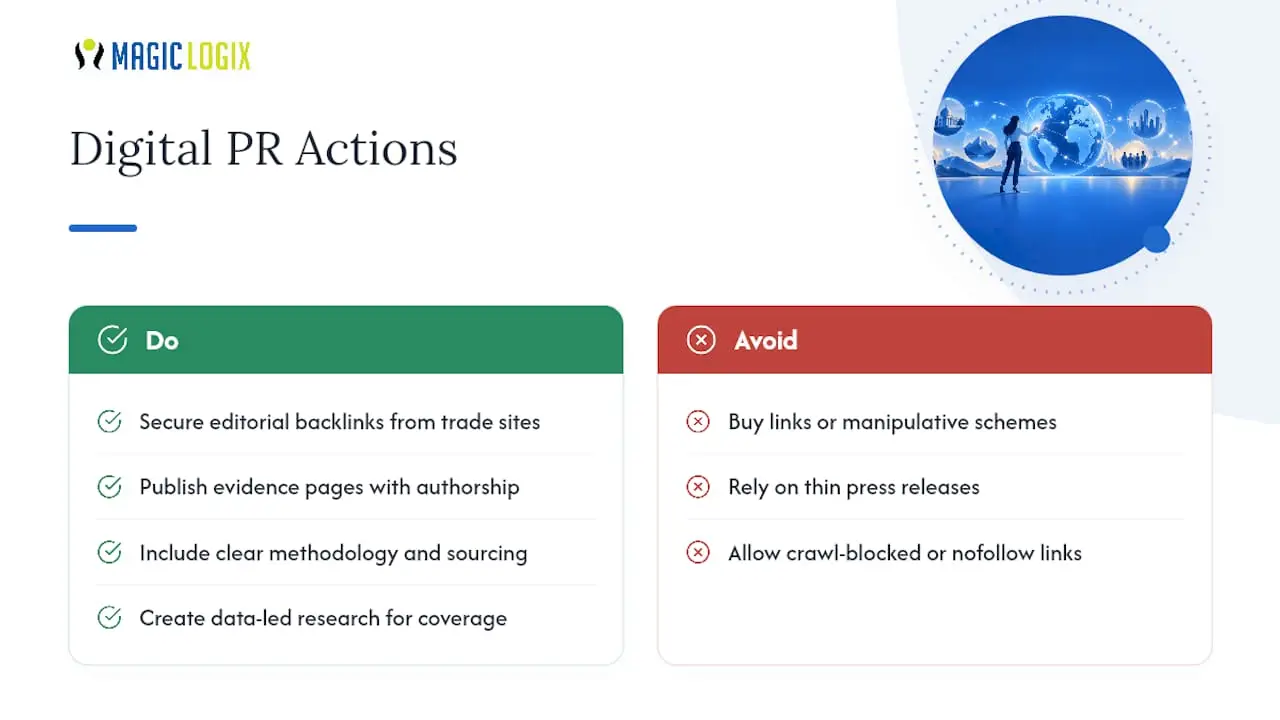
One caution: Google’s Search Essentials guidance is explicit that earned links still need to be crawlable and that manipulative link schemes violate its spam policies. A coverage hit means nothing to your rankings if the resulting link sits behind a nofollow tag on a site Google barely indexes, or if it was clearly bought rather than earned.
What Types of Digital PR Campaigns Actually Earn Links?
Not every PR idea earns coverage equally. Some formats consistently outperform others because they solve a journalist’s real problem: filling a story with something concrete, fast, and quotable.
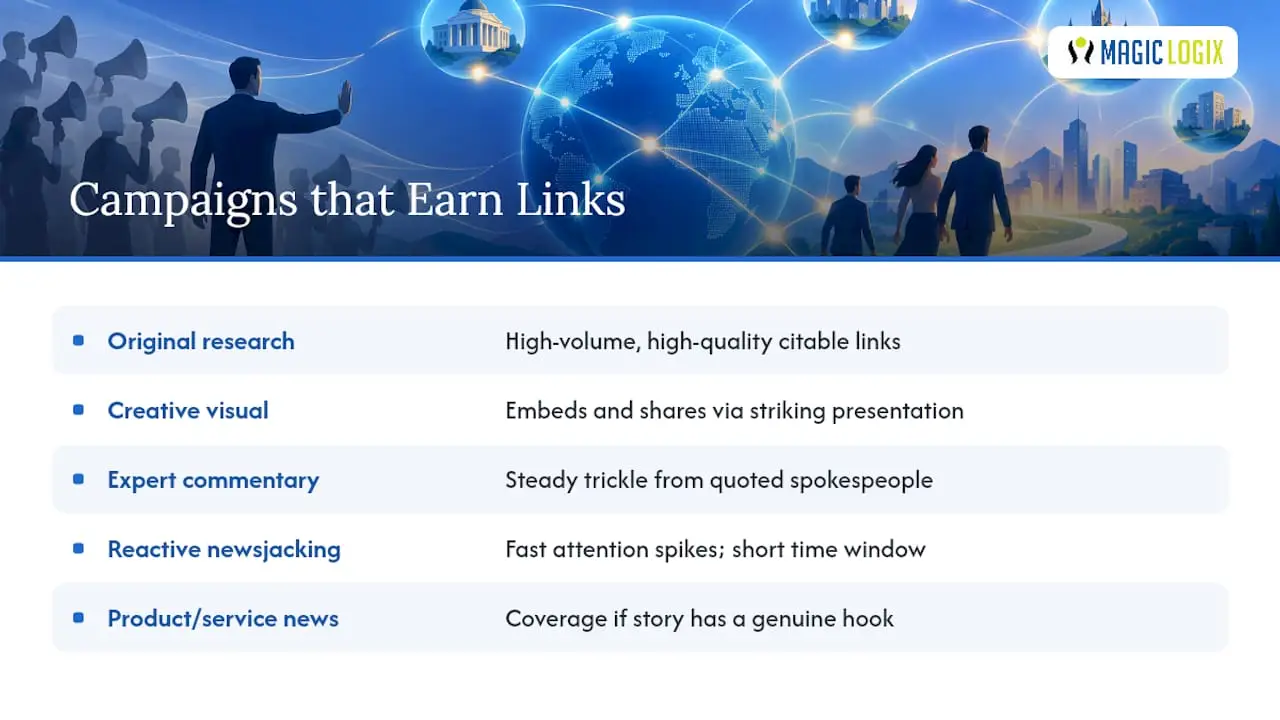
Data-led and original research campaigns sit at the top of the list. Surveying your customers, analyzing your own platform data, or aggregating public datasets into a fresh angle gives reporters exactly what Cision’s journalist survey says they want most. These campaigns take longer to build but tend to earn the highest volume and quality of links, since the story lives on your site indefinitely as a citable source.
Creative and visual campaigns work well when the data itself isn’t groundbreaking but the presentation is. Interactive maps, animated charts, or a striking infographic can turn a modest dataset into something a lifestyle or trade outlet wants to embed. These campaigns lean on design more than raw numbers.
Expert commentary and contributed content offer a lower-lift, ongoing option. Instead of one big campaign, you position a named spokesperson to comment on breaking industry news, contribute op-eds, or answer journalist queries through services reporters use to source quotes. This builds relationships and a steady trickle of links rather than one spike.
Reactive PR, or newsjacking, means responding fast to a trending story with your own angle or data. The window is usually measured in hours, not days, and it only works if your spokesperson adds real interpretation instead of repeating the headline back. Treat newsjacking as an attention tactic, not a durable SEO strategy. Pair it with evergreen research assets that keep earning links long after the news cycle moves on.
Product- and service-led news, like a major feature launch, a partnership announcement, or an internal study tied to your offering, rounds out the mix. These stories work best when there’s a genuine hook beyond “we launched something,” since journalists routinely ignore pitches that read like a press release with no story attached.
If you want ideas for repurposing existing marketing formats into PR-ready assets, integrated marketing campaign examples and influencer marketing campaign examples both show formats that translate well into evidence pages once you add data and a named expert.
How Do You Run a Digital PR Campaign Step by Step?
A digital PR campaign fails most often not because the pitch was bad, but because the sequence was backward. Journalists respond to assets, not ideas. Build the proof before you ask for coverage.
- Set objectives tied to SEO and business outcomes. Decide upfront whether you’re targeting referring domains to a specific commercial page, branded search lift, or share of voice in a category. Vague goals produce vague campaigns.
- Choose the story and build the evidence page first. This page needs a clear methodology, downloadable visuals, and a named expert willing to be quoted on the record. Practitioner guidance across the PR industry is consistent on this: journalists act on a pitch only when the asset saves them reporting time, meaning the page has to do most of the work before the email even goes out.
- Research journalists by beat, not by publication. A generic list of “top 50 tech reporters” wastes everyone’s time. Match your story to the specific beat a writer covers, and check their recent bylines before you pitch.
- Write a short, personalized pitch. Cision’s 2025 State of the Media report found 86% of journalists reject pitches that don’t fit their audience or beat, and 85% prefer a short introductory email explaining why you’re reaching out before diving into the ask.
- Follow up once, briefly, and respectfully. One polite nudge after four or five business days is standard. Repeated follow-ups on the same pitch tend to damage the relationship rather than help it.
- Handle logistics before the story breaks. Set embargo dates if needed, keep a shared asset folder ready for images and data files, and get legal or leadership sign-off before, not during, a reporter’s deadline.
Pro Tip: Build a one-page “reporter kit” for every campaign, a single link containing your evidence page, three ready quotes, and downloadable charts in both PNG and editable formats. It cuts the back-and-forth that kills placements when a reporter is on a same-day deadline.
Generative AI tools can speed up journalist research and first-draft personalization, but treat AI output as a starting point, not a final pitch. More than half of journalists now use generative AI themselves, yet a large share remain worried about factual errors slipping into AI-assisted PR content, so a human still needs to verify every claim and quote before it goes out.
How Do You Measure Digital PR Success for SEO?
The mistake most teams make is counting placements. A tally of “12 articles this quarter” tells you almost nothing about business impact unless you connect it to search and revenue signals.
Track these SEO metrics first:
- Referring domains gained from the campaign, not just total backlinks, since domain diversity carries more weight than link count alone.
- Referral sessions landing directly from coverage in the days and weeks after publication.
- Keyword visibility shifts on the specific pages that received new links.
- Branded search volume, which often rises after a coverage spike and signals growing awareness even among people who never clicked through.
Then track PR and business metrics alongside them. PRSA’s guidance on measuring earned media recommends tracking message pull-through (did coverage actually repeat your key point or just mention your name), AI-search visibility, and leads generated, rather than relying on publication count as a proxy for success. Separate PRSA commentary makes the same case for prioritizing qualitative measures like share of voice over raw impression counts.
For tooling, combine Google Search Console for keyword and click data, GA4 or your analytics platform for referral traffic, a media monitoring tool for mention tracking, and an AI-visibility platform to check whether your evidence pages show up in AI-generated answers. A tool like 90-day AI search visibility tracking can help you audit whether your PR-earned pages are actually being cited by AI systems, not just ranking in traditional search.
Give a campaign at least 60 to 90 days before judging its SEO impact. Backlinks take time to get crawled, and ranking shifts lag behind link acquisition. For deeper attribution modeling, measuring digital marketing effectiveness walks through how to connect campaign spend to downstream ROI across channels.
How Should PR and SEO Teams Work Together?
The handoff between PR and SEO is where most campaigns quietly fall apart. Someone needs to own the evidence page, and it usually works best when SEO builds the page structure and PR owns the story angle and outreach, so the page is both crawlable and genuinely pitchable.
Approval workflows need to move fast, especially for newsjacking, where a same-day story window means legal and comms sign-off has to happen in minutes, not days. Build a pre-approved messaging framework for your spokesperson ahead of time so reactive opportunities don’t stall waiting on a committee.
Measurement is a shared responsibility too. SEO teams track the ranking and traffic side; PR teams track message pull-through and sentiment. Neither view is complete alone, and teams that never compare notes tend to overvalue vanity placements while undervaluing the quieter, high-relevance trade coverage that research on fragmented media consumption shows often delivers stronger message pull-through than a single national hit.
What Does a Digital PR Program Cost, and How Long Does It Take?
Budgets typically break into three buckets: research and creative production (the biggest line item, since data collection and design take real hours), outreach and journalist database tools, and media monitoring software to track pickup after launch. A single strong campaign can run anywhere from a few thousand dollars for a lean in-house effort to significantly more for a multi-asset, agency-run program with custom visuals.
Expect placement timelines of two to six weeks from pitch to publish for most stories, longer for embargoed or investigative pieces. SEO impact typically follows another 60 to 90 days behind that, once search engines crawl and index the new links.
In-house teams with existing data and design capacity can run smaller campaigns affordably. Once you need consistent journalist relationships, faster turnaround, and dedicated creative production, an agency partnership usually pays for itself in coverage volume and link quality.
What Do Practitioners Get Wrong About Digital PR?
The biggest mistake agencies see is teams pitching before the evidence page exists. A journalist can’t cite a data point that lives only in a slide deck or a spreadsheet nobody outside the company can see. The page has to be live, sourced, and crawlable before the first email goes out.
The second mistake is treating measurement as an afterthought. Campaigns that map every placement back to referring domains, branded search, and message pull-through from day one consistently outperform those that only count clippings after the fact. That discipline, more than any single tactic, separates PR that moves rankings from PR that just generates a nice screenshot for a slide.
— Hassan
Get SEO-Driven Digital PR Support From Magic Logix
Magic Logix builds the evidence page and the search strategy under one roof, so your PR campaign doesn’t stall waiting for a developer to publish a data page or an SEO specialist to check if a link is actually crawlable. That’s the gap that sinks most in-house PR efforts: the story gets pitched, the coverage lands, and then nobody follows through on the technical side to make sure it actually moves rankings.
Our search engine optimization team and digital marketing group work from the same data, so an evidence page gets built with SEO structure baked in from the start, not bolted on after a journalist already linked to it. If your campaign needs interactive charts, downloadable visuals, or a dedicated microsite to host your research, our web design team builds pages designed to be cited, not just clicked. That combination of data, design, and search strategy is a common approach to digital transformation for clients ranging from small businesses to enterprise brands.
If you’re ready to turn a PR idea into a page that earns links and holds up in AI search results, start a conversation with Magic Logix about your next campaign.
Sources
- How to Pitch Journalists: 8 Media-Approved Tips — Cision
- Why media relations matters even more in the age of AI — PRSA
- Digital PR for SEO: How to Earn Backlinks, Authority & Rankings — Search Engine Land
- Google Search Essentials — Google Search Central
FAQ
What Is Digital PR for SEO in Simple Terms?
Digital PR for SEO means earning media coverage through original research, expert commentary, or newsworthy campaigns that naturally produce backlinks and brand mentions search engines trust. It differs from link building because the link is a byproduct of a real story, not the goal of the outreach itself.
How Is Digital PR Different From Traditional Link Building?
Link building often requests or buys placements directly, sometimes on low-relevance sites, while digital PR earns links through journalist-approved stories on outlets with real editorial standards. Search Engine Land notes this makes digital PR one of the more durable, non-spammy paths to ranking-relevant backlinks.
How Long Does It Take to See SEO Results From Digital PR?
Placements typically land within two to six weeks of outreach, and SEO impact tends to follow another 60 to 90 days after that once search engines crawl the new links. Newsjacking can produce faster visibility but rarely delivers the same lasting SEO value as evergreen research campaigns.
What Makes a Digital PR Pitch Successful?
Original data and multimedia assets are the top elements journalists say they want from a pitch, and 86% reject pitches that don’t match their beat, according to Cision’s 2025 State of the Media report. A short, personalized email pointing to a live evidence page consistently outperforms a mass-blasted press release.
Can Magic Logix Run a Digital PR and SEO Program Together?
Yes. Magic Logix combines SEO, web design, and digital marketing services so evidence pages get built, optimized, and measured under one coordinated plan instead of scattered across separate vendors. Pricing details are available directly through a consultation on the site.