
Optimizing for AI Overviews mostly means doing strong, current SEO and adding something a generic summary cannot supply: your own expertise, data and point of view. Google says there is no special markup or secret file for these features. Your pages need to be indexed, eligible to appear with a snippet, and genuinely helpful. No one can promise you a citation, but you can make your pages easier to understand, easier to trust and harder to replace.
This guide separates what Google has documented from what is still emerging, then walks through a checklist, a measurement plan and the mistakes we see most often.
TL;DR
- AI Overviews run on the same foundations as core Google Search, so indexing, crawlability and helpful content come first. No special schema or AI meta tag is required.
- Original, first-hand content (your data, your process, your experience) gives an AI system a reason to cite you instead of the next page that says the same thing.
- Brand mentions across the web track AI visibility far more closely than backlinks do, according to one large 2025 study.
- You can now measure these features in Search Console, and you can also opt out if the traffic does not fit your goals.
- Treat everything beyond Google’s own guidance as informed testing, not settled fact.
Table of Contents
- What AI Overviews are and how they choose sources
- Is SEO still the foundation?
- The AI Overviews optimization checklist
- Established guidance versus emerging practice
- How to measure AI Overview performance
- What to expect from clicks
- Should you opt out?
- A 90-day plan for a small or mid-sized business
- Common mistakes
- Our perspective
- Support from Magic Logix
- FAQ
- Sources
What AI Overviews are and how they choose sources
AI Overviews are AI-generated summaries that appear above the regular results for many searches. They pull from several pages, and they show links to the sources behind the answer. Google’s documentation describes them as part of Search, not a separate engine, and explains how they work from a site owner’s perspective.
Two practical consequences follow:
- The eligibility rules look familiar. A page has to be indexed and eligible to be shown with a snippet before it can appear as a supporting link.
- There is no separate submission process. You cannot apply to be included.
How often they appear depends on the query. Ahrefs’ analysis of 590 million searches found that AI Overviews showed for 9.46% of desktop keywords, mostly informational ones. Those figures are from 2025 and shift as Google changes the feature, so check your own queries rather than relying on an average.
Is SEO still the foundation?
Yes. Google’s own guide opens by answering exactly this question, and the answer is that SEO best practices remain relevant for its generative AI features. The data points the same way.
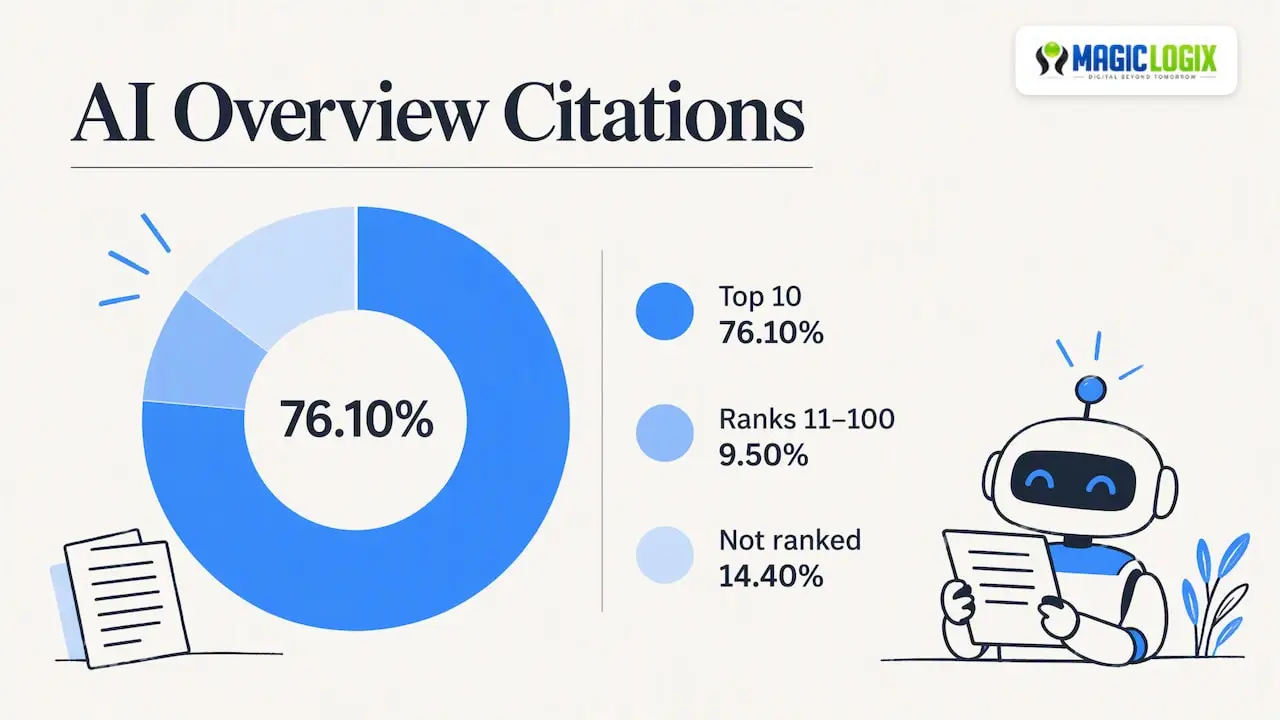
An Ahrefs study of cited pages found that 76.10% of AI Overview citations came from pages ranking in the top 10. The same study found roughly 24% came from outside it (9.50% ranking 11 to 100, and 14.40% not ranking in the results at all). So rankings help a lot, but they are not a hard gate. A page that is clearly the most useful answer can be cited without sitting on page one.
For a business owner, the takeaway is simple. If your technical SEO is shaky, fix that before anything labeled “AI.” Our SEO optimization service covers that groundwork, and it is the layer every other tactic sits on.
The AI Overviews optimization checklist
Use this as a working list. Each item is tied to Google’s guidance or to a named study, and we mark which is which.
1. Confirm eligibility
- Pages return a 200 status and are not blocked by robots.txt or a noindex tag.
- Important content is in HTML that Google can render, not hidden behind scripts or logins.
- The page can show a snippet. Google states that pages must be indexed and snippet-eligible to appear in AI features.
- Check the URL Inspection tool in Search Console for a few key pages.
If your site is slow or heavily client-rendered, our walkthrough on server-side rendering and LCP explains the fixes engineers usually start with.
2. Lead with a direct answer
Put a concise answer to the main question in the first paragraph, then expand. This helps readers first. It also gives any summarizing system a clean passage to work with. This is a widely used editorial practice, not a documented ranking factor, so treat it as good writing rather than a lever.
3. Make each section stand alone
Use clear H2 and H3 headings that describe what follows. A section should make sense if someone lands on it alone. Short paragraphs, lists for steps and tables for comparisons all help.
4. Add non-commodity content
This is the highest-value item. Google’s guidance encourages content with a unique point of view, first-hand expertise or original information. Ask of every page: what does this say that a summary of the top ten results would not?
Examples a small business can produce:
- Your real pricing ranges, with how you arrive at them.
- Photos and notes from actual jobs, with the details that went wrong and how you fixed them.
- Your own survey of 30 customers, labeled honestly as a small sample.
- A comparison of options based on how you actually use them.
Our guide to SEO content briefs shows how to build that requirement into every page before it is written.
5. Write for people, not for query variations
Packing pages with rephrased versions of the same question does not help. Google discourages mass-produced content built to manipulate search. Cover the topic once, thoroughly, in language your customer uses.
6. Keep structured data accurate
Structured data is not required for AI features. It is still useful where it matches visible content, such as Organization, Product or Article markup, because it helps search engines understand the page. Do not add markup for content readers cannot see.
7. Build brand presence off your site
Ahrefs studied 75,000 brands and found that brand web mentions had a 0.664 correlation with AI Overview visibility, brand search volume 0.392 and backlinks 0.218. Correlation is not proof of cause, and the study is from 2025. Still, it suggests that being talked about in your field matters more than a pile of links.
Practical ways to earn mentions: publish original data others want to reference, speak at local or industry events, contribute to trade publications, and keep your business profiles consistent. Our piece on digital PR evidence pages describes how to turn research into something journalists can use.
8. Keep content current
If a page covers something that changes, such as regulations, pricing or product details, show the date and update it. Outdated information is a trust problem for readers and for any system that summarizes you.
Established guidance versus emerging practice
Much of what circulates under the label “GEO” or “AEO” is untested. This table helps you decide where to spend effort.
| Practice | Status | Our view |
|---|---|---|
| Indexable, crawlable, snippet-eligible pages | Documented by Google | Do first |
| Helpful, original, people-first content | Documented by Google | Do first |
| Clear headings and semantic HTML | Documented by Google | Do first |
| Brand mentions and authority off-site | Supported by correlation studies | Invest steadily |
| Answer-first formatting | Common editorial practice | Use where it helps readers |
| Special AI schema or meta tags | Google says not needed | Skip |
| Repeating query variants | Discouraged by Google | Avoid |
| Guaranteed citation tactics | No reliable evidence | Be skeptical of any promise |
GEO (generative engine optimization) and AEO (answer engine optimization) are useful names for the work of being understood by AI answer systems. They are not a separate discipline from good SEO. If you want a deeper view across several platforms, see our overview of generative AI for SEO.
How to measure AI Overview performance
Until recently, measurement meant screenshots and guesswork. Google’s Search Console now includes a generative AI performance report, which Google says it rolled out to all websites worldwide as of August 31, 2026. It shows how your site performs in generative AI features on Google Search, and it does not cover experimental Search Labs features.
A simple monthly routine:
- Pull the report. Note impressions from AI features by device and country.
- Compare against standard performance. Look at clicks and click-through rate for the same pages and queries over several months.
- Group pages by type. Informational guides, service pages and product pages behave differently.
- Track business outcomes. Leads, calls, form fills and sales matter more than impressions.
- Record changes you make. Note the date of each major content update so you can connect cause and effect, loosely.
Expect noise. A few weeks of data rarely proves anything. Look for direction over a quarter.
Our guide to digital marketing performance metrics covers how to tie search data to revenue.
What to expect from clicks
Be realistic. Ahrefs’ study found that AI Overviews reduced clicks by 34.5% in the data it analyzed, and that most triggering queries were informational ones people were not bidding on. That is one study, from 2025, and your numbers may differ.
This changes how to judge success:
- Informational pages may bring fewer clicks but more brand exposure. A citation is a trust signal in front of a potential customer.
- Commercial pages still need to convert the clicks they do get. Clear offers, fast load times and obvious next steps matter more than ever.
- Branded searches are a useful leading indicator. If people start searching for your name after seeing you cited, that is a real result.
Should you opt out?
You have a choice. Google’s help page says that as of August 31, 2026, the Search generative AI control is available to all websites. By default your site is included. Google also states that excluding your site from these features is not a negative signal for ordinary organic rankings.
For most businesses seeking visibility, staying included makes sense. Consider opting out only if you have measured the report and concluded the exposure does not serve you, for example if you publish paid content whose value is lost when summarized. Make that decision with data, not worry.
A 90-day plan for a small or mid-sized business
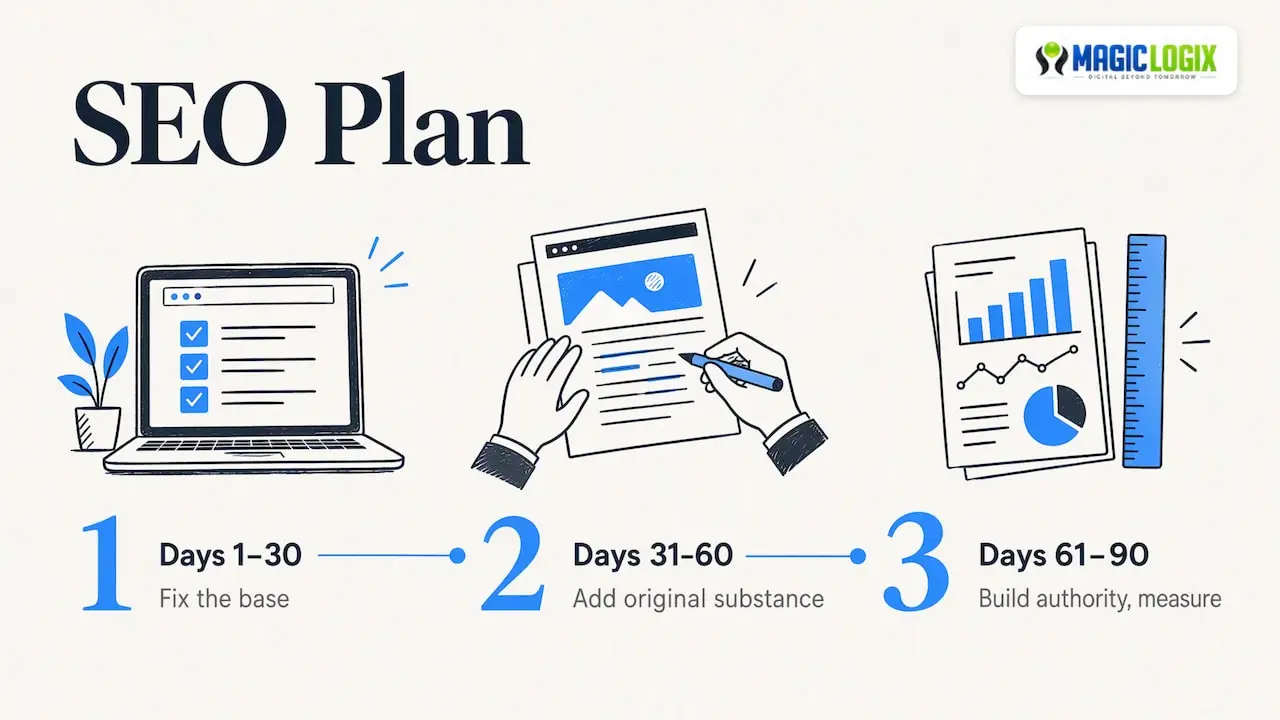
Days 1 to 30: fix the base.
Audit indexing, crawl errors, page speed and mobile usability. Pick 10 pages that matter most to revenue. Confirm each is eligible for snippets.
Days 31 to 60: add original substance.
Rewrite those pages to open with a direct answer, then add what only you can offer: real examples, numbers from your own work, photos, named expertise. Add publish and update dates.
Days 61 to 90: build authority and measure.
Publish one piece of original research or a detailed guide. Pitch it to two or three trade outlets. Set up your monthly Search Console review and write down your baseline.
This is a plan, not a promise. It improves the underlying quality of your site, which helps in ordinary search as well.
Common mistakes
- Chasing AI-only tricks. There is no special tag. Time spent on one is time not spent on content.
- Publishing summaries of summaries. If your page restates the top results, you give no reason to cite it.
- Ignoring technical health. A beautiful guide that is not indexed cannot appear anywhere.
- Over-trusting averages. Industry-wide figures vary by study and by month. Your own queries tell you more.
- Measuring only clicks. Visibility, brand searches and conversions complete the picture.
Our perspective
We see AI Overviews as a change in where trust gets built, not the end of search. Many business owners we speak with worry they need a new playbook. In our view they need the old one done well: a technically sound site, content with real substance, and a brand people recognize.
At Magic Logix, our approach to “Digital Beyond Tomorrow” is to connect search, design and analytics so the work holds up as platforms change. We would rather help you build pages that are useful and measurable than chase tactics that may not last. We also advise caution with anyone promising citations or rankings. Platform behavior is evolving, and nobody controls it.
If you do one thing this quarter, pick your five most important pages and ask what on each is truly yours. Then make that the center of the page.
— Hassan Bawab
Support from Magic Logix
If you want help auditing eligibility, planning original content or setting up measurement, our team works across search and AI visibility. You can explore our Search & AI Visibility capabilities, read about our GEO optimization approach, or start a conversation with Magic Logix about where your site stands today.
FAQ
Do I need special schema markup to appear in AI Overviews?
No. Google’s documentation says no special schema or AI-specific markup is required. Your pages must be indexed and eligible to show a snippet. Use structured data only where it accurately describes visible content.
Can I rank in AI Overviews without ranking on page one?
Sometimes. Ahrefs found that about 24% of cited pages in its study came from outside the top 10, while 76.10% came from inside it. Page-one rankings improve your odds, but a highly useful, original page can still be cited.
How do I know if my site appears in AI Overviews?
Use the generative AI performance report in Search Console. It shows impressions from AI features, segmented by device and country. Compare it with your standard performance data over several months.
Will AI Overviews reduce my traffic?
Possibly for informational queries. Ahrefs reported a 34.5% click reduction in its 2025 analysis, though results vary by site and query type. Watch your own data and focus on conversions and brand searches, not clicks alone.
Can I opt out of AI features in Google Search?
Yes. Search Console has a Search generative AI control in settings. Google says opting out does not act as a negative ranking signal for regular organic results.
Sources
- Google: Guide to optimizing for generative AI features
- Google: AI features and your website
- Google Search Console Help: Generative AI performance report
- Google Search Console Help: Search generative AI control
- Ahrefs: Insights from 55.8M AI Overviews
- Ahrefs: 76% of AI Overview citations pull from the top 10
- Ahrefs: AI Overview brand visibility factors