
A digital marketing RFP has to do one job well: force every agency that responds to price and plan against the same measurable outcomes. That means anchoring the document to specific KPIs and targets, handing bidders your baseline performance data and account access, and publishing your scope and scoring weights up front. Skip any of those three, and you get proposals that look impressive but can’t actually be compared.
TL;DR:
- Gathering 6 to 12 months of historical performance data on paid media, revenue, and account ownership is essential for accurate agency forecasting.
- Structuring the RFP into clear modules with line-item pricing prevents the evaluation from become skewed by vague scope or unstandardized bids.
- Using a weighted rubric that evaluates strategy, results, team, and cost ensures a fair, measurable comparison between proposals.
- The full RFP process typically takes 8 to 10 weeks, with shorter timelines risking superficial responses and less thorough evaluation.
- Including detailed post-launch, handover, and legal terms upfront helps avoid conflicts and ensures the agency understands project expectations early.
Table of Contents
- What Should a Digital Marketing RFP Include in the Executive Summary?
- What Data Should You Gather Before Writing the RFP?
- How Do You Structure the RFP So Bids Are Comparable?
- How Do You Score and Compare Agency Proposals?
- How Long Does a Digital Marketing RFP Process Take?
- What Belongs in the Post-Launch and Handover Terms?
- How Should Agencies Format Their RFP Responses?
- An Editorial Take on Buyer Mistakes in the RFP Process
- Get Help Running Your Digital Marketing RFP
- Sources
- FAQ
What Should a Digital Marketing RFP Include in the Executive Summary?
The executive summary is where most RFPs go soft. Agencies skim it in ninety seconds and decide whether the rest of your document is worth their time, so vague language here costs you strong responses before they’re even drafted. Write it tight, and write it with numbers.
Here’s a template you can adapt directly:
- Why now: “Our organic and paid channels have plateaued at EX in monthly revenue. We’re issuing this RFP to find a partner who can grow qualified leads by [target]% within [timeframe].”
- Specific outcome: “Primary KPI: reduce customer acquisition cost from $85 to $60 within 6 months, while maintaining a 3.5x minimum ROAS.”
- Scope: “This engagement covers paid media, creative production, and conversion rate optimization. SEO and lifecycle marketing are out of scope for this phase.”
- Budget and constraints: “Media and management budget: $40,000 to $55,000 monthly, media spend included in the cap. Contracts start net-30.”
- Logistics: “Questions accepted through [date]. Submissions due [date]. Contact: [name, email].”
Every one of those lines should carry a real number. If you’re still building your target metrics, measuring digital marketing effectiveness with clear KPI frameworks before you write the RFP saves you from picking arbitrary targets an agency can’t actually plan against.
What Data Should You Gather Before Writing the RFP?
Agencies can’t forecast results without a baseline. DesignRush’s RFP guidance recommends pulling 6 to 12 months of historical performance before you draft a single scope line, and that window matters: shorter data hides seasonality, and agencies will pad their forecasts with caution to cover the gap.
Collect these before you circulate anything:
- Paid media and funnel history — spend, impressions, click-through rate, cost per acquisition, and ROAS by channel, month over month.
- Revenue baselines and definitions — average order value, customer lifetime value, and a written definition of your primary conversion event (a purchase, a demo request, a signed lease).
- Technical inventory and ownership — who controls your analytics platform, Google Tag Manager, CRM, and ad accounts, and whether the incoming agency gets full access or view-only during the bid.
- Creative assets and performance examples — your best and worst performing ads or landing pages, with the numbers attached, so bidders see what’s already been tried.
Pro Tip: List account ownership explicitly, even if the answer is “the client owns everything.” Agencies read ownership language as a signal of how much control they’ll actually have, and vague answers here are a common reason strong agencies decline to bid at all.
How Do You Structure the RFP So Bids Are Comparable?
TrinityP3’s modular RFP template breaks the document into seven sections that keep every bidder answering the same questions in the same order: executive summary, background, baseline data, scope by module, proposal requirements, evaluation criteria, and timeline and terms. Stray from that order and you’ll spend your evaluation window reformatting responses instead of comparing them.
Inside “scope,” break the work into modules rather than one open-ended ask. Each module needs its own required outputs so bids line up cell for cell:
| Module | What to request | Example required output |
|---|---|---|
| Paid media | Channels, budget split, testing cadence | Minimum 4 tests/month, weekly optimization log |
| Creative | Concepts per cycle, formats, revision policy | 6 new concepts/month, 2 revision rounds included |
| CRO | Testing tool, hypothesis process, reporting | Monthly A/B test plan with statistical significance threshold |
| Analytics | Dashboard platform, update frequency | Live dashboard, updated weekly, shared access |
| Lifecycle/email | Segmentation approach, send cadence | Automated flows for 3+ lifecycle stages |
| SEO | Technical audit scope, content cadence | Monthly technical audit, 4 content pieces/month |
For pricing, ask for line items rather than a single bundled number. The Write Direction’s guidance on comparable bids makes the case plainly: without a line-item breakdown of management fees, media spend, and pass-through tool costs (ad platforms, analytics software, stock creative), you can’t tell whether one agency’s “$50,000” quote is cheaper or just structured differently than another’s.
The failure mode on the other side is overprescribing. If you dictate the exact ad copy or campaign structure, you’re not evaluating an agency’s thinking, you’re evaluating their ability to follow orders. State the outcome and the required output format. Let the “how” stay part of what you’re judging.
How Do You Score and Compare Agency Proposals?
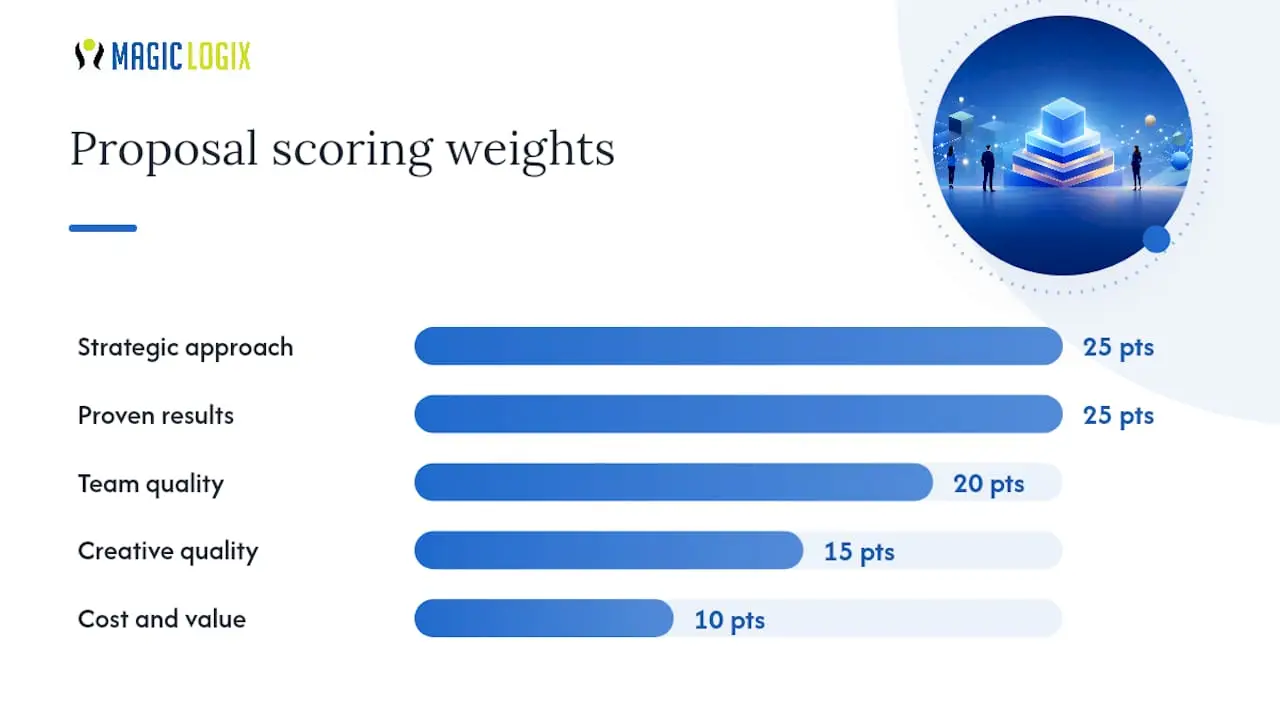
A weighted rubric turns “I liked their vibe” into a defensible decision. Use something close to this split, adjusted for what matters most to your business:
- Strategic approach (25 points): Does their plan address your specific baseline and constraints, or does it read like a template?
- Proven results (25 points): Case studies with real numbers in a comparable industry or spend range.
- Team quality (20 points): Named team members, not just agency logos and titles.
- Creative quality (15 points): Samples relevant to your category, not generic portfolio pieces.
- Cost and value (10 points): Line-item pricing compared against projected outcomes, not just the bottom-line total.
- Project management and culture fit (5 points): Communication style and reporting cadence during the sales process itself, which usually previews how they’ll run the account.
Have each evaluator score independently before comparing notes. Blind, separate scoring first prevents the loudest voice in the room from setting the anchor for everyone else, and averaging the results afterward surfaces disagreements worth discussing rather than burying them.
Watch for red flags that should knock a proposal out regardless of score: no named team members, guaranteed rankings or return multiples, or deliverables described in adjectives instead of numbers. TrinityP3’s methodology treats line-item pricing as non-negotiable for exactly this reason. It’s the fastest way to catch a bid that’s low only because it’s vague.
How Long Does a Digital Marketing RFP Process Take?
A full process typically runs 8 to 10 weeks from first draft to signed contract, and each stage has a natural minimum:
- Internal prep (1-2 weeks): Gathering baselines, aligning stakeholders on the executive summary.
- Publish and question window (1-2 weeks): Distribute the RFP, accept questions, and answer every question to every bidder at once, never one agency at a time.
- Submission period (2-3 weeks): Give agencies enough runway to build a real strategy, not a rushed template.
- Evaluation and finalist presentations (1-2 weeks): Score independently, then bring your top 2-3 in for live presentations and reference checks.
- Award and contracting (1 week): Final negotiation and signature.
You can compress this to 4-5 weeks for urgent hires, but expect shallower strategic thinking from bidders and less time for reference checks. That trade-off is fine for smaller, well-defined projects. It’s a real risk on a six-figure annual retainer.
What Belongs in the Post-Launch and Handover Terms?
Write your “definition of done” before launch, not after: tracking QA complete, assets live, and each KPI either verified or covered by an agreed measurement plan. DesignRush recommends building in a 90-day stabilization phase with response-time SLAs and a set optimization cadence, which catches the gap between “campaign launched” and “campaign actually working.”
Beyond that, spell out:
- Reporting cadence and format (weekly dashboard, monthly strategic review)
- Handover items if the relationship ends: playbooks, editable creative files, recorded training sessions
- Commercial protections: holdbacks tied to SLA performance, service credits for missed deadlines, and defined exit assistance
Pro Tip: Tie a small percentage of monthly payment to SLA performance rather than withholding it entirely. Full holdbacks make agencies defensive; performance-linked credits keep the incentive aligned without turning the relationship adversarial.
How Should Agencies Format Their RFP Responses?
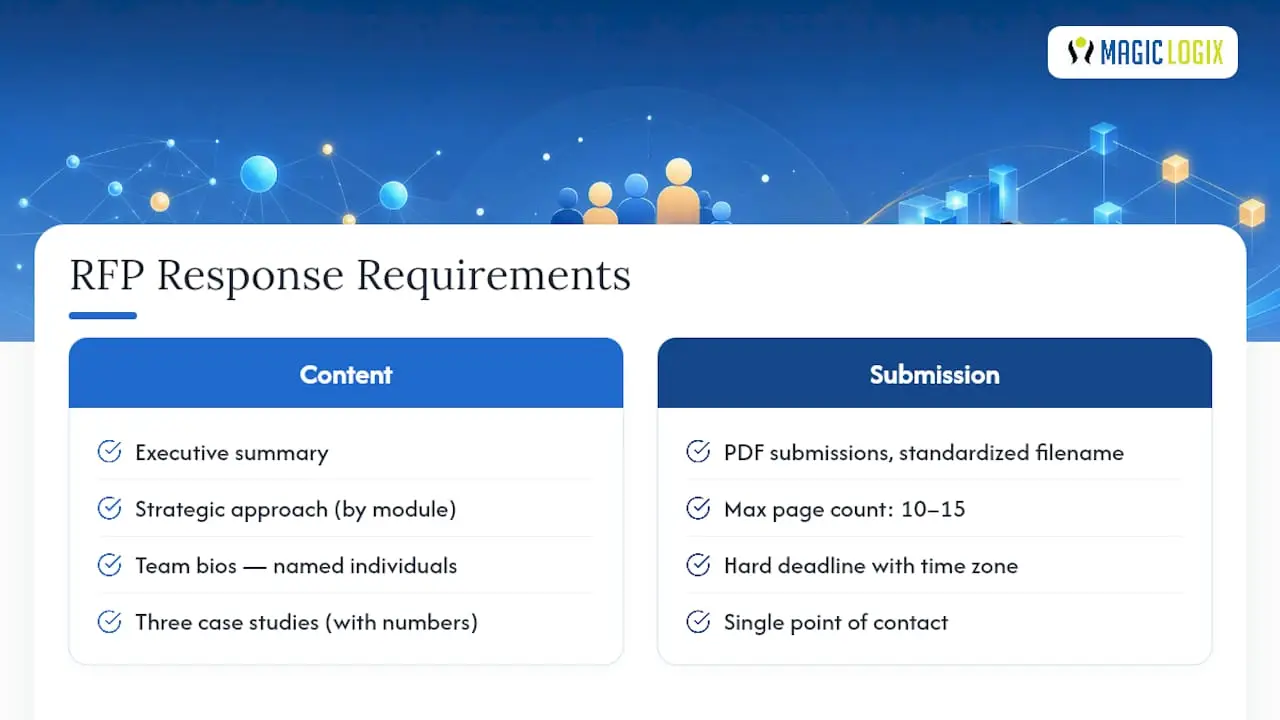
Unclear submission instructions are the single most avoidable reason you end up comparing apples to spreadsheets. Spell out format requirements in the RFP itself, not in a follow-up email after the first sloppy response arrives.
State a maximum page count (10-15 pages works for most mid-market engagements) and require a consistent structure: executive summary, strategic approach by module, team bios with named individuals, three relevant case studies with real numbers, line-item pricing, and references. Ask for PDF submissions with a standardized file name convention so you’re not hunting through an inbox for “Proposal_Final_v3.pdf.”
Set a hard submission deadline with a stated time zone and a single point of contact for questions. Require that every question and its answer get shared with all bidders simultaneously, which keeps the process fair and stops one agency from quietly gaining an information edge.
On legal terms, include your confidentiality expectations and intellectual property clauses directly in the RFP rather than leaving them for contract negotiation. State whether unused creative concepts, strategy documents, or pitch materials submitted during the process belong to you or stay with the agency if you don’t select them. This single clause causes more post-award friction than almost any other term, because agencies invest real strategic work into a proposal and reasonably want to know what happens to it if they lose.
Finally, name your qualification bar up front: minimum years in business, required experience in your industry or spend range, and whether subcontracted work is disclosed. A five-person boutique and a 200-person agency can both be right for your project, but only if you’ve told them what “qualified” means before they spend a week writing a proposal.
An Editorial Take on Buyer Mistakes in the RFP Process
Most buyers under-invest in baselines, then over-invest in scoring theatrics. A precise baseline and a published rubric change agency behavior more than any interview question ever will, because agencies stop guessing what you want and start proposing what they can measure. Skip the formal RFP entirely for urgent hires or budgets under roughly $100,000 a year. Use the process to build a partnership, not just to run a procurement drill.
— Hassan
Get Help Running Your Digital Marketing RFP
Building and scoring an RFP well takes real hours, and most marketing leaders are already stretched thin running the business the RFP is meant to grow. Some agencies work directly with buying teams to draft the RFP, facilitate weighted scoring across evaluators, and support onboarding once a vendor’s selected, which saves the internal time a DIY process usually eats up and keeps every bid measured against the same rubric instead of five different gut checks.
That kind of structured support matters most when the stakes are outcome-driven growth, not just a vendor swap. If your business is preparing for a bigger digital marketing push and wants a partner who can help set the targets before the RFP even goes out, explore how Magiclogix approaches digital marketing for business growth and get a sense of what a well-run engagement should look like on the other side of the selection process.
Sources
- How to Write a Digital Marketing RFP in 2026 + Template
- Marketing Agency RFP Template (Free Download)
FAQ
What Is a Digital Marketing RFP?
It’s a document a business sends to agencies outlining scope, budget, baseline performance, and evaluation criteria so multiple agencies can submit comparable proposals for the same work.
How Long Should a Digital Marketing RFP Be?
Most effective RFPs run 5 to 10 pages covering the executive summary, baseline data, modular scope, proposal requirements, and evaluation criteria, without dictating exact tactics.
How Much Budget Detail Should I Include?
State a budget range and specify clearly whether media spend sits inside or outside that cap. This single detail is the most common source of noncomparable bids.
Should Small Businesses Bother With a Formal RFP?
Not always. For budgets under roughly $100,000 annually or urgent hiring needs, a shorter proposal request or direct conversation, like the approach Magiclogix uses with smaller clients, often gets you to a decision faster with less overhead.
What’s the Biggest Mistake Buyers Make in Scoring?
Scoring as a group discussion instead of independently first. Blind scoring followed by averaged results catches disagreements that a single loud opinion in the room would otherwise bury.