

Expect a flat fee of roughly $500 to $5,000 a month depending on account size, and remember that number covers management only, not the media budget itself. The rest of this guide breaks down what shapes that fee, how to convert any quote into one comparable monthly number, and what to watch for before you sign.
TL;DR:
- Flat fees generally range from $500 to $5,000 per month, but actual costs depend on account size, complexity, and whether management is combined with media spend.
- Management fees are separate from ad spend and can be based on a percentage of spend, flat retainer, hourly rates, or hybrid models, with percentage fees becoming less justifiable at higher budgets.
- Larger accounts above $50,000 monthly spend may use custom or hybrid pricing, as straight percentage fees become disproportionately high relative to workload.
- Agencies managing multiple channels or complex campaigns typically charge higher fees, with platform complexity directly influencing costs.
- Always request an all-in monthly cost estimate, including setup, creative, and channel charges, to properly compare proposals and avoid hidden expenses.
Table of Contents
- PPC Management Pricing Ranges and How to Calculate Your All-In Monthly Budget
- The Four PPC Management Pricing Models Explained
- What’s Included in a PPC Management Fee, and What Costs Extra
- PPC Management Fees by Ad-Spend Tier
- How to Compare PPC Management Quotes Like a Pro
- Red Flags in PPC Proposals and How to Negotiate Better Terms
- The Real Cost Stack Behind a PPC Retainer
- Get a Clear PPC Pricing Conversation With Magiclogix
- Sources
- FAQ
PPC Management Pricing Ranges and How to Calculate Your All-In Monthly Budget
Here’s the confusion that trips up almost every business owner comparing quotes: a “$1,500 management fee” from one agency and a “12% of spend” quote from another look nothing alike until you do the math. They might land in the exact same place, or one might cost you double. You have to convert both to a dollar figure before you can compare anything.
Published benchmarks group accounts into three rough bands. Small accounts, generally under $10,000 a month in spend, tend to see management fees between $500 and $2,500. Mid-size accounts, roughly $10,000 to $50,000 in monthly spend, typically pay mid-range management fees varying by account complexity and spend. Larger accounts above $50,000 in spend commonly land at substantial management fees often customized for higher complexity accounts, often with custom pricing once complexity climbs high enough.
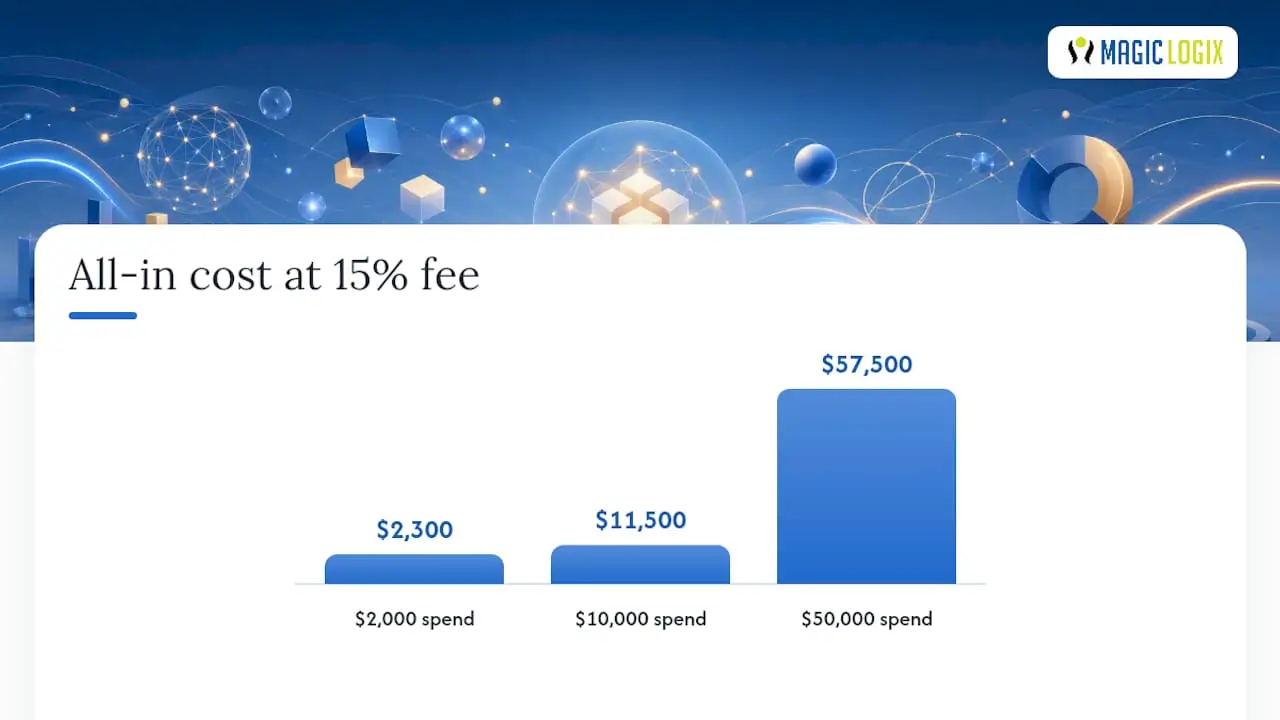
The critical habit to build: management fee and ad spend are two separate line items, and both come out of your budget. Here’s how that plays out at three common spend levels:
- $2,000 monthly ad spend: a 15% management fee runs $300, so your all-in monthly cost is $2,300. A flat retainer might instead run $600 to $800, pushing the all-in total to $2,600 to $2,800.
- $10,000 monthly ad spend: a 15% fee costs $1,500, for an all-in total of $11,500. A comparable flat retainer in the $1,800 to $2,500 range would put your all-in cost closer to $11,800 to $12,500.
- $50,000 monthly ad spend: a 15% fee jumps to $7,500, for an all-in total of $57,500. Many agencies cap or flatten pricing at this tier specifically because a straight percentage starts to look excessive relative to the actual hours worked.
That last example is where percentage pricing shows its weak spot. The workload to manage a $50,000 account is not proportionally more work than a $2,000 account, but a flat percentage fee scales linearly with spend.
Pro Tip: Always ask an agency to quote your all-in monthly number, not just their fee structure. If they hesitate to do that math with you on a discovery call, treat it as a signal to ask harder questions.
Platform complexity is part of why fees vary so widely between agencies quoting the same account size. The U.S. search advertising market continues to grow at a scale that keeps competition for ad placements high, which raises the skill and bid-management sophistication required to run campaigns efficiently across Google, Microsoft, and social platforms simultaneously. An agency juggling five channels for your account is doing meaningfully more work than one running a single Google Ads campaign, and the fee should reflect that.
Understanding paid search management as a discipline, rather than a line item, helps explain why these ranges exist in the first place. It’s not just campaign babysitting. It’s continuous bid adjustment, audience testing, and budget reallocation across channels that shift performance week to week.
The Four PPC Management Pricing Models Explained
Every proposal you receive will fall into one of four buckets. Knowing which one you’re looking at, and where it breaks down financially, saves you from a bad surprise three months in.
- Flat retainer. You pay a fixed monthly fee regardless of ad spend fluctuations. Agencies favor this for predictable revenue; you should favor it once your spend grows past the point where a percentage fee stops making sense. A typical range runs $500 to $5,000 depending on scope.
- Percentage of ad spend. The agency charges 10% to 20% of what you spend on ads each month. This model scales agency revenue directly with your budget, which sounds fair until you realize the agency earns more just because you increased spend, whether or not their workload actually increased.
- Hourly. You pay for time worked, often billed at $75 to $200 an hour depending on the strategist’s seniority. This suits narrow, well-defined projects like a campaign audit or a one-time account restructure, not ongoing management.
- Hybrid or performance-based. A smaller flat base fee combines with a bonus tied to results, such as cost-per-lead targets or revenue share. This aligns incentives well but requires airtight tracking and clear definitions of what counts as a “result” before you sign anything.
Where the math actually gets interesting is the crossover point between flat and percentage pricing. At $10,000 spend, that same 15% fee costs $1,500, right in the middle of typical flat-fee ranges, meaning the two models often cost about the same. This is the exact crossover point where flat fees start saving real money as budgets scale.
Ask directly whether a percentage quote includes tiering. If it doesn’t, and your spend is likely to grow, negotiate a flat-fee conversion clause into the contract now rather than renegotiating later from a weaker position.
For a deeper look at how these structures apply across marketing services generally, not just paid ads, see how marketing agency pricing models work across retainer types.
What’s Included in a PPC Management Fee, and What Costs Extra
A management fee is supposed to cover the operational work of running your campaigns. Most reputable agencies include campaign setup and structure, keyword research and match-type strategy, ongoing bid and budget optimization, negative keyword maintenance to cut wasted spend, and a baseline monthly report.
That’s the floor, not the ceiling. Here’s what commonly gets billed as an extra, and it’s exactly where budgets balloon if you don’t ask upfront:
- Ad creative production, including copywriting and design for display or social ads.
- Landing page builds or conversion-rate optimization work tied to your ads.
- Management of additional channels beyond the one quoted, such as adding Microsoft Ads or Meta on top of a Google Ads retainer.
- Advanced attribution modeling or custom dashboard builds beyond standard reporting.
- Initial account audit or onboarding fees, charged separately from the ongoing retainer.
Scope drives almost all of this. An account running one platform with a handful of campaigns costs less to manage than one spanning five platforms, a large product catalog for Shopping ads, and weekly reporting instead of monthly. Ask specifically how many campaigns, ad groups, and platforms the quoted fee assumes, because “unlimited campaigns” and “up to 10 campaigns” can carry the exact same sticker price with wildly different actual workloads behind them.
Pro Tip: Get the inclusion list in writing before you sign, not as a verbal assurance on a sales call. “Reporting” can mean a five-minute automated export or a 45-minute strategy call, and those two things should not cost the same.
Tactical execution matters here too. Reviewing how agencies actually optimize PPC campaigns for return gives you a concrete sense of what the hours inside a management fee are actually buying you, beyond the line-item list.
PPC Management Fees by Ad-Spend Tier
Benchmarks get more useful when you can see them side by side against your own spend level. The table below reflects commonly published ranges and which pricing model tends to dominate at each tier.
| Monthly Ad Spend | Typical Management Fee | Common Pricing Model |
|---|---|---|
| Under $2,500 | $500 to $1,000 | Flat fee or percentage with a minimum |
| $2,500 to $10,000 | $1,000 to $2,500 | Percentage of spend (10% to 20%) |
| $10,000 to $50,000 | $2,500 to $7,500 | Percentage, often with declining tiers |
| $50,000+ | $7,500 or higher | Flat or custom/hybrid pricing |
These bands come from industry fee-mapping data that agencies and buyers alike use to sanity-check quotes.
At the low end, minimum fees dominate rather than percentage rates. Agencies typically do not take on accounts for extremely low monthly fees, so even a small budget will get quoted against a floor, commonly $500 to $1,000, regardless of what a straight percentage calculation would suggest.
At the high end, the math flips. Once spend clears roughly $50,000 a month, a straight percentage fee often becomes harder to justify against the actual hours an agency spends, which is exactly why custom and hybrid pricing take over at that tier. It’s also the spend level where some companies start seriously weighing an in-house hire against continued outsourcing, since a full-time PPC manager’s salary can start to look comparable to a large agency retainer once the account is big enough to keep one person fully occupied.
How to Compare PPC Management Quotes Like a Pro
Three proposals rarely arrive in the same format, and that’s often by design rather than accident. Normalize them before you decide anything.
- Capture the headline rate and confirm what it excludes. Ask point blank: does this fee include ad spend, or is spend billed separately? Some smaller shops bundle a limited ad budget into a package price, which sounds appealing until you realize the included spend is too small to generate meaningful data.
- Ask about minimums and setup fees, then amortize them. A one-time onboarding charge of $500 to $2,500 looks painless on its own, but spread it across your actual contract length. A $1,500 setup fee on a three-month trial adds $500 a month to your real cost. On a 12-month contract, that same fee adds barely $125 a month.
- Add every per-channel and creative charge, then compute one total. If Google Ads is quoted at $1,200 and adding Microsoft Ads costs another $400, and creative production runs $300 more, your real monthly cost is $1,900, not the $1,200 headline number that appeared on page one of the proposal.
Once you have that single number for every agency you’re considering, build a short RFP checklist to compare the rest of what you’re actually buying: reporting cadence (weekly versus monthly), who owns the ad account itself, whether there’s a service-level agreement for response times, and what a change order costs if you need mid-contract adjustments to targeting or budget.
Pro Tip: Request the last three months of reporting samples from any agency finalist before you sign, not after. A vague sample report is a preview of what you’ll get every month for the life of the contract.
Businesses trying to prove the value of that reporting to leadership internally often benefit from pairing it with a broader framework for measuring digital marketing effectiveness, since PPC rarely operates in a vacuum from the rest of a marketing budget.
Red Flags in PPC Proposals and How to Negotiate Better Terms
A handful of warning signs show up again and again in weak proposals, and every one of them is worth pushing back on before you sign.
- The agency insists on owning the ad account rather than granting you admin access, which traps your campaign history and data if you ever leave.
- Vague deliverables like “ongoing optimization” with no defined cadence or reporting attached to that phrase.
- Unexplained minimums that don’t map to any stated scope of work, such as “$1,000 minimum” with no breakdown of what that buys.
- No reporting detail, meaning you’re told results are good without dashboards, screenshots, or raw numbers to verify it.
- Inflated creative charges stacked on top of an already-full management fee, especially for basic ad copy variations.
On the negotiation side, a few levers consistently work in the buyer’s favor. Ask for declining-percentage tiers if you’re on a percentage model and expect spend to grow. Request a hard cap on total monthly fees regardless of spend fluctuations. Propose a fixed-scope pilot month with clearly defined deliverables before committing to a long-term contract. And insist, in writing, on account ownership, full data export rights, and a defined handover plan if the relationship ends. Agencies confident in their work rarely object to any of these terms.
The Real Cost Stack Behind a PPC Retainer
Most agencies quote a single number and leave you to guess what’s inside it. That opacity is exactly what makes buyers nervous, and it’s a fair reaction. A retainer isn’t one thing. It’s seven distinct components stacked together: senior strategist hours, junior analyst hours, tooling allocation for bid management and reporting platforms, time spent synthesizing data into reports, direct client communication, agency overhead, and margin.
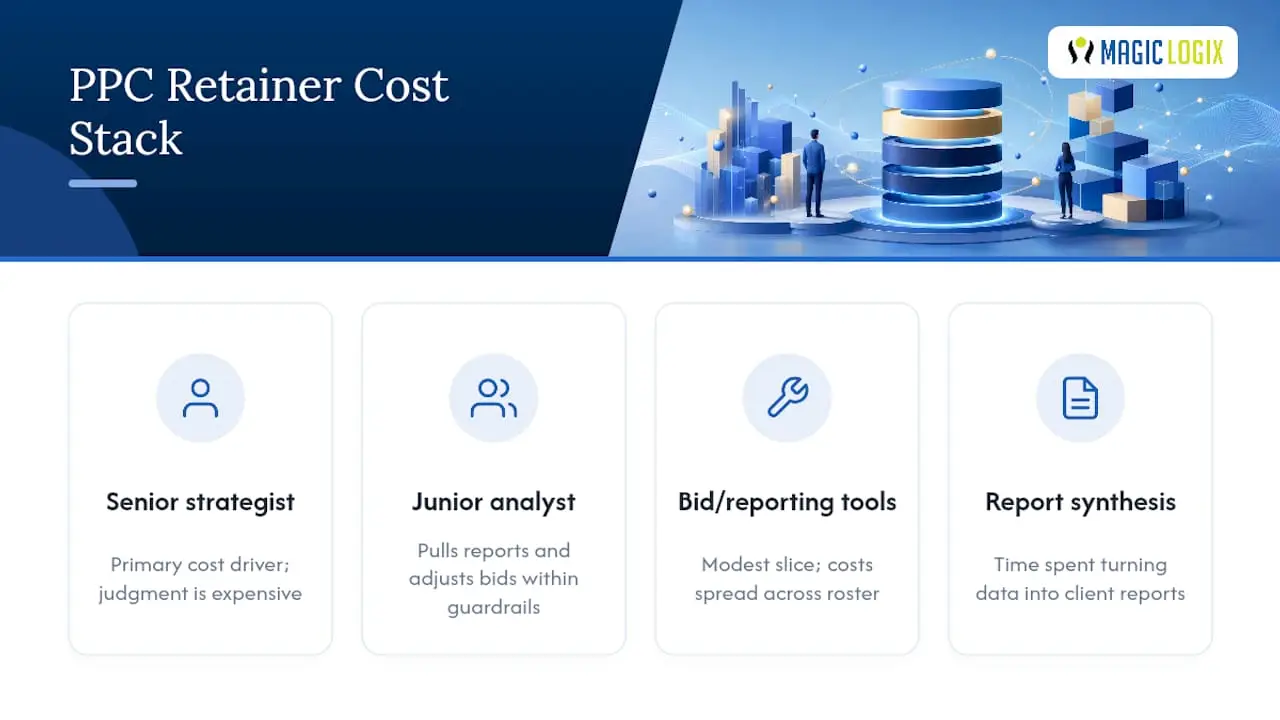
Senior strategist time is almost always the dominant cost driver, and it should be. A junior analyst can pull reports and adjust bids within guardrails someone else set, but the person deciding whether to shift budget from Search to Performance Max, or when to kill an underperforming campaign entirely, needs judgment built from pattern recognition across many accounts. That judgment is expensive, and it’s the primary reason monthly minimums exist. An agency can’t profitably assign meaningful senior time to a $500-a-month account, so the minimum protects against exactly that math problem.
Tooling allocation is smaller than most buyers assume, typically a modest slice of the total fee, since platform costs get spread across an agency’s full client roster rather than billed one-to-one. Overhead and margin round out the rest, covering everything from account management software to the simple fact that agencies need to stay in business.
A transparent breakdown like this changes the conversation with any agency you’re evaluating. Once you know what’s supposed to be inside a retainer, you can ask specifically where your money goes instead of accepting a flat number on faith. For readers who want a closer look at the analytics layer behind those reports, paid search intelligence covers what advanced tracking and attribution actually require.
— Hassan
Get a Clear PPC Pricing Conversation With Magiclogix
You’ve now seen exactly what should be inside a retainer and where hidden costs tend to hide. Some agencies build pricing around that same transparency, managing campaigns across multiple platforms under one retainer instead of stacking separate fees for every channel you add.

Retainer bands typically start where a serious multi-channel campaign needs real strategist attention, and the agency will help you understand where your account falls before you commit to anything. If your current spend has grown past what your last quote assumed, or you’re not sure whether your current fee still matches your actual workload, that’s the exact situation an audit is built for. Explore how a tailored digital marketing engagement for business growth works, and request a pricing conversation to see what a transparent retainer looks like against your specific ad spend.
Sources
- How Much Does PPC Management Cost in 2026? Real Fees | AdBot
- PPC Management Cost Calculator — 2026 Google Ads Agency Fee Estimator | UseCalcPro
- PPC Management Pricing: The Cost Stack Most Agencies Hide
- Statista: Search advertising outlook — United States
FAQ
What Is a Normal PPC Management Fee?
Expect a flat retainer between $500 and $5,000 a month, or a percentage model charging 10% to 20% of ad spend, depending on account size and complexity.
Does the Management Fee Include My Ad Spend?
No. The management fee pays the agency for its work; ad spend is a separate cost paid directly to the ad platforms like Google or Microsoft.
Is a Flat Fee or Percentage Model Better?
Percentage pricing tends to cost less at low spend levels, but flat fees usually become the cheaper option once monthly spend passes roughly $50,000.
Are Setup Fees Normal for PPC Management?
Yes, one-time setup or onboarding fees between $500 and $2,500 are common, and some agencies waive them for longer contract commitments.
What Should Be Included in a PPC Management Fee?
Standard inclusions are campaign setup, keyword research, ongoing bid optimization, negative keyword management, and basic monthly reporting; creative production and landing pages are frequently billed separately.
How Do I Know if a PPC Quote Is Too High?
Convert every quote to one all-in monthly number at your actual ad spend, then compare that figure against the published tier ranges for your spend level before deciding.