

Most businesses pay between $1,000 and $5,000 a month for SEO, with the monthly retainer as the dominant pricing model by far. Hourly work typically runs $100 to $150, and one-off projects like audits or migrations often land between $2,500 and $5,000. Your actual number depends on three things: how much technical debt your site is carrying, how competitive your industry is, and how much of the work you can absorb in-house.
TL;DR:
- Most businesses pay between $1,000 and $5,000 monthly for SEO, with an industry average around $3,200, depending on technical debt, industry competitiveness, and in-house capacity.
- Entry-level SEO costs $300 to $1,000 per month for basic audits and fixes, while mid-tier packages at $2,500 to $5,000 include content, outreach, and technical remediation.
- Agencies typically charge $100 to $150 hourly, with project-based pricing for audits or migrations ranging from $2,500 to over $30,000 depending on scope.
- Proposal evaluation should focus on itemized hours and scope clarity; effective hourly rates often reveal hidden costs behind seemingly low retained fees.
- Spending outside the common $1,000–$5,000 monthly range—either significantly above or below—may indicate overscoping or automated work that won’t deliver sustained growth.
Table of Contents
- How Much Does SEO Cost? Benchmarks at a Glance
- SEO Pricing Models Explained: Retainer, Hourly, Project, and More
- What Drives SEO Cost Differences Between Agencies?
- What Do You Actually Get at Each Budget Tier?
- How Do You Evaluate an SEO Proposal Before Signing?
- Three Realistic SEO Pricing Scenarios
- How Magic Logix Approaches SEO Scoping and Pricing
- What I’d Do With Three SEO Proposals on My Desk
- Get a Transparent SEO Quote Built Around Your Site, Not a Template
- Sources
- FAQ
How Much Does SEO Cost? Benchmarks at a Glance
Two of the largest industry surveys agree on the shape of SEO pricing, even if the exact averages differ slightly. Ahrefs surveyed 439 agencies and consultants and found an average monthly retainer of about $3,209, with the most common hourly band sitting at $100 to $150 and the most common project price between $2,501 and $5,000. Separately, Clutch’s review data puts the average monthly cost around $3,199, with hourly rates in a nearly identical $100 to $149 range and average project costs near $37,158 spread across roughly 12 months of work.
Those two numbers, both hovering near $3,200 a month, are not a coincidence. They reflect what it actually costs to run a competent SEO program with a small team of specialists (a strategist, a content lead, a technical SEO) touching your account regularly.
Here’s how that breaks down by tier:
- Entry-level: $300 to $1,000 per month. Usually automated audits, basic on-page fixes, and minimal human oversight.
- Small business: $1,000 to $2,500 per month. Local SEO, recurring content, and foundational link work.
- Mid-tier: $2,500 to $5,000 per month. A dedicated content calendar, ongoing outreach, and technical remediation.
- Premium / competitive niche: $5,000 to $10,000 per month. Specialist content, digital PR, and senior staff time.
- Enterprise: $10,000+ per month, sometimes reaching $30,000 or higher for multi-market or multi-brand programs.
Most retainers cluster between $500 and $5,000 a month. Ahrefs’s survey found that the majority of respondents pay within that range, with enterprise programs breaking above $5,000. That single data point is probably the most useful number in this entire article: if a proposal lands wildly outside that band in either direction, you owe yourself a second look at what’s actually being delivered.
Project-based work follows its own logic. A technical audit or a site migration tends to price as a fixed engagement rather than an ongoing fee, and Backlinko’s pricing analysis notes that US-based providers generally charge more than agencies in many emerging markets, partly due to labor costs and partly due to the seniority of talent available domestically.
SEO Pricing Models Explained: Retainer, Hourly, Project, and More
SEO agencies charge in five basic ways, and each one fits a different kind of business relationship. Confusing them, or letting a vendor blend them without clarity, is where a lot of budget gets wasted.
- Monthly retainer. You pay a fixed fee for ongoing work: content, technical fixes, link building, and reporting, month after month. This is the model most agencies prefer, and survey data from Clutch confirms retainers are the majority commercial structure in the industry. Retainers fit businesses that need continuous attention because search rankings erode without maintenance, similar to how a lawn needs mowing every couple of weeks, not once a year.
- Hourly billing. You pay for time logged, usually $100 to $150 per hour based on both major surveys cited above. This works well for narrow, defined tasks (fixing a specific crawl error, auditing a redirect map) but gets expensive fast for open-ended strategy work.
- Project-based pricing. A fixed fee for a defined deliverable, like a full technical audit, a site migration, or a content overhaul. Typical project costs run $2,501 to $5,000 for focused work, though larger migrations or enterprise audits can run into five figures.
- Performance-based pricing. You pay based on rankings achieved, traffic gained, or leads generated. It sounds appealing on paper, but practitioners with real scar tissue warn that performance pricing frequently misaligns incentives, pushing agencies toward easy, low-value keywords or short-term tactics that inflate metrics without moving revenue.
- Package pricing. A bundled, tiered offering (Starter, Growth, Enterprise) with fixed inclusions at each level. This works well if your needs are simple and predictable, but it can leave gaps if your business doesn’t match the package’s assumptions.
Pro Tip: If a proposal blends models, say a low retainer plus a “bonus” tied to ranking targets, treat the performance piece as a red flag rather than a discount. It usually means the base retainer alone wasn’t enough to justify the work, and the bonus structure is designed to recover margin on the agency’s terms, not yours.
For most businesses outside of the largest enterprise accounts, a straightforward retainer with clear monthly deliverables beats a hybrid model. It’s easier to budget for, easier to audit, and easier to walk away from if the results aren’t showing up. If you want a deeper breakdown of how agency pricing models apply across marketing disciplines beyond SEO, it’s worth understanding how retainers compare to project fees in paid media and web development too, since many agencies price those services using the same underlying logic.
What Drives SEO Cost Differences Between Agencies?
That’s not an accident or a scam. It usually comes down to six factors baked into every serious proposal.
Starting site condition. A site with years of technical debt (broken redirects, duplicate content, a slow server, no structured data) needs remediation before growth work even starts. Backlinko’s research identifies the business’s starting point as the single biggest driver of price variance, and a technical SEO audit that uncovers major structural issues can add thousands to a first-quarter scope.
Industry competitiveness. Ranking a local plumber for “emergency drain cleaning near me” and ranking a fintech startup for “best business checking account” require entirely different levels of investment. High-stakes verticals like finance, legal, and healthcare demand specialist content creation and stronger link authority, which pushes budgets higher across the board.
Content volume and quality bar. A blog that needs four generic posts a month costs far less to produce than a resource hub requiring subject-matter expert review, original data, and legal sign-off.
Link-building and PR effort. Earning links through digital PR, guest placements, or partnerships takes real relationship-building time. That labor shows up directly in the invoice.
Staff seniority and tooling to scale production. An agency running Ahrefs, Semrush, and a dedicated technical lead prices differently than a solo freelancer using free tools. You’re often paying for judgment, not just hours.
Implementation responsibility. Does the agency just recommend changes, or do they build them? Agencies that implement fixes directly in your CMS, coordinate with developers, and manage the CMS relationship charge more than ones that hand you a spreadsheet and walk away.
A useful gut check: proposals under roughly $800 a month in competitive US markets often signal outsourced or automated work, according to proposal evaluation guidance from HeySellIt, and can carry hidden costs later in the form of penalty cleanup or a total strategy restart.

What Do You Actually Get at Each Budget Tier?
Dollar figures mean little without knowing what they buy. Here’s a realistic breakdown of deliverables by tier, based on how most agencies structure scope against price.
Entry-level ($300 to $1,000/month). Expect automated site monitoring, basic on-page fixes (title tags, meta descriptions, alt text), and light content guidance. There’s rarely a dedicated strategist on the account, and reporting tends to be templated rather than custom. This tier suits a business testing the waters or maintaining an already-healthy site rather than pursuing real growth.
Small business ($1,000 to $2,500/month). This is where local SEO becomes serious: Google Business Profile optimization, citation building, review management, and two to four pieces of original content per month. Basic link-building outreach usually enters the mix here, though volume stays modest.
Mid-market ($2,500 to $5,000/month). A full content program with editorial calendars, structured outreach for backlinks, and ongoing technical remediation replace one-off fixes. You typically get a named account strategist and monthly strategy calls rather than automated reports. This tier is where most growth-stage businesses land, and it’s also the range both Ahrefs and Clutch identify as the most commonly reported average.
Competitive verticals ($5,000 to $10,000/month). Finance, legal, healthcare, and other high-stakes industries need specialized content written or reviewed by subject-matter experts, active digital PR campaigns, and dedicated senior strategists who understand the regulatory and trust signals search engines weigh heavily in these spaces.
Enterprise ($10,000+/month). Cross-functional teams (technical, content, analytics, and paid media coordination), custom dashboard integrations, and faster reporting cadences (weekly instead of monthly) become standard. Enterprise programs also typically include multi-market or multi-brand coordination, which adds project management overhead that smaller retainers don’t carry.
A quick way to sanity-check any quote: match the deliverables list against the tier above, not just the sticker price. A $3,000 monthly retainer that only delivers entry-level activity (automated fixes, no dedicated content, templated reporting) is priced like mid-market work but scoped like the bottom tier. That gap is exactly where wasted budget hides.
How Do You Evaluate an SEO Proposal Before Signing?
The fastest way to compare two proposals that look nothing alike on paper is to normalize them into the same units. Here’s a step-by-step method that works whether you’re comparing a $1,500 quote to a $4,000 one, or trying to figure out if a “custom package” is actually a good deal.
- Ask for itemized hours, not vague line items. “SEO strategy and execution” tells you nothing. Ask how many hours per month go to content, technical work, link building, and reporting respectively.
- Calculate the effective hourly rate. Divide the monthly fee by the guaranteed hours. A proposal evaluation framework from HeySellIt recommends this exact calculation to reveal whether a low-looking retainer is actually cheap, or just allocating fewer hours at a high hourly rate. If a $2,000/month retainer includes only 10 hours of work, that’s a $200 effective hourly rate, well above typical market bands.
- Require clear scope boundaries in the contract. What’s included, what triggers an additional fee, who owns the content and data after the relationship ends, and what the reporting cadence looks like should all be written down, not implied.
- Frame the proposal in business terms. A useful discipline borrowed from CFO-style evaluation is to ask the agency to connect their plan to unit economics: expected revenue per channel and a realistic payback timeline, according to proposal evaluation guidance from Delante. Most vendor pitches skip this step entirely, which tells you something on its own.
- Watch for red flags. Guaranteed rankings, vague “proprietary algorithms,” reluctance to share past client results, or a heavy tilt toward performance-based fees for the bulk of the contract are all signs to slow down.
If you want a broader framework for vetting vendors beyond pricing mechanics, alignment on communication style and account management structure matters just as much; a guide to choosing an SEO company covers those softer criteria in more depth.
Three Realistic SEO Pricing Scenarios
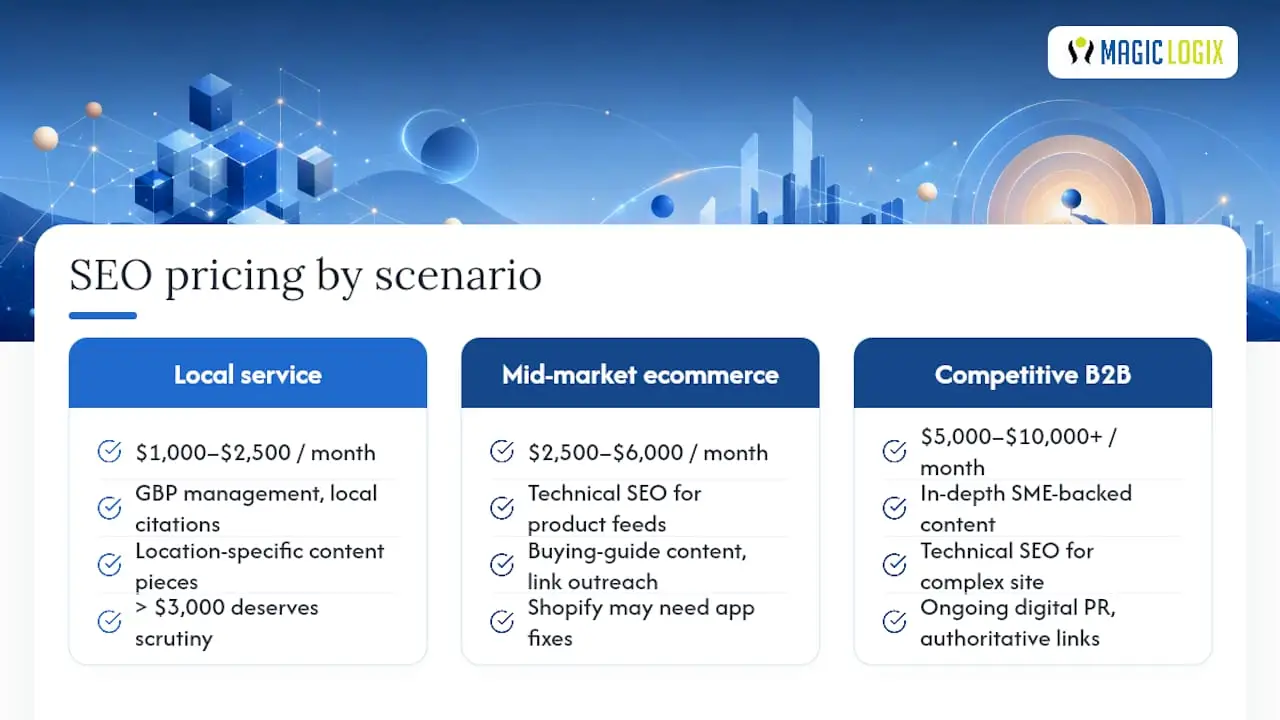
Scenario one: a local service business. A regional HVAC company with one location and moderate local competition should expect to pay $1,000 to $2,500 a month for a program built around Google Business Profile management, local citations, and a handful of location-specific content pieces monthly. Anything above $3,000 for this scope deserves scrutiny.
Scenario two: a mid-market ecommerce store. A store doing $2 million to $10 million in annual revenue, competing on product and category pages, typically lands in the $2,500 to $6,000 monthly range, covering technical SEO for product feeds, content for buying guides, and ongoing link outreach. Ecommerce platforms carry their own technical quirks, and Shopify-specific SEO work often requires app-level fixes that a generalist retainer won’t budget for.
Scenario three: a competitive B2B software company. Selling into a crowded SaaS category with high-value keywords usually requires $5,000 to $10,000+ a month, funding in-depth content backed by subject-matter experts, technical SEO for a complex site architecture, and consistent digital PR to earn authoritative backlinks.
To sanity-check any quote against these scenarios, use a simple formula: estimate the hours your scope realistically requires, multiply by the market hourly band of $100 to $150, then compare that number to the proposed monthly fee. If a vendor’s price sits dramatically below that math, they’re either underscoping the work or padding margin somewhere you can’t see yet.
How Magic Logix Approaches SEO Scoping and Pricing
Pricing SEO honestly starts with refusing to quote a number before understanding the site. Magiclogix builds every retainer proposal from a diagnostic phase first: a technical and content audit that surfaces the real scope of work, then a scope document, and only then a price built around a retainer, project, or blended mix depending on what the business actually needs.
That sequence matters because it prevents the two most common pricing failures in this industry: underscoping a site that needs heavy technical remediation, and overselling a package the business doesn’t actually require.
Magiclogix approaches this work as part of a broader digital marketing practice, not an isolated SEO transaction, which shows up in how proposals get built:
- Diagnostics come before pricing, never the other way around.
- Scope documents specify deliverables in hours and outputs, not vague retainer language.
- SEO work connects to paid media, content, and analytics rather than operating in a silo.
- Pricing draws on experience across more than 35,000 completed projects spanning small businesses to enterprise brands.
That track record doesn’t mean every engagement looks the same. It means the scoping discipline behind the price has been tested across a wide range of industries and budget sizes, which is exactly the kind of proof point worth asking any agency for before you sign anything.
What I’d Do With Three SEO Proposals on My Desk
If you’re holding two or three SEO proposals right now, don’t start by comparing the monthly fee. Start by running each one through the effective hourly rate calculation and matching deliverables to the tiers above. The proposal that looks cheapest on the cover page sometimes turns out to be the most expensive once you see how few hours it actually buys.
My honest recommendation: push for a pilot. A four to eight week audit-plus-implementation sprint with clearly defined KPIs and acceptance criteria tells you more about how an agency actually operates than any sales deck ever will. You get to see their communication style, their reporting quality, and whether they hit deadlines, all before committing to a 12-month retainer.
One more thing worth saying plainly: be wary of any agency that leans heavily on performance-only pricing as the centerpiece of their pitch. It sounds like it removes your risk, but it often just relocates the risk into short-term tactics that fade the moment the contract ends. A retainer with KPI-linked milestones gives you the same accountability without the incentive to chase the wrong metrics.
— Hassan
Get a Transparent SEO Quote Built Around Your Site, Not a Template
SEO pricing should start with diagnostics, followed by a scope document, and a fee that matches the real work a site needs, not a generic package pulled off a shelf. That matters because the biggest source of wasted SEO budget isn’t a high price. It’s a mismatched scope hiding behind a price that looked reasonable on paper.

If you’re a small business ready to move past DIY fixes, or a mid-market brand comparing your third vague proposal this month, Magiclogix’s digital marketing services built for business growth combine SEO with the paid media, content, and analytics work that actually drives revenue, not just rankings. Request a scoped proposal and see exactly what your budget buys before you sign anything.
Sources
- Clutch — SEO firms pricing (overview)
- SEO Pricing: How Much Does SEO Cost? 439 People Polled — Ahrefs
- Evaluate an SEO Agency Proposal — Metrics Rule
FAQ
How much do agencies charge for SEO?
Most agencies charge $1,000 to $5,000 a month for retainer work, with Ahrefs’s survey data showing an average around $3,209 and hourly rates typically falling between $100 and $150.
How much does it cost to get good SEO?
Effective SEO for a small or mid-market business generally starts around $1,000 to $2,500 a month, though competitive industries like finance, legal, or healthcare often require $5,000 or more to fund the specialist content and link-building effort those categories demand.
Is hiring an SEO agency worth it?
For businesses without in-house technical and content expertise, an agency is usually worth it because search rankings require ongoing maintenance across technical, content, and authority-building work that’s hard to sustain part-time. The value depends heavily on matching your budget tier to a realistic scope, which is why comparing deliverables against pricing benchmarks matters more than comparing sticker prices alone.
What’s the difference between hourly and retainer SEO pricing?
Hourly pricing bills for time logged on specific tasks, typically $100 to $150 an hour, while a retainer is a fixed monthly fee covering ongoing, continuous work. Retainers are the dominant model in the industry because SEO requires sustained attention rather than one-time fixes.
Why do SEO quotes vary so much between agencies?
Quotes vary based on your site’s starting technical condition, how competitive your industry is, how much content and link-building the strategy requires, and whether the agency implements fixes directly or just advises. A site with years of technical debt will always cost more to fix than a healthy one, regardless of which agency you choose.