

Instagram works for B2B when you give it a clear job: building trust with buyers who are already checking you out. It rarely closes deals by itself. It makes the deal easier to win by showing a prospect, in about a minute, that your company is real, active and good at what it does. A strong B2B Instagram strategy pairs that job with a steady content mix, a few honest metrics and a clear link to the rest of your marketing. That is the approach Magic Logix takes to social media strategy, under the idea of Digital Beyond Tomorrow: every channel supports a larger plan.
TL;DR
- Give Instagram one main job: proof of credibility, hiring or relationships. Treat direct lead capture as a bonus.
- Match formats to the buying journey: Reels to be discovered, carousels to teach, Stories to prompt a next step.
- Keep roughly 80% of posts useful and no more than 20% promotional. B2B brands often lean even lighter on promotion.
- Measure profile visits, saves, shares, follower quality and mentions in sales conversations, not likes alone.
- Run Instagram alongside LinkedIn, search and email, not instead of them.
Table of Contents
- What Instagram does for a B2B brand
- Build your B2B Instagram strategy in five steps
- B2B Instagram content ideas by format
- The 80/20 rule for B2B Instagram
- Influencers and partners in B2B
- B2B Instagram examples worth copying
- How to measure B2B Instagram results
- Instagram and LinkedIn work as a pair
- Where Magic Logix fits
- Perspective
- FAQ
- Sources
What Instagram does for a B2B brand
Business buyers use Instagram too. Martech.org’s February 2026 B2B guide cites figures that show how mainstream it is: 172 million US users, more than 30% of users aged 35 or older, and 58% of Americans earning over $100,000 a year. It also reports that 36% of users treat the app as a search tool.
Those numbers say your buyers are there. They do not say they are there to buy from you. Most B2B decisions involve several people, a long evaluation and plenty of background checking. Instagram fits into that checking stage in three ways:
- Verification. A prospect who hears your name looks at your profile. A clean, active account tells them you are a real team with real customers.
- Familiarity. Repeated, useful appearances in a feed make your name feel known by the time a sales conversation starts.
- People and partnerships. Candidates, partners and suppliers look at your account too. Team photos and process footage help with all three.
This is why you should pick one main goal before you post. A company that wants to be trusted by buyers posts different things from one that wants to hire engineers. Trying to do everything at once gives you a feed that does none of it well.
Who should invest first
Instagram pays off fastest when you have something to show: a physical process, a visible team, a product with a visual side, customers willing to be featured, or expertise that can be explained in a few slides. Software firms, manufacturers, logistics companies, agencies, professional services and ecommerce suppliers can all meet that bar. If your work is confidential, plan content around your people, your methods and your published ideas instead of client sites.
Build your B2B Instagram strategy in five steps
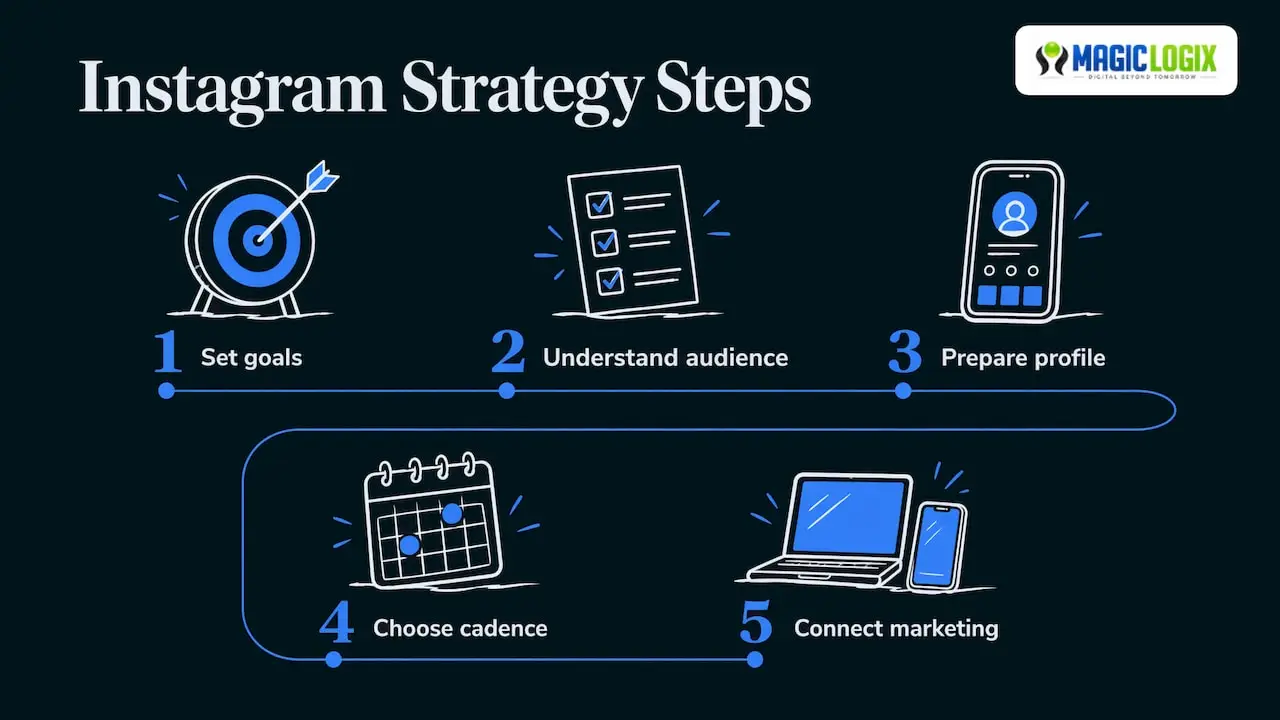
1. Set goals tied to the business
Start from a business objective, such as shortening the sales cycle, supporting an account-based campaign or growing recruitment. Then write an Instagram goal you can count. Buffer’s Instagram guide recommends specific targets, for example reaching a defined number of new people, over vague aims like “increase awareness”. It also suggests tracking reach, views and the follower conversion rate, meaning the share of profile visitors who follow.
2. Ask who is actually watching
Before you build a calendar, ask your best customers and your sales team which platforms influenced their decision and which content they found useful. Ten short conversations beat any benchmark. Add what Instagram Insights shows you: accounts reached, accounts engaged, follower growth, profile activity and audience demographics. HubSpot’s Instagram for Business guide notes that Insights data refreshes every 24 hours, covers 7, 14, 30 and 90 day windows, and is not kept beyond 90 days or exported natively. So record your numbers monthly in your own sheet.
3. Prepare the profile like a storefront
Your bio should say who you serve and what you do in plain words. Add a link-in-bio that goes to a page built for the visit, not a generic homepage. Use Story Highlights as a permanent FAQ: services, process, customers, team, events. Pin your three strongest posts so a first-time visitor sees proof immediately.
4. Pick a cadence you can sustain
A realistic starting point for a small team is two or three feed posts a week, mostly carousels, plus one or two Reels and regular Stories. Consistency matters more than volume. A calendar that survives six months beats a burst that stops after six weeks. This is a working suggestion, not a rule from Instagram.
5. Connect it to the rest of your marketing
Instagram content should point to material that goes deeper, such as a landing page, a webinar, a case study or a guide. Our guide to building a buyer-focused B2B content strategy shows how to plan that deeper layer so social posts have somewhere useful to send people.
B2B Instagram content ideas by format
The most useful way to plan content is by what each format does best. Martech.org maps formats to the funnel, and the HubSpot data below supports the same split.
| Format | Best job | B2B content ideas |
|---|---|---|
| Reels | Awareness | Myth-busting, a 30-second expert insight, event recaps, a day in the life of a project team |
| Carousels | Education | Case study summaries, method explainers, checklists, FAQs, industry data broken into slides |
| Stories | Next step | Webinar reminders, demo booking prompts, polls, Q&A boxes, link stickers |
| Highlights | Reference | Services, process, customer stories, hiring, press |
The numbers back this mix. Martech.org reports that carousels have the highest average engagement of any post type, at 2.4% (Hootsuite data), and that Reels take about 35% of all Instagram screen time. HubSpot’s 2026 Instagram Marketing Report found Reels adoption rising from 37% of marketers in 2024 to 61% in 2026. HubSpot’s engagement survey also found that B2B marketers are the group most likely to say Reels deliver the best return, as reported in its 2026 Instagram Engagement report.
Ten ideas you can start with
- A carousel that turns a customer success story into four or five slides: problem, approach, outcome, lesson. Our guide to writing a B2B case study covers the source material.
- A Reel that corrects a common misunderstanding in your industry.
- A carousel answering the five questions prospects ask most often on sales calls.
- Behind-the-scenes footage of how your product is made, shipped or supported.
- Team introductions that name the person, their role and what they solve for customers.
- A recap of a conference or webinar with three takeaways.
- A poll in Stories asking your audience to choose between two approaches, then a follow-up with the answer.
- A short walkthrough of a template, checklist or tool your customers use.
- A customer on camera, with permission, describing what changed.
- A monthly update post showing what your team shipped or learned.
Authenticity does most of the work in the process and people categories. Real photography and unscripted moments build credibility faster than stock images, as this look at authentic brand content from the outdoor sector shows.
The 80/20 rule for B2B Instagram
The 80/20 rule is a content balance: about 80% of posts offer value, such as tips, education and inspiration, and about 20% promote your offer. Forbes Advisor presents it this way, noting that useful content keeps followers engaged and makes the promotional posts feel natural. Metricool’s guide adds that B2B and service brands often lean closer to 10 to 15% promotional, and that Stories can carry links and promo stickers more often without hurting feed reach.
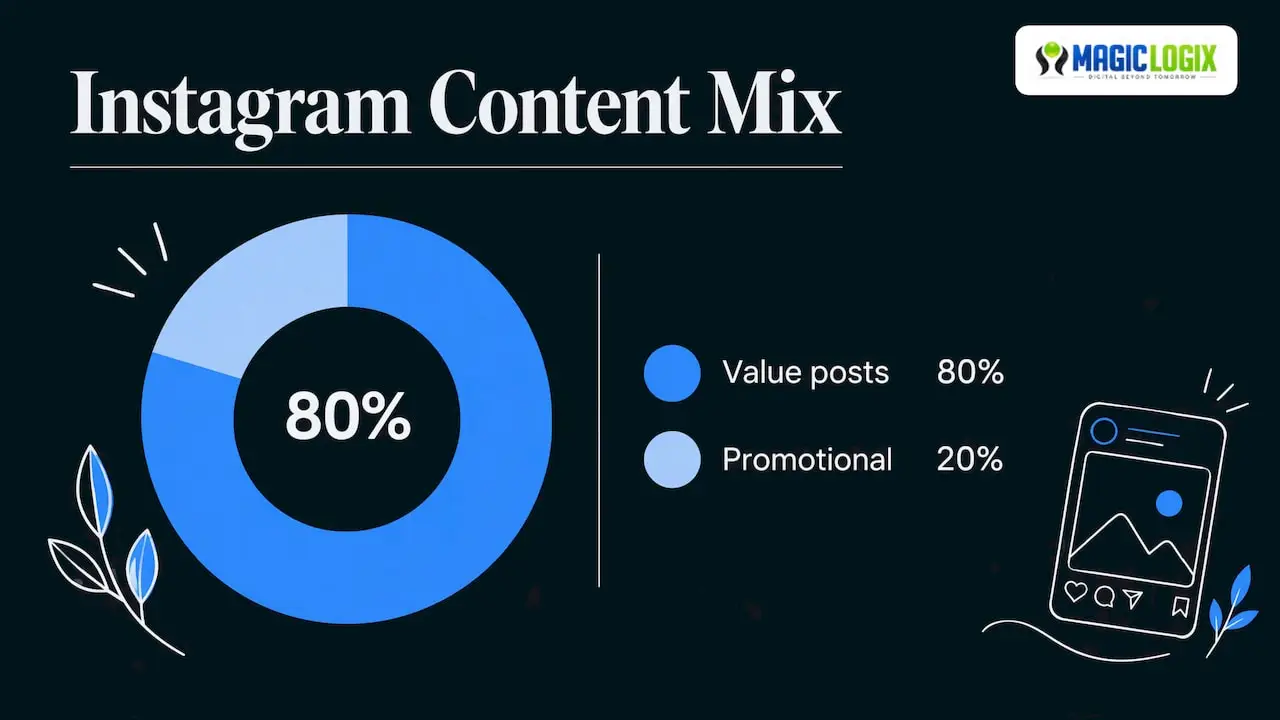
The risk of ignoring it shows up in HubSpot’s survey: 36% of Instagram marketers say being too salesy has cost them followers.
A simple way to apply it is with four content pillars:
- Teach: tips, explainers and how-tos.
- Show: process, team and behind-the-scenes.
- Prove: customer stories, results you are cleared to share and reviews.
- Sell: offers, demos and events.
One sell post for every three or four value posts works as a starting ratio. Put most direct calls to action in Stories and in the link-in-bio. Use “learn more” style prompts that lead to a landing page rather than “buy now”, a point also made by Forbes Agency Council members for long sales cycles.
Influencers and partners in B2B
A B2B influencer is an industry expert or thought leader whose view carries weight with buyers. Mailchimp describes them as people whose expertise can shape purchasing decisions and build credibility. They can be customers, employees, analysts or partner brands.
The most workable formats are an Instagram takeover by an expert, a joint carousel, a customer feature or a co-hosted live session. Anchor the collaboration in a problem your audience has, not a product plug. For a deeper look at running these programs, see our guide to B2B influencer marketing and our roundup of influencer campaign examples. If you pay for a partnership, the creator must tag the business relationship. HubSpot’s guide notes that branded content tools require partner tagging for any value exchange, in line with FTC rules and Instagram policy.
B2B Instagram examples worth copying
Rather than a list of famous accounts, look for patterns that repeat in strong B2B feeds. These are illustrations of approach, not results we are reporting:
- A software company turns release notes into a monthly carousel series, so customers see steady progress and prospects see an active product.
- A manufacturer films its production floor in short Reels, which answers the “are they real and capable?” question in seconds.
- A professional services firm posts one framework a week as a carousel, which saves well and gets shared inside teams.
- A staffing or recruiting firm features candidate and client stories in Highlights, which serves both sides of its market.
- A B2B ecommerce supplier tags products in posts and Stories. HubSpot notes that Instagram Shopping lets brands tag products in feed posts, Stories and Reels and connect catalogs through Meta Commerce Manager.
The common thread is a defined audience, a repeatable series and a face behind the account.
How to measure B2B Instagram results
Likes are easy to count and hard to value. HubSpot’s survey found 64% of marketers call likes the top engagement type, yet 40% say interacting with the audience is the strategy yielding the most return. For B2B, measure signals that sit closer to a buying decision:
- Profile visits after a post or a mention elsewhere.
- Saves and shares, which show people found the content worth keeping or passing to a colleague.
- Follower quality: the share of followers who match your target roles and industries.
- Link clicks from bio and Stories, tracked with UTM parameters in your analytics.
- Sales mentions: how often prospects say they saw your content.
- Reel signals: Instagram’s head, Adam Mosseri, has said the most important Reels metrics are watch time, like rate and send rate, per the HubSpot engagement report.
For return on investment, Sprout Social’s ROI guide gives the standard formula: value received minus investment, divided by investment, times 100. Investment includes ad spend, creative production, software and staff time. Because B2B value often arrives weeks later, review quarterly rather than weekly.
Benchmarks help you sanity-check progress. Martech.org’s roundup, drawing on Electro IQ data, puts average monthly follower growth for business accounts at 0.98% and average cross-industry engagement at 0.43%. Treat them as rough context. Your own trend line matters more. Our guide to digital marketing performance metrics explains how to build a scorecard across channels, and our explainer on Instagram impressions clears up one of the most confused numbers in Insights.
Instagram and LinkedIn work as a pair
LinkedIn is where many B2B buyers expect professional content and where active demand is easiest to capture. Instagram adds the human side: faces, places and process. Keep your company page strong on both. Our LinkedIn company page guide covers the professional side, and the same case study or carousel can be adapted for each channel.
The rule of 7 is a useful reminder here. It is an old advertising rule of thumb that a prospect needs repeated exposures before buying. No study fixes the exact number, and high-value B2B purchases likely need more. The takeaway is repetition across channels, not a magic count.
Where Magic Logix fits
If your team lacks the hours or the creative capacity to run this consistently, our social media marketing service sits within Marketing & Growth Systems, alongside content marketing, data analytics and paid media. We build social strategy so it supports your broader goals, from the profile and content plan to measurement. If you want to talk through your situation, you can reach Magic Logix here.
Perspective
Most B2B teams ask whether Instagram will generate leads. We think a better question is whether a buyer who checks your profile comes away more confident in you.
That changes how you plan. You stop chasing viral posts and start building a body of proof: customers, people, process and clear thinking, published steadily. Each piece makes the next sales conversation a little easier.
It also means Instagram belongs inside a connected system. Content, search, paid media and analytics should inform each other, so a carousel that resonates can become a landing page, a webinar or an email sequence. That is how we approach social media strategy at Magic Logix: one plan, measured honestly, with room to adjust as platforms change.
Hassan Bawab
FAQ
How do I market my business on Instagram when my customers are other businesses?
Complete your profile, choose one main goal and publish useful content in a steady rhythm: carousels for teaching, Reels for reach and Stories for next steps. Show customers, your team and your process. Track profile visits, saves and mentions in sales conversations.
What is a B2B influencer?
A B2B influencer is an industry expert, customer, employee or partner whose opinion carries weight with business buyers. Working with them through takeovers, joint posts or customer features can extend your reach to a relevant audience. Pay arrangements must be disclosed with Instagram’s partner tagging.
What is the 80/20 rule on Instagram?
It means about 80% of your content is useful or educational and about 20% promotes your offer. B2B brands often keep promotion even lower in the feed and place offers in Stories and the link-in-bio.
Which Instagram formats work best for B2B?
Reels suit discovery, carousels suit education and Stories suit prompting an action. HubSpot’s survey found B2B marketers most likely to rate Reels as their top return format, while Martech.org reports carousels with the highest average engagement. A mix of the two covers most goals.
How often should a B2B company post on Instagram?
Two or three feed posts a week, one or two Reels and regular Stories is a sensible starting point for a small team. Choose the rhythm you can keep for six months, then adjust using your own Insights data.
Sources
- B2B marketing on Instagram: What you need to know (Martech.org)
- The HubSpot Blog’s 2026 Instagram Marketing Report
- How to use Instagram for Business (HubSpot)
- Instagram for Business: Answers to the 12 Most Common Questions (Buffer)
- Social Media Marketing: The Ultimate Guide for Businesses (Forbes Advisor)
- How B2B Companies Can Leverage Instagram For Marketing (Forbes Agency Council)
- Promotional Content on Social Media (Metricool)
- The Role of Influencers in B2B Marketing (Mailchimp)
- How to measure Instagram ROI (Sprout Social)