
A customer data platform (CDP) is most useful when it solves one specific job: building audiences you can act on, personalizing across channels, spotting customers about to leave, measuring marketing at the customer level, or managing consent. The best first use case is the one where your data is already available and the payoff is easy to measure. At Magic Logix, our brand position is Digital Beyond Tomorrow, and for customer data that means starting from the business question, not the software.
This guide walks through the use cases that come up most, what each one needs from your data, and how to choose where to begin.
TL;DR
- A CDP keeps a persistent, unified customer record and shares it with your other systems, so every use case starts with clean identity and data quality.
- The most common use cases fall into three groups: acquisition, engagement and retention, with measurement and consent running underneath.
- Audience segmentation is the usual starting point because it shows results quickly and proves the value of a unified customer view.
- Pick one use case, name the data it needs, set a metric before launch and review it on a fixed schedule.
- A CDP works alongside your CRM and marketing automation tools. It does not replace them.
Table of Contents
- What a CDP does, in plain terms
- The most common CDP use cases
- How to choose your first use case
- What your data needs before any use case works
- What results to expect, and how to read them
- CDP, CRM and marketing automation: how they fit
- Where Magic Logix fits
- FAQ
- Sources
What a CDP does, in plain terms
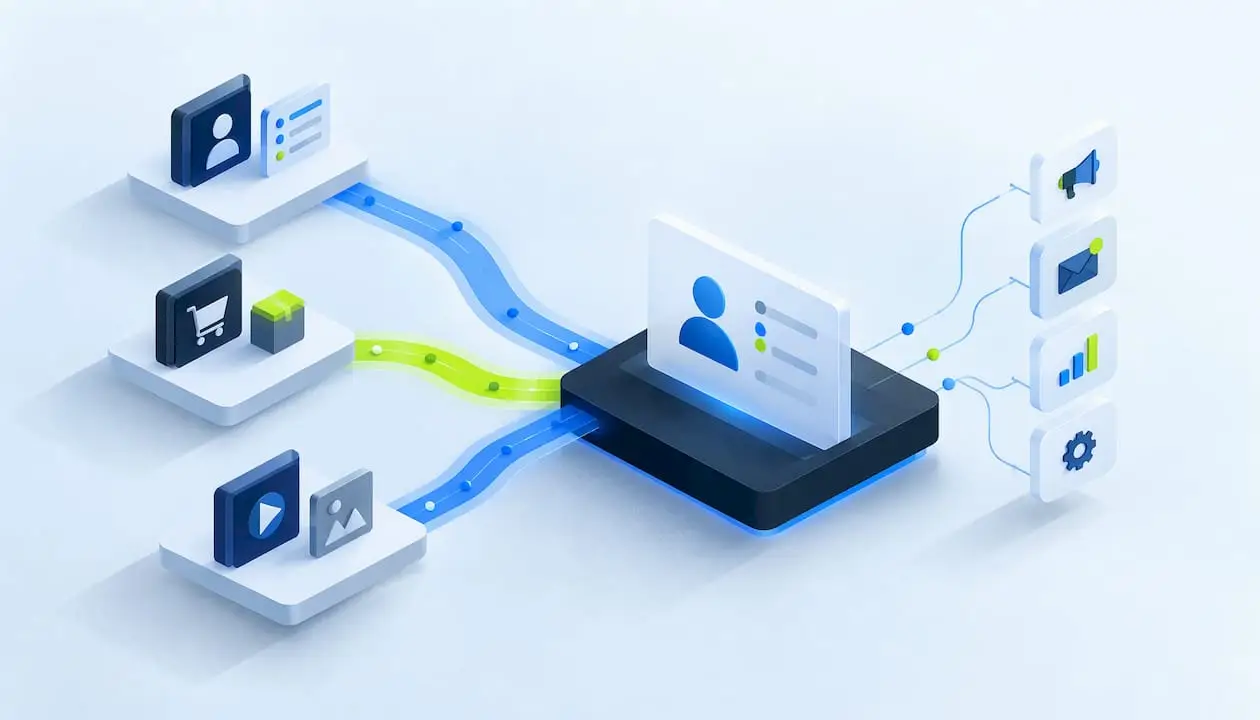
Think of your customer data as plumbing. Email data sits in one pipe, website behavior in another, purchases in a third. A CDP connects them so the same person looks like one person everywhere.
The CDP Institute, the industry body that tracks the category, defines a CDP as software that creates and maintains a persistent, unified customer record that other systems can use. It takes primary responsibility for customer identity and record structure. It relies mainly on a company’s own data about identified people, though it can also include outside data and anonymous visitors.
That definition explains every use case below. Each one is a different way of putting a trustworthy customer profile to work.
The most common CDP use cases
It helps to group use cases by the stage of the customer relationship they serve. KPMG’s guidance for US companies recommends the same approach: break use cases into strategic categories such as attract, retain and cross-sell or upsell, then decide which data sources to prioritize for each.
| Goal | Use case | Data it leans on |
|---|---|---|
| Acquire | Lookalike audiences, suppression lists, paid media targeting | Purchase history, site behavior, ad platform identifiers |
| Engage | Real-time personalization, cross-channel campaigns, product recommendations | Behavioral, transactional and demographic data |
| Retain | Churn prediction, win-back, loyalty programs | Engagement history, purchase frequency, service interactions |
| Measure | Journey mapping, attribution, A/B testing | Touchpoint data across channels |
| Govern | Consent management, privacy compliance | Consent records, data source inventory |
Audience segmentation and targeting
Segmentation means grouping customers by what they do and buy, so you stop sending one message to everyone. Examples: recent first-time buyers, lapsed subscribers, high-spend repeat customers.
It is the usual first project. It needs less data than prediction, it can be activated in email and paid media within one campaign cycle, and the result (open rate, click rate, conversion rate by segment) is easy to read.
Suppression and smarter paid media
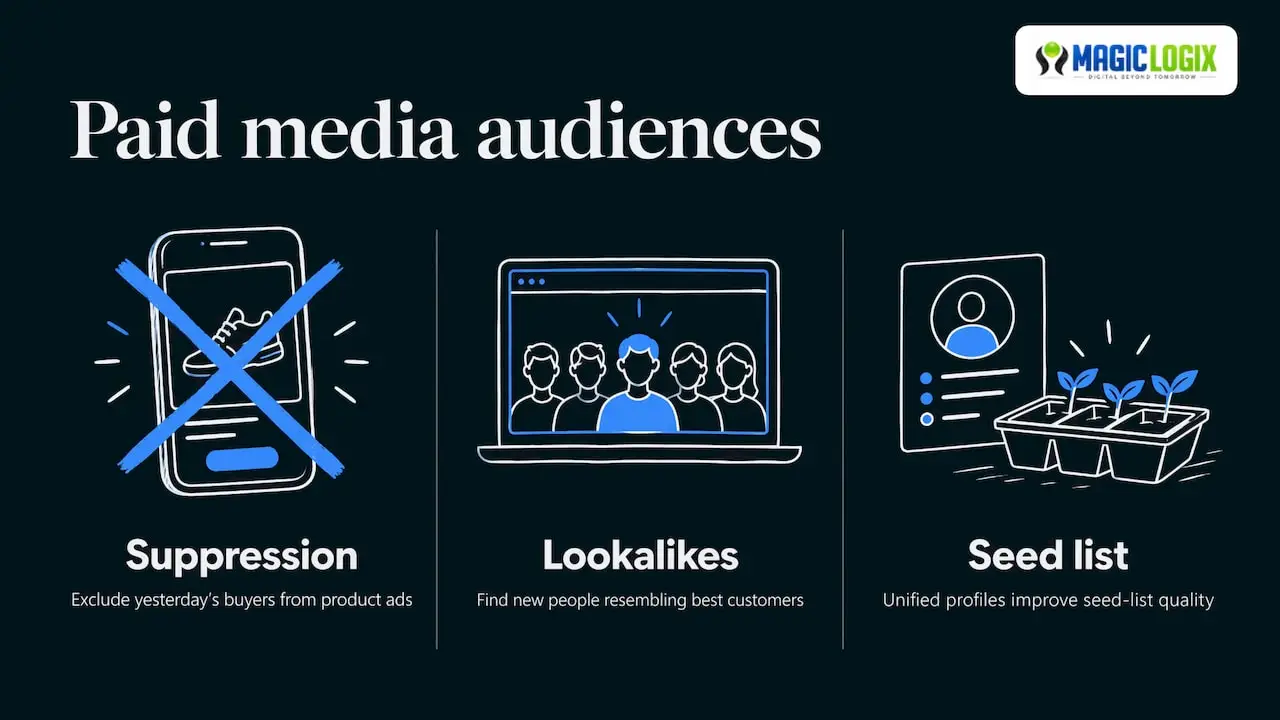
Suppression means excluding people from a campaign who should not see it, such as customers who bought yesterday and are still being shown the ad for that product. It is unglamorous and often the quickest saving, because it stops wasted ad spend and awkward customer experiences.
Paid media also benefits from lookalike audiences, where an ad platform finds new people who resemble your best customers. The quality of the seed list matters, and a unified profile makes that list better.
If your paid campaigns draw on thin or fragmented data, our Marketing & Growth Systems work is where audience quality and ad management meet.
Personalization across channels
Personalization means changing what a person sees based on what you know about them: the homepage banner, the email product block, the next-best offer. Martech.org lists personalization engine, activation hub and source of truth among the core ways teams use a CDP.
The practical rule: personalize in the channel where you have the most volume first, usually email or the website, then extend. Our guide to predictive personalization covers a realistic timeline for marketing leaders.
Customer journey mapping and orchestration
A customer journey is the path someone takes from first contact to repeat purchase. A CDP can map it by tracking behavior across channels and touchpoints, which shows where people drop off or stall.
Orchestration is the next step: triggering the right message when someone reaches a certain point. It depends on governance and clear ownership of the data, which we cover in customer journey orchestration.
Churn prediction and retention
Churn means customers who stop buying or cancel. A CDP can apply predictive analytics to behavior and engagement patterns to flag at-risk customers so you can run retention campaigns before they leave. The same unified view can help customer service representatives see a customer’s history in one place.
This use case needs history. If you have only a few months of data, start with simple rules (no purchase in 90 days, no login in 30) and add modeling later.
Attribution and measurement
Attribution answers the question of which marketing efforts led to a sale. Martech.org makes a sensible point here: perfect attribution is the enemy of good enough attribution. A CDP gathers data from most touchpoints, so you can make an educated judgment about where to focus, revise or stop spending.
For how to set up the metrics themselves, see our piece on measuring digital marketing effectiveness.
Consent and privacy management
Consent management records what each customer agreed to and applies it everywhere you use their data. In the US that matters for state privacy laws such as California’s CCPA. The CDP Institute lists managing consent among the core reasons companies adopt a CDP. Our CCPA compliance guide for marketing teams explains what your team should have in place. For legal interpretation of your own obligations, speak with your company’s counsel.
Feeding AI with governed data
The CDP Institute also notes that companies use CDPs to give AI systems governed data. The reasoning is simple: AI-driven recommendations and engagement are only as good as the profiles behind them, and consent rules should travel with the data.
How to choose your first use case
Many teams try five use cases at once and finish none. Use this short framework instead.
- List the business problems. Examples: high ad costs, low repeat purchase rate, slow campaign launches.
- Match each to a use case from the table above.
- Check the data. For each, write down the sources required and whether you already collect them with consent.
- Score by speed and clarity. Which one can you launch within one quarter, and which has a metric you can read cleanly?
- Commit to one, with a baseline number recorded before launch.
A useful test: if you cannot name the single metric that would prove the use case worked, it is not ready.
What your data needs before any use case works
KPMG’s report describes the groundwork as unifying demographic, behavioral and transactional data and addressing privacy, consent, governance, data quality and integration complexity. In practice, check these before you start:
- Identity: can you match an email address to a purchase and to a website session?
- Source access: can your ecommerce platform, email tool and CRM export or connect data?
- Consent: do you know what each customer agreed to?
- Ownership: who fixes a broken data feed, and how quickly?
Your own first-party data, the information customers share directly with you, is the strongest base for all of this. It is also the data you are most clearly entitled to use.
What results to expect, and how to read them
Published figures vary by company and industry, so treat them as a range of possibilities, not a forecast. KPMG’s 2025 report says CDP users recorded 2.5x higher conversion rates and 17% higher customer lifetime value. It also reports that over half of marketers reached ROI within six months, and a 10% reduction in campaign time-to-market.
Use those numbers to set direction, not promises. Your own plan should include:
- A baseline: the metric as it stands before launch.
- A control group: a slice of customers who do not receive the new treatment.
- A review date: 90 days is a practical first checkpoint.
- A decision rule: what result means expand, adjust or stop.
Small teams can win with modest targets. A segment that lifts email click rate a few points, or a suppression list that trims wasted ad spend, is a real result.
CDP, CRM and marketing automation: how they fit
A common misconception, according to KPMG’s Guillaume Carré, is that a CDP replaces CRMs or marketing automation tools. His view in the 2025 report is that CDPs work best when integrated with those systems, giving a fuller picture of customer interactions.
A simple way to remember it:
- CRM: records your relationships and sales conversations.
- Marketing automation: sends and times messages.
- CDP: keeps the unified customer record that both can draw from.
Before buying anything, map how leads and customer records flow between tools. Our guide to CRM and marketing integration shows how to do that mapping first.
Where Magic Logix fits
Most CDP use cases end in the same place: an audience, a message and a measured result. That is the work our marketing automation and data analytics services cover, alongside paid media management and AI-driven customer engagement. If you are weighing which customer data use case to tackle first, our team can help you shape the plan around your goals and your existing tools.
Our perspective
Most customer data projects stall for the same reason: the team starts with the platform and looks for a problem afterward. We think the order should be reversed. Start with the customer outcome you want, such as more repeat purchases, lower acquisition cost or faster campaigns, and work backward to the data and the tools.
That is how we approach digital transformation at Magic Logix. We combine data analytics, marketing automation, paid media and creative work, because a unified profile only matters once it changes what a customer sees. A segment nobody activates is just a spreadsheet.
Our advice to small and mid-sized businesses: choose one use case, fix the data it depends on, measure it against a baseline, then expand. Our clients range from small enterprises to large corporations, and the discipline is the same at every size.
Hassan Bawab
FAQ
What is the most common CDP use case?
Audience segmentation for personalized marketing is the one most teams start with. It needs a relatively small set of data, connects directly to email and ad campaigns, and shows results quickly. Those results make the case for expanding to prediction and orchestration.
What is the difference between a CDP and a CRM?
A CRM manages relationships and sales activity, mostly for people you already know by name. A CDP builds a unified customer record from many sources, including behavior and transactions, and shares it with other systems. They work best together, and KPMG’s 2025 report says a CDP does not replace a CRM.
Can a small business use a CDP?
Yes, if it has enough customer data across at least two or three sources and a clear goal. A small ecommerce brand might unify store purchases, email engagement and ad audiences to run suppression and win-back campaigns. Start with one use case and a modest target.
How long before a CDP use case shows results?
It depends on your data and the use case. KPMG’s report says more than 50% of marketers achieved ROI within six months. A practical plan is to review a first use case at 90 days against the baseline you set before launch.
Does a CDP help with privacy compliance?
It can, because it can hold consent records in one place and apply them across channels. The CDP Institute lists consent management as a core use. Your legal obligations under state privacy laws still need review by your counsel.
Sources
- What Is a CDP? Customer Data Platform Meaning & Definition, CDP Institute
- 12 ways to use a customer data platform, Martech.org
- Harnessing Customer Data Platforms, KPMG US (2025)