

A marketing data warehouse is a central, cloud-based store where data from your ad platforms, website analytics, CRM and email tools lands in one consistent structure, so you can query it together instead of reconciling exports by hand. For most small and mid-size teams, the practical path is to start with two or three core sources, agree on a handful of metric definitions, and add sources only when a real question needs them. This guide explains the parts, the decisions and the checks that keep centralized marketing data trustworthy.
TL;DR
- A marketing data warehouse combines campaign, web, CRM and sales data in one place so every channel is measured with the same definitions.
- It is different from a database, a data lake, a data mart and a customer data platform (CDP), though it often works alongside them.
- Start small: two or three sources, five to ten agreed metrics, one dashboard people actually use.
- Plan for pipeline upkeep and privacy rules such as the California Consumer Privacy Act (CCPA) from day one.
- Magic Logix pairs data analytics with marketing automation and paid media, which is where centralized data pays off.
Table of Contents
- What a marketing data warehouse is
- Why marketing teams centralize their data
- How it differs from a database, data lake, data mart and CDP
- Do you need one yet?
- The building blocks
- A practical setup plan
- How to evaluate whether it is working
- Pipelines, privacy and governance
- Where Magic Logix fits
- Our perspective
- FAQ
- Sources
What a marketing data warehouse is
A data warehouse, in Google Cloud’s definition, is an analytical database plus the components and procedures around it, built for reporting and analysis rather than for running day-to-day applications. A marketing data warehouse applies that idea to one job: collecting campaign performance, customer interaction and revenue data from many tools so they can be analyzed side by side.
Think of it as plumbing. Your ad accounts, analytics tool, CRM and email platform are the taps. The warehouse is the tank where everything arrives, gets cleaned and is labeled the same way. Dashboards, reports and models are what you draw from the tank.
Without it, most teams work from channel-by-channel exports. Google Ads counts conversions one way, your analytics tool another, and the CRM a third. A warehouse does not make those numbers agree on its own. It gives you one place where you decide, once, how a lead, a customer and a conversion are defined, and then apply that rule everywhere.
What “centralized marketing data” means in practice
Centralized does not mean copying everything. It means that the data you need to answer your recurring business questions sits in one place, with consistent field names, time zones, currencies and customer identifiers. A typical first scope looks like this:
| Source type | Examples | Typical question it answers |
|---|---|---|
| Paid media | Google Ads, Meta Ads, LinkedIn Ads | What did each campaign cost and deliver? |
| Web analytics | Google Analytics 4, Search Console | Which pages and sources drive visits and conversions? |
| CRM | Salesforce, HubSpot CRM or similar | Which leads became customers, and what are they worth? |
| Email and automation | Your email and marketing automation platform | Which messages move people to act? |
| Commerce or billing | Store platform, payment system | What revenue actually came in, and from whom? |
Why marketing teams centralize their data
The reasons are less about technology than about decisions.
- One version of the truth. Finance, sales and marketing stop arguing about whose number is right.
- Cross-channel views. You can compare cost per qualified lead across search, social and email using the same rule.
- History. Platforms limit how far back they report or change how they attribute. Your own copy lets you analyze long-run trends, seasonality and past campaigns.
- Customer-level analysis. When ad, web and CRM records can be joined, you can study lifetime value, churn and segments rather than clicks alone.
- Better inputs for automation and AI. Personalization, scoring and segmentation are only as good as the data feeding them.
If measuring return on investment is your main goal, our guide to measuring digital marketing effectiveness covers which metrics to define first, and the overview of digital marketing performance metrics helps you choose what belongs in the warehouse model.
How it differs from a database, data lake, data mart and CDP
These terms get mixed up, and the confusion leads to buying the wrong thing.
| Option | What it holds | Best for | Relation to a marketing warehouse |
|---|---|---|---|
| Database | Operational records for one application | Running a website, store or CRM | A source that feeds the warehouse |
| Data warehouse | Cleaned, structured data from many sources | Reporting, analysis, attribution | The core of your analytics |
| Data lake | Raw data of any format | Large volumes, data science | Can sit upstream of the warehouse |
| Data mart | A focused slice of a warehouse | One team, such as marketing | A subset or a smaller version |
| Customer data platform (CDP) | Unified customer profiles | Audience building and activation | Often reads from, or is built on, a warehouse |
The short version: a warehouse is where you analyze and measure, and a CDP is where you build audiences and send them to channels. Snowflake’s own guide to data-driven marketing draws the same line between campaign intelligence and measurement on one side and customer 360 and activation on the other. Some organizations choose a composable approach, assembling modular components around the warehouse so they keep control of their customer data, as described in AWS’s architecture write-up on composable CDPs.
Do you need one yet?
Not every business needs a warehouse on day one. These signals suggest you are ready:
- You spend on three or more channels and compare them in spreadsheets every month.
- Reports from different tools disagree and nobody can say which is right.
- You want to tie ad spend to closed revenue, not just form fills.
- Your analytics tool’s interface limits the questions you can ask or how far back you can look.
- You plan to use automation, scoring or AI personalization and need clean customer data first.
If you have one or two channels and a simple funnel, a well-built dashboard on top of your analytics and CRM may be enough for now. Revisit the question when you add channels, products or a sales team.
The building blocks
Every marketing warehouse, whatever the vendor, has five layers.
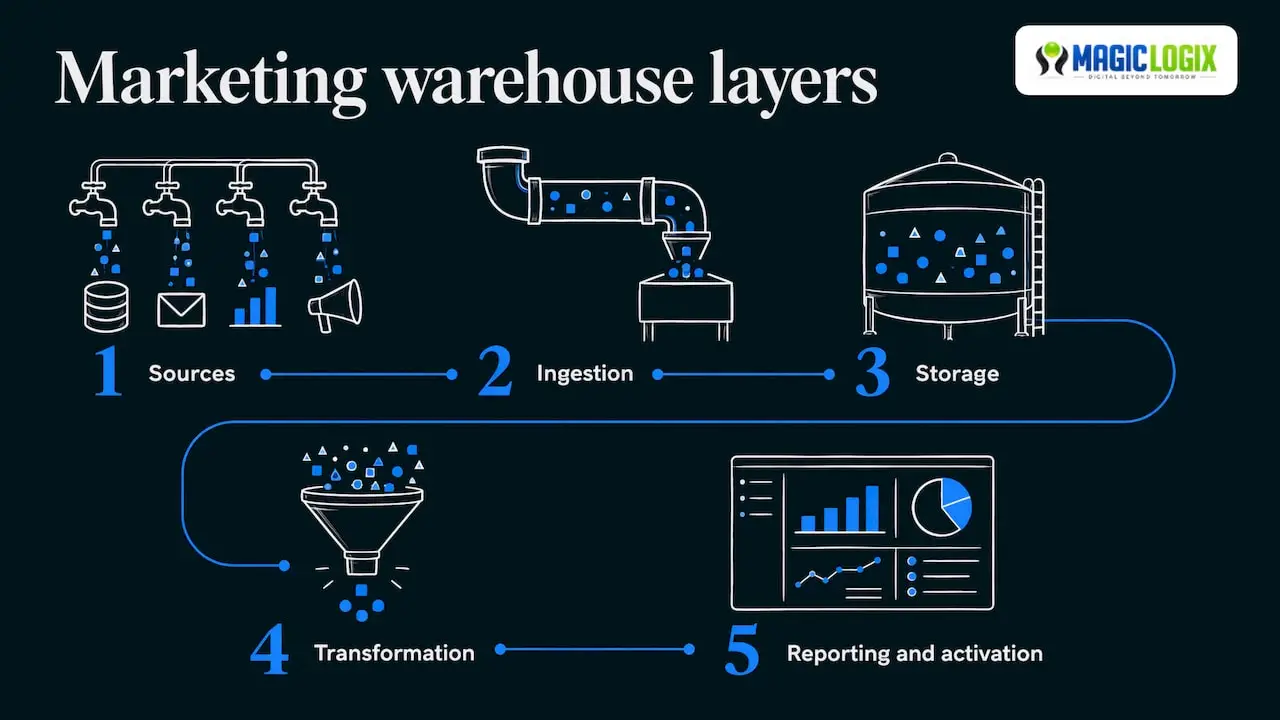
1. Sources
The platforms listed in the table above. Start with the ones that hold spend and revenue, since those two sets of numbers drive most decisions.
2. Ingestion
Connectors or pipelines move data from each source into the warehouse on a schedule. Some run on a daily batch, others stream. Take Google Analytics 4 as an example: its export to Google’s warehouse product has separate daily and streaming options, and according to a 2026 reference on the GA4 BigQuery export, standard properties cap the daily export at 1 million events per day. Check Google’s current documentation before you plan around that limit, since platform limits change.

3. Storage
This is the warehouse itself. Cloud options such as Google BigQuery, which Google describes as a fully managed analytics data warehouse, remove the need to run servers. Other major cloud platforms offer comparable services. Choose based on the tools your team already uses, who will write the queries and how your costs will scale with data volume.
4. Transformation
Raw exports are messy. Transformation turns them into tables people can trust: standardizing campaign names, converting currencies, removing duplicates, and joining ad clicks to CRM records. This is the layer where your definitions live, such as what counts as a marketing qualified lead or how you calculate customer acquisition cost. Many teams document and test these transformations in version-controlled code, so a change to a definition is visible and reversible.
5. Reporting and activation
Dashboards, scheduled reports, attribution models and audience syncs. Keep this layer small at first. A single dashboard that the team opens every week beats twenty that nobody maintains.
A practical setup plan
Here is a sequence that works for small and mid-size teams and scales to larger ones.
Step 1: Write down the questions
List the five to ten decisions you make repeatedly: where to move budget, which campaigns to pause, which leads to prioritize. If a data source does not help answer one of them, leave it out for now.
Step 2: Choose your first two or three sources
Snowflake’s guide suggests organizations can begin by bringing together data from a couple of core sources and grow from there. Paid media plus CRM is a common starting pair, because together they connect spend to revenue.
Step 3: Agree on definitions before you build
Decide, in writing, how you define a lead, an opportunity, a customer, a channel and a conversion window. Settle which system is the source of truth for revenue. This step costs nothing and prevents the most common failure: a beautiful warehouse that reproduces the same disagreements.
Step 4: Standardize naming
Use consistent UTM parameters and campaign naming across every platform. Messy tags are the single biggest cause of unusable cross-channel reports, and no warehouse can fully repair them after the fact.
Step 5: Pick the stack for your team
Weigh these criteria:
- Skills: who writes SQL, and who needs point-and-click reporting?
- Volume: how many events and rows per day, and how fast will that grow?
- Cost model: storage, query and connector fees; model them for a busy month, not an average one.
- Integrations: do connectors exist for your actual platforms?
- Governance: access controls, audit logs and the ability to delete a person’s data on request.
Step 6: Build, test and reconcile
Load history, then compare warehouse totals against each platform’s own reports. Small gaps are normal because platforms attribute and time-stamp differently. Large gaps point to a pipeline or definition problem. Record the acceptable variance, for example within a few percent for spend, and monitor it each week.
Step 7: Ship one dashboard, then expand
Release a first report built around your core questions. Collect feedback for a month, then add the next source or the next analysis, such as customer segmentation or customer journey analytics.
How to evaluate whether it is working
Measure the warehouse itself as you would any marketing investment.
| Check | What to look for |
|---|---|
| Data freshness | Reports update on the schedule you set, with alerts when a pipeline fails |
| Reconciliation | Spend and revenue match source systems within your agreed tolerance |
| Adoption | The team opens the dashboard weekly and cites it in budget decisions |
| Time saved | Hours spent building monthly reports before and after |
| Decision quality | Budget shifts and campaign changes tied to warehouse findings, tracked over quarters |
Treat these as your own baselines. There is no universal benchmark, so record where you start and compare against yourself.
Pipelines, privacy and governance
Centralizing data concentrates both value and risk, so plan for upkeep and rules early.
Pipelines break. In a 2023 StreamSets research report, 60% of marketing data professionals described their pipelines as brittle, and 68% said fragmentation made data harder to understand, govern and manage. The lesson is to budget time for monitoring, alerting and documentation, not only for the initial build.
Personal data carries legal duties. If you do business with California residents and meet the thresholds, the California Consumer Privacy Act gives consumers rights over the personal information businesses collect, including the right to opt out of its sale or sharing. A warehouse that joins ad, web and CRM data must be able to honor those requests across every table. Other states have their own privacy laws, so confirm which apply to you with your attorney or privacy counsel.
A short governance checklist:
- Limit access by role, and log who queries personal data.
- Store only the personal fields you need for analysis.
- Keep a map of where each customer identifier appears.
- Test that an opt-out or deletion request reaches every table and export.
- Review connectors and permissions every quarter.
Where Magic Logix fits
A warehouse is a foundation. The value shows up when the data drives action: better paid media decisions, sharper segments, automated follow-up and clearer reporting. Magic Logix offers data analytics together with digital marketing and paid media and marketing automation, so the people who read your numbers are also the people who act on them. If you want to talk through which data to centralize first and how it should feed your campaigns, explore our Marketing & Growth Systems services.
For a deeper view of how the pieces connect, read our explainer on marketing intelligence.
Our perspective
Most marketing data projects fail on definitions, not on technology. Teams buy a warehouse, connect every platform they own, and then discover that sales and marketing still define a “qualified lead” differently.
At Magic Logix, we start from the decision. Which budget call are you trying to make better? That answer tells us which two or three sources to connect first, and which metrics deserve a single, written definition.
We also believe the warehouse is not the finish line. Our work spans data analytics, paid media, marketing automation and web development, because centralized data only earns its cost when it changes what you do next: who you target, what you send and where you spend. Our positioning, Digital Beyond Tomorrow, reflects that: build the data foundation so the next channel, the next AI tool or the next search surface plugs into something reliable.
A final note on AI search. Platform behavior and best practices are still evolving, and no one can promise citations or rankings. Clean, well-structured first-party data gives you a firm base whichever way they go.
Hassan Bawab
FAQ
What is the difference between a marketing data warehouse and a CDP?
A warehouse stores and analyzes cleaned data from many sources, which makes it the place for reporting, attribution and modeling. A customer data platform focuses on unified customer profiles and sending audiences to channels. Many teams use both, with the CDP reading from the warehouse.
How much marketing data do I need before a warehouse makes sense?
There is no fixed threshold. The usual trigger is complexity: several channels, conflicting reports and a need to connect spend to revenue. If you manage one or two channels with a simple funnel, a dashboard on your existing tools may serve you until your mix grows.
Which data sources should I connect first?
Start with paid media and your CRM, because together they link cost to closed revenue. Add web analytics next, then email and commerce data. Connect a new source only when a specific question requires it.
Is a marketing data warehouse covered by privacy laws?
Yes, whenever it holds personal information. In the US, laws such as the California Consumer Privacy Act give residents rights over their data, and your warehouse must be able to act on opt-out and deletion requests. Confirm which state laws apply with your attorney.
How long does it take to set one up?
It depends on the number of sources, the state of your campaign tagging and how settled your definitions are. A focused first release with two or three sources is a realistic starting scope, with expansion in later phases.
Sources
- What is a Data Warehouse? (Google Cloud)
- BigQuery documentation (Google Cloud)
- GA4 BigQuery Export 2026: Marketing Analytics Reference
- The Definitive Guide to Data-Driven Marketing (Snowflake, 2024)
- Event-driven Composable CDP Architecture (AWS, 2025)
- Marketing’s Hidden Problem (StreamSets, 2023)
- California Consumer Privacy Act (California Attorney General)