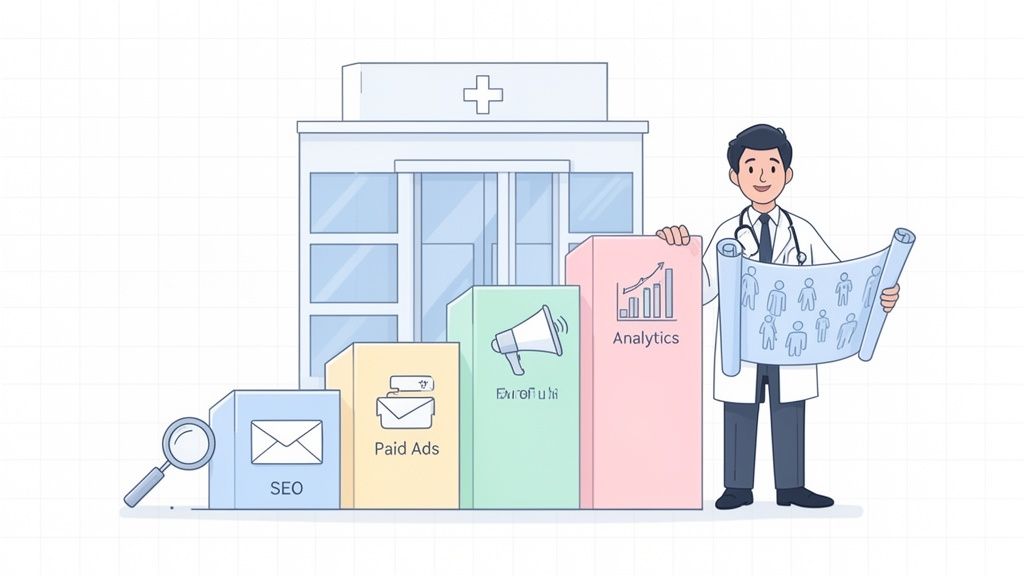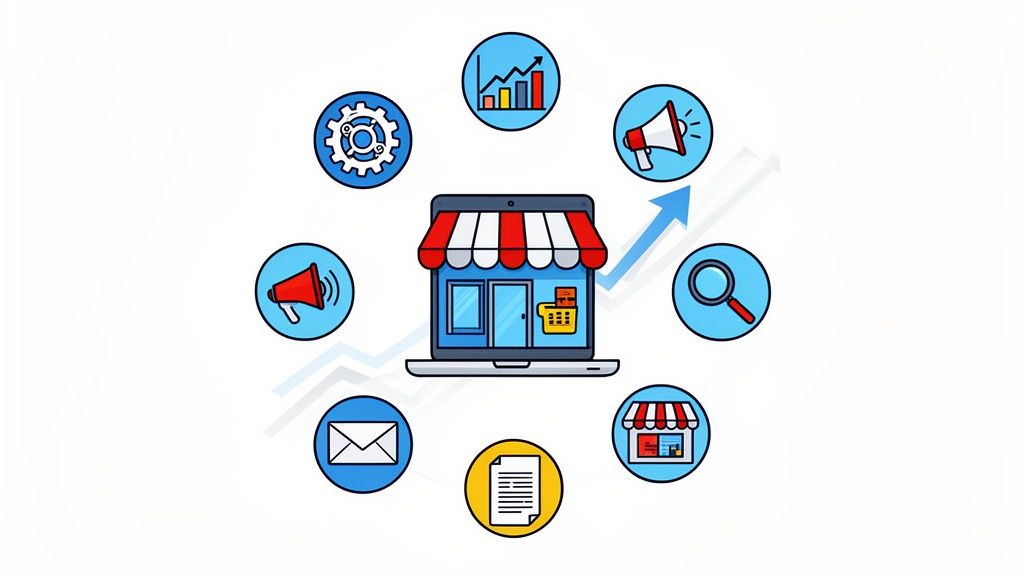
Let's cut through the noise. The real-world benefits of digital transformation boil down to three simple things: more profit, happier customers, and your business running like a well-oiled machine. It's a fundamental shift in how you operate, using technology to become more nimble, competitive, and driven by data, not guesswork.
Beyond Buzzwords: What Digital Transformation Really Means

This isn't just about buying new software or moving your files to the cloud. Real digital transformation means completely rethinking how your business works, how you create value for customers, and how you stay a step ahead of everyone else.
Think of it like swapping an old, crinkled paper map for a live GPS. The paper map works, sure, but it’s static. It can't tell you about a sudden traffic jam, a closed road, or a brilliant shortcut that just opened up. A live GPS, on the other hand, pulls in real-time data to constantly find you the best path. That's the perfect way to think about this—moving from rigid, outdated ways of working to dynamic, intelligent operations that adapt on the fly.
It Starts with a Cultural Shift
At its heart, this change is just as much about people and mindset as it is about technology. It means building a culture that gets excited about data, isn't afraid to experiment, and is willing to challenge the old "this is how we've always done it" attitude.
True transformation happens when technology is woven into every part of the business, connecting departments that rarely used to talk. It’s about tearing down the walls between marketing, sales, customer service, and operations. When every team sees the same customer data, they can finally make smart, coordinated decisions that make the entire customer journey better.
"Digital transformation is a foundational change in how an organization delivers value to its customers." – George Westerman, MIT Sloan
The Real-World Impact
Ultimately, the benefits of digital transformation show up on the bottom line. It’s about more than just looking "modern"; it's about building a business that can weather any storm and stay profitable. The goal is to create an organization that is:
- Agile: You can pivot quickly when the market shifts or when customer demands change.
- Customer-Centric: Your entire focus is on creating smooth, personalized experiences that people love.
- Efficient: Repetitive, soul-crushing tasks get automated, freeing up your team for the creative, strategic work that really matters.
- Data-Driven: Decisions are backed by hard evidence and analytics, not just a gut feeling.
This guide will walk you through these specific advantages, showing exactly how a digital-first approach builds a more competitive and future-proof organization.
Driving Profitability with Data-Driven Decisions

Here's where the rubber meets the road. This is where digital transformation directly beefs up your bottom line by swapping guesswork for genuine strategic insight. Think of it as the difference between feeling your way through a dark maze and having a brightly lit dashboard guiding every turn.
By weaving data into the very fabric of your business, you stop reacting to what the market did and start anticipating what it will do next. This shift from reactive to proactive is the absolute core of driving profitability in the modern world.
Turning Data into Dollars
Imagine you run an e-commerce store. The old way of setting prices was probably based on a simple markup or just copying what your competitors were doing. Not very scientific.
Now, with data, you can implement dynamic pricing algorithms. These tools adjust prices in real-time based on demand, inventory levels, or even the time of day, making sure you get the maximum revenue from every single sale.
This data-first mindset goes way beyond pricing. It’s about knowing exactly which marketing channels give you the highest return, who your most profitable customers are, and where operational clogs are secretly draining your budget. These aren’t just interesting tidbits; they are actionable intelligence that fuels smarter financial moves.
By making data the foundation of your strategy, you de-risk major business bets. Instead of launching a new product based on a hunch, you can analyze market trends and customer behavior to validate your ideas before investing significant capital.
Predictive Analytics: Your Financial Crystal Ball
One of the most powerful tools in your digital arsenal is predictive analytics. It’s where you use historical data and AI to forecast what’s coming down the pike. It’s less of a mystical crystal ball and more of a highly sophisticated weather forecast for your business.
For instance, predictive models can help you:
- Optimize Inventory: See demand spikes coming for specific products. You’ll have enough stock for peak seasons without wasting cash on items that just gather dust.
- Reduce Customer Churn: Pinpoint customers who are at risk of leaving and reach out with targeted offers or support before they walk away.
- Refine Marketing Campaigns: Predict which customer segments will respond best to a new campaign, so you can focus your ad spend where it will have the biggest impact.
The numbers don't lie. A striking 29% of businesses report at least an 11% boost in performance or profits after putting real money into data and analytics. Even better, simply embedding key performance indicators (KPIs) into your daily workflows can increase the chances of a successful transformation by a factor of seven.
Embedding KPIs for Continuous Growth
For data to really work for you, it needs to be part of the daily grind through Key Performance Indicators (KPIs). These aren’t just numbers to glance at in a quarterly meeting; they're the vital signs of your business, guiding real-time decisions. For a deeper dive, our guide on what is marketing intelligence explains how this discipline can directly help your business.
The table below breaks down the concrete financial wins you can expect from a digitally-driven approach.
Key Financial Benefits of Digital Transformation
This table summarizes how adopting digital strategies translates into tangible ROI, improving the core financial metrics that matter most.
| Benefit Area | Key Metric Improved | Average Performance Uplift |
|---|---|---|
| Sales Conversion | Customer Acquisition Cost (CAC) | 15-20% Reduction |
| Marketing ROI | Return on Ad Spend (ROAS) | 25% Increase |
| Operational Costs | Process Automation Rate | 30% Improvement |
| Customer Loyalty | Customer Lifetime Value (CLV) | 18% Growth |
By keeping a close eye on these KPIs, you create a direct, undeniable link between your digital efforts and your financial results. This clarity gives you the hard evidence needed to champion continued investment and prove the journey is paying off.
Enhancing The Customer Experience to Boost Sales

If data builds the financial foundation of your business, then a stellar customer experience is the engine that powers its growth. Today, people expect far more than just a good product. They want seamless, intuitive, and personal interactions at every single touchpoint.
This is where digital transformation really shines. It gives you the power to deliver exactly that, turning casual browsers into loyal brand advocates.
Think about the old customer journey. It was often clunky and disconnected—a phone call here, an in-store visit there, maybe an email that would get answered in a few days. Each interaction was a separate event, with almost no context carried over from one to the next. Digital tools have completely dismantled that fragmented model.
Modern platforms create a single, unified view of each customer. This allows your marketing, sales, and support teams to work from the same playbook, ensuring every conversation feels consistent and personal. It’s the difference between a stranger who keeps reintroducing themselves and a trusted advisor who remembers what you talked about last time.
Building Personal Connections At Scale
At the heart of this upgraded experience are powerful tools like Customer Relationship Management (CRM) systems and marketing automation platforms. A CRM isn't just a digital address book; it's a living record of every single interaction a customer has with your brand.
The real magic happens when you connect that data to marketing automation. You can send personalized product recommendations based on past purchases, offer a timely discount to someone who abandoned their shopping cart, or deliver helpful content that speaks directly to their needs. This level of personalization makes customers feel seen and understood—a massive driver of loyalty.
The impact is backed by hard numbers. Research shows that companies using digital sales strategies see a 20% increase in customer satisfaction and a 15% lift in sales conversion rates. What's more, CRM systems can boost sales team productivity by up to 34% and shorten the sales cycle by 14%.
Tools That Reshape The Customer Journey
Beyond personalization, digital tools make the entire experience smoother for both the customer and your team. This is where you can really pull ahead of the competition.
Consider these key technologies:
- AI-Powered Chatbots: They offer instant, 24/7 support for common questions, freeing up your human agents to tackle more complex issues. Customers get answers right away, without sitting on hold.
- Social Intelligence Tools: These platforms keep an eye on social media for mentions of your brand. You can proactively address customer complaints before they blow up and engage with positive feedback to build your reputation.
- Predictive Analytics: By analyzing browsing behavior and purchase history, you can anticipate what a customer might want next. This is how brands serve up those "you might also like" suggestions that feel incredibly relevant.
By crafting a seamless and responsive customer journey, you aren’t just making people happy—you are directly impacting sales velocity. A great experience removes friction, builds trust, and makes the decision to buy much easier.
From Good Service to Business Growth
Ultimately, every improvement to the customer experience has to tie back to a business outcome. A frictionless journey shortens the sales cycle because customers find what they need, faster. Personalized recommendations increase the average order value. And exceptional support builds the kind of loyalty that turns a one-time purchase into a lifetime of value.
Understanding this journey from your customer's perspective is crucial. If you're looking to map out these interactions, our guide explaining what is customer journey analytics is a great place to start. By optimizing these touchpoints, you build a powerful competitive advantage that is difficult for others to replicate.
Achieving Peak Operational Efficiency with Automation
Now, let's pull back the curtain and look at the engine that drives your business—your internal operations. One of the biggest wins from a digital transformation is how it smooths out the bumps, gets rid of waste, and just unlocks a massive amount of productivity. It’s all about making your entire organization run better, faster, and smarter.
Imagine your supply chain no longer depends on a patchwork of manual spreadsheets. Instead, it runs on real-time data, automatically adjusting to shipping delays. Picture your monthly financial reports generating themselves, accurately and on time, freeing your finance team from the grind of data entry. This isn't some far-off dream; it's what a digitally tuned business looks like today.
Think of automation and artificial intelligence as a powerful force multiplier for your team. They take on the repetitive, rule-based, and often error-prone tasks that eat up so much time and mental energy. This gives your people the space to focus on what they do best: thinking strategically, solving complex problems, and coming up with the next big idea.
The Power of Automated Workflows
At its heart, operational efficiency is about doing more with less—less time, fewer resources, and less manual work. Digital tools are what make this possible. When you connect different systems and automate workflows, you create a seamless flow of information that moves tasks across departments without a hitch.
Take a look at these common business process automation examples:
- Invoice Processing: A system can catch an incoming invoice, match it to the right purchase order, route it for approval, and schedule the payment, all without anyone having to lift a finger.
- Employee Onboarding: The moment an offer letter is signed, all the necessary new-hire paperwork, IT setup requests, and training schedules can be triggered automatically.
- Inventory Management: When stock for a popular product dips below a set level, the system can automatically shoot off a reorder request to the supplier. You can explore more concepts like this in our guide on business process automation examples.
These aren't just time-savers. They drastically cut down on the risk of human error, help with compliance, and give you a crystal-clear view of where your operational bottlenecks are.
The real goal here is to build an agile organization. By using cloud infrastructure and collaborative software, you don’t just cut operational costs; you also gain the ability to pivot faster and smarter in a market that’s always changing.
From Simple Automation to Intelligent Operations
The next evolution of efficiency comes from weaving in AI. Basic automation is great at following a set of pre-programmed rules, but AI can learn, adapt, and make intelligent decisions on its own. This opens up a whole new playbook for optimization. To really hit that peak level of efficiency, smart businesses are also starting to leverage Large Language Models for advanced automation across different departments.
The numbers speak for themselves. Operational efficiency is what 40% of executives point to as the top benefit from their digital projects. Even more telling, a huge 26% of businesses are seeing performance improvements of 11% or more from what they've invested in AI and automation. These stats highlight a major shift in thinking, where employee productivity is now outranking customer experience as the number one goal for many digital leaders.
Key Areas for Efficiency Gains
So, where should you start looking for these benefits? Here are a few high-impact areas where digital tools can make a difference almost immediately.
- Supply Chain Optimization: Use real-time data from sensors and logistics partners to track every shipment, predict delivery times, and get ahead of disruptions before they become problems.
- Financial Operations: Automate everything from expense reports to the financial closing process. This ensures greater accuracy and gets you the reports you need much faster.
- Human Resources: Streamline recruitment, performance management, and payroll with integrated HR platforms that slash the administrative workload.
- IT Operations: Put automated monitoring and self-healing systems in place that can spot and fix IT issues, often before anyone in the business even notices.
When you target these core functions, you create a ripple effect of efficiency that spreads across the entire company, building a business that's stronger, more resilient, and ultimately more profitable.
How to Measure the Success of Your Digital Journey
Putting new technology in place is only half the battle. The real win comes from proving it actually works. A successful digital journey needs a clear, practical playbook for measuring what truly matters—and that means moving beyond vague feelings of progress. You need to define specific Key Performance Indicators (KPIs) that tie your digital projects directly to tangible business outcomes.
Without measurement, your transformation is just a collection of expensive experiments with no clear return. By setting up the right metrics from the start, you build a framework to demonstrate real ROI, gain unstoppable momentum, and make smart, data-driven adjustments along the way.
Think of it like building a house. The real value isn't just in the individual bricks and boards; it's in the strong, efficient structure they create.

As you can see, true operational excellence isn't just one thing. It’s the result of systematically automating processes and building a more responsive, agile organization from the ground up.
Adopting a Balanced Scorecard Approach
A common mistake is getting fixated only on financial metrics. While numbers like revenue and cost savings are obviously critical, they don't tell the whole story. A balanced scorecard approach gives you a much more complete picture by tracking performance across four key areas.
- Financial Perspective: Are your digital efforts actually improving the bottom line?
- Customer Perspective: Are customers happier and more loyal because of these changes?
- Internal Process Perspective: Are your internal operations running faster and smoother?
- Learning & Growth Perspective: Is your team becoming more skilled, adaptable, and innovative?
By keeping an eye on metrics in each of these categories, you can capture the full value of your investment. You’ll see everything from hard financial gains to the softer—but equally important—improvements in customer satisfaction and team agility.
Key KPIs for Every Business Function
The right KPIs will always depend on your specific goals and business model, but certain metrics are universally helpful for tracking digital progress. The key is to connect technology adoption directly to business results across marketing, sales, and operations.
Think of it this way: launching a new CRM is a project milestone. Seeing a 15% increase in your sales team's close rate is a business outcome. Your measurement strategy has to be laser-focused on the latter.
The goal is to create an undeniable link between action and result. When you can show that implementing a new automation tool led directly to a 20% reduction in process cycle time, you build a powerful case for further investment.
The table below breaks down some practical KPIs you can use to track the success of your digital initiatives across different departments.
Digital Transformation KPIs by Business Function
This table offers a practical guide to key performance indicators that businesses can use to track the success and ROI of their digital transformation efforts across various departments.
| Business Function | Primary KPI | What It Measures |
|---|---|---|
| Marketing | Customer Lifetime Value (CLV) | The total revenue a business can expect from a single customer account, indicating loyalty and satisfaction. |
| Sales | Sales Cycle Length | The time it takes to close a deal, measuring the efficiency and effectiveness of the sales process. |
| Operations | Employee Productivity Rate | The output per employee over a specific period, reflecting the impact of automation and streamlined workflows. |
| IT | IT Cost Savings | The reduction in technology-related expenses achieved through cloud migration, automation, or optimized systems. |
By tracking these specific metrics, you move from hoping your digital strategy is working to knowing it is. This data-driven clarity is what allows you to make informed decisions, secure buy-in from leadership, and steer your transformation toward continued success.
Charting Your Transformation Path Forward
Knowing the benefits is one thing, but actually doing something is what separates the market leaders from everyone else. This is where we get into the practical side of things—a clear, actionable roadmap to kick off or speed up your digital journey. Think of this not as a rigid, one-size-fits-all plan, but as a flexible framework to help you build real momentum and move forward with confidence.
The journey doesn’t start with a massive tech overhaul. It starts with a simple, honest look at where you stand today. Before you can map out a course, you have to know your starting point.
Conduct a Digital Maturity Audit
First things first, you need to evaluate your current capabilities. A digital maturity audit is your way of benchmarking your processes, skills, and technology against what’s happening in your industry and what your direct competitors are doing. This isn’t some complex technical exercise; it's a strategic look at how ready your business really is for change.
Start asking some critical questions across your key business areas:
- Customer Engagement: How well do you really know your customer’s journey? Are your interactions personalized and consistent, no matter how they connect with you?
- Operational Processes: Where are your biggest manual headaches? Which repetitive tasks are eating up your team's valuable time?
- Data & Analytics: Is your data easy to get to, or is it locked away in a dozen different systems? Are you making decisions based on solid insights or just going with your gut?
- Company Culture: Is your team actually open to change? Do they have the right skills to pick up new tools and adjust their workflows?
Answering these questions gives you a clear-eyed view of your strengths and, more importantly, where your biggest opportunities for a quick win are hiding.
Identify a High-Impact Pilot Project
Instead of trying to boil the ocean with a massive, company-wide initiative, pick one high-impact pilot project. Your goal is to score a quick win that proves the value of this whole effort and builds momentum. A successful pilot project is the best proof of concept you can have, making it much easier to get buy-in for bigger changes down the road.
A great pilot project is one that’s visible, solves a well-known pain point, and can deliver measurable results within 90 to 120 days. This creates a story of success that inspires confidence across the organization.
For example, maybe you could automate the invoice approval process in your finance department. Or you could implement a simple CRM to give your sales team one single view of every customer interaction. Small businesses can find more specific ideas in our article on digital transformation for small business. The key is to pick something that's manageable in scope but will make a meaningful difference.
Secure Leadership Buy-In and Build Culture
Finally, no transformation project ever succeeds without strong support from the top and a culture that’s willing to embrace change. When you talk to leadership, frame your initiative around business outcomes, not technology. Don’t talk about implementing "cloud infrastructure"; talk about "cutting IT operational costs by 15% and boosting system uptime."
This focus on results is what gets executives on board. But just as important is getting your team ready for the changes. You need to create an environment where people feel safe to experiment, and where failure is seen as a learning opportunity, not a career-ender. Offer training, be transparent about the goals, and make sure to celebrate the small victories along the way. Your people are your greatest asset on this journey; empowering them is the only way to make success stick.
A Few Common Questions About Digital Transformation
Diving into a major business shift always brings up a lot of questions. Let's tackle some of the most common ones we hear to clear up any confusion and give you a better feel for the journey ahead.
Where Do I Even Start?
The first real step isn't about buying new software or hiring a consultant. It's about taking an honest look at where you are right now. Before you do anything else, you need to conduct a digital maturity audit. This is just a way of benchmarking your current processes, your team's skills, and the technology you're already using against what the best in your industry are doing.
This audit will immediately shine a light on your biggest weaknesses. More importantly, it will show you where the biggest opportunities are for a quick, impactful win. It’s about asking tough questions: Where are our operational bottlenecks? How are we really engaging with customers? Is the team ready for this kind of change? Without this baseline, you're just guessing, and that’s a recipe for wasting time and money.
How Long Is This Going to Take?
I'll be blunt: there's no finish line. Digital transformation isn't a project you complete and then check off a list; it's a permanent shift in how you operate and evolve. But that doesn't mean you have to wait years to see results. The trick is to start small.
Pick a high-impact pilot project that you can knock out in just three or four months. This could be anything from automating a tedious financial report to launching a simple customer feedback tool. The goal is to get a measurable win on the board quickly. This approach proves the concept, builds momentum, and gets everyone excited and bought-in for the bigger initiatives to come.
Isn't This Just for Big Corporations?
Not at all. While massive enterprises get a lot of attention for their huge digital projects, you could argue that these changes are even more crucial for small and medium-sized businesses (SMBs). Why? Because SMBs are nimble. They can adopt new tools and pivot their strategy much faster than a corporate giant tangled in bureaucracy.
For a smaller business, automating just one key process can free up a huge chunk of an employee’s time, letting them focus on work that actually grows the business. A simple CRM can completely change the game for customer relationships and sales. Digital tools are the ultimate leveler, allowing smaller players to compete on the quality of their experience and their efficiency, not just on their size.
At the end of the day, the single greatest benefit for any business, regardless of size, is the power to make smarter decisions, faster. When you weave data into the fabric of your daily operations, you stop guessing and start knowing. That insight is the real competitive advantage in any market.
Ready to figure out what your own transformation path looks like? At Magic Logix, we blend data-driven strategy with the right technology to create real, measurable business growth. See what our digital solutions can do for you.