
A working B2B social media strategy is a six-step program: set business outcomes, map your audience, pick the right channels, build content around funnel stages, measure what actually moves pipeline, and govern the whole thing so it doesn’t collapse under legal review. That’s the whole framework. Everything else is execution detail.
Here’s where to start this week:
- Agree on one measurable pipeline goal (not “increase engagement”)
- Define your ideal customer profile with your sales team, not alone
- Set UTM standards before you publish a single post
- Pick two platforms max for your 90-day pilot
- Add a “How did you hear about us?” field to every lead form
Pro Tip: Run a 90-day pilot before committing budget for a full year. You’ll learn more from 90 days of disciplined tracking than from 12 months of posting on instinct.
Key Takeaways
A B2B social media strategy succeeds when it maps content to funnel stages, activates employees as a distribution channel, and measures influenced pipeline instead of vanity engagement.
| Point | Details |
|---|---|
| Start with a 90-day pilot | Set one measurable pipeline goal before committing to a year-long program. |
| Prioritize LinkedIn first | LinkedIn delivers the strongest organic B2B results; add video platforms based on buyer behavior. |
| Map every asset to a funnel stage | TOFU, MOFU, and BOFU content each need a distinct format and call to action. |
| Measure influence, not last-click | Combine CRM data, UTMs, and self-reported attribution fields to capture dark social. |
| Magiclogix builds the full program | Magiclogix designs strategy, content, advocacy programs, and CRM-integrated measurement for B2B teams. |
Table of Contents
- What Makes a B2B Social Media Strategy Different From B2C?
- A Practical 6-Step Framework for B2B Social Media Strategy
- Which Platforms Should You Prioritize for B2B?
- How Do You Build a 90-Day B2B Content Calendar?
- Which Tactics Actually Generate B2B Leads?
- How Do You Measure and Report B2B Social Media ROI?
- Who Should Own B2B Social Media Governance?
- What Tools Support a B2B Social Media Tech Stack?
- What Do Real B2B Social Programs Actually Show?
- How Do Data Privacy Laws Affect Your Social Media Marketing?
- What I’d Prioritize If I Were Starting Today
- How Magiclogix Helps You Build and Measure Social Programs That Work
- Sources
- FAQ
What Makes a B2B Social Media Strategy Different From B2C?
B2B social media works because it builds trust and shapes shortlist formation long before a prospect ever talks to sales. It doesn’t drive impulse buys. A $50,000 software decision doesn’t happen because someone saw a clever meme on Tuesday. It happens because your brand kept showing up credibly for six months while three stakeholders quietly built consensus.
That timeline matters more than most marketing teams admit. Research from Oktopost found that the vast majority of B2B purchases go to a vendor that was already on the buyer’s shortlist on day one. Social content doesn’t close that final deal. It earns the invitation to bid in the first place.
The structural differences show up everywhere in how you plan:
- Buying cycle: B2C is often days; B2B routinely runs three to nine months with multiple committee reviews
- Decision makers: B2C targets one buyer; B2B typically involves five to eleven stakeholders across departments
- Content tone: B2C leans emotional and aspirational; B2B needs credibility, data, and risk reduction
- KPIs: B2C chases direct conversions; B2B tracks influenced pipeline and shortlist presence
Channel concentration also looks different. LinkedIn dominates most B2B programs, but your specific channel mix should follow where your buyers actually spend time, not a generic playbook, according to Gartner’s guidance for software marketers.
A Practical 6-Step Framework for B2B Social Media Strategy
Building a b2b social media strategy that survives contact with a CFO’s budget review requires six sequential steps. Skip one and the whole thing wobbles.
1. Set business outcomes first
Before you touch a content calendar, decide what social is supposed to do for revenue. Vague goals like “grow our following” don’t survive a quarterly business review. Tie every objective to a funnel stage:
- TOFU target example: 15% lift in branded search volume over 90 days
- MOFU target example: 25 demo requests attributed to social touches per quarter
- BOFU target example: $200,000 in influenced pipeline from social-sourced accounts
2. Map your audience and buyer journey
You need a real ideal customer profile, not a persona slide nobody references again. Work with sales to identify the actual titles, functions, and pain points showing up in your closed-won deals. Our B2B marketing segmentation guide walks through building this without guesswork.
3. Select channels based on evidence
Choose platforms your buyers actually use, not the ones your team enjoys posting on. More on this in the next section.
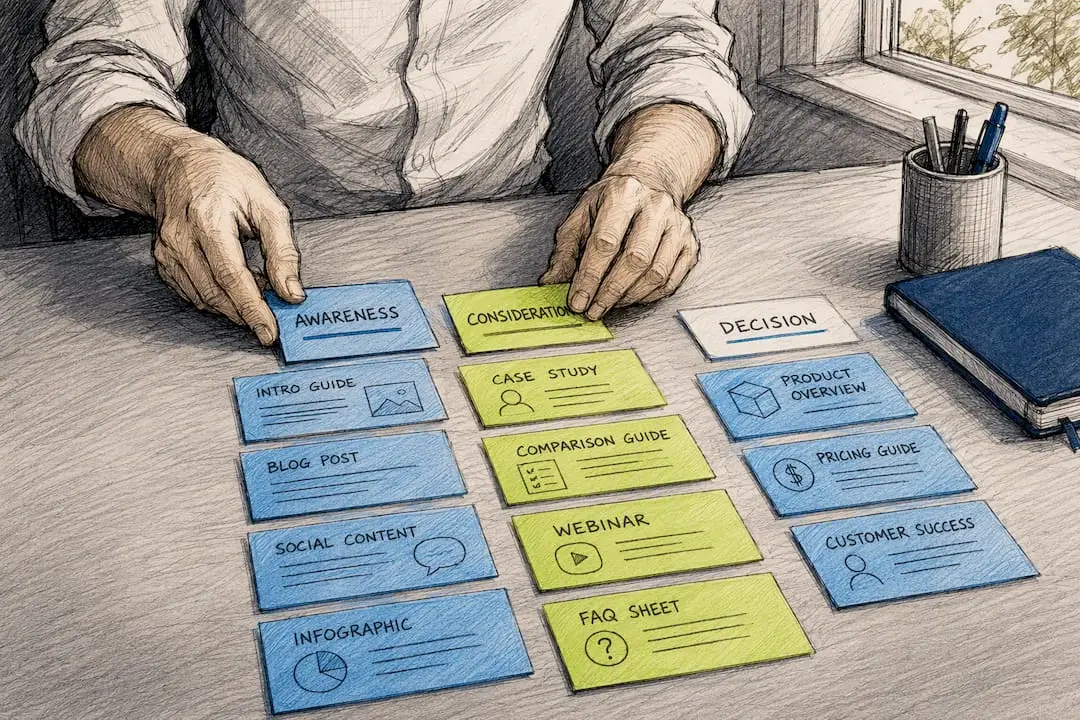
4. Design content mapped to funnel stages
Every piece of content should have a job: awareness, consideration, or decision support. Content with no funnel assignment is just noise with a nice graphic.
5. Measure and attribute properly
Track influenced pipeline, not vanity metrics. Directive’s guidance on B2B SaaS measurement recommends combining CRM data, consistent UTMs, and self-reported attribution fields to capture the full picture.
6. Build governance and operating rhythm
Someone owns approvals. Someone owns the calendar. Someone owns the crisis plan. Without this, your program either moves too slowly or moves fast and breaks something.
Your 90-day pilot
Don’t launch a full-scale program on day one. Run a pilot instead:
- Goal: Generate 15 to 20 marketing-qualified leads attributable to social within 90 days
- Success criteria: At least 5% of pipeline touches include a social interaction logged in CRM
- Resourcing sketch: One part-time content owner (10 to 15 hours weekly), one social manager, a modest ad budget for amplification testing, and 8 to 12 pieces of content monthly
Connecting posts to your CRM
This is where most B2B programs quietly fail. Standardize UTM naming conventions before your first post goes live, not three months in when you’re trying to reconcile a mess of inconsistent tags. Add a “How did you hear about us?” field to every demo and contact form. That single field recovers a surprising share of what’s called dark social, the influence that never shows up in a last-click report because someone screenshotted your post and sent it to a colleague on Slack. Most B2B marketers undercount social’s actual influence because they rely on platform-native analytics instead of CRM data, which is exactly why standardized tagging and self-reported fields matter so much.
Which Platforms Should You Prioritize for B2B?
Start with LinkedIn. For most B2B programs, it’s not a close call. Statista’s platform rankings consistently show it as the top-rated network for B2B marketers, and recent industry data from SAGE Marketing’s State of B2B Social Media report confirms LinkedIn has consolidated its lead for organic B2B results. Add video platforms when your buyers actually consume video content or when you have the capacity to produce it consistently.
- LinkedIn: Best for thought leadership, employee advocacy, and executive visibility. Supports long-form posts, short video, live events, and document carousels. Requires moderate resourcing but delivers the strongest organic reach for most B2B categories.
- YouTube: Best for demos, tutorials, and search-driven discovery. Long-form video is a heavy production lift but compounds in search value over years.
- Instagram: Useful for employer branding and culture content that supports recruiting and trust building. Lower priority for direct lead generation.
- Facebook: Mostly relevant for community groups or paid retargeting; organic reach has declined for B2B pages specifically.
- TikTok: Worth testing if your buyers skew younger or your category benefits from behind-the-scenes, low-polish video. Requires a fast, informal content style most enterprise teams aren’t structured to produce.
Pro Tip: Don’t spread thin across five platforms with a two-person team. Master LinkedIn and one video channel before adding anything else.
Larger organizations managing multiple brands or global teams often lean on platform-management software like Sprout Social or Sprinklr to handle publishing, listening, and approval workflows at scale, with Salesforce integration tying social activity back to the CRM record. These are useful examples of what enterprise tooling looks like, not a requirement for smaller teams starting out.
How Do You Build a 90-Day B2B Content Calendar?
Content that isn’t mapped to a funnel stage is just activity. Every asset needs a stage, a format, and a call to action before it goes on the calendar.
| Funnel Stage | Content Formats | Example Assets |
|---|---|---|
| TOFU (awareness) | Carousels, short-form video, industry commentary | “5 trends reshaping [industry]” carousel, quick-take video reactions |
| MOFU (consideration) | Webinars, case studies, comparison guides | Recorded webinar clips, customer results breakdowns |
| BOFU (decision) | Product demos, customer stories, ROI calculators | Demo walkthrough video, named customer success story |
A 90-day cadence built around this matrix looks like a steady rhythm, not a scramble:
- Weeks 1 to 2: Publish 3 to 4 TOFU posts weekly while producing your first flagship MOFU asset (a webinar or original research piece)
- Weeks 3 to 6: Launch the webinar, then repurpose it into 6 to 8 short clips, 2 carousels, and an email sequence
- Weeks 7 to 10: Introduce BOFU content tied to a specific product launch or customer win; test paid amplification on your top-performing organic post
- Weeks 11 to 13: Review performance, double down on formats that drove demo requests, retire what didn’t
Repurposing is where lean teams punch above their weight. One webinar becomes clips, carousels, a blog post, and an email nurture sequence. Our long-form content guide covers how to structure source material so it splits cleanly into distribution-ready pieces. Distribution should flow in sequence: organic post first, employee advocacy amplification second, paid boost third on whatever proves itself organically.
Which Tactics Actually Generate B2B Leads?
Ranked by typical impact for the effort required, these tactics move pipeline faster than generic posting:
- Employee advocacy — Your people’s networks dwarf your company page’s reach. Recruit 10 to 15 employees, provide pre-written post options, and let them personalize before sharing.
- KOL and business influencer partnerships — Industry voices lend credibility your brand account can’t manufacture alone. Our influencer campaign examples show how B2B brands structure these partnerships.
- ABM-aligned social targeting — Sync your named-account list with LinkedIn’s matched audiences so target accounts see relevant content repeatedly.
- Repurposing top organic posts into ads — Your best-performing organic content already proved itself; paid amplification just extends its reach to a colder audience.
- Gated webinars — Still one of the most reliable MOFU-to-BOFU converters when the topic solves a specific, named problem.
For each tactic, execution details matter more than the idea itself:
- Employee advocacy needs a content owner curating shareable posts weekly, not employees guessing what to post
- KOL partnerships work best with a clear content brief and a 60 to 90-day cadence, not one-off collaborations
- ABM alignment requires your sales and marketing teams sharing the same account list, updated monthly
Expect lead quality signals to show up before volume does: watch for increased demo requests from named target accounts and shorter time-to-opportunity on social-sourced leads.
Pro Tip: Your executives are an underused distribution channel. A CEO’s post about a customer win often reaches further organically than the same post from your brand account.
How Do You Measure and Report B2B Social Media ROI?
Measure social as an influence channel, not a last-click conversion source. If you’re only counting direct conversions from social, you’re missing most of its actual contribution to pipeline.
| Funnel Stage | Primary Metrics |
|---|---|
| Awareness (TOFU) | Impressions, branded search lift, follower growth quality |
| Consideration (MOFU) | Content downloads, webinar registrations, demo requests from social |
| Decision (BOFU) | Pipeline influence, deal velocity on social-touched accounts, closed-won revenue with social touchpoints |
Attribution modeling should evolve as your CRM data matures:
- Start with linear attribution, crediting every touch equally, while your CRM touch logging is still basic
- Graduate to position-based attribution once you can reliably track first and last social touches
- Add self-reported attribution fields on forms to catch what tracking pixels miss entirely
A workable reporting cadence keeps stakeholders informed without drowning your team in dashboard maintenance:
- Weekly: Quick engagement and content performance signals for the internal team
- Monthly: KPI trend review against your funnel-stage targets
- Quarterly: Full influenced-pipeline and ROI presentation for leadership
Most teams struggle here not because the metrics are hard to define, but because integrating social data into revenue reporting is a genuine data infrastructure problem. Solving it usually justifies shifting some budget from paid channels toward the owned and earned programs proving their worth in CRM. Our guide to proving digital marketing ROI covers the reporting infrastructure this requires in more depth.
Who Should Own B2B Social Media Governance?
A small cross-functional core team runs the program day to day: a content owner, a social manager, a demand gen liaison who watches pipeline impact, and a legal contact for review. Everyone else, subject matter experts and executives, contributes content without owning the calendar.
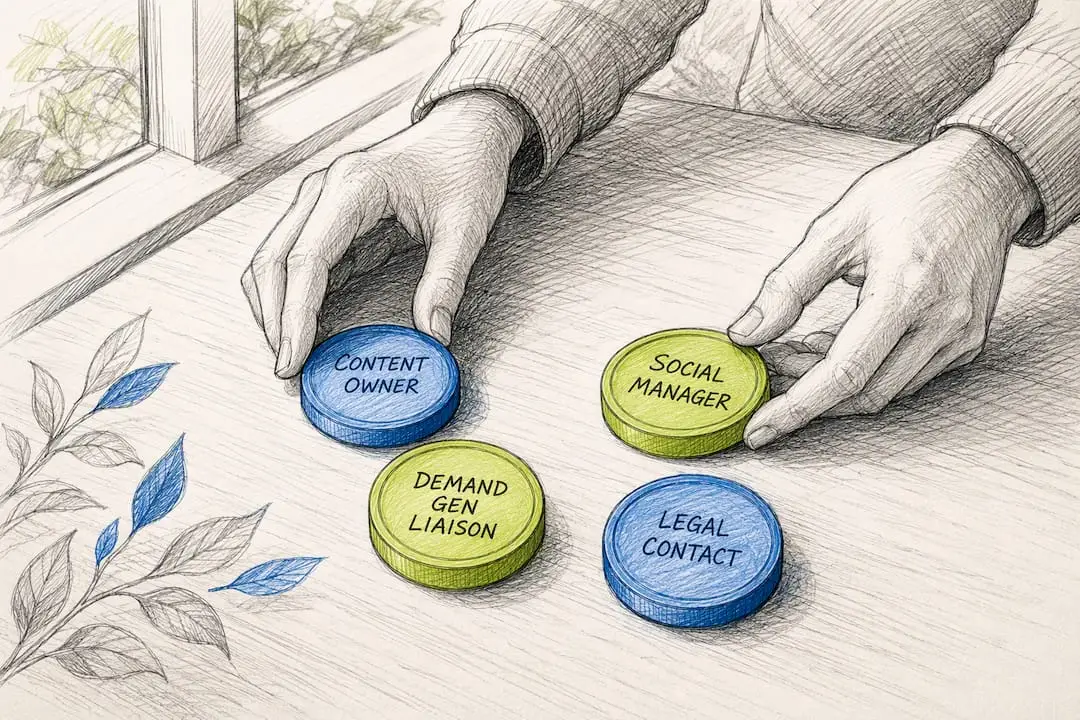
Time commitment varies sharply by role. The content owner and social manager need meaningful weekly hours; the legal contact and demand gen liaison typically need only a few hours monthly for review and reporting sync.
Approval workflows should scale with risk:
- TOFU commentary and curated content need minimal gating, maybe a quick peer review
- Case studies, customer quotes, and any claims involving data or results need legal and customer approval before publishing
- Crisis-adjacent topics need executive sign-off, no exceptions
For reputation issues, designate one person who owns the first alert and a simple 24-hour checklist: pause scheduled posts, assess the situation internally, draft a response with legal input, and respond only once leadership has reviewed the language.
Pro Tip: Write your crisis checklist before you need it. Teams that improvise a response during an actual incident almost always make it worse.
What Tools Support a B2B Social Media Tech Stack?
Five tool categories cover most of what a B2B social program needs: content calendar and publishing, social listening, employee advocacy, analytics and attribution, and CRM integration.
- Publishing and listening: Platforms like Sprout Social and Sprinklr handle scheduling, approval workflows, and monitoring conversations about your brand and competitors across networks
- Employee advocacy: Dedicated advocacy platforms make it easy for employees to share pre-approved content with one click, tracking reach that would otherwise go completely unmeasured
- Analytics and attribution: Tools that integrate directly with Salesforce or your CRM of choice let you connect social touches to actual pipeline records instead of guessing
- CRM integration priority: Whatever stack you choose, prioritize the CRM connection first. A beautifully designed dashboard that can’t tie back to Salesforce won’t survive a budget conversation.
A platform like Baby Love Growth’s content strategy tool can also help teams plan topics using data rather than gut instinct, which pairs well with the funnel-mapping work covered earlier.
What Do Real B2B Social Programs Actually Show?
Two patterns show up repeatedly in agency-managed B2B social programs. One consumer software client saw demo requests from LinkedIn nearly double within a single quarter after shifting budget from brand-account posting to a structured employee advocacy program involving 12 employees. A manufacturing client’s short-form video pilot, built from repurposed trade show footage, generated more qualified inbound conversations in six weeks than the prior year’s entire organic posting history.
What separates programs that work from ones that stall:
- Do train employees on messaging before asking them to post; don’t just forward links and hope
- Do keep a human editing pass on AI-drafted content; don’t publish AI output unedited, since Hootsuite’s research notes buyers increasingly use AI tools during research themselves, which makes original data and named authorship matter more, not less
- Don’t scale advocacy programs past what your content pipeline can actually feed; an advocacy program with nothing fresh to share dies within weeks
The teams winning right now made their people the channel, not just the distribution mechanism. Company pages amplify; employees actually get read.
How Do Data Privacy Laws Affect Your Social Media Marketing?
Compliance isn’t optional overhead you bolt on later. It shapes what data you can collect from social campaigns and how you can use it from day one. Regulations like the California Consumer Privacy Act and Europe’s GDPR govern how you handle any personal data captured through social lead forms, retargeting pixels, and CRM syncs, and the rules differ meaningfully depending on where your prospects are located.
Practical compliance starts with a few non-negotiables. Get explicit consent before adding social lead form submissions to email nurture sequences. Document what data you collect through tracking pixels and how long you retain it. Give prospects a clear way to request deletion of their data, and actually honor those requests within the timeline your jurisdiction requires.
Platform-specific rules add another layer. LinkedIn’s Lead Gen Forms and Facebook’s Custom Audiences both come with their own data handling terms that your legal contact should review before campaigns launch, not after. If your company operates in multiple regions, build your consent language and data retention policy around the strictest applicable standard rather than maintaining separate systems for each jurisdiction.
This is exactly why the governance section above matters. A legal contact reviewing campaigns before launch catches compliance gaps a marketing team focused on engagement metrics will likely miss. Treat privacy review as a standard step in your approval workflow, not a separate project that happens once a year when someone gets nervous.
What I’d Prioritize If I Were Starting Today
If I were advising a marketing leader starting from zero, I’d tell them to ignore the platform hype cycle entirely and prove pipeline influence on one channel before expanding anywhere else. Most teams try to do LinkedIn, YouTube, and TikTok simultaneously with two people and wonder why nothing gains traction. Depth beats breadth here, every time.
For the first 90 days:
- Pick LinkedIn and one supporting format (usually short-form video)
- Recruit 10 employees for advocacy before you spend a dollar on paid amplification
- Track every lead back to CRM from day one, even if the tagging feels tedious
Prove the model works at small scale. Then, and only then, scale distribution and advocacy together.
How Magiclogix Helps You Build and Measure Social Programs That Work
Magiclogix is the alternative to building this entire framework from scratch with a stretched internal team. We handle the pieces most B2B marketing departments don’t have bandwidth for: strategy design tied to your actual pipeline goals, content production mapped to funnel stages, employee advocacy program setup, and CRM-integrated measurement that shows leadership exactly what social contributed to closed revenue.
We’ve built these programs across industries ranging from small businesses to enterprise brands, which means we’ve already solved the attribution and governance problems that trip up most teams in month three. If you’re ready to move past posting on instinct and into a program with real measurement behind it, our digital marketing for business growth page outlines how we structure engagements, including the 90-day pilot approach covered throughout this guide. Reach out and we’ll map what a pilot would look like for your specific pipeline goals.
Sources
The following sources support the statistics, platform guidance, and measurement approaches referenced throughout this guide:
- B2B social media statistics (2026) | Oktopost
- The State of B2B Social Media (2026 Report) — SAGE Marketing
- How to Measure Social Media ROI for B2B SaaS – Directive
- Gartner — B2B social media channels for software marketers
FAQ
How Do You Create a B2B Social Media Strategy?
Start by setting a measurable business outcome tied to a funnel stage, then map your audience, select platforms based on where buyers actually spend time, build content for each funnel stage, and set up CRM-linked measurement before you publish your first post.
What Is B2B Social Media?
B2B social media is the use of platforms like LinkedIn, YouTube, and Instagram to build trust, shape shortlist formation, and support multi-stakeholder buying decisions, rather than drive the immediate purchases typical of B2C social marketing.
How Long Does It Take to See Results From a B2B Social Strategy?
Most programs need a 90-day pilot to generate reliable signals, since B2B sales cycles often run three to nine months and social’s main job early on is shaping shortlist consideration, not closing deals directly.
Which Platform Should B2B Companies Prioritize First?
LinkedIn should be the starting point for most B2B programs, given its consistent lead in organic B2B results, with video platforms added based on whether your buyers actually consume video content.
How Do You Measure ROI From B2B Social Media?
Track influenced pipeline and attributed revenue through CRM integration, standardized UTM tagging, and self-reported attribution fields, rather than relying solely on last-click conversion data from platform analytics.