
Digital transformation in marketing is the deliberate reconfiguration of data, martech, and operating processes so marketing consistently delivers measurable customer and revenue outcomes. It is not a rebrand or a new app. If you want a first move, start by unifying your customer data or piloting one high-impact use case, like an automated personalization flow, and make sure someone at the executive level is sponsoring it.
TL;DR:
- Building a customer data platform and piloting real-time personalization use cases are key early steps to enable meaningful digital transformation.
- Marketers should focus on unifying data, modernizing martech stacks, and establishing AI governance to maximize long-term value.
- Conducting thorough audits, setting clear success metrics, and starting with small, measurable pilots help avoid overpromising and stalled initiatives.
- Success depends on organizational culture that encourages data sharing, curiosity, and collaboration across functions rather than on technology alone.
- Aligning marketing digital initiatives with broader enterprise systems and complying with data privacy regulations are critical for sustainable transformation.
Table of Contents
- What digital transformation in marketing actually means
- Core capabilities to prioritize: data, martech, AI, and personalization
- The business case: what to expect and when
- A prioritized step-by-step strategy to get started
- How to measure success and prove marketing’s impact
- People, process, and governance: making transformation stick
- Common challenges and how to overcome them
- Case studies and examples worth studying
- Why organizational culture decides whether this works
- Fitting marketing transformation into the wider business transformation
- Privacy regulation and data ethics are now part of the strategy
- How Magic Logix approaches this playbook with clients
- Where Magic Logix fits into your transformation
- Sources
- FAQ
What digital transformation in marketing actually means
Think of digital transformation as rewiring how marketing works, not just what marketing buys. It connects three things: the data you collect about customers, the martech tools you use to act on that data, and the workflows your team follows every day. When those three pieces work together, marketing can respond to a customer in real time instead of guessing what they want next quarter.
Not every tech purchase counts as transformation. A new social scheduling tool is a tactic. A unified view of the customer that feeds personalization, orchestration, and reporting across channels is transformation.
Initiatives that count:
- Building a customer data platform (CDP) that unifies profiles across channels.
- Automating personalized journeys triggered by real behavior.
- Consolidating fragmented martech into a connected, API-first stack.
- Using AI to generate or optimize content and campaign decisions at scale.
What does not count: swapping one email tool for another without changing the data or process behind it. Real transformation is ongoing modernization, closer to maintaining a house than renovating it once and walking away.
Core capabilities to prioritize: data, martech, AI, and personalization
Not every capability deserves the same budget or urgency. Four areas tend to produce the most value, in roughly this order.
Customer data foundations. A CDP is only useful if it handles the full loop: collection, unification across sources, segmentation, activation into channels, and privacy controls baked in from the start. Gartner’s CDP capability frameworks list over a dozen criteria worth checking before you buy, so treat vendor demos as a checklist exercise, not a sales pitch.
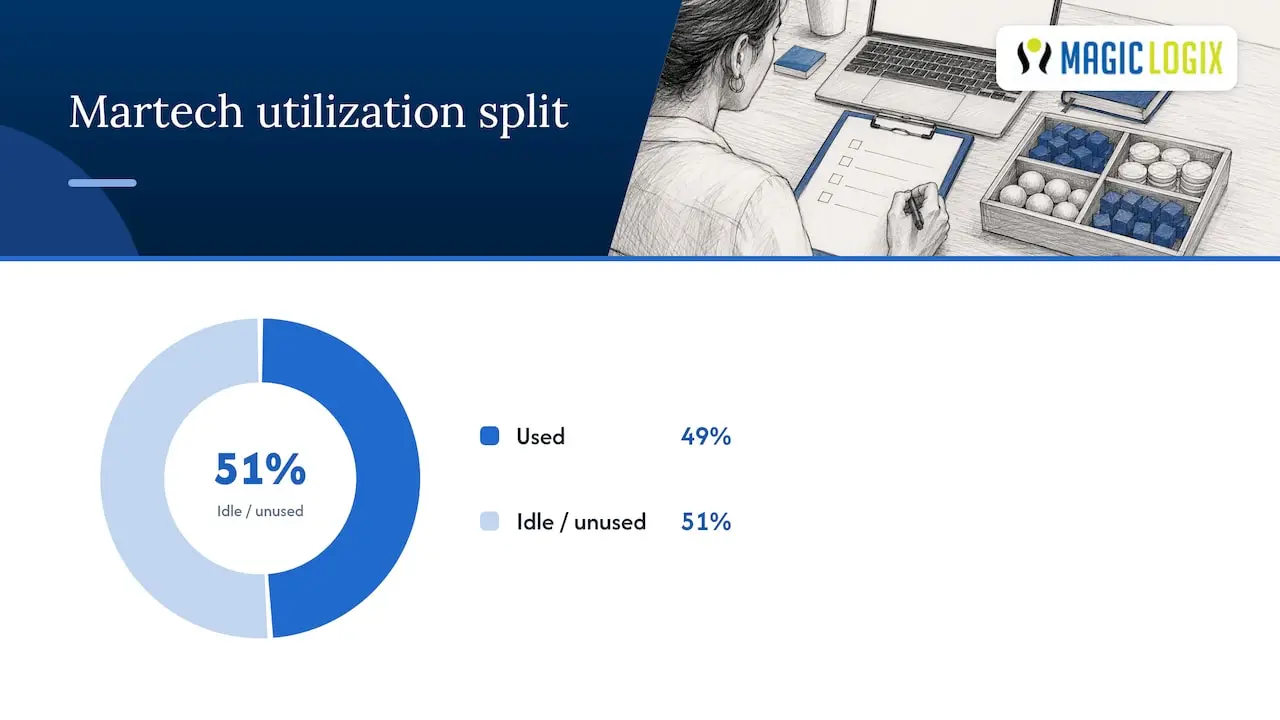
Martech modernization. Gartner’s research found martech utilization has dropped to about 49%, meaning half the tools companies already own sit idle. The fix is composable, API-first architecture and a stack audit that cuts overlap before adding anything new.
AI use and guardrails. AI can generate content and power decisioning engines at a pace no human team can match, but McKinsey’s research on personalization stresses that scaling generative AI requires governance and content validation to catch bias, factual errors, and brand drift before they reach customers.
Orchestration and activation. A campaign hub that triggers in real time based on customer behavior beats a calendar of scheduled sends every time.
- Audit your CDP against collection, unification, segmentation, activation, and privacy criteria.
- Map every martech tool to a specific job it does; cut anything duplicated.
- Set a validation step for AI-generated content before it ships.
- Choose one orchestration use case with a clear real-time trigger.
Pro Tip: Before adding a new AI tool, ask what workflow it replaces. If the answer is “none yet,” you are buying a pilot, not a capability.
The business case: what to expect and when
Marketing leaders often ask for transformation budget with vague promises of “better engagement.” That does not survive a finance review. The stronger case ties specific levers to specific numbers.
The main value drivers are conversion lift from personalization, higher customer lifetime value (CLV), operational efficiency from automation, and faster campaign turnaround. McKinsey’s guidance on CMO and C-suite alignment recommends framing marketing as a growth investment with clear short and long-term measurement tied to revenue and CLV, which is exactly the language a CFO expects.
Martech utilization sits near 49% across surveyed organizations, according to Gartner’s research, which means the fastest ROI often comes from using what you already own before buying anything new.
Before piloting anything, set a conservative baseline: current conversion rate, current cost per acquisition, current campaign lead time. Compare against that, not against a hoped-for best case.
- Baseline your current metrics before launching a pilot.
- Attach every AI initiative to one measurable outcome, not a general efficiency claim.
- Expect incremental gains first; transformation compounds over quarters, not weeks.
The biggest overpromise in this space is treating AI as a fix for a broken process. AI speeds up what you already do well and exposes what you do poorly faster.
A prioritized step-by-step strategy to get started
Trying to transform everything at once is how most initiatives stall. A staged approach, borrowed from practitioner guidance on overcoming digital transformation barriers, works better because it builds credibility with small wins before asking for bigger budget.
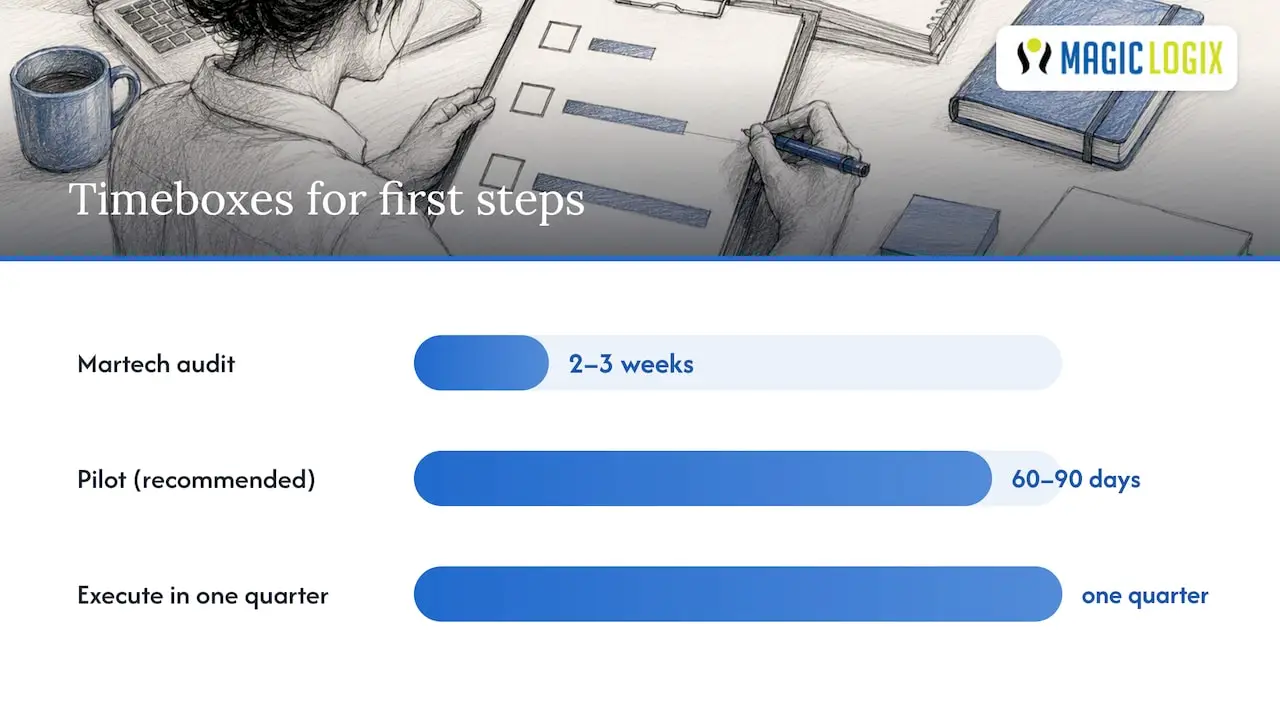
- Run a martech audit. Timebox it to two or three weeks. List every tool, who owns it, what it costs, and what it actually does. The output should surface obvious overlap and at least one quick win.
- Select use cases using the four S’s. Choose initiatives that are supportive of a clear business goal, selective rather than sprawling, simple enough to execute in one quarter, and specific enough to measure.
- Build the data and governance foundation. This means a working CDP, documented consent management, and a data model that other teams can actually query.
- Design a timeboxed pilot. Set success metrics before launch, not after. A 60 to 90 day pilot with a defined kill criterion beats an open-ended “let’s see how it goes” project.
- Operationalize what works. Turn the pilot into a templated workflow with clear ownership, a governance checkpoint, and a written runbook so it survives staff turnover.
Our internal guide to change management in digital transformation walks through how to sequence this without stalling day-to-day campaign work.
Pro Tip: Pick your first pilot based on data readiness, not ambition. The best-looking idea on a whiteboard often needs data infrastructure you do not have yet.
How to measure success and prove marketing’s impact
The number one reason transformation budgets get cut is a failure to show clear, credible results. The fix starts with picking the right KPIs before launch, not after.
Track incremental revenue, CLV, conversion lift, customer acquisition cost (CAC), and marketing-influenced revenue. These give the board a story that connects marketing activity to dollars, not just impressions.
- Use incrementality testing to isolate what marketing actually caused versus what would have happened anyway.
- Pair marketing mix modeling with closed-loop attribution so long-term brand effects and short-term campaign effects both get counted.
- Run uplift tests on personalization and AI-driven decisioning before scaling them broadly.
| Measurement method | What it answers | Best used for |
|---|---|---|
| Incrementality testing | Did this activity cause the lift, or would it have happened anyway | Campaign-level ROI claims |
| Marketing mix modeling | How channels interact over time | Budget allocation across channels |
| Closed-loop attribution | Which touchpoints preceded a conversion | Digital funnel optimization |
| Uplift testing | Does a new tactic beat the control group | Personalization and AI pilots |
When you present to the CFO or board, include your confidence level alongside the number, and show a timeline of when results should materialize rather than a single end-of-quarter figure. Our guide to measuring digital marketing effectiveness and our pragmatic metrics guide both go deeper into building dashboards finance teams actually trust.
People, process, and governance: making transformation stick
Technology is the easy part. The harder part is getting people to work differently, and that requires structure, not just goodwill.
Cross-functional governance works best when the CMO and CIO share ownership of the roadmap, supported by an AI council that reviews new use cases and a set of named data stewards responsible for data quality. McKinsey’s research on scaling AI-powered workflows found that end-to-end workflow redesign, backed by cross-functional sponsorship, drives adoption far more than isolated pilots ever do.
Skills gaps show up fastest around data literacy and AI literacy. Marketers do not need to become data scientists, but they do need to read a dashboard and question an AI-generated recommendation before publishing it.
AI governance deserves its own checkpoint. Every piece of AI-generated content should pass through a validation step that checks for factual accuracy, tone, and brand consistency before it reaches a customer. Practical frameworks for defining brand judgment criteria in AI governance are worth borrowing rather than building from scratch.
- Assign clear data stewardship roles, not a vague “someone on the team handles it.”
- Build an AI council that reviews new use cases before they scale.
- Train marketers on reading dashboards and questioning AI output, not just running it.
- Document every workflow as a runbook so it survives when someone leaves.
Pro Tip: If nobody can explain who owns a piece of customer data, that gap will surface as a governance problem later, usually during an audit or a rollout you cannot afford to delay.
Common challenges and how to overcome them
Three obstacles show up in nearly every transformation effort: stack sprawl, skills gaps, and resistance to change.
Stack sprawl happens when teams buy tools independently over years without anyone tracking overlap. McKinsey’s analysis of rewiring martech into a growth engine argues the fix is sunsetting redundant platforms and consolidating into fewer, smarter tools that AI agents can actually access consistently. A quarterly tool audit prevents sprawl from creeping back.
Skills gaps are less about hiring a room full of data scientists and more about teaching existing marketers to interpret data and question automated decisions. Short, role-specific training beats a one-time company-wide seminar.
Change management fails most often when transformation is announced top-down without involving the people who will run the new process daily. Practitioner guidance on overcoming common transformation barriers recommends involving frontline teams early, in the audit phase, so the eventual rollout feels like something they built rather than something imposed on them.
The pattern across all three challenges is the same: small, visible wins build the trust that bigger, riskier changes need later.
Case studies and examples worth studying
You do not need a famous case study to understand what works. The pattern across organizations that succeed with digital transformation marketing looks consistent: they start narrow, measure honestly, and scale only what proves out.
A retailer consolidating five disconnected email tools into one orchestration platform typically sees faster campaign turnaround within the first quarter, simply because the team stops re-entering the same customer data three times. A B2B company piloting AI-generated first drafts of ad copy, validated by a human editor before publishing, usually cuts content production time without sacrificing brand voice, provided the validation step is not skipped under deadline pressure.
The AMA’s reporting on marketing transformation in the age of AI points to organizations using AI to generate a growing share of outbound marketing messages, with the successful ones focused on efficiency gains and unified customer intelligence rather than replacing human judgment outright.
The common thread is sequencing: unify the data first, pilot one use case second, and only scale once the pilot’s numbers hold up under a second look. Skipping straight to scale is the most common way these efforts stall.
Why organizational culture decides whether this works
Two companies can buy the same martech stack and get completely different results. The difference is almost always culture, not technology.
Teams that treat data as a shared asset move faster than teams where each department guards its own spreadsheet. A CDP does nothing for a company where sales, marketing, and product all define “customer” differently and refuse to reconcile it.
Leaders who model curiosity about data, asking “what does the number actually show” instead of accepting a dashboard at face value, spread that habit through the team faster than any training program. Conversely, a culture that punishes failed experiments quietly kills the pilot mindset that transformation depends on. If a test that did not work becomes a mark against someone’s performance review, nobody will propose the next test.
The most reliable cultural sign of a transformation-ready team is that people ask for data before opinions in a meeting. That habit, more than any tool purchase, predicts whether a pilot turns into a scaled program.
Fitting marketing transformation into the wider business transformation
Marketing transformation rarely happens in isolation, and treating it that way creates friction down the line. The customer data platform marketing wants often needs to connect to systems that sales, finance, and product already use.
McKinsey’s guidance on aligning the C-suite around customer-centric growth frames marketing’s data and technology needs as part of a broader enterprise conversation, not a departmental request. When marketing’s CDP and the company’s core systems of record are not designed to talk to each other, you end up with two versions of the truth about the same customer.
The practical move is to bring IT and finance into the martech audit from day one rather than presenting them with a finished plan. A shared data model, even a simple one, saves months of reconciliation work later. Enterprise transformation initiatives that succeed tend to treat marketing’s customer data needs as a first-class input to the company’s overall data architecture, not an afterthought bolted on after IT has already built its systems.
Privacy regulation and data ethics are now part of the strategy
Every data unification project runs into the same question early: what are we actually allowed to do with this data, and where.
Rules vary by market and by the type of data involved, so a workable approach is designing consent management and data minimization into the CDP from the start rather than retrofitting compliance after launch. This is a place where a general framework helps but a lawyer familiar with your specific markets matters more than any blog post.
The practical habit worth building is treating every new AI use case, and every new data source, as a privacy question before it becomes an engineering question. A personalization engine that quietly uses data customers never agreed to share creates legal risk and, just as damaging, breaks the trust that made personalization valuable in the first place. Teams that document consent at the point of collection, and that can trace exactly where a given data point came from, move faster later because they are not scrambling to answer an audit question they should have already answered.
How Magic Logix approaches this playbook with clients
We apply this same audit-first, pilot-then-scale approach with the businesses we work with, because it holds up better than a big-bang rollout. Our process usually starts with a capability audit across the client’s existing martech, data, and content workflows, then moves to one focused pilot before we recommend scaling anything further.
- We look at data unification and CDP readiness before recommending new tools.
- We build AI governance and content validation into campaign workflows, not as an afterthought.
- We design orchestration and personalization flows around a single measurable outcome first.
The most common misprioritization we see is a business investing in AI content tools before their underlying data is unified, which produces personalized-sounding messages built on inconsistent customer records. The correction is usually straightforward: pause the AI rollout, spend a few weeks fixing the data foundation, then resume with a cleaner pilot. A thorough audit step before any AI tool rollout is a recommended best practice based on experience with many client projects across business sizes.
— Hassan
Where Magic Logix fits into your transformation
If you are ready to move past planning and into execution, expert teams can run the martech audits, AI governance frameworks, and campaign orchestration builds this playbook describes, tailored to where your data and team actually stand today.
Our digital marketing and marketing automation services cover campaign orchestration and automated personalization end to end, and our web development team handles the integration points a CDP or personalization engine needs to work with your existing site. If you want a second opinion on where your stack stands before you commit budget, consulting providers can offer walkthroughs to assist evaluation.
Sources
- The next frontier of personalized marketing | McKinsey
- Sprinklr and AMA Bootcamp: Marketing Transformation in the Age of AI (AMA)
- The biggest barriers to digital transformation and how to overcome them | IE University
FAQ
Is digital marketing still worth it in 2026?
Yes, digital marketing remains worth it, though the returns increasingly depend on how well your data and martech stack are unified rather than on channel spend alone. Companies with rationalized stacks and clear measurement tend to get more from the same budget than those adding tools without a plan.
Is digital transformation a good career path?
Digital transformation work spans data, martech, analytics, and change management, and demand for people who can bridge those areas has grown as companies rationalize fragmented stacks. It suits people comfortable with both technical systems and cross-functional persuasion, since much of the job is getting different departments to agree on a shared approach.
What are the top digital transformation companies?
There is no single official ranking of “top” digital transformation companies, since firms specialize differently across data strategy, martech implementation, and creative execution. Evaluate a provider by asking for a specific audit approach and measurable pilot outcomes rather than by a general reputation.
Is AI replacing digital marketing?
AI is not replacing digital marketing, it is changing which tasks marketers do themselves versus delegate to automation. Reporting on marketing transformation shows organizations using AI to generate a growing share of outbound messages, but the marketers who succeed are the ones directing and validating that output, not stepping away from it.