Customer journey orchestration is the real-time coordination of every customer interaction across channels, using identity, behavior, and intent to trigger the next-best action the moment it matters. Done right, it converts more abandoned carts, shortens service escalations, and cuts down on the repeat contacts that quietly drain support budgets. The rest of this guide covers how the pieces fit together, where teams get stuck, and how to run a pilot without waiting a year for a full rollout.
TL;DR:
- Effective customer journey orchestration requires unified data, identity resolution, decisioning, real-time activation, and journey-level measurement to avoid scripted automation.
- Manual triggers alone create noisy messaging, whereas true orchestration filters signals for relevant, timely customer interactions that improve recovery and progression rates.
- Organizational ownership, data synchronization, and clear decisioning rules are common hurdles; regular review and defined roles are crucial to prevent conflicts and delays.
- Moving toward AI-driven, continuous decisioning in 2026 will depend heavily on operational data quality and explainability to ensure trust and compliance.
- Starting small with one high-impact journey, narrow signals, and cross-team responsibility accelerates pilot success and sets the foundation for broader orchestration deployment.
Table of Contents
- What Is Customer Journey Orchestration, and What Are Its Five Core Capabilities?
- Why Does Customer Journey Orchestration Matter for Business Results?
- How Does Real-Time Journey Orchestration Actually Work?
- Orchestration vs. Journey Mapping vs. Journey Management: What’s the Difference?
- Where Does Customer Journey Orchestration Deliver the Clearest Value?
- What Are the Most Common Orchestration Implementation Challenges?
- What’s Next for Customer Journey Orchestration in 2026?
- How Do You Pilot Customer Journey Orchestration in 90 Days?
- What Templates and Resources Help Teams Get Started?
- When Should You Build Orchestration Internally vs. Bring in a Partner?
- How Magic Logix Helps You Put Orchestration Into Practice
- Sources
- FAQ
What Is Customer Journey Orchestration, and What Are Its Five Core Capabilities?
Most vendors sell customer journey orchestration as a feature. It is really a discipline built on five operational capabilities, and if your stack is missing even one, you get scripted automation dressed up as orchestration. CX Today defines it as real-time coordination of interactions across channels, based on behavior and intent, and that definition hinges on identity resolution, decisioning, and real-time triggers working together, not separately.
Here is the practical breakdown of what actually has to be in place:
- Unified data covering both operational systems (inventory, order status, service tickets) and engagement systems (email opens, site behavior, app activity).
- Identity resolution that stitches anonymous and known interactions into one profile, in a way that respects consent.
- Decisioning that ranges from simple rules (“if cart abandoned, send reminder”) to machine learning models that weigh dozens of signals for a next-best action.
- Real-time activation that fires the decision into the right channel within seconds or minutes, not hours.
- Journey-level measurement that tracks the full arc of an interaction, not just whether one email got opened.
The gap most teams miss is the difference between a behavioral trigger and an orchestrated decision. A trigger fires because someone clicked something. An orchestrated decision considers what else is true right now: is this item back in stock, is there an open support ticket, has this customer already been contacted twice today? Behavioral triggers alone tend to create noisy, tone-deaf messaging. Orchestration is what filters that noise into something a customer actually wants to receive.
Why Does Customer Journey Orchestration Matter for Business Results?
The business case comes down to fewer wasted contacts and more completed journeys, not just more messages sent. When orchestration works, you see it in metrics that campaign dashboards never surface: how many customers who started a return actually finished it, how many abandoned carts converted after a single well-timed nudge, and how much it costs to serve one customer end to end.
Journey KPIs to watch: Talkdesk’s research on journey orchestration points to recovery rate, progression rate, containment, and cost-to-serve as the metrics that actually reflect orchestration performance, and none of them show up in a standard email or ad dashboard.
Campaign metrics answer “did this message perform?” Journey metrics answer “did this customer get what they needed?” That distinction changes what you report to leadership. A few practical KPIs worth tracking from week one:
- Abandonment recovery rate: the percentage of abandoned carts, forms, or applications that get completed after an orchestrated intervention.
- Journey progression rate: how many customers move from one defined stage to the next without dropping off.
- Cost-to-serve per journey: total cost of touches (agent time, messages, discounts) divided by completed journeys.
- Repeat contact reduction: the drop in customers who have to reach out more than once to resolve the same issue.
None of these numbers move overnight. But teams that track them instead of open rates tend to catch problems weeks before a quarterly report would.
How Does Real-Time Journey Orchestration Actually Work?
The runtime flow behind orchestration follows a consistent pattern: signal, identity, decision, action, measure. Understanding each stage matters because a weak link anywhere in that chain quietly breaks the whole system.
Signal capture starts the loop. Every meaningful event, a page view, a cart add, a support call, a payment failure, needs to reach the orchestration layer within seconds, not at the next nightly batch job. Latency is the silent killer here: a next-best-action engine that reacts to yesterday’s cart abandonment is just a slow email campaign wearing a better name.
Identity resolution turns anonymous signals into a single, consent-aware profile. This is where privacy regulations actually intersect with technology decisions. A profile that ignores consent status is a liability, not an asset, regardless of how complete it looks.
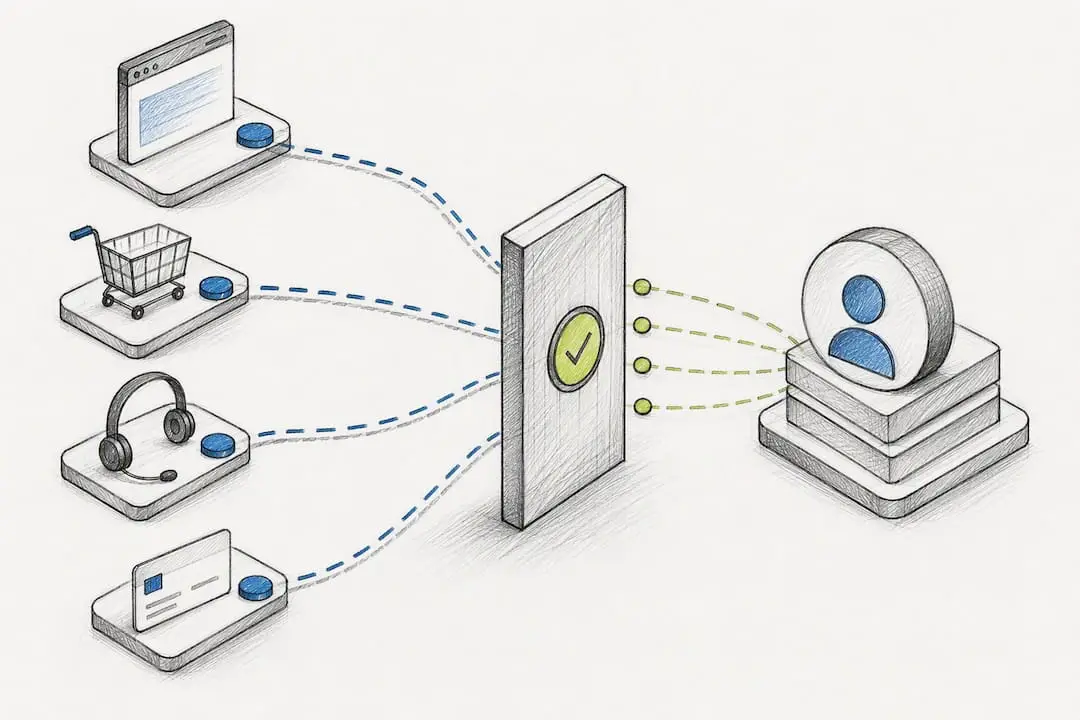
Decisioning is where rules and machine learning split. Rules work fine for simple, high-confidence scenarios (“customer abandoned checkout, send reminder in 30 minutes”). Machine learning earns its place when you’re weighing competing offers or channels across a large customer base, but only if the decision is explainable. Industry commentary on 2026 orchestration trends points to AI-driven decisioning replacing periodic optimization with continuous learning, which raises the bar on being able to show a human why a model chose what it chose.
Activation pushes the decision into the channel, whether that’s email, SMS, a contact center agent’s screen, or an in-app message. Emarsys notes that real-time activation needs native or near-native channel execution, because every extra handoff between disconnected tools adds latency that can kill the moment entirely. Suppression rules matter here too: a customer mid-escalation with support should not get a promotional blast about the very product that’s broken.
Measurement closes the loop, feeding journey-level outcomes back into the decisioning engine.
- Governance ties the whole thing together: a documented RACI (who’s Responsible, Accountable, Consulted, Informed), a change control process for adjusting rules, and audit logs showing why a decision fired.
Pro Tip: Before adding a single new channel or data source, write down who owns the decisioning rules for each journey. Teams that skip this step end up with three departments editing the same customer flow with no one noticing the conflicts until customers complain.
Orchestration vs. Journey Mapping vs. Journey Management: What’s the Difference?
These three terms get used interchangeably, and that confusion causes real project delays. Journey mapping is the planning phase: visualizing the stages a customer moves through, often built in a workshop with sticky notes or a mapping tool. Journey management is the ongoing discipline of monitoring and adjusting those defined journeys over time, usually through dashboards and periodic reviews. Orchestration is the runtime layer that actually executes decisions in the moment, based on live signals.
- Journey mapping answers “what should this experience look like?” and produces a static blueprint.
- Journey management answers “is this experience performing as designed?” and involves ongoing review.
- Orchestration answers “what should happen for this specific customer, right now?” and requires real-time infrastructure.
A useful sequence: map the journey first to agree on stages and goals, manage it to catch drift and underperformance, then orchestrate it to automate the moment-to-moment decisions. Teams that try to orchestrate before they’ve mapped anything usually end up automating a broken process faster.
Where Does Customer Journey Orchestration Deliver the Clearest Value?
Some use cases make the value of orchestration obvious almost immediately, because the alternative is visibly worse.
- Cart abandonment tied to inventory. Instead of a generic “you left something behind” email, orchestration checks whether the item is still in stock and whether a similar item at a better margin is available, then picks the message and channel accordingly.
- Service escalation with suppressed marketing. When a customer opens a support ticket, orchestration should automatically pause unrelated promotional sends until the case closes. Nothing erodes trust faster than a refund apology followed by a cheerful upsell email an hour later.
- Loyalty milestone recognition across channels. A customer who hits a spending threshold or anniversary date gets recognized consistently, whether they’re checking the app, opening email, or talking to an agent, instead of getting the reward pitched twice or not at all.
- Proactive churn intervention from engagement decay. When login frequency or purchase cadence drops below a customer’s own historical baseline, orchestration can trigger a retention offer before that customer has consciously decided to leave.
What Are the Most Common Orchestration Implementation Challenges?
Most orchestration projects don’t fail because the technology can’t do the job. They fail because of how the organization is set up around the technology. TechTarget’s analysis of enterprise CX orchestration makes exactly this point: the hard part is coordination and ownership across teams, not tool availability.
- Batch syncs and siloed systems kill the “real time” in real-time orchestration. If your CRM updates nightly, your decisioning engine is always working from stale data. Fix it by prioritizing event streaming or webhook-based updates for your highest-value signals first, rather than trying to real-time everything at once.
- Identity and consent mismatches happen when different systems track the same customer under different IDs or consent statuses. Build identity resolution rules that default to the most restrictive consent state until reconciled.
- Unclear ownership across marketing, IT, and customer service leads to conflicting rules firing on the same customer. CX Today’s guidance on stalled orchestration programs calls this “journey wobble,” and the fix is a documented RACI with a regular review cadence, not another tool purchase.
- Over-personalization creeps in when decisioning engines optimize purely for conversion without a human checking whether the result feels invasive.
Pro Tip: Set a review cadence before you launch, not after something breaks. Even a monthly 30-minute meeting between marketing, IT, and customer service owners catches conflicting rules faster than any dashboard alert.
What’s Next for Customer Journey Orchestration in 2026?
The biggest shift underway is a move from scheduled optimization to continuous, AI-driven decisioning. Instead of a quarterly rules review, orchestration platforms are increasingly adjusting next-best-action logic in near real time based on outcome data.
- Agentic AI for decisioning. AI agents are starting to handle high-volume, lower-stakes decisions under marketer-defined guardrails, freeing human strategists to focus on exceptions and edge cases.
- Continuous optimization. Reinforcement-learning approaches are replacing the old cycle of “set a rule, review it in Q3.”
- Operational data as a first-class input. Inventory levels, fulfillment status, and service history are becoming as important to decisioning as clickstream data, because they’re what turn a behavioral trigger into a genuinely helpful decision.
- Explainability as a requirement, not a nice extra. As AI agents take on more decisioning, being able to show why a decision fired matters for both compliance and trust, especially in regulated industries like finance and healthcare.
Teams that invested early in clean operational data feeds are the ones positioned to take advantage of these shifts without a rebuild.
How Do You Pilot Customer Journey Orchestration in 90 Days?
Skip the multi-quarter platform rollout. The teams that actually get orchestration working start with one journey, prove it, then expand.
- Pick one high-impact journey. Cart recovery and service escalation are common starting points because they’re cross-functional and have obvious, measurable outcomes.
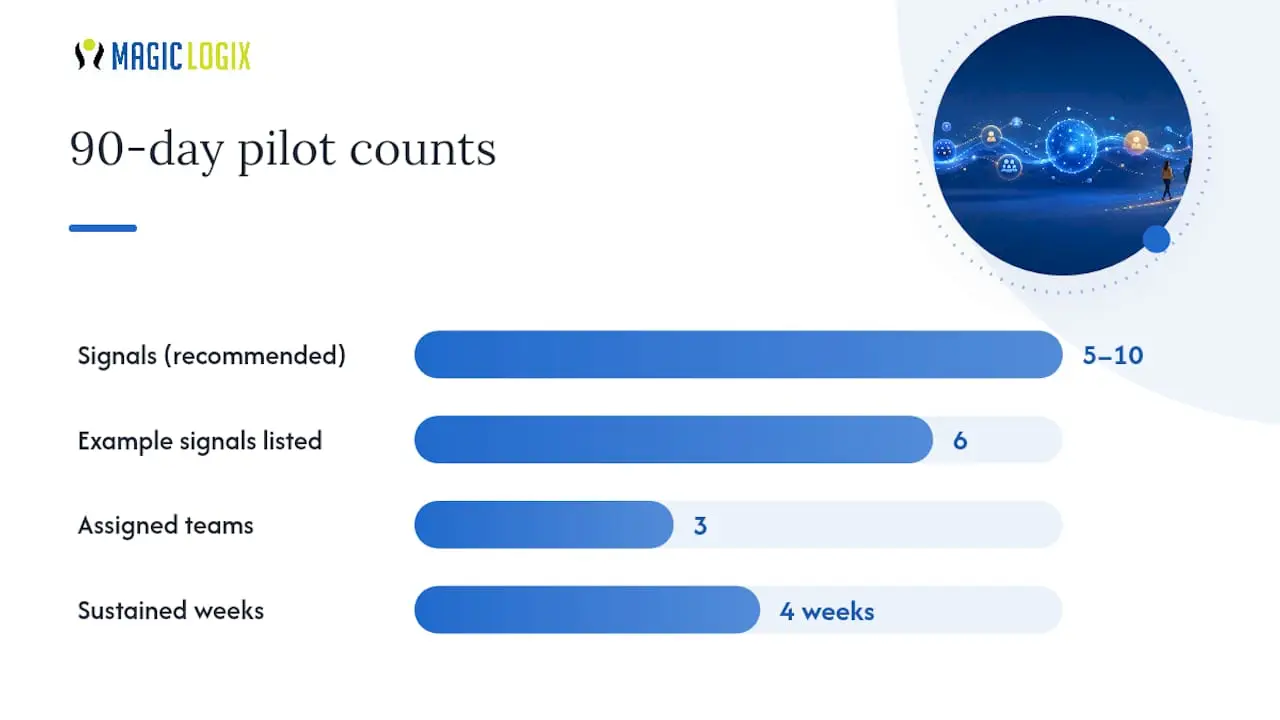
- Choose 5 to 10 clean signals. CX Today recommends starting with a short list: identity match, recent purchase, cart add, checkout error, open support ticket, and loyalty tier are usually enough for a first pass.
- Assign owners before you build anything. Someone from marketing, IT, and customer service each needs a defined role in the RACI before rules go live.
- Build the decisioning logic simply. Start with rules, not machine learning. You can layer ML in once you have baseline performance data to train against.
- Measure weekly at the journey level. Track recovery rate and progression rate, not just message opens, and review results with all three teams every week during the pilot.
- Set scale criteria in advance. Decide upfront what “working” looks like, such as a sustained lift in recovery rate over four consecutive weeks, before you expand to a second journey.
Pro Tip: Resist the urge to launch three journeys at once because “the platform can handle it.” A single well-measured pilot that proves clear lift is worth more to your case for expansion than three half-tracked launches.
Bringing in outside help to instrument the operational signals correctly, through a partner focused on data-driven customer insights, often shortens this pilot phase considerably compared to building the integration layer from scratch.
What Templates and Resources Help Teams Get Started?
A recurring pattern shows up across many digital marketing and customer engagement projects: the businesses that treat orchestration as a pilot, not a platform purchase, see results faster and with fewer internal fights over ownership.
A few resources worth using directly:
- The customer engagement strategy template helps map the stakeholder RACI and signal priorities before any tool gets touched.
- The 90-day marketing automation strategy framework outlines a data-first sequencing approach that pairs well with a single-journey pilot.
- The predictive personalization resource covers when to introduce machine learning decisioning versus sticking with rules longer than teams typically want to.
These aren’t theoretical checklists. They reflect the same sequencing this guide recommends: map ownership, prove one journey, then scale with governance already in place rather than bolted on afterward.
When Should You Build Orchestration Internally vs. Bring in a Partner?
My take: build internally when the journey touches proprietary systems you’ll be maintaining for years and when you have engineering capacity to spare right now, not next quarter. Bring in a partner when speed matters more than owning every line of integration code, or when the identity resolution and channel activation work is more complex than your internal team has tackled before.
Most teams underestimate how long identity resolution takes to get right and overestimate how fast they can build real-time activation without help. If you’re unsure which camp you’re in, the fastest way to find out is a short stakeholder workshop that maps your current signals against the five-capability model before committing budget either way.
— Hassan
How Magic Logix Helps You Put Orchestration Into Practice
If you’ve read this far, you already know the hard part isn’t picking a platform, it’s connecting operational data, resolving identity cleanly, and getting marketing, IT, and customer service to agree on ownership before anything goes live. That’s the exact gap Magic Logix closes: integrating advanced data analytics with hands-on marketing automation work, so the pilot you just read about actually gets built instead of stalling in a planning deck.
Magic Logix’s digital marketing and marketing automation services cover the practical layer most teams get stuck on: connecting operational and engagement data, building decisioning rules, and instrumenting the real-time signals a pilot journey needs. A typical engagement path starts with an audit of your current data and channel setup, moves into a single-journey pilot like the ones described above, and only expands into a broader retainer once that pilot shows measurable lift. If your team is still deciding between building this in house or bringing in outside hands, a quick way to start is reviewing what’s currently live on your site with the Magic Logix capabilities overview, then booking a conversation about where a pilot journey would fit your business first.
Sources
- Customer journey orchestration explained — CX Today
- CX orchestration is the new hard part — TechTarget
- Customer Journey Orchestration in 2026 — MarqOps
- A complete guide to customer journey orchestration — Emarsys / SAP
FAQ
What are the 5 stages of a customer journey?
Most frameworks describe five stages: awareness, consideration, decision, purchase, and loyalty (or retention). Orchestration platforms use this structure to decide which signals matter most at each stage, since a checkout error means something different during “decision” than it does after “purchase.”
What are the 7 steps of the customer journey?
A more detailed model expands the five stages into seven: awareness, consideration, evaluation, purchase, onboarding, retention, and advocacy. The extra steps separate the immediate post-purchase experience from long-term loyalty behavior, which matters for orchestration because those two stages usually need very different signals and triggers.
What is the most popular journey mapping tool?
There’s no single dominant tool; teams use everything from dedicated mapping software to workshop-based visual boards. What matters more than the specific tool is treating mapping as the planning phase that comes before journey management and orchestration, not a replacement for either.
What are the 5 A’s of the customer journey?
The 5 A’s, aware, appeal, ask, act, and advocate, describe a marketing funnel model focused on how customers move from noticing a brand to recommending it. It’s a useful lens for planning campaigns, but real-time orchestration needs more granular operational signals than this model provides on its own.
How is customer journey orchestration different from marketing automation?
Marketing automation typically runs pre-built workflows triggered by a single event, like a welcome email series. Customer journey orchestration coordinates decisions across multiple systems and channels in real time, weighing several signals at once rather than following one fixed sequence.