
Social media governance is the operating system of roles, workflows, and enforcement rules that controls what your brand publishes, who approves it, and how you prove compliance later. It’s distinct from a policy document and a marketing strategy. The single best first move is straightforward: name a governance owner and build a complete account inventory this week, before you write a single new rule.
TL;DR:
- Building a social media governance system requires identifying a governance owner and creating a complete account inventory before drafting policies or procedures.
- Effective governance includes role-based access controls, documented approval workflows, archiving systems, and an AI policy, not just written policies alone.
- Most failures stem from outdated account inventories and lack of enforcement, making regular audits and clear ownership essential for risk mitigation.
- Tiered approval processes and crisis protocols, including quarterly drills, are key to maintaining speed and control without bottlenecks.
- Ongoing reviews and training, tied to platform changes and incidents, help sustain governance effectiveness and adapt to new risks over time.
Table of Contents
- What Is Social Media Governance, and How Does It Differ From Policy?
- Why Governance Matters Now: The Risks It Actually Prevents
- Core Components Every Governance Plan Needs
- How Do You Build a Social Media Governance Framework?
- Roles, Account Ownership, and Access Controls in Practice
- Security, Compliance, and AI Policy: Where Enforcement Lives
- Approval Workflows and Crisis Response: Speed Without Losing Control
- How Do You Measure and Maintain Governance Over Time?
- Your 30/90/180-Day Governance Checklist
- Publisher Perspective: What We See in the Field
- How Magic Logix Helps You Operationalize Governance
- Sources
- FAQ
What Is Social Media Governance, and How Does It Differ From Policy?
Governance is the system. Policy is one document within that system. Strategy is the set of goals the system exists to protect.
Think of it like running a warehouse. Strategy is the sales target. Policy is the safety manual on the wall. Governance is the actual operation: who has keys to which doors, who signs off on a shipment before it leaves, and what gets logged when something goes wrong. A company can have a beautifully written social media policy and still suffer a brand crisis because nobody enforced it, no one owned the approval queue, and three former employees still had login credentials.
A working governance framework produces a specific set of artifacts, not just intentions:
- A written policy covering brand voice, legal review triggers, and platform-specific rules
- A role matrix defining who drafts, who approves, and who publishes
- A documented approval workflow with defined routing for high-risk content
- Audit logs and an archive system that satisfy regulatory review
- A current account inventory tying every profile to a business owner
Most mature organizations place governance ownership in a cross-functional group. Marketing runs day-to-day execution, but legal, IT, and compliance hold veto power over specific categories of risk. That structure, often called a Center of Excellence, tends to outperform governance owned solely inside a marketing department, because marketing alone rarely has the authority to enforce a pause during a crisis.
Why Governance Matters Now: The Risks It Actually Prevents
Every risk below has already cost a real organization real money or real reputation, and none of them are hypothetical anymore.
Brand and reputational risk shows up fastest and spreads hardest. A single tone-deaf post, screenshotted before deletion, can dominate a news cycle for days. Governance limits this through mandatory review tiers for anything touching sensitive topics.
Compliance and regulatory risk grows every year that regulators pay closer attention to digital disclosures. Financial services, healthcare, and any publicly traded company face specific archiving and recordkeeping obligations that a casual social media habit simply doesn’t satisfy.
Legal risk includes defamation, false advertising claims, and copyright violations from reused images or video. Legal review triggers inside an approval workflow catch most of this before it publishes, not after.
Human and internal risk is the quiet one. Former employees keeping account access, shared passwords sitting in a spreadsheet, and no offboarding checklist are the ordinary conditions under which most account failures happen.
Security risk has intensified with account takeovers and phishing campaigns targeting brand social accounts specifically because they carry an audience and a reputation worth hijacking.
Third-party app and influencer risk enters through connections you didn’t fully vet: a scheduling tool with excessive permissions, or a partner who fails to disclose a paid relationship, exposing the brand to the same scrutiny the FTC applies to any sponsored post.
AI and automation risk is the newest and fastest growing category. Gartner projects marketing leaders expect AI to handle 36% of marketing work by 2028, roughly double current levels. That pace means undisclosed AI-generated content and unsupervised automated posting are becoming routine failure points, not edge cases.
Statistic to remember: the financial exposure from poor data governance is not abstract. Worldwide data breach fines and settlements run into the billions in aggregate, and social accounts are increasingly a vector regulators examine when a breach occurs.
Core Components Every Governance Plan Needs
A governance plan is only as strong as its weakest documented component. Skipping one of these because “we’re too small for that” is exactly how mid-size companies end up in the incident reports.
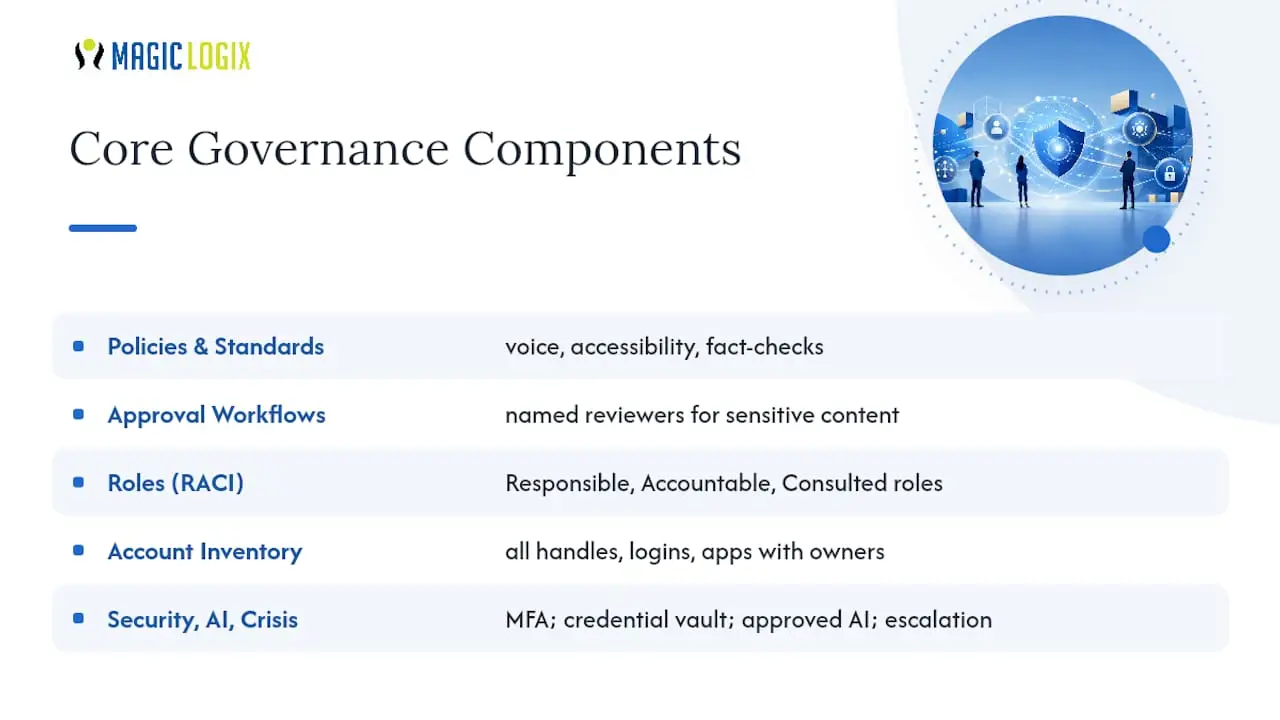
Policy and content standards. This covers brand voice rules, accessibility requirements like alt text and captions, and a factual-accuracy check before anything publishes. It should read like a set of guardrails, not a legal brief nobody opens.
Approval workflows and publishing rules. Define exactly what content needs a second set of eyes and what can go live without one. Routine posts move fast; anything touching legal claims, pricing, health information, or a sensitive news event routes through named reviewers.
Roles and ownership, often structured as a RACI matrix. Someone is Responsible for drafting, someone is Accountable for the final sign-off, and legal or compliance is Consulted on defined categories.
Account inventory and ownership records. Every handle, every login, every connected app, tied to a named business owner. This single document, recommended consistently across enterprise governance guides, is the foundation everything else builds on.
Security protocols, including multi-factor authentication, a credential vault instead of shared passwords, and single sign-on where the platform supports it.
An AI use policy naming approved tools, requiring disclosure where relevant, and setting a human-review checkpoint before anything AI-assisted publishes.
Crisis management procedures, including a pause protocol and an escalation chain that doesn’t depend on one person being reachable.
Monitoring, archiving, and training round it out. Archiving matters for compliance review; training matters because policies nobody remembers don’t prevent anything. A social media strategy sets the goals this whole structure exists to protect, but the components above are what actually keep the goals achievable without a public incident along the way.
How Do You Build a Social Media Governance Framework?
Building governance from scratch feels like a lot until you break it into a sequence. Here’s the order that avoids the two most common failure modes: moving too slowly to matter, or moving so fast that nobody adopts it.
-
Secure executive sponsorship and form a cross-functional Center of Excellence. Pull in marketing, legal, IT, and compliance from day one. Governance owned by one department alone tends to lose enforcement power exactly when it matters most.
-
Conduct a full account and tool inventory. List every platform, every handle, every connected third-party app, and classify each by risk level. You cannot govern what you haven’t counted.
-
Define your role matrix and access controls. Decide who drafts, who approves, who publishes, and who can pull the plug. Set firm offboarding rules now, before the next departure catches you off guard.
-
Draft your policies. Cover employee social conduct, influencer and third-party collaboration rules, and AI use standards. Set approval tiers proportional to risk, not a single one-size-fits-all queue.
-
Implement supporting tools. Single sign-on, a privileged access management or credential vault system, an archiving tool for compliance, and monitoring software to catch issues before they escalate.
-
Pilot in one brand or business unit. Train the pilot team, run it for a defined period, and measure adherence and approval speed before rolling it company-wide.
-
Scale based on what the pilot taught you. Adjust approval tiers that caused bottlenecks, fix gaps the pilot exposed, and only then expand to every business unit and market.
This sequence matters because governance built in the wrong order, tools before roles, policy before ownership, tends to create friction that teams quietly route around. A pilot catches that friction while the stakes are still low.
Roles, Account Ownership, and Access Controls in Practice
A workable role architecture typically has four levels: contributors who draft, approvers who review against brand and legal standards, publishers who hold posting access, and administrators who control platform-level settings and offboarding. A RACI entry for a routine product post might read: contributor drafts, brand approver reviews, publisher posts, and legal is consulted only if the post makes a specific claim.
Single sign-on paired with role-based permissions eliminates the biggest practical failure point: shared logins that nobody can trace back to an individual. When access ties to an employee’s SSO credential instead of a shared password, revoking it on their last day takes one click instead of a company-wide password reset.

Contractor and agency access needs its own lifecycle. Grant time-limited access tied to the contract term, review it at each contract renewal, and build offboarding into the termination checklist itself, not as an afterthought someone remembers three weeks later.
Security, Compliance, and AI Policy: Where Enforcement Lives
Policy without enforcement is a wish list. Enforcement lives in specific technical and procedural controls.
Multi-factor authentication should be non-negotiable on every account with publishing access. Session logging and anomaly detection catch suspicious login patterns before an account takeover becomes a public post. Credential vaulting replaces the shared-password spreadsheet with something that logs who accessed what, and when.
Archiving and audit trails matter beyond internal tidiness. Regulated industries face specific recordkeeping obligations, and even unregulated brands benefit from being able to reconstruct exactly what happened during an incident review.
Influencer and third-party collaboration rules deserve their own line item. The FTC’s plain-language influencer guide spells out disclosure requirements for sponsored content, and governance frameworks that skip this exposure treat it as a marketing nuance rather than a legal obligation.
AI policy should name approved tools explicitly, require disclosure where a platform or regulation calls for it, and set a firm human-in-the-loop checkpoint before AI-assisted content goes live. Approaches that build ethical AI content practices into the workflow from the start tend to avoid the credibility damage that comes from AI missteps discovered after publication.
- Require MFA on every publishing-level account, no exceptions
- Vault credentials centrally instead of sharing passwords by message
- Archive every published post and its approval trail for regulatory review
- Name approved AI tools and require disclosure where relevant
- Set a mandatory human review checkpoint before AI-assisted content publishes
Pro Tip: Run a quarterly access audit even if nothing has gone wrong. Stale permissions accumulate silently, and the audit is far cheaper than the incident it prevents.
Approval Workflows and Crisis Response: Speed Without Losing Control
The most common reason governance programs fail isn’t lax policy. It’s an approval process so slow that teams quietly stop using it.
Proportional approval tiers solve this. Trusted contributors publish routine content within pre-approved guardrails, while only higher-risk categories, legal claims, sensitive news, health or financial statements, route through named reviewers. Oktopost’s research on enterprise governance confirms that this tiered structure is what prevents the bottlenecks that eventually kill adoption entirely.
Automated pre-publish checks add a second layer without adding human delay. Flagging posts that mention regulated terms, missing a required disclosure tag, or breaking brand-voice rules catches a meaningful share of problems before a human reviewer even opens the queue.
Every organization needs a tested pause procedure:
- A named first responder who can pull down content or halt scheduled posts within minutes
- A defined escalation timeline specifying who gets notified at 15 minutes, one hour, and end of day
- A quarterly rehearsal of the crisis scenario, not just a document nobody has opened since it was written
A pause procedure you’ve never rehearsed is a plan you’re testing for the first time during an actual crisis. That’s the worst possible moment to find the gaps.
How Do You Measure and Maintain Governance Over Time?
Governance decays without maintenance. The policy that felt airtight in January often has gaps by September, usually because a new platform feature, a new team member, or a new AI tool arrived and nobody updated the rulebook.
Track a small set of KPIs that actually predict risk: policy adherence rate, average approval cycle time, incidents per quarter, and time-to-pause during a test or real event. These numbers tell you whether governance is working faster than any qualitative review will.
A quarterly review cadence is the practical standard, with trigger-based reviews added whenever a new platform launches, a major AI tool gets adopted, or an incident exposes a gap the quarterly schedule hadn’t caught yet. Tie these reviews to the same performance metrics your team already tracks for campaign results, since governance that stays disconnected from business outcomes tends to lose executive attention within a year.
Ongoing training should live alongside onboarding, not as a once-a-year compliance module. Central documentation, kept in one place everyone can find, prevents the common failure where three versions of “the policy” circulate and nobody knows which one is current.
Your 30/90/180-Day Governance Checklist
Momentum matters more than perfection here. Start with what reduces risk fastest, then build out the rest.
- Days 1 to 30: Complete the full account inventory, lock down credentials with MFA and a vault, and assign a named owner to every account.
- Days 31 to 90: Draft your core policy documents, define approval tiers, and pilot the workflow with one team.
- Days 91 to 180: Roll out training company-wide, implement archiving and monitoring tools, and run your first quarterly review.
Prepare three starter templates before you begin: a one-page policy outline, a role matrix template, and an incident response worksheet. None of this needs to be elaborate on day one. Locking down credentials and naming account owners alone eliminates a large share of the risk most companies are carrying without realizing it.
Publisher Perspective: What We See in the Field
Most governance failures don’t come from a missing policy. They come from a policy nobody enforced, sitting next to an account inventory that was outdated. The gap between having a document and running a system is where the risk actually lives.
Running governance internally works when a company already has cross-functional buy-in and someone with authority to enforce a pause. Bringing in an outside partner makes more sense when the audit itself needs to happen fast, or when internal politics make it hard for marketing to hold legal and IT accountable to the same rulebook. Either path works. Skipping the audit doesn’t.
— Hassan
How Magic Logix Helps You Operationalize Governance
Some companies work directly with marketing, legal, and IT teams to close the gap between a governance policy sitting in a drawer and a governance system that actually runs. Rather than handing you a template and walking away, they build the account audit, the role matrix, and the approval workflow alongside your team, then help you pilot it before company-wide rollout.

Engagement typically starts one of three ways: a focused governance audit to find your current gaps, a pilot program in a single business unit, or an ongoing retainer for teams that want continuous support as platforms and AI tools evolve. Each option connects to the broader digital marketing strategy work we already do for growing businesses, so governance doesn’t sit disconnected from the campaigns it’s meant to protect.
If your account inventory is out of date or nobody owns your approval queue, that’s the place to start. Reach out to discuss a governance audit and get a clear picture of your gaps within the first conversation.
Sources
For disclosure requirements around sponsored content, the FTC’s influencer marketing guide is the primary reference every organization running influencer programs should read directly rather than secondhand.
On the scale of AI’s coming impact on marketing operations, Gartner’s research on AI automation growth and its findings on media spend allocation offer useful context for building the business case internally. For the financial stakes of poor data governance broadly, Statista’s data on breach fines and settlements puts real numbers behind the risk.
- FTC: .com Disclosures and influencer guidance (plain-language influencer guide)
- Gartner press release: AI automation expectations in marketing
- Statista: worldwide data breach fines and settlements
FAQ
What Is the 5-5-5 Rule for Social Media?
The 5-5-5 rule is a content practice, not a governance rule: it suggests spending five minutes commenting on others’ posts, sharing five pieces of content, and creating five original posts each day. It’s a productivity habit for individual creators, not a substitute for organizational governance controls.
What Are the Four Pillars of Good Governance?
Applied to social media, the four pillars typically cited are accountability (clear ownership of decisions), transparency (documented rules and disclosures), participation (cross-functional input from legal, IT, and compliance), and enforcement (actual consequences and controls, not just written policy).
What Are the Core Elements of a Social Media Governance Framework?
A working framework needs a documented policy, defined approval workflows, a role matrix with named owners, security controls like MFA and credential vaulting, an AI use policy, and a regular review cadence, ideally quarterly.
Do Small Businesses Need Formal Social Media Governance?
Yes, though the scale differs. Even a small team benefits from an account inventory, MFA on every login, and one clear approval step before anything sensitive publishes, since the risks of account takeover or a compliance misstep don’t scale down with company size.
How Often Should a Governance Policy Be Reviewed?
A quarterly review cadence is the practical standard, supplemented by trigger-based reviews whenever a new platform, AI tool, or incident reveals a gap the scheduled review hasn’t caught yet.