

A marketing technology stack is the set of connected tools your team uses to collect data, run campaigns, and measure results. The right move is not adding more software. It’s making your data layer trustworthy, naming your CRM as the single system of record, and prioritizing the five to ten integrations that actually carry customer data across tools. Get that right, and you cut wasted spend, speed up decisions, and get reporting you can trust.
TL;DR:
- Prioritizing data accuracy and governance is crucial, with the CRM serving as the single source of truth to prevent conflicting customer records.
- Focus on 5 to 10 critical data flows for integration, such as lead handoff and attribution, and assign owners to monitor and maintain these flows monthly.
- Building a minimal stack around a CRM, one automation platform, and basic analytics avoids costly overlaps and sets a foundation for scalable growth.
- An audit should inventory tools, map data flows, and score their fragility to identify the most impactful fixes and reduce integration waste.
- Waiting to improve martech governance risks compounding data issues that will hinder emerging AI-driven automation and decision-making layers.
Table of Contents
- What Is a Marketing Technology Stack, Really?
- What Are the Core Components of a Martech Stack?
- Why Does an Efficient Martech Stack Actually Matter?
- How Do You Build a Martech Stack, Step by Step?
- How Do You Audit an Existing Martech Stack?
- What Integrations Should You Prioritize First?
- What Measurement Approach Fits Your Stack?
- Should You Choose Best-of-Breed Tools or a Unified Platform?
- What Does a Phased Martech Rollout Look Like?
- How Magic Logix Approaches Martech Stack Projects
- What’s the Real Risk of Waiting on Martech Governance?
- Sources
- FAQ
What Is a Marketing Technology Stack, Really?
Most teams still think of a martech stack as a list of software subscriptions. That framing is outdated. A modern stack is an architecture: a set of layers that pass customer data between each other so your campaigns run on shared, trustworthy information instead of five conflicting spreadsheets.
Five layers do the real work.
- Data layer: your CRM, customer data platform, or data warehouse holding the single version of truth about each customer.
- Engagement layer: marketing automation and email or SMS tools that act on that data to run campaigns.
- Content layer: your CMS and digital asset manager, controlling what gets published and where.
- Activation layer: paid media, social, and other channels where campaigns actually reach people.
- Analytics and AI layer: dashboards, attribution models, and increasingly, AI agents that interpret results and trigger next actions.
The 2026 shift is that last layer getting a new tenant. Industry surveys point to an emerging AI agent layer that runs end-to-end tasks across platforms rather than just generating content inside one tool. That only works if the data layer underneath it is governed and consistent. An AI agent making decisions on messy, duplicated customer records will make messy, duplicated decisions.
What Are the Core Components of a Martech Stack?
Every stack, regardless of size, draws from the same six categories. Knowing what each one owns, and where they overlap, is what separates a clean stack from an expensive mess.
- CRM: owns the customer record, deal stage, and lifecycle status. This should be your source of truth.
- Marketing automation platform (MAP): owns campaign execution, lead scoring, and nurture logic.
- CDP or data warehouse: owns unified behavioral and transactional data pulled from multiple sources.
- CMS/DAM: owns published content and creative assets.
- AdTech: owns paid media targeting, bidding, and audience syncs.
- iPaaS (integration platform as a service): owns the connections between everything above.
Overlap is where budgets bleed. A CDP and a MAP both trying to own lead scoring, or a CRM and a CDP both claiming to be the “source of truth” for the same contact record, creates duplicate data and contradictory reports. This is the single most common failure pattern in stacks that have grown by accumulation rather than design.
Stage matters here too. A small team usually needs a CRM, a MAP, and basic analytics, nothing more. A mid-market company adds a CDP once its channel count outgrows what a MAP alone can unify. Enterprise teams need iPaaS and dedicated governance because the number of integrations makes manual maintenance impossible. If you’re weighing marketing automation platforms specifically, a platform comparison can help you match features to your actual stage instead of your aspirational one.
Why Does an Efficient Martech Stack Actually Matter?
The financial case is direct. Companies running large, poorly integrated stacks can spend roughly 40% of their martech budget fixing integration problems instead of funding actual marketing work.
The 40% Problem: Nearly half of a typical martech budget at poorly integrated companies goes toward solving sync failures, duplicate data, and broken field mappings rather than campaigns, content, or media.
Forrester’s research adds another dimension: 12% of ad budgets are lost specifically to poor coordination between martech and adtech systems. Add what practitioners call the “reporting tax,” the 20 to 30% of an analyst’s week spent reconciling numbers across disconnected dashboards, and the true cost of a fragmented stack is measured in analyst hours, not just software line items. With marketing budgets flatlined around 7% of revenue.gartner.com/en/newsroom/press-releases/2025-05-12-gartner-2025-cmo-spend-survey-reveals-marketing-budgets-have-flatlined-at-seven-percent-of-overall-company-revenue), every dollar lost to integration debt is a dollar that can’t go to campaigns.
How Do You Build a Martech Stack, Step by Step?
Buying platforms before mapping what your team actually needs to do is the most common, and most expensive, mistake. Strong stacks get designed around the customer journey first, with the CRM as the central system of record.
- Map the journey and jobs-to-be-done. List what your team needs to accomplish at each stage: capture a lead, score it, nurture it, hand it to sales. Buy tools to fill those jobs, not the other way around.
- Establish your system of record. Your CRM should own the contact and deal record. Every other tool syncs into it, not around it.
- Build the minimal viable stack. Start with CRM, one MAP, and basic analytics. Resist adding a CDP or ABM tool until the core three are working reliably.
- Select integrations deliberately. Pick the handful of data flows that matter most (lead handoff, campaign attribution) before wiring up everything else.
- Apply crawl-walk-run. Core infrastructure first, specialized tools like account-based marketing or multi-touch attribution only as the business scales.
- Align stakeholders before procurement. Get sales, ops, and IT to sign off on the system of record before a single contract is signed.
Pro Tip: Before evaluating any new platform, write down the three jobs it needs to do and who on your team owns each one. If you can’t name an owner, you’re not ready to buy.
How Do You Audit an Existing Martech Stack?
An audit turns a vague sense that “things aren’t talking to each other” into a prioritized fix list. Start by building an inventory that captures, for every tool in the stack: the business owner, actual usage (not license count), annual cost, every integration it touches, and where its function overlaps another tool’s.
From there, document the flows themselves at field level:
- Which direction data moves (one-way or bidirectional).
- How often it syncs (real time, hourly, nightly batch).
- Who owns the mapping if it breaks.
- What happens downstream if that flow fails for a day.
Score each flow on business impact versus fragility. A lead handoff from your ad platform to your CRM that runs on a fragile, undocumented API connection is a five-alarm fix. A nightly sync of newsletter unsubscribes into a rarely used dashboard can wait. This scoring exercise, more than any new tool purchase, is what actually reduces the 40% integration waste most fragmented stacks carry.
What Integrations Should You Prioritize First?
Chasing perfect synchronization across every tool in your stack is a trap. The better approach, backed by integration specialists, is to prioritize 5 to 10 critical flows and accept lower precision everywhere else.
The flows worth that attention almost always include:
- Lead handoff from ad platforms or forms into your CRM.
- Attribution events flowing from your MAP into analytics.
- Consent and opt-out status propagating across every channel tool.
- Enrichment data writing back from a CDP into the CRM record.
- Purchase or conversion events syncing into your ad platforms for optimization.
Most breakage comes from a small set of repeat offenders: one-way syncs that quietly diverge over time, field-mapping errors introduced during a platform update, and third-party API changes nobody on your team was watching for. Treating an integration as a one-time project instead of an ongoing product is the root cause behind most of these.
Pro Tip: Assign a named owner to each of your critical flows and set a recurring monthly health check, not just an alert for when something breaks. By the time an alert fires, the bad data has usually already reached a report someone made a decision from.
What Measurement Approach Fits Your Stack?
Your stack’s maturity should dictate your measurement approach, not the other way around. Three methods dominate, and each depends on a different level of data cleanliness.
- Multi-touch attribution works when your event tracking across channels is consistent, giving credit across the touchpoints in a customer’s path.
- Incrementality testing isolates the actual lift a channel drives, independent of what attribution models claim.
- Marketing-mix modeling (MMM) works at the aggregate level and tolerates messier data, useful when your stack isn’t fully governed yet.
A governed data layer, one with consistent naming, deduplication rules, and a shared metric layer, is what makes any of these trustworthy. Semantic metric layers that define KPIs once and apply that definition everywhere are becoming standard precisely because conflicting dashboards erode confidence in the numbers faster than any modeling choice does. Track pipeline velocity, cost per qualified lead, and time-to-report as your operational KPIs; they reveal stack health faster than revenue alone, which lags behind fixes by months. Some analytics-driven approaches show measurable ROI gains once reporting becomes reliable enough for teams to actually act on it.
Should You Choose Best-of-Breed Tools or a Unified Platform?
Best-of-breed tools give you the strongest feature in each category but multiply your integration surface area. Unified platforms cut integration work but often force compromises on individual features.
Neither answer is universally right. What matters is a disciplined vendor checklist:
- Does the vendor offer open APIs, or lock data behind proprietary formats?
- What is the total cost of ownership, including implementation and ongoing maintenance, not just the license fee?
- Can they run a live integration demo with your actual CRM, not a sandbox?
Bring your technical owner into procurement conversations from the first vendor call, not after the contract is drafted. A platform that looks perfect in a sales demo can quietly become your next silo if nobody who understands your data model has vetted it first.
What Does a Phased Martech Rollout Look Like?
A realistic rollout runs in three phases. Phase 0 (two to four weeks) is the audit: inventory every tool, map critical flows, assign an owner. Phase 1 (four to eight weeks) delivers quick wins, fixing the one or two flows causing the most reporting pain. Phase 2 (ongoing) builds core integrations and expands only as new jobs-to-be-done appear.
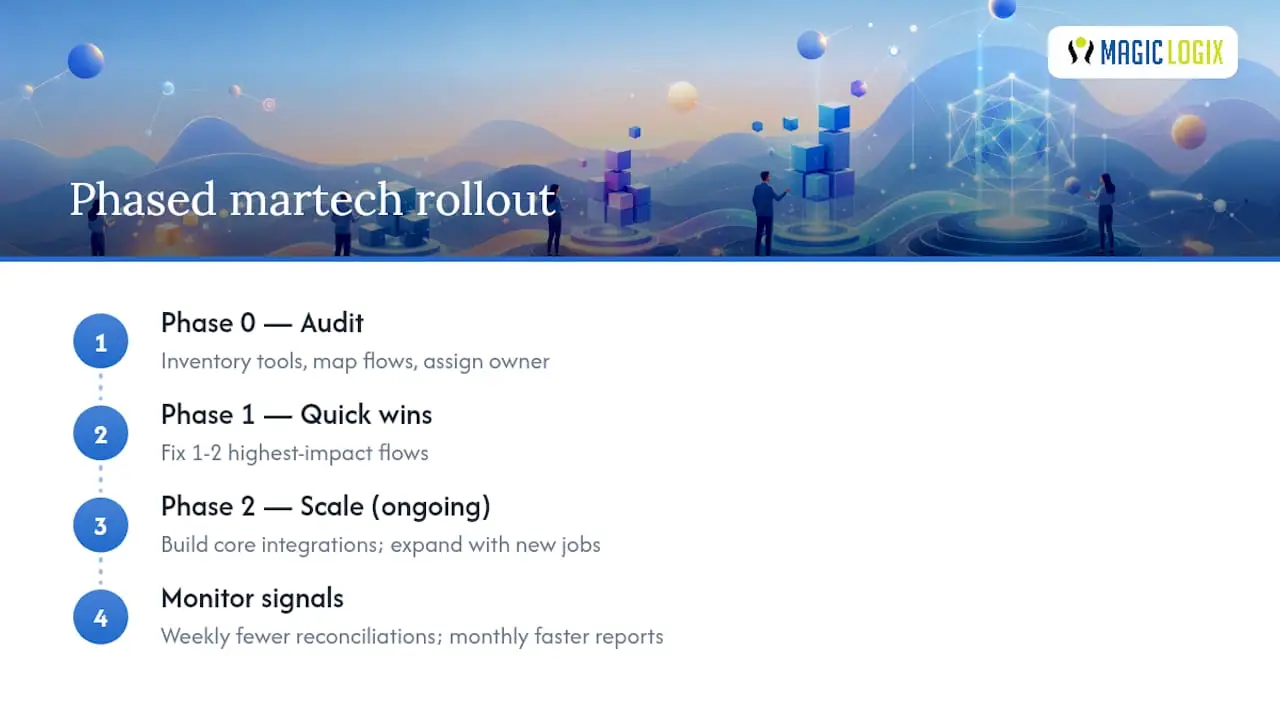
Watch weekly for fewer manual data reconciliations and monthly for shrinking time-to-report. Those two signals move faster than revenue and tell you the rebuild is working before the bigger numbers catch up.
How Magic Logix Approaches Martech Stack Projects
Consulting firms typically build martech stacks around the principle of a governed data layer first, with integrations treated as ongoing products rather than one-time setups. Typical engagements include stack audits, architecture design centered on a system of record, and integration roadmaps tied to measurable KPIs.
- Stack audits that inventory tools, owners, and critical data flows.
- Integration design centered on the CRM as system of record.
- Ongoing monitoring and governance handoff so fixes don’t regress.
Every engagement is scoped to the client’s actual jobs-to-be-done, not a generic template.
What’s the Real Risk of Waiting on Martech Governance?
Most teams treat martech governance as a someday project. That’s backwards. The AI agent layer arriving across marketing platforms in 2026 will only be as good as the data it acts on, and a stack full of duplicate records and undocumented syncs will make an AI agent’s mistakes faster and harder to trace, not fewer. The practical next step is not another tool purchase. It’s running an integration audit this quarter and naming one person who owns your critical data flows. If you need help executing that, Magiclogix’s digital marketing services can walk your team through the audit and the build.
— Hassan
Sources
For deeper detail: Adobe’s martech overview on integration and growth, House of Martech on sync failures, and Trackingplan’s 2026 guide on governed data layers.
- 7 MarTech integration failures & how to fix them — House of Martech
- The Hidden Cost of a Siloed MarTech Stack — MarTech Advisor
FAQ
Can You Give Examples of Marketing Technology Stacks?
A small-business stack might pair a CRM, one email marketing tool, and Google Analytics. An enterprise stack typically adds a CDP, a dedicated attribution platform, an iPaaS for integrations, and increasingly an AI agent layer sitting on top of all of it.
What Is the 3-3-3 Rule for Marketing?
Definitions of this rule vary across marketing contexts, and it isn’t a standardized martech framework, so treat any specific claim about it with caution rather than as an established stack-building principle.
What Is a Technology Stack Example?
A technology stack example is any named combination of tools working together, such as a CRM plus a marketing automation platform plus an analytics dashboard, all sharing customer data through defined integrations.
What Does “Marketing Stack” Mean?
A marketing stack is shorthand for a marketing technology stack: the connected software layers, data, engagement, content, activation, and analytics, that a team uses to run and measure campaigns.