

Marketing automation software runs from about $0 to $50 a month for a bare-bones starter plan up to $4,400 or more monthly at the enterprise level, but the sticker price is not your real budget. Your true first-year cost, including implementation, integrations, and staff time, often significantly exceeds the license fee, potentially two to three times higher. (https://knowledgelib.io/business/industry-benchmarks/marketing-technology-spending-benchmarks-2026/2026). Skip that math, and you’ll blow your budget by month four.
TL;DR:
- Budgeting for marketing automation should account for at least 2.5 to 3 times the license cost in the first year, including implementation and staffing expenses.
- Total cost of ownership often exceeds license fees significantly, with ongoing expenses like integrations, administration, and operations making up 50 percent or more of costs.
- Contact volume, feature tiers, and seat counts can cause costs to escalate rapidly, especially when crossing vendor tier thresholds without negotiation.
- Common overruns stem from data cleanup, multiple integrations, third-party enrichment, and unanticipated implementation or admin fees.
- A pilot-first approach focusing on a single use case and modelled costs reduces risks and controls expenses better than large, unscoped platform purchases.
Table of Contents
- How Much Does Marketing Automation Cost by Business Size?
- What Are the Real TCO Layers Behind the License Fee?
- What Do Real Marketing Automation Budgets Look Like?
- What Hidden Costs Blow Up Marketing Automation Budgets?
- How Do You Budget for and Control Marketing Automation Costs?
- When Should You Expect Marketing Automation to Pay Off?
- Why Pilot-First Budgeting Beats Big-Bang Rollouts
- Get Help Modeling and Controlling Your Automation Costs
- Sources
- FAQ
How Much Does Marketing Automation Cost by Business Size?
Vendors love to advertise their entry-level tier because it looks approachable. A $500-a-month platform sounds like a rounding error in most marketing budgets. The real question is not what the license costs. It’s what you’ll spend once contacts, seats, and features scale past the free trial.
Pricing in this category moves along three levers: how many contacts you store, how many teammates need seats, and which feature tier unlocks the automation you actually want (multi-step journeys, predictive scoring, revenue attribution). Most platforms bundle these into tiers, and the jump from one tier to the next is rarely proportional. You might double your contact list and see your bill triple, because you tripped a tier boundary.
Here’s roughly what businesses at each stage pay for the software license alone, based on current market benchmarks:
- Startup or small business: Realistic monthly costs run $50 to $500 for a small list with basic email and workflow automation, though bare-bones free tiers exist for lists under a few hundred contacts.
- Mid-market: Expect $500 to $3,000 a month once you need marketing and sales alignment, lead scoring, and multiple integrations.
- Enterprise: License anchors typically start around $1,250 and climb past $4,400 a month, depending on the vendor and how many business units share the platform.
Contact volume compounds this quickly. A company with 1,000 contacts might sit comfortably in a $50 to $200 monthly tier with room to grow. Push that to 10,000 contacts and many platforms bump you into a $300 to $800 range, sometimes higher if you need advanced segmentation. At 50,000 contacts, you’re often looking at $1,000 to $3,000 monthly just for the license, before anyone touches implementation.
Now layer in the buffer most teams forget. The gap between “what the pricing page says” and “what finance actually approves” is where most automation budgets go wrong.
Seats matter too, though less predictably. Some platforms charge per seat once you cross a threshold (say, five marketing users), which turns a growing team into an unplanned cost center. Before you sign anything, map your contact growth curve for the next 18 months against the vendor’s tier boundaries. If you’re six months from tripping a pricing cliff, negotiate that ceiling now, not after the invoice arrives.
What Are the Real TCO Layers Behind the License Fee?
License fees typically cover only 30 to 50 percent of your true total cost of ownership once you’re past a small-team setup. The rest hides in five layers that vendors rarely mention on their pricing page.
- License fees (recurring): the subscription itself, scaled by contacts, seats, and feature tier.
- Implementation (mostly one-time): platform configuration, data migration, workflow building, and integration setup, typically front-loaded in months one through three.
- Infrastructure and integrations (recurring): middleware, API connections to your CRM and e-commerce stack, and any data enrichment tools that feed your automation logic.
- Ownership and administration (recurring): the internal or contracted staff time needed to keep campaigns running, lists clean, and workflows updated.
- Ongoing operations (recurring): reporting, optimization, A/B testing, and the periodic retraining or reconfiguration that keeps performance from decaying.
Enterprise deployments make the pattern obvious. Median total annual cost for enterprise marketing automation, including licensing, setup, and support, runs about $127,000. Implementation commonly adds substantial costs, and ongoing operational expenses significantly increase the total investment beyond the license fee. That’s not an outlier case. It’s the median.
Pro Tip: *Ask every vendor for a “total cost at 12 months” number, not just a monthly license quote.
The layers that scale fastest are integrations and administration. A platform that talks to your CRM, your e-commerce cart, your ad platforms, and your customer support tool needs ongoing middleware maintenance. Each new integration is a new failure point, and each failure point needs someone watching it. That’s why a company running lean with one integration pays far less in the ownership layer than one running eight.
What Do Real Marketing Automation Budgets Look Like?
Seeing the numbers by business type makes the abstract layers concrete. Here are three scenarios that reflect how companies at different stages actually spend.
- Lean startup: A five-person marketing team on a $50 to $200 monthly license, doing implementation in-house with existing staff. Year 1 total, including a modest ramp-up buffer for template building and list cleanup, runs roughly $3,000 to $8,000. Year 2 stabilizes near $2,400 to $4,800, since most of the setup work is already done.
- Growth-stage company: A mid-tier license around $1,000 to $1,500 a month, with two to three integrations (CRM, e-commerce, and a support tool) and a part-time dedicated admin. Year 1 lands around $30,000 to $45,000 once you add implementation and a quarter-time staff allocation. Ongoing years settle closer to $20,000 to $30,000.
- Enterprise organization: License costs alone often exceed $50,000 annually, but the median total first-year cost, including the $85,000 implementation figure and the $45,000 in yearly operations noted in enterprise benchmarking data, commonly approaches or exceeds $127,000.
The growth-stage scenario is where most budgeting mistakes happen. Companies at this stage often use enterprise-style ambitions (multi-channel journeys, lead scoring, predictive segments) on a mid-market budget, then wonder why the implementation phase runs three months longer than planned. The fix isn’t a bigger license. It’s scoping the first use case tightly enough that your part-time admin can actually maintain it.
What Hidden Costs Blow Up Marketing Automation Budgets?
The overruns that catch teams off guard almost always come from the same handful of categories, and they’re predictable enough that you can budget for them in advance.
- Data cleanup and migration: dirty contact lists, duplicate records, and inconsistent field mapping from your old system.
- Integration middleware: connecting your automation platform to a CRM or e-commerce system often runs around $14,400 a year in tooling and maintenance.
- Data enrichment: third-party services that fill in missing firmographic or behavioral data, commonly around $12,000 annually.
- Implementation architecture: initial setup and workflow design work, frequently cited around $18,000 for a proper build.
- Part-time certified administration: someone who actually knows the platform, often around $22,000 a year for a fractional role.
- Content and template production: emails, landing pages, and dynamic content don’t build themselves.
- Overage fees: exceeding your contact or send-volume tier mid-cycle, which many vendors bill retroactively.
Pro Tip: When a vendor gives you a vague answer to “what does implementation typically cost for a company our size?” treat that vagueness as a red flag. A vendor who has done this hundreds of times should have a real number, not a shrug.
How Do You Budget for and Control Marketing Automation Costs?
Building a defensible budget starts with a simple model: take your license fee, multiply it by 2.5 to 3, then add implementation and a realistic ops staffing line. That single calculation catches most surprises before they hit finance.
- Model your TCO before you sign, not after: license × 2.5–3.0, plus a one-time implementation line, plus recurring ops.
- Tie every cost line to an outcome KPI (cost-per-qualified-lead, pipeline velocity) so spend has a defensible reason to exist.
- Roll out in phases: pick one high-value use case first (lead nurturing or cart-abandonment recovery are common starters), prove it, then expand.
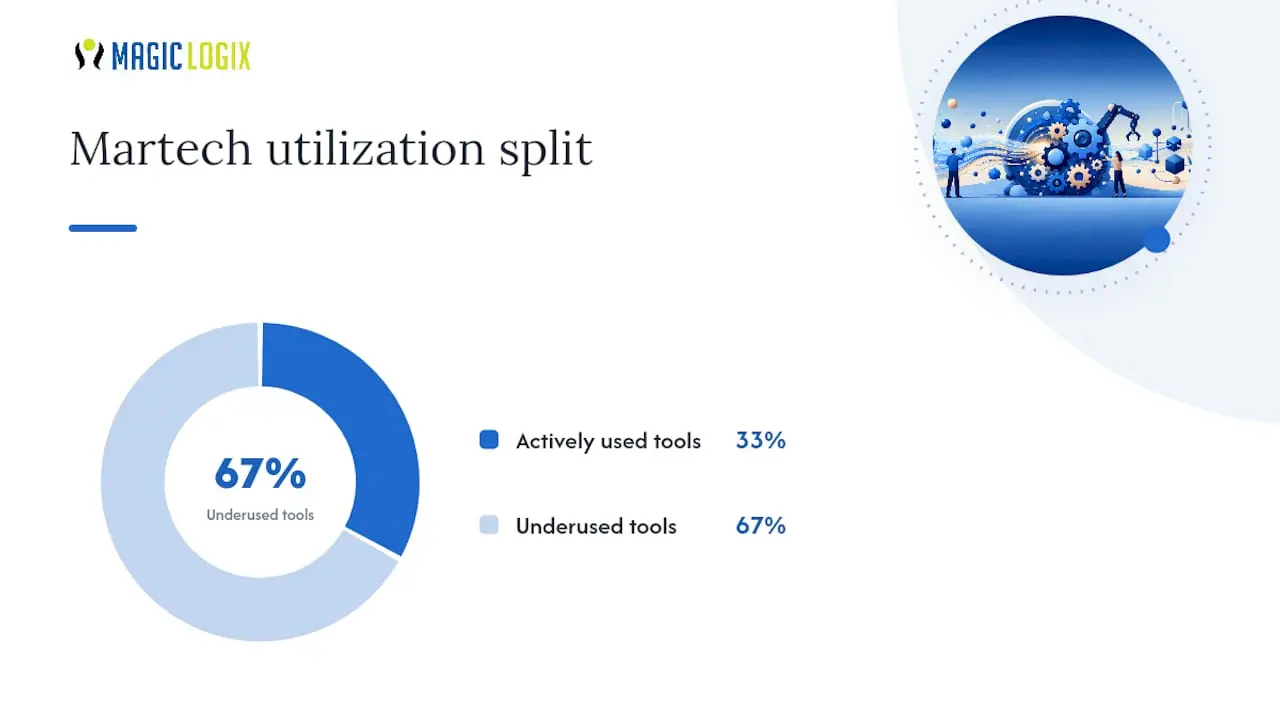
- Consolidate redundant tools. Industry surveys show martech utilization often sits near 33 percent, meaning a third of your stack is doing the real work while the rest quietly bills you.
- Negotiate contract clauses that cap per-contact or per-seat price jumps when you cross a tier boundary, rather than accepting whatever the renewal quote says.
Pro Tip: Before signing a multi-year contract, ask specifically what happens to your price if your contact list doubles. Get the number in writing, not a verbal assurance.
A phased rollout does double duty: it caps your initial spend and gives you real usage data before you commit to a bigger footprint. For SMB teams building this out for the first time, a structured step-by-step rollout checklist helps sequence which use case to tackle first. Reviewing a platform comparison built around total cost before you sign also keeps you from anchoring on the wrong feature tier. And if your existing stack already includes overlapping tools, closing that gap is often the fastest way to improve marketing efficiency without adding new spend.
When Should You Expect Marketing Automation to Pay Off?
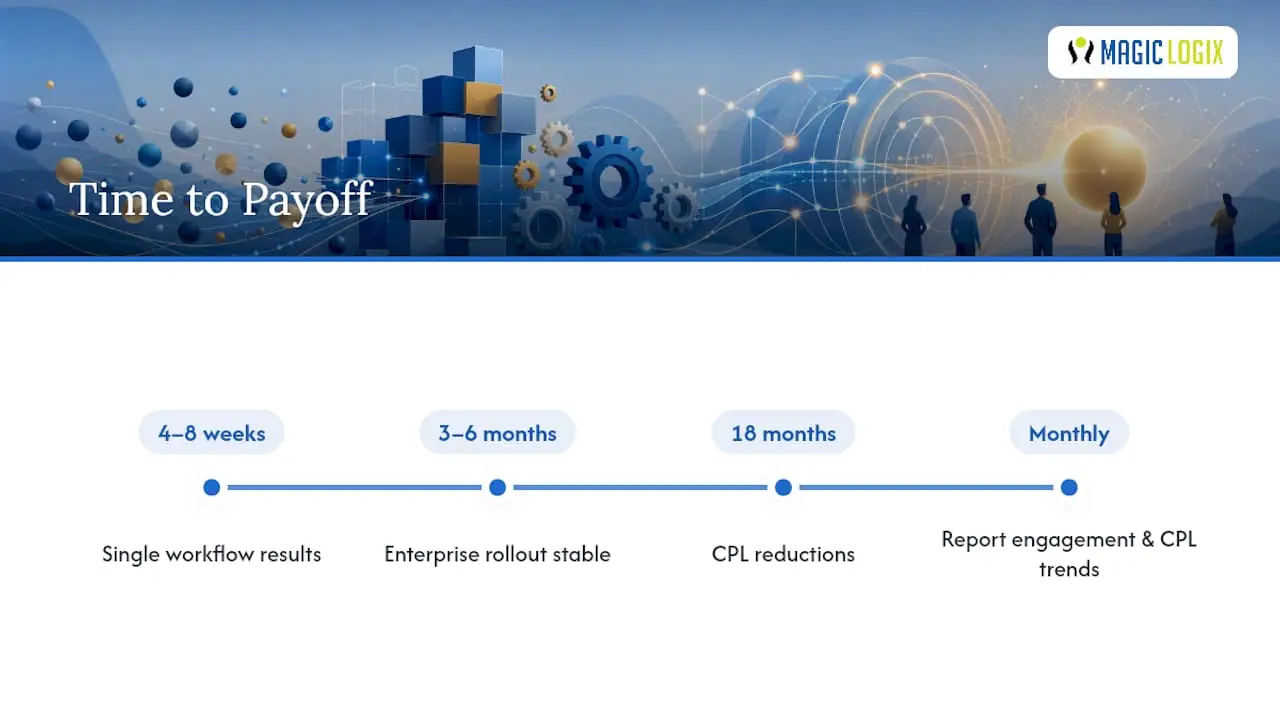
Time to first value depends heavily on scope. A single automated workflow, like a welcome email series or abandoned-cart recovery, can show results within four to eight weeks. A full enterprise rollout with multiple integrated journeys usually takes three to six months before you see stable, attributable performance.
The payoff, once it arrives, tends to be real. Some enterprise adopters report roughly $5.44 returned for every dollar invested, and many B2B teams see meaningful reductions in cost-per-qualified-lead within 18 months of a mature deployment.
Track these early, before the big ROI numbers materialize: email engagement lift, lead response time, cost-per-qualified-lead trendline, and workflow completion rates. Reporting these to stakeholders monthly, rather than waiting for an annual review, keeps budget conversations grounded in measurable outcomes instead of vendor promises.
Why Pilot-First Budgeting Beats Big-Bang Rollouts
Most cost overruns we see trace back to one decision: buying the platform before scoping the use case. Teams get excited about the demo, sign for the enterprise tier, then spend six months figuring out what to automate first. That sequence guarantees a bloated TCO.
Magic Logix builds pilots the other way around. We scope a single high-value workflow, model the real total cost (license, integration, admin time) before a dollar gets spent, and only expand once that pilot proves out.
Not every team needs an agency for this. If you have a certified admin and a clean data source, internal execution works fine. Where agencies earn their fee is in the messier cases: multiple integrations, legacy data, or a team that’s never run a phased rollout before. Our agency playbook for scaling automation results covers both paths.
— Hassan
Get Help Modeling and Controlling Your Automation Costs
Most vendors will sell you the license and disappear once implementation gets hard. Magic Logix builds the TCO model first, so you know your real Year 1 number before you sign anything, then stays through implementation and governance instead of handing you a login and walking away.
Our approach covers the parts of the cost equation that vendors leave out:
- TCO modeling: a real license × multiplier estimate specific to your contact volume and integration count, before you commit.
- Implementation and integration: connecting your CRM, e-commerce stack, and reporting tools without the middleware guesswork.
- Retainer-based governance: ongoing optimization so your platform doesn’t slip into the 33 percent utilization trap that stalls so many deployments.
Magic Logix has run more than 35,000 projects for businesses figuring out exactly this kind of budget question. If you want a clear-eyed look at what your specific setup would actually cost across Year 1 and beyond, start with our digital marketing strategy for small business resource, then reach out for a scoped estimate built around your contact list and current stack.
Sources
- B2B marketing automation platform benchmarks (The Starr Conspiracy)
- The hidden cost of marketing automation platforms nobody talks about (AuthorFormer)
- Marketing technology spending benchmarks 2026 (Knowledgelib)
- Marketing automation cost: What businesses should budget in 2026 (Anglara)
FAQ
How Much Does Marketing Automation Software Cost?
License costs range from roughly $50 a month for small-business plans to $4,400 or more monthly at the enterprise level, but the true first-year cost typically runs 2.5 to 3 times the license fee once implementation and staffing are included.
How Much Does It Cost to Send 10,000 Emails?
This is usually bundled into your contact-based tier rather than billed per send, so the cost depends on your platform’s contact pricing at that volume, generally $300 to $800 a month for a list around 10,000 contacts.
How Much Do AI Automations Cost?
AI-driven features like predictive scoring or generative content typically live in higher feature tiers, adding to your base license cost rather than billing separately, and they’re a major reason enterprise tiers run well above $1,250 a month.
What Does Marketing Automation Do?
It automates repetitive marketing tasks like email sequences, lead scoring, and multi-channel campaign triggers based on customer behavior, freeing your team to focus on strategy instead of manual execution.
Is Marketing Automation Worth the Investment?
For most mid-market and enterprise teams, yes: benchmark data shows returns around $5.44 per dollar invested once the platform is properly implemented and governed, though a poorly scoped rollout can erase that return through hidden costs.