
A professional website redesign in 2026 typically runs in a broad range reflecting small to enterprise projects, with visual refreshes starting at a lower cost and enterprise replatforms potentially reaching substantially higher levels. As a practical rule of thumb, budget 15–20% of your build cost per year for ongoing maintenance, with a hard floor of $200/month for any site your business depends on. According to 2026 benchmark data, redesigns typically cost 15–25% more than equivalent new builds because of the migration, URL mapping, and content preservation work that comes with replacing an existing site. That premium is real, and planning for it upfront is what separates projects that finish on budget from ones that don’t.
Key Takeaways
| Point | Details |
|---|---|
| Cost ranges by scope | Visual refreshes run $1,500–$10,000; full redesigns $10,000–$50,000; replatforms $30,000–$250,000+. |
| Maintenance rule of thumb | Budget 15–20% of build cost per year for upkeep, with a hard floor of $200/month. |
| Top cost drivers | Page count, custom features, integrations, content readiness, and platform migration move the price most. |
| Discovery phase | A 1–2 week discovery phase prevents scope creep and typically costs far less than mid-project corrections. |
| Magiclogix approach | Magiclogix structures redesigns with a phased, discovery-first model and SLA-backed post-launch support for predictable costs. |
Table of Contents
- What does a website redesign cost by project scope?
- What actually drives the price up (or down)?
- What should a professional redesign actually include?
- How long does a website redesign take, and why does discovery matter?
- How do agencies price redesign projects, and what payment terms should you expect?
- E-commerce redesign costs — what extra items should you budget for?
- How can you lower redesign costs without creating problems later?
- How do you budget for a redesign and justify the ROI?
- What questions should you ask agencies before you sign?
- Three realistic example budgets broken down by line item
- Why a specialist agency like Magiclogix reduces cost uncertainty
- Sources
- FAQ
What does a website redesign cost by project scope?
The single biggest mistake SMBs make is treating “website redesign” as one thing with one price. It isn’t. The cost swings dramatically based on scope, and the three main project types each deliver something meaningfully different.
| Tier | Typical Price Range | Timeline | Core Inclusions |
|---|---|---|---|
| Visual refresh | $1,500–$10,000 | 2–6 weeks | New visual design, typography, color system, basic template updates, no structural changes |
| Full redesign | $10,000–$50,000 | 6–16 weeks | Discovery, IA, wireframes, UI design, frontend/backend dev, QA, launch, SEO migration plan |
| Replatform + rebuild | $30,000–$250,000+ | 12–24+ weeks | All of the above plus platform migration, data migration, custom integrations, training |
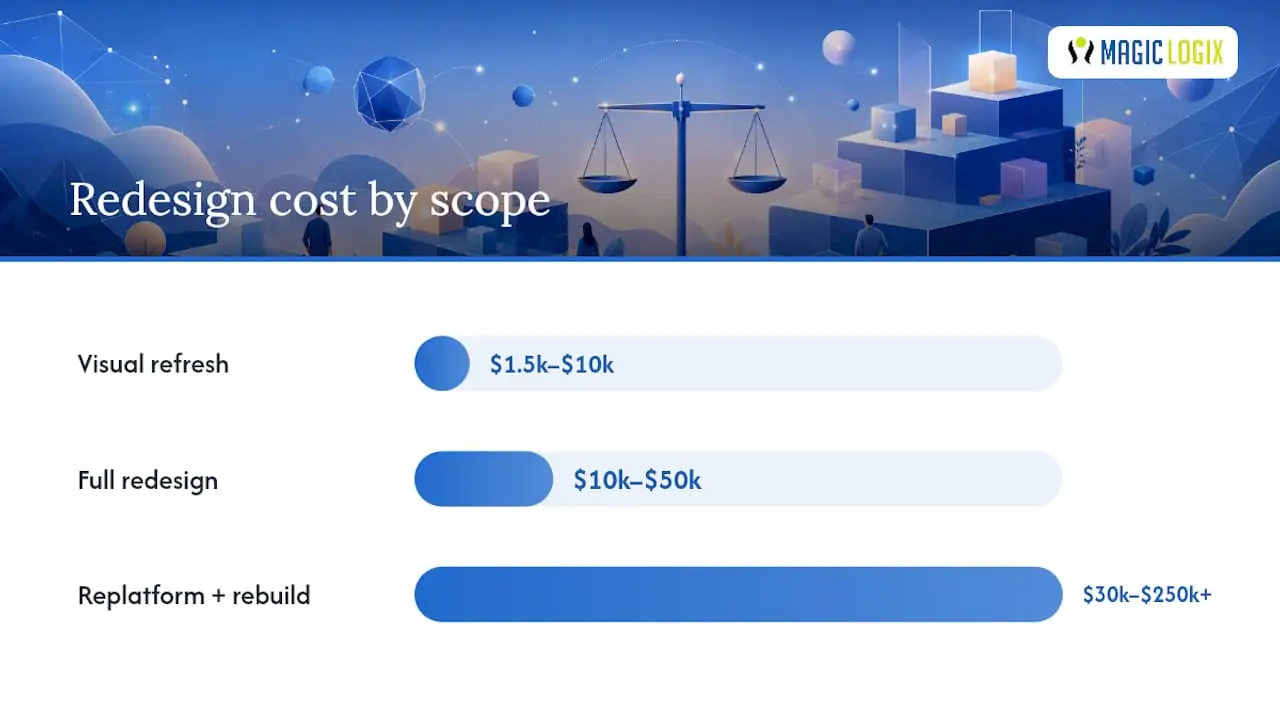
A visual refresh is essentially a coat of paint: new fonts, updated colors, refreshed imagery. It won’t fix broken navigation or a checkout flow that leaks conversions. A full redesign restructures the site from the information architecture outward, which is why it costs more and takes longer. A replatform adds the complexity of moving from one CMS or e-commerce platform to another, and that migration work alone can represent 20–30% of total project cost.
Rough line-item estimates for common deliverables:
- Discovery and strategy: $1,500–$5,000
- Information architecture and wireframes: $2,000–$6,000
- UI/visual design (10–30 pages): $3,000–$12,000
- Frontend development: $4,000–$20,000
- Backend/CMS setup and configuration: $2,000–$15,000
- Third-party integrations (per integration): $500–$3,000 each
- Content migration and copywriting: $1,500–$8,000
- QA and testing: $1,000–$4,000
- Launch support and training: $500–$2,500
These ranges assume a professional agency.
What actually drives the price up (or down)?
Scope is the engine, but specific technical and organizational factors are what move the needle on any given quote. Understanding these lets you ask sharper questions and spot where a vendor may be underquoting.
Page count and template complexity. A 20-page brochure site with three templates costs far less than a 200-page site with 12 custom templates. Each unique template requires its own design and development cycle. Reusing components across templates is where smart agencies save clients real money.
Custom features and functionality. A custom configurator, a member portal, a booking system, or a complex search filter each adds $2,000–$10,000+ to a project. The more a feature requires custom code rather than an off-the-shelf plugin, the higher the cost.

Integrations. Connecting your site to a CRM like Salesforce or HubSpot, an ERP, a marketing automation platform, or a payment gateway adds both development time and ongoing maintenance overhead. Budget $500–$3,000 per integration, more if the API is poorly documented or the data model is complex.
Platform migration. Moving from WordPress to Webflow, or from Magento to Shopify, requires data mapping, content transformation, and often custom import scripts. This work is time-intensive and easy to underestimate.
Content migration and readiness. If your existing content is clean, well-structured, and ready to move, migration is straightforward. If it’s scattered across PDFs, outdated pages, and inconsistent formats, expect significant cleanup costs. Content readiness is one of the most underestimated cost drivers in any redesign.
Accessibility and performance requirements. WCAG 2.1 AA compliance, Core Web Vitals optimization, and multilingual support each add scope. Accessibility audits and remediation alone can run $2,000–$8,000 depending on site size.
SEO preservation. A redesign that ignores URL structure, redirect mapping, and metadata can cause significant organic traffic loss after launch. A proper SEO migration plan, including 301 redirect mapping and crawl validation, is a non-negotiable line item, not an optional add-on.
Stakeholder count and approval cycles. Every additional decision-maker adds review rounds. A project with five internal approvers will take longer and cost more than one with a single point of contact, even if the deliverables are identical.
Pro Tip: Ask every vendor during the proposal stage: “What assumptions are you making about content readiness, and what happens to the timeline and price if those assumptions are wrong?” A vendor who can’t answer that question clearly hasn’t scoped the project honestly.
What should a professional redesign actually include?
A well-scoped redesign contract covers eight distinct phases. If a proposal skips any of them, you’re either getting a partial service or absorbing hidden risk.
Core delivery phases and deliverables:
- Discovery and strategy: Stakeholder interviews, competitor audit, analytics review, goal definition, and a written project brief. This phase produces the document that governs everything else.
- Information architecture (IA) and wireframes: Sitemap, page hierarchy, user flow diagrams, and low-fidelity wireframes for key templates. These are approved before any visual design begins.
- UI design: High-fidelity mockups for all approved templates, a design system or component library, and responsive design specs for mobile and tablet.
- Frontend development: HTML/CSS/JavaScript build, CMS theme or template development, and responsive implementation.
- Backend development: CMS configuration, custom functionality, integrations, and database work where applicable.
- QA and testing: Cross-browser and cross-device testing, form and checkout testing, performance benchmarking, and accessibility checks.
- Launch plan: Staging-to-production deployment checklist, DNS cutover plan, redirect implementation, and a rollback procedure.
- Training and documentation: CMS training for your team, an admin guide, and a handoff document covering all integrations and credentials.
Scope clarifications to add to any contract:
- Who owns all design files, source code, and content after launch? (You should.)
- Does the scope include a 301 redirect map for all changed URLs?
- What is the rollback procedure if a critical bug appears post-launch, and what is the response SLA?
- What constitutes “acceptance” of each deliverable, and how many revision rounds are included?
- Are third-party license costs (plugins, fonts, stock imagery) included or billed separately?
Post-launch rollbacks deserve specific attention. A responsible agency maintains a staging environment and a production backup so that a critical issue discovered within 48–72 hours of launch can be reversed without data loss. If a vendor’s contract doesn’t mention a rollback plan, ask for one in writing before you sign.
How long does a website redesign take, and why does discovery matter?
Timeline and cost are directly linked. Projects that skip or rush the early phases almost always expand in scope mid-build, which costs more to fix than it would have cost to plan correctly from the start.
Phase-by-phase timeline by project size:
- Visual refresh (2–6 weeks): Week 1: brief and asset collection. Weeks 2–4: design. Week 5–6: development and QA.
- Full redesign (6–16 weeks): Weeks 1–2: discovery and strategy. Weeks 3–4: IA and wireframes. Weeks 5–8: UI design. Weeks 9–13: development. Weeks 14–15: QA. Week 16: launch.
- Replatform + rebuild (12–24+ weeks): Weeks 1–2: discovery. Weeks 3–5: IA, platform selection, and migration planning. Weeks 6–10: design. Weeks 11–18: development and integration. Weeks 19–22: QA and UAT. Weeks 23–24: staged launch and monitoring.
Decision gates matter at each phase transition. Design should not begin until wireframes are approved. Development should not begin until design is signed off. Each gate requires a named decision-maker on your side, and delays at any gate push the entire timeline.
Discovery (weeks 1–2) is the highest-ROI investment in any redesign project. It produces the brief, the sitemap, the technical requirements, and the risk register that prevent scope creep. Projects that skip it routinely encounter mid-build surprises that cost two to three times what discovery would have.
For a practical overview of how the redesign process maps to business outcomes, the phases above align closely with how experienced agencies structure their engagements.
How do agencies price redesign projects, and what payment terms should you expect?
Understanding the pricing model matters as much as understanding the price. Different models shift risk differently between you and the vendor.
Pricing model comparison:
- Fixed price: The agency quotes a single number for a defined scope. You get cost certainty; the agency absorbs overrun risk. Works well when scope is clearly defined upfront. Any scope change triggers a change order.
- Time and materials (T&M): You pay an hourly or daily rate for actual hours worked. Flexible for evolving projects, but cost certainty is low. Best for projects where requirements are genuinely unclear at the start.
- Staged/phased billing: A hybrid where each phase is fixed-priced separately. You approve and pay for discovery before committing to design, and design before committing to development. This model gives you natural exit points and aligns payment to delivered value.
- Retainer: A monthly fee for ongoing work, often used post-launch for maintenance, content updates, and incremental improvements. Typically $500–$5,000/month depending on scope.
Typical payment schedules:
- Fixed-price projects: 25–33% deposit at signing, 25–33% at design approval, 25–33% at development completion, final 10–15% at launch acceptance.
- T&M projects: monthly invoicing against actuals, sometimes with a retainer deposit.
- Phased projects: payment at the start of each phase, with the next phase contingent on approval of the previous one.
Pro Tip: Negotiate a 10–15% holdback on the final payment, released only after a 30-day post-launch period with no critical bugs. This gives the agency a financial incentive to resolve issues quickly and gives you leverage if the launch has problems.
E-commerce redesign costs — what extra items should you budget for?
An e-commerce redesign is a different animal from a brochure site rebuild. Two projects with identical page counts can vary by $30,000–$50,000 or more if one involves a complex product catalog and the other doesn’t.
E-commerce-specific cost line items:
- Catalog migration: Moving product data, variants, pricing, and images from one platform to another. For catalogs over 500 SKUs, expect $3,000–$10,000+ in migration work alone.
- Payment gateway setup and testing: Stripe, PayPal, Authorize.Net, and similar integrations require configuration, sandbox testing, and PCI compliance review. Budget $1,000–$3,000.
- Shipping and tax rule configuration: Real-time shipping rate APIs, multi-state tax rules, and international shipping logic add complexity. $500–$2,500 depending on rule complexity.
- Search and filtering: Faceted search, filtered navigation, and product recommendation engines are often custom builds. $2,000–$8,000.
- Checkout optimization: A/B tested checkout flows, guest checkout, saved payment methods, and upsell logic. $1,500–$5,000.
- Fraud prevention and security: Tools like Signifyd or Kount, plus SSL configuration and security hardening. The IBM Cost of a Data Breach Report documents the financial impact of security incidents, which makes this a non-optional budget line.
Migration safety checklist for e-commerce launches:
- Test all payment methods in a staging environment before go-live.
- Verify that historical order data is preserved and accessible.
- Confirm that all product URLs either remain the same or have 301 redirects in place.
- Run a full cart-to-confirmation flow test for each shipping zone.
- Validate inventory sync if you use a warehouse management or ERP system.
The cost multiplier on e-commerce comes from the combination of data complexity, integration depth, and the zero-tolerance for errors at checkout. A bug that breaks a contact form is annoying. A bug that breaks checkout costs you revenue every hour it’s live.
How can you lower redesign costs without creating problems later?
Cutting cost is possible without cutting quality, but it requires discipline about where you cut and where you don’t.
-
Start with an MVP scope. Define the minimum viable site that achieves your primary business goal, launch it, and add features in subsequent phases. A phased approach spreads cost over time and lets real user data guide what to build next, rather than assumptions made in a conference room.
-
Use a design refresh before a full rebuild. If your site’s structure and content are sound but the visual design feels dated, a refresh costs 60–70% less than a full redesign. Run a quick conversion audit first to confirm the problem is aesthetic, not structural.
-
Leverage component libraries and templates. Agencies that build on established component systems (like a custom design system or a well-maintained theme) can deliver faster and cheaper than those who build from scratch. Ask vendors whether they use a component library and whether you’ll own it after launch.
-
Arrive with content ready. Content creation and copywriting during a redesign project is one of the most common causes of delays and cost overruns. If you can provide final copy, approved images, and structured data before design begins, you can reduce project cost by 15–25%.
-
Limit custom integrations in phase one. Every integration adds cost and risk. Identify which integrations are truly necessary at launch versus which ones can be added in month three or six.
-
Reduce stakeholder approval layers. Designate one internal decision-maker with authority to approve deliverables. Every additional approver adds review cycles, and review cycles add time, which adds cost on T&M projects and delays fixed-price ones.
-
Scope discipline over feature creep. The most expensive words in a redesign project are “while we’re at it.” Every mid-project addition should go through a formal change order with a cost and timeline impact assessment.
Pro Tip: Use a content-first approach: write and finalize your key page copy before design begins. Designers who work from real content produce layouts that fit the actual message, which means fewer revision rounds and a faster path to approval.
How do you budget for a redesign and justify the ROI?
A website redesign is a capital investment, and it should be treated like one. That means building a pro forma, not just getting a quote.
If your redesign costs $20,000, budget $3,000–$4,000 per year for ongoing maintenance, with a hard floor of $200/month. That covers dependency updates, security patches, content updates, analytics reviews, and minor enhancements. Recurring costs like hosting and plugin licenses typically add $15–$150/month on top of that, per Forbes Advisor’s cost analysis.
Sample ROI calculation:
The conversion rate assumption above (1.2% to 2.0%) is conservative. A well-executed redesign that addresses key user experience factors can produce notable improvements in conversion rates. Tie your ROI case to your own analytics baseline, not industry averages, and your finance team will take it more seriously.
Showing the range demonstrates rigor and makes the base case more credible than a single-point estimate.*
For SMBs looking to connect redesign ROI to broader digital marketing for business growth, the website is typically the highest-leverage asset in the stack — every channel drives traffic back to it.
What questions should you ask agencies before you sign?
Getting three comparable proposals requires asking every vendor the same questions. Without a structured RFP, you’ll end up comparing apples to oranges and choosing on price rather than value.
Must-ask questions for every vendor:
- What does your discovery phase include, and what deliverables does it produce?
- How do you handle scope changes mid-project? Show me a sample change order.
- Who owns the design files, source code, and content after launch?
- What is your URL migration and 301 redirect process?
- How do you test before launch, and what does your QA checklist cover?
- What is your post-launch support policy, and what’s the SLA for critical bugs?
- Who will be my day-to-day contact, and what is their role on the project?
- Can you share two or three case studies from clients in a similar industry or with a similar scope?
How to compare proposals on equal footing:
- Create a deliverables matrix listing every phase and deliverable from the outline above.
- Mark which deliverables each proposal explicitly includes versus excludes.
- Note every assumption each vendor makes (content readiness, number of templates, integrations included).
- Calculate the true cost by adding likely change orders for excluded items.
- Weight the final score by deliverable completeness, not headline price.
RFP red flags to watch for:
- A proposal with no discovery phase or a discovery phase shorter than one week.
- No mention of SEO migration or redirect mapping.
- Vague language like “up to X pages” without defining what counts as a page.
- No post-launch support period or a support period shorter than 30 days.
- A contract that assigns IP ownership to the agency rather than the client.
For broader guidance on how to hire a marketing agency and structure the engagement for real results, the same principles apply: scope clarity upfront prevents expensive surprises later.
Three realistic example budgets broken down by line item
These three examples use real-world assumptions to show how totals form. They are illustrative, not quotes.
Example 1: Visual refresh for a 15-page service business site
Assumptions: Content is final and provided by client. No structural changes. No new integrations. WordPress CMS.
Example 2: Full redesign for a 40-page B2B company site
Assumptions: One CRM integration. Client provides copy; agency handles migration. Existing WordPress site moving to a new WordPress build.
Example 3: Replatform + rebuild for a mid-market e-commerce brand
Assumptions: Magento to Shopify Plus migration. 800 SKUs. Two payment gateways. Real-time shipping API. No custom ERP integration.
Common hidden costs to watch for across all three:
- Stock photography and licensed font costs (often $200–$1,500, billed separately).
- Premium plugin or SaaS tool licenses not included in the agency quote.
- Copywriting for new pages added mid-project.
- Additional revision rounds beyond the contract allowance.
- Post-launch bug fixes outside the warranty period.
It’s standard practice on any project with dependencies you don’t fully control.
Why a specialist agency like Magiclogix reduces cost uncertainty
Most budget overruns on redesign projects don’t come from bad intentions. They come from under-scoped discovery, vague contracts, and agencies that quote to win rather than to deliver. A specialist agency structures the engagement to prevent those failure modes from the start.
Magiclogix approaches redesign projects with a phased, modular build model: discovery and strategy come first and produce a written brief that governs scope, timeline, and budget. Design doesn’t begin until that brief is approved. Development doesn’t begin until design is signed off. Each phase has defined deliverables, acceptance criteria, and a named decision gate.
What SMBs typically get from a Magiclogix engagement:
- A dedicated discovery phase (1–2 weeks) that produces a project brief, sitemap, technical requirements, and a risk register before any design work begins.
- Modular design and development using reusable component systems, which reduces per-page cost and speeds up future updates.
- An SEO migration plan included as a standard deliverable, not an optional add-on.
- SLA-backed post-launch support with defined response times for critical issues.
- Ongoing maintenance retainers structured around the 15–20% annual rule, so year-two costs are predictable from day one.
For SMBs that want to connect a redesign to a broader digital marketing strategy for small business, Magiclogix combines web development with SEO, paid media, and marketing automation in a single engagement, which eliminates the coordination overhead of managing multiple vendors.
To request a scoped estimate, contact Magiclogix directly through the website and ask for a discovery-phase proposal. That first conversation costs nothing and produces a clear picture of what a project would actually involve.
When should you redesign vs. just iterate?
The honest answer is that most businesses redesign too often and iterate too rarely, or they iterate on the wrong things and then redesign out of frustration.
A full redesign is justified when the site’s information architecture is broken, the platform is end-of-life, the brand has fundamentally changed, or conversion rates are structurally low despite good traffic. Those are problems that targeted fixes can’t solve. But if the site’s bones are sound and the conversion problem is isolated to a specific page or flow, a targeted UX intervention — a redesigned pricing page, a simplified checkout, a faster homepage — will deliver faster ROI at a fraction of the cost.
The signal I find most reliable: run a heatmap and session recording audit on your top five pages before committing to a full redesign. If the data shows users are confused by navigation or can’t find what they need, that’s an architecture problem. If it shows they’re engaged but dropping off at a specific CTA or form, that’s a conversion optimization problem. One justifies a redesign. The other justifies a sprint.
Magiclogix helps you budget and build with confidence
Redesign projects fail when the budget is built on assumptions and the scope is built on hope. Magiclogix structures every engagement around a discovery phase that produces a real brief, a real budget, and a real timeline before any design or development begins. That means fewer surprises, fewer change orders, and a final product that actually matches what was scoped.
Whether you’re planning a visual refresh or a full replatform, the right first step is a scoped conversation, not a ballpark quote. Magiclogix works with small and mid-sized businesses across industries to build sites that perform, not just sites that look good. Request your digital marketing and web development estimate today and get a clear picture of what your project will actually cost.
Sources
- Website Redesign Cost: 2026 Budget Guide | Refact
- Website Redesign Cost 2026: $2K-$50K+ Breakdown
- How to budget for ongoing website maintenance | Bedrock Labs
- IBM — Cost of a Data Breach Report
FAQ
How much does a website redesign cost in 2026?
Most small and mid-sized businesses spend $5,000–$50,000 on a professional redesign, with visual refreshes starting near $1,500 and enterprise replatforms reaching $250,000 or more. The final number depends on scope, page count, integrations, and content readiness.
How long should a website redesign take?
A visual refresh typically takes 2–6 weeks, a full redesign 6–16 weeks, and a replatform plus rebuild 12–24 weeks or longer. Discovery and stakeholder approval speed are the two factors that most commonly extend timelines.
How do you redesign an existing website without losing SEO rankings?
A proper SEO migration plan, including 301 redirect mapping for all changed URLs, metadata preservation, and a post-launch crawl validation, is the standard approach. Skipping redirect mapping is one of the most common causes of traffic loss after a redesign launch.
What is the 3-second rule in website design?
The 3-second rule holds that a visitor decides whether to stay or leave within roughly three seconds of landing on a page. Page speed, a clear headline, and an obvious next step are the three elements that most directly influence that decision.
Is it cheaper to redesign a website in-house or hire an agency? For a useful comparison of agency versus automated platforms and the associated costs, see this SEO agency vs. automated platforms analysis.
In-house redesigns appear cheaper because labor costs are internal, but they typically take longer, require more coordination, and often lack specialized skills in UX, SEO migration, and QA. Agencies carry higher upfront cost but deliver faster timelines, defined deliverables, and accountability. For most SMBs without a dedicated web development team, a specialist agency like Magiclogix produces a better outcome per dollar spent.