
Brand lift measurement is the practice of quantifying the incremental change in consumer perception caused by ad exposure, using a randomized exposed vs. control study design. Your most useful next step is to pick one primary KPI, set up a holdout group before your campaign launches, and run at least one survey-based study on your next video flight.
Brand lift measurement will tell you:
- Whether your ads shifted awareness, ad recall, favorability, consideration, or purchase intent
- Which creative executions drove the most perception change
- How much lift you generated per dollar spent (cost-per-lifted-user)
Brand lift measurement will NOT tell you:
- How many conversions or purchases your campaign directly caused
- Exact revenue attribution or return on ad spend (ROAS)
- Why individual users made a purchase decision
Key Takeaways
Effective brand lift measurement requires a randomized exposed vs. control design, a clearly defined primary KPI, and enough budget and flight length to reach statistical significance before the campaign launches.
| Point | Details |
|---|---|
| Choose one primary KPI | Match your metric to your campaign objective: ad recall for awareness, consideration for mid-funnel. |
| Protect the control group | Isolate your holdout from all other active brand media to avoid contamination that distorts results. |
| Plan sample size upfront | Platform study designs often lock at launch; underpowered studies cannot be fixed retroactively. |
| Use relative lift for high-baseline brands | Absolute lift understates performance when baselines are already high; headroom determines the ceiling. |
| Magiclogix measurement framework | Magiclogix combines platform-native and third-party studies to deliver cross-channel lift measurement for mid-market brands. |
Table of Contents
- What is brand lift and why does it matter for video campaigns?
- Core brand lift metrics: what each KPI actually measures
- How brand lift studies work: design, surveys, and statistical confidence
- Which platforms let you run brand lift studies?
- Best practices for designing a reliable brand lift study
- How to interpret your brand lift results
- Turning lift data into concrete campaign optimizations
- How Magiclogix approaches brand lift measurement
- What most brand lift guides get wrong
- Magiclogix helps you measure what your ads actually change
- Sources
- FAQ
What is brand lift and why does it matter for video campaigns?
Brand lift is the measurable, incremental improvement in how consumers perceive your brand after seeing your ads, isolated from all other factors. Brand lift studies compare an exposed group and a control (holdout) group to measure changes in awareness, recall, favorability, consideration, and purchase intent attributable to those ads.
Performance metrics like clicks, conversions, and ROAS tell you what people did. Brand lift tells you what they think. Those are different questions, and confusing them is one of the most common mistakes in campaign reporting. A campaign can drive strong click-through rates while doing nothing for brand consideration, or it can build significant awareness without generating a single trackable conversion in the same window.
Brand lift studies are the right tool when you are:
- Running top-of-funnel video or display campaigns where direct conversion is not the goal
- Validating whether a new creative direction actually resonates with your audience
- Proving campaign value to stakeholders who want evidence beyond last-click attribution
- Testing whether a media mix change (more YouTube, less display) moved the needle on perception
The video-first emphasis matters here. YouTube and connected TV placements are where brand-building budgets concentrate. Platform-native tools like Google Brand Lift are built specifically to measure perception shifts from video ad exposure. Understanding digital marketing performance metrics across both brand and performance dimensions gives you the full picture of what a campaign actually accomplished.
Core brand lift metrics: what each KPI actually measures
Every brand lift study should be anchored to one primary metric that matches your campaign objective. The seven standard metrics below cover the full funnel from first awareness to purchase readiness.
- Brand awareness: Does the consumer know your brand exists? Typically measured with an unaided or aided recall question.
- Ad recall: Did the consumer remember seeing your specific ad? The most sensitive metric for short flights; it moves fastest.
- Brand familiarity: How well does the consumer know your brand beyond just recognizing the name?
- Brand favorability: Does the consumer have a positive opinion of your brand? Moves more slowly than recall.
- Consideration: Would the consumer consider your brand the next time they are in the market?
- Purchase intent: How likely is the consumer to buy from you in a defined timeframe?
- Message association: Does the consumer connect a specific claim or attribute to your brand after seeing the ad?
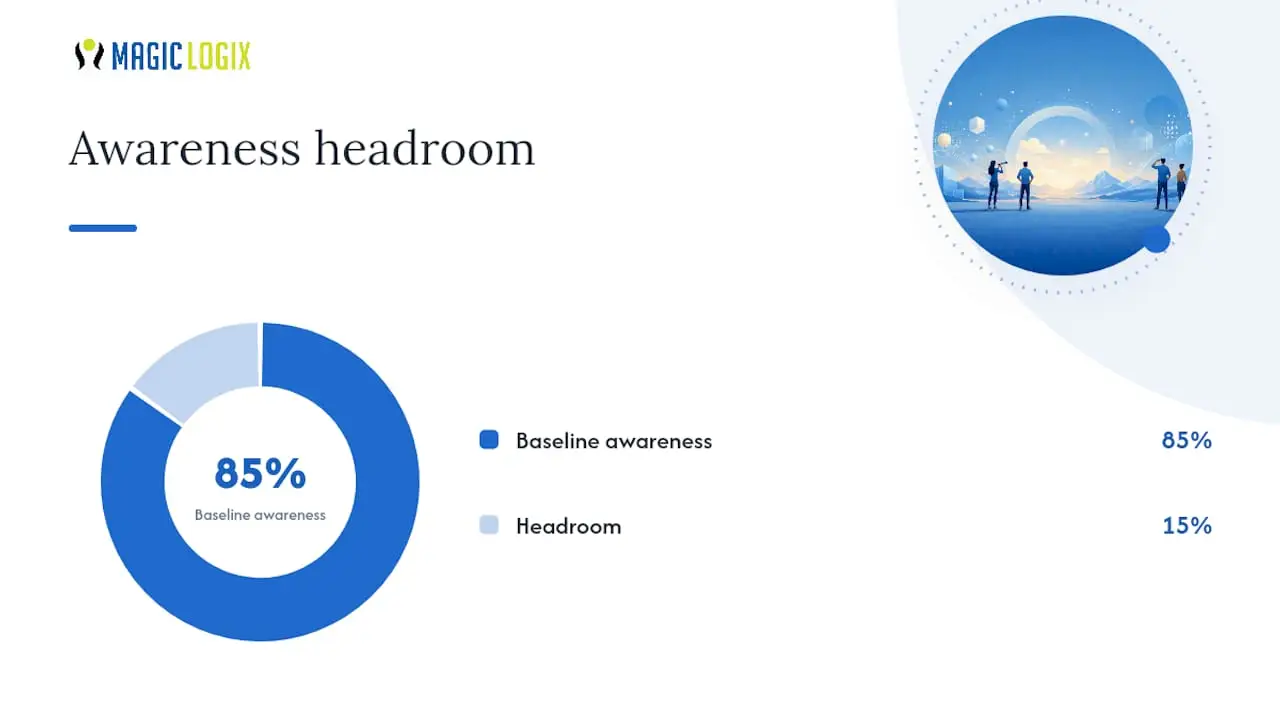
Headroom is the ceiling on how much lift is theoretically possible. If your brand awareness baseline is already 85%, you have only 15 points of headroom, so even a strong campaign will show modest absolute lift. Relative lift is the fairer comparison in high-baseline categories.
| Metric | Typical survey question | Business decision it informs |
|---|---|---|
| Ad recall | “Do you recall seeing an ad for [Brand] in the past week?” | Creative memorability; frequency tuning |
| Brand awareness | “Which of these brands have you heard of?” | Reach strategy; new-market entry |
| Consideration | “Which brands would you consider for your next purchase?” | Mid-funnel investment; competitive positioning |
| Purchase intent | “How likely are you to purchase from [Brand] in a defined timeframe?” | Lower-funnel readiness; promotion timing |
| Message association | “Which brand do you associate with [claim/attribute]?” | Creative messaging effectiveness |
How brand lift studies work: design, surveys, and statistical confidence
The core design is a randomized control trial: users are randomly split into an exposed group (who see the ads) and a control group (a holdout who does not). After a defined exposure window, both groups receive a short survey, usually a single question. The difference in responses between the two groups, adjusted for baseline, is the lift attributable to your campaign.
Survey mechanics
Surveys are delivered in-platform, typically as a single-question prompt shown to users shortly after ad exposure. Google Brand Lift, for example, serves these surveys within YouTube itself, capturing responses in a real-world environment rather than a recruited panel. The question is kept to one item per survey to minimize drop-off and keep response quality high.
Timing matters. Ad recall peaks within 24–72 hours of exposure and decays quickly. Awareness and consideration metrics are more durable but also slower to move, which means shorter flights may not generate enough signal on those deeper metrics.
Sample size and statistical confidence
An underpowered study is worse than no study at all because it produces inconclusive results that look like “no lift” when the real problem is insufficient data. The minimum sample size you need depends on three variables: your baseline rate, the detectable lift threshold you are targeting, and your desired confidence level (typically 90% or 95%).
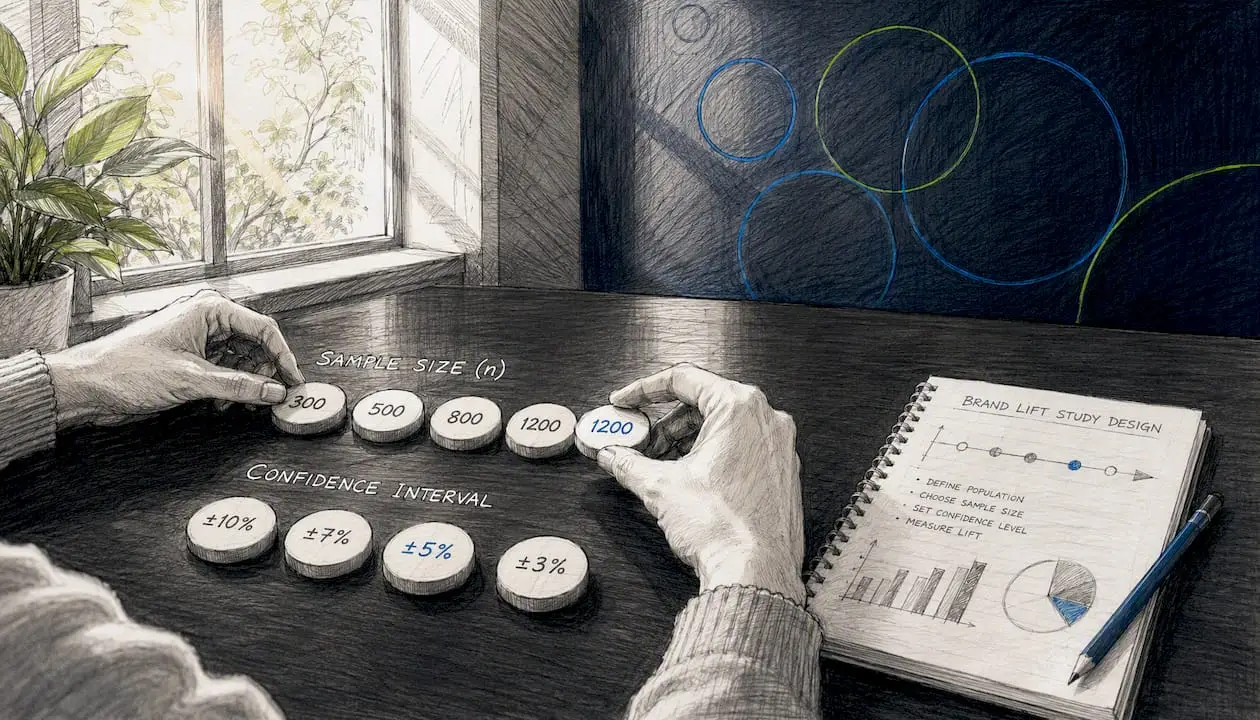
As a practical rule, the lower your baseline awareness, the easier it is to detect lift because there is more headroom. High-baseline brands need larger samples to detect the same absolute shift. Platform-native tools like Google Brand Lift include a measurement eligibility calculator that estimates whether your planned budget and flight length will generate enough survey responses to reach statistical significance.
Pro Tip: Plan your sample size before the campaign launches, not after. Some platforms lock the study design at flight start, meaning you cannot retroactively extend a study that ran short. Facebook’s Brand Lift guidance explicitly warns that underpowered studies cannot be fixed by adding time after the fact.
Confidence intervals tell you the range within which the true lift likely falls. Results that cross zero (e.g., “3 points, CI: -1 to +7”) are not statistically significant and should be treated as inconclusive.
Control group contamination is one of the most damaging and overlooked risks. Running concurrent retargeting or overlapping media to the same audience contaminates the holdout and can neutralize measured lift entirely. If your control group is being reached by other active campaigns for the same brand, the gap between exposed and control narrows artificially, making a real lift look like zero. Isolate your study audience from other active media during the measurement window. Understanding push vs. pull marketing strategies and how cross-channel activity interacts is useful context here.
Which platforms let you run brand lift studies?
Choosing the right measurement approach depends on your channel mix, budget, and how much cross-platform visibility you need.
Platform-native tools
Google Brand Lift is the most widely used platform-native option for video campaigns. It is built specifically for YouTube and Display & Video 360 (DV360) placements, delivers surveys inside the YouTube environment, and reports absolute lift, relative lift, lifted users, and cost-per-lifted-user in near real time. That near-real-time reporting is a genuine advantage: you can make midflight creative swaps based on early lift signals rather than waiting for a post-campaign report.
Meta Brand Lift works similarly for Facebook and Instagram campaigns, using a holdout group design and in-feed survey delivery. Both platforms are convenient and cost-effective, but they are siloed: Google Brand Lift measures Google inventory, Meta measures Meta inventory, and neither gives you a cross-channel view.
Third-party panel vendors
Vendors like Dynata, Lucid, and Nielsen run independent brand lift panels that are not tied to a single platform. They can measure lift across channels simultaneously, which makes them the right choice for large campaigns running across multiple platforms or for brands that need a methodology that is independent of the media seller. The trade-off is cost and turnaround time. Third-party studies typically cost more and take longer to field than platform-native options.
DIY post-hoc surveys
You can run your own brand surveys using tools like SurveyMonkey or Qualtrics, fielding to a sample before and after a campaign. This approach is directional at best. Without true randomization at the user level, you cannot cleanly isolate ad exposure as the cause of any shift you observe. Use DIY surveys when budget constraints make platform-native or third-party studies impractical, and treat the results as a signal rather than a proof point.
| Approach | Best for | Minimum budget | Cross-channel? |
|---|---|---|---|
| Google Brand Lift (Standard) | YouTube/DV360 video campaigns | Platform minimum spend threshold | No |
| Google Brand Lift (Enhanced) | Larger YouTube campaigns needing more responses | ~3x standard minimum | No |
| Meta Brand Lift | Facebook/Instagram campaigns | Platform minimum spend threshold | No |
| Third-party panel (Dynata, Lucid, Nielsen) | Multi-platform or independent measurement | Higher; varies by vendor | Yes |
| DIY pre/post survey | Small budgets; directional only | Minimal | Yes (directional) |
Google Brand Lift’s budget and eligibility rules include a 10-day spend window requirement and an Enhanced Lift option that requires roughly three times the standard minimum budget to collect more survey responses and reach significance faster. If your campaign is close to the eligibility threshold, the Enhanced option is worth the additional spend because it reduces the risk of an underpowered study.
Best practices for designing a reliable brand lift study
A well-designed study gives you results you can act on. A poorly designed one gives you noise that looks like data.
Pre-launch checklist:
- Define one primary KPI that matches your campaign objective (ad recall for awareness flights, consideration for mid-funnel)
- Set your holdout percentage before launch (typically 10–15% of your audience)
- Confirm your planned budget and flight length meet the platform’s eligibility threshold
- Document your baseline: pull any prior brand tracker data or past lift results for the same metric
- Avoid launching during major PR events, product launches, or brand crises that could shift baseline perception independently of your ads
Creative-level testing:
Breaking results out by creative execution is where brand lift studies deliver their sharpest insight. Creative is often the primary variable driving lift differences across executions, and flat lift with strong reach usually points to a creative problem rather than a targeting or frequency problem. Structure your campaign so each creative variant runs to a comparable audience segment, and make sure each variant has enough impressions to generate its own statistically meaningful result.
Pro Tip: Batch your creatives into two or three variants rather than running five or six simultaneously. Too many variants split your impressions too thin, and none of them reach the sample size needed for significance. Two strong variants tested head-to-head will teach you more than six weak signals.
Execution controls:
- Cap frequency at a level that gives users enough exposures to register the brand message. Lift often concentrates among users with multiple exposures, so too-low frequency can suppress detectable lift.
- Keep targeting consistent across the flight. Mid-flight audience changes can introduce selection bias.
- Isolate the study audience from other active brand campaigns to protect the control group.
- Plan for a flight length of at least four to six weeks for consideration and intent metrics, which move more slowly than ad recall.
Measurement hygiene:
Avoid incentivized panels for brand lift surveys. Respondents who are paid to complete surveys tend to answer more positively across the board, inflating lift artificially. Platform-native tools handle this by design, but if you are working with a third-party vendor, ask explicitly about their panel recruitment and incentive structure.
Re-measure quarterly or after any significant creative or media change. A single study is a snapshot; a series of studies is a trend line, and the trend line is what tells you whether your brand is actually building over time. Reviewing media planning examples that connect flight length and frequency to exposure outcomes can help you structure your study windows more precisely.
How to interpret your brand lift results
Reading lift numbers correctly is what separates a team that acts on data from one that just reports it.
Absolute lift is the most intuitive metric: the percentage-point gap between exposed and control.
Cost-per-lifted-user is calculated by dividing your total campaign spend by the number of “lifted users” (the estimated count of people whose perception actually shifted). If you spent $200,000 and generated 40,000 lifted users, your cost-per-lifted-user is $5.00. This metric lets you compare the efficiency of different campaigns, creatives, or placements on a common basis.
What counts as strong lift? Context matters more than any universal benchmark. Ad recall tends to move more easily than consideration or purchase intent. New brands with low baselines can see double-digit absolute lift on awareness; established brands in saturated categories may see 2–3 points and call it a win. The right benchmark is your own prior results, your category’s norms (available from vendors like Dynata or Nielsen), and the headroom your baseline allows.
When results are inconclusive: If your confidence intervals cross zero, do not report the result as “no lift.” It means the study lacked the statistical power to detect lift at the level it may have occurred. The right response is to plan a longer or better-funded study in the next flight, not to conclude the campaign failed. Connecting lift signals to downstream behavioral data through customer journey analytics can provide corroborating evidence when lift results alone are ambiguous.
Present results to stakeholders in this order: significance first (is the result statistically valid?), then direction (did it go up?), then magnitude (by how much?), then the action you are recommending based on the finding.
Turning lift data into concrete campaign optimizations
Lift data is only useful if it changes what you do next. Here is how to move from measurement to action.
Creative actions:
- Pause creatives with flat or negative lift, even if they are driving strong click-through rates. A high-CTR ad that does not move brand perception is optimizing for the wrong outcome.
- Prioritize the highest-lift creative in your next flight and test variants of it (different opening frames, different calls to action, different talent) to push lift further.
- Use message association results to identify which brand claims are landing. If your “most trusted” message is not associating, rewrite the creative around the claim that is.
Media actions:
- Shift budget toward placements and formats that show higher lift per dollar. If YouTube pre-roll is generating twice the lifted users per $1,000 spent compared to display, that is a reallocation signal.
- Use frequency findings to tune delivery. If lift concentrates at three to five exposures, set frequency caps that ensure most of your audience reaches that threshold rather than spreading impressions too thin. Guidance on how to optimize PPC campaigns applies the same reallocation logic to paid search budgets.
- For B2B campaigns, segment lift results by job title or company size to find the audience segments where your creative is most effective.
Measurement actions:
- Schedule a re-measurement study four to six weeks after any significant creative or media change to confirm the optimization worked.
- Stitch lift results to downstream behavioral signals: did the cohort that showed higher consideration also show higher site visit rates or longer session durations in the weeks that followed? That connection is how you build the case for brand investment with performance-minded stakeholders. Measuring digital marketing effectiveness across both perception and behavioral signals gives you the full attribution story.
How Magiclogix approaches brand lift measurement
Magiclogix uses a five-stage framework for every brand lift engagement: define the objective, design the study, collect responses, test for significance, and optimize based on findings. That sequence sounds simple, but most measurement failures happen in the first two stages, not the last three.
The framework combines platform-native measurement (Google Brand Lift for YouTube and DV360 campaigns) with third-party panel studies from vendors like Dynata and Lucid for clients running cross-channel campaigns. Platform-native tools give you speed and cost efficiency; third-party panels give you independence and cross-platform coverage. For most mid-market brands, the right answer is platform-native for ongoing campaign measurement and a third-party study once or twice a year for a channel-agnostic baseline.
Magiclogix’s team has completed over 35,000 digital marketing projects, which means the measurement frameworks here are drawn from real campaign experience across industries, not theoretical models. For brands that want help designing a study, interpreting results, or connecting lift signals to revenue, Magiclogix’s digital marketing services are built for exactly that kind of engagement.
What most brand lift guides get wrong
Brand lift measurement is often sold as a validation tool, something you run after a campaign to confirm it worked. That framing is backwards, and it is why so many studies come back inconclusive.
The study design has to be built into the campaign plan from day one. The holdout group needs to be set before the first impression serves. The primary KPI needs to be chosen before the creative is finalized, because the creative should be built to move that specific metric. Running a brand lift study as an afterthought, bolted onto a campaign that was planned without it, is like trying to measure the effect of a drug after you have already given it to the entire trial population.
The second thing most guides underemphasize is creative. Reach and frequency are table stakes. The variable that actually separates a 2-point lift from a 12-point lift is almost always the creative execution. Flat lift with strong reach is a creative problem, not a media problem. That distinction matters because the fix is completely different: you do not solve a creative problem by buying more impressions.
Finally, the obsession with statistical significance can become its own trap. It is a signal that your study was underpowered, and the right response is to plan a better-funded study next time, not to dismiss the directional finding. Brand building is a long game. A consistent directional signal across three underpowered studies is more meaningful than one technically significant result from a single flight.
Magiclogix helps you measure what your ads actually change
Most brands running video campaigns already have performance data. What they are missing is the perception layer: evidence that their ads are shifting how consumers think and feel about the brand, not just whether they clicked.
Magiclogix builds brand lift measurement into campaign strategy from the start, not as a post-campaign add-on. The team designs the holdout, selects the right platform-native or third-party methodology for your channel mix, and translates lift results into specific creative and media recommendations. With over 35,000 completed projects, Magiclogix brings cross-industry measurement experience to brands that want more than a dashboard number. If you are ready to connect your ad spend to real shifts in brand perception, talk to the Magiclogix team about building a measurement framework for your next campaign.
Sources
The following sources are worth bookmarking for platform-specific mechanics, methodology guidance, and vendor comparisons.
- Brand Lift Measurement: Key Metrics for Campaign Success – Dynata
- About Brand Lift – Google Ads Help
- Brand Lift: meaning, examples, how it works
Consult platform documentation directly for current budget thresholds and eligibility calculators, as these figures update periodically. For cross-channel campaigns, contact a third-party vendor to scope a study that covers your full media mix.
FAQ
What is a good brand lift percentage?
There is no universal benchmark, but ad recall typically shows the largest absolute lifts (often 5–15 percentage points), while consideration and purchase intent move more slowly and show smaller absolute gains. The right benchmark is your own historical results, your category norms, and the headroom your baseline allows.
What are the core metrics in a brand lift study?
The seven standard metrics are brand awareness, ad recall, brand familiarity, brand favorability, consideration, purchase intent, and message association. Most studies focus on one or two primary metrics aligned to the campaign objective.
How does the exposed vs. control design work?
Users are randomly split into an exposed group (who see the ads) and a control holdout (who do not). Both groups receive a short survey after the exposure window, and the difference in responses between the two groups is the lift attributable to the campaign.
What is the difference between absolute and relative lift?
Absolute lift is the raw percentage-point gap between the exposed and control groups. Relative lift expresses that gap as a percentage of the control group’s baseline. For high-baseline brands, relative lift is the fairer measure because headroom limits how large an absolute gain can be.
How much budget do you need for Google Brand Lift?
Google Brand Lift requires meeting a minimum campaign spend threshold within a 10-day window. The Enhanced Lift option, which collects more survey responses for greater statistical confidence, requires roughly three times the standard minimum budget. Check Google’s current eligibility calculator for the specific thresholds, as these figures update periodically.