
"Digital transformation" isn't some scary, corporate buzzword meant only for the Fortune 500 crowd. At its core, it’s about using today's technology to work smarter, reach more customers, and build a business that’s ready for whatever comes next. It’s a fundamental shift, but one that’s completely within reach for small businesses.
Why Digital Transformation Is a Must for Small Businesses
Let's be honest, the term 'digital transformation' can feel a little intimidating. It often brings to mind massive, multi-million dollar projects. But for a small business, the reality is far more practical and, frankly, far more urgent.
It's really about adapting to a world where your customers and competitors are already living and breathing online. This isn't just a "nice-to-have" anymore; it's a direct response to some very real pressures. Customers now expect seamless online experiences, whether that's booking an appointment in two clicks or getting a question answered instantly via chat. They want to connect with you on their own terms, day or night.
At the same time, your savviest competitors are already using technology to get ahead. They’re automating the tedious stuff to free up time for big-picture thinking, digging into data to understand what customers really want, and using targeted marketing to grab market share.
The New Competitive Reality
Picture a local Dallas retailer trying to go head-to-head with giants like Amazon. Without a solid online presence, an easy-to-use website, and smart digital marketing, they're practically invisible to a massive chunk of potential buyers. This is the exact challenge that digital transformation solves. It helps level the playing field.
The push to adopt new tools is moving faster than ever. Recent data shows a staggering 92% of SMEs now see digital transformation as vital for their success. It's not just a trend; it's the new standard. In fact, projections show 96% of SMBs plan to be using emerging tech like AI by 2026, with many admitting that not doing so would hurt their growth.
The goal isn’t to rip out everything and start over. Think of it as a strategic, step-by-step journey to solve specific problems, boost efficiency, and ultimately, build a stronger, more future-proof company.
Moving Beyond Survival to Strategic Growth
Just looking at this as a defensive move is a huge missed opportunity. Sure, it helps you keep up, but its real power is in unlocking brand new ways to grow and become more efficient. By bringing in the right tools, you can move from just surviving to truly thriving.
Here are some of the core benefits that are driving this shift:
- Enhanced Customer Experience: A simple Customer Relationship Management (CRM) system can help you personalize your communication, turning one-time buyers into loyal fans.
- Improved Operational Efficiency: Imagine automating tasks like invoicing, scheduling, or inventory management. That’s countless hours saved, freeing you and your team up for work that actually moves the needle.
- Data-Driven Decision Making: Basic analytics tools can show you what your customers love and what they ignore, helping you make smarter choices about your products, services, and marketing. You can learn more in our guide on the top digital marketing strategies for small business growth.
- Increased Agility and Resilience: When your business has a strong digital foundation, you can pivot much faster. Whether a new competitor pops up or customer tastes change overnight, you'll be ready to adapt.
Crafting Your Digital Transformation Roadmap
A successful digital transformation isn't about throwing money at the latest software and hoping for the best. For a small business, it has to be a deliberate process that starts with a clear, honest plan. Think of this roadmap as your North Star—it ensures every decision you make actually supports your bigger business goals and keeps you from wasting precious time and money on mismatched tech.
Jumping in without a plan is like starting a cross-country road trip without a map; you’ll just burn a lot of fuel going in circles. The first, most critical step is to take an honest look in the mirror.
Start with a Digital Readiness Assessment
Before you can figure out where you're going, you need to know exactly where you stand. A Digital Readiness Assessment is just a straightforward evaluation of your business’s current strengths and—more importantly—its weaknesses when it comes to technology and day-to-day processes. This isn't some complex technical audit; it's a practical, boots-on-the-ground review.
Get your team together and ask some direct questions:
- Where are the biggest time sinks? Pinpoint those manual tasks that drain hours from the week, like creating invoices one by one or manually scheduling appointments.
- What frustrates our customers the most? Is it slow response times? A clunky website on mobile? The inability to book services online?
- What data are we completely blind to? Do you really know where your best customers come from? Can you tell which marketing efforts are actually bringing in revenue?
- How well do our current tools talk to each other? Or do they? Having multiple, disconnected systems is one of the most common signs of digital inefficiency I see.
Answering these questions gives you a baseline. It helps you see the gaps between where you are today and where you need to be, turning those vague frustrations into specific problems you can actually solve.
Set Tangible Goals Tied to Business Outcomes
Once you’ve identified the real pain points, you can start setting meaningful goals. Please, avoid vague ambitions like "be more digital." Instead, focus on specific, measurable outcomes that will have a real impact on your bottom line.
A strong digital goal isn't about the technology itself; it's about what the technology enables. The objective should always be a business improvement, not just a software implementation.
For example, a Dallas-based home services company I worked with set goals like these:
- Cut order processing time by 30% by implementing an automated invoicing system.
- Increase customer retention by 15% by using a simple CRM to track interactions and send personalized follow-ups.
- Boost website lead generation by 25% by improving their analytics and adding a much more user-friendly contact form.
These goals are crystal clear, measurable, and directly tied to business growth. They provide a solid "why" behind your efforts, which is absolutely essential for getting your team on board and for measuring success down the road. The pressures driving these goals—customer expectations, what your competitors are doing, and the simple need to grow—are universal.
This is the reality for every small business today.
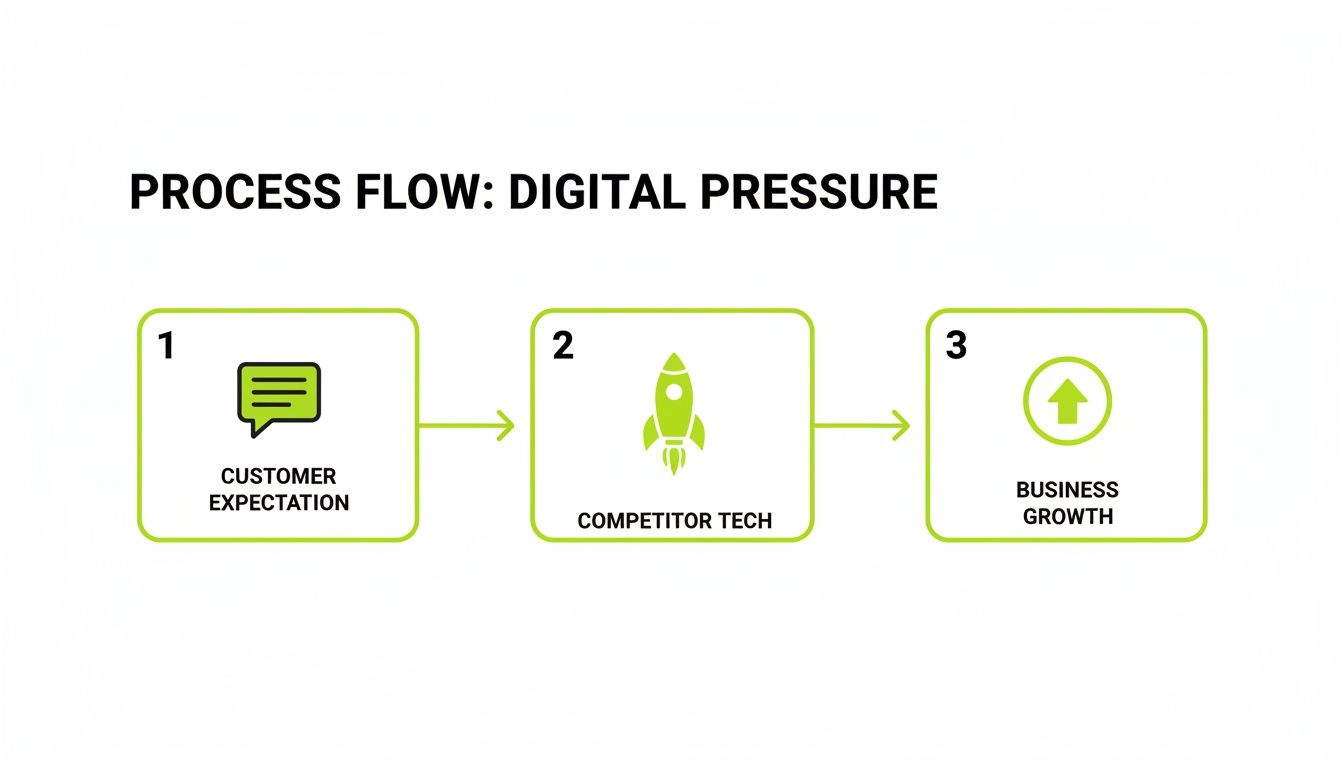
This constant pressure from customers and competitors is precisely why a well-defined roadmap is non-negotiable. To see how this fits into a broader strategy, check out our guide on how to write a marketing plan.
Prioritize Initiatives with an Impact vs. Effort Matrix
Okay, you have a list of potential projects. Now what? As a small business, you can't do everything at once. You have to focus your limited resources where they will deliver the most value, and fast.
A simple but powerful tool for this is the Impact vs. Effort Matrix. It helps you visually map out your initiatives so you can immediately see which ones are the true low-hanging fruit.
Here’s a look at how to structure this matrix to rank your potential projects.
Digital Initiative Prioritization Matrix
| Initiative Example | Business Impact (High/Med/Low) | Implementation Effort (High/Med/Low) | Priority Quadrant |
|---|---|---|---|
| Implement Online Booking System | High | Low | Quick Win |
| Launch a Basic Email Newsletter | Medium | Low | Quick Win |
| Develop a Customer Loyalty App | High | High | Major Project |
| Full ERP System Implementation | High | High | Major Project |
| Redesign Website Homepage | Medium | Medium | Fill-In |
Your highest priorities should always be the Quick Wins—projects with high impact and low effort. For a local service business, implementing an online booking system is a classic example. It dramatically improves the customer experience (high impact) but can be set up relatively quickly with modern software (low effort).
On the other hand, something like a full-scale Enterprise Resource Planning (ERP) system might also be high impact, but its complexity and cost make it a major, long-term project you table for later.
By starting with those quick wins, you build momentum, generate immediate ROI, and free up resources for those larger, more strategic initiatives down the line.
Where to Focus for the Biggest Impact
You've got a roadmap, but now for the million-dollar question: where do you actually start? As a small business owner, you don't have an unlimited budget or endless hours to burn. You have to be smart and invest in digital changes that bring real, tangible results—and fast.
The key is to focus your efforts on four foundational pillars that directly fuel growth and efficiency. These aren't just buzzwords; they represent the core of your business. Nailing them with the right digital tools is the quickest way to build momentum and see a genuine return.
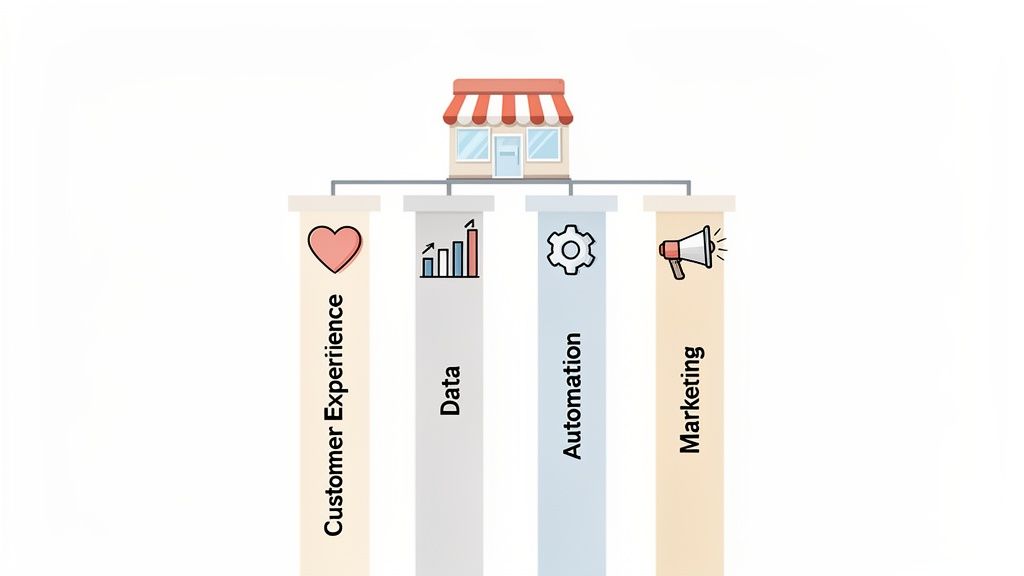
Elevate the Customer Experience
Your customers are everything, and their expectations have completely shifted. They now demand seamless, personalized, and instant service. Focusing on the customer experience (CX) isn't a "nice-to-have" anymore; it's a competitive must-have that directly impacts how many customers you keep and how much you earn.
A Customer Relationship Management (CRM) system is almost always the perfect place to start. It acts as a central hub for all your customer data, from past purchases to support tickets, giving you a complete picture of every relationship.
Instead of sending out generic email blasts, a CRM lets you group your audience and send messages that actually matter to them. Imagine sending a special offer to customers who haven't bought anything in six months or a simple thank-you note after a big sale. That's the kind of personal touch that builds loyalty big-box stores just can't match.
- Mini Case Study: A Dallas-based B2B consulting firm was losing track of leads. Inquiries from their website would just sit in an inbox, and opportunities were constantly being missed. By setting up a simple CRM, they automated lead capture and created a structured follow-up process. The result? Within three months, their lead-to-proposal conversion rate jumped by 40% because nothing fell through the cracks.
Leverage Data for Smarter Decisions
Running a business on gut feelings is a massive gamble. Going digital gives you the power to make calls based on cold, hard data, turning guesswork into a genuine strategy. You're probably already sitting on a goldmine of information—you just need to know how to use it.
Start with your website analytics. Tools like Google Analytics are free and incredibly powerful. They can show you:
- Which pages on your site get the most traffic.
- Where your visitors are coming from (e.g., Google search, Facebook).
- How long people stick around and which pages make them leave.
This data is direct feedback on what's working and what's not. If you notice your "Services" page has a high exit rate, that's a huge red flag that the content isn't connecting. It’s time for a rewrite.
Turning data into insights is the core of smart business growth. It's about asking the right questions: "Why are customers abandoning their carts?" or "Which marketing channel brings us the most valuable clients?" The answers are in your analytics.
Automate Operations to Reclaim Your Time
For a small business, one of the most immediate wins from digital transformation is getting your time back. Repetitive, manual tasks drain your energy and pull you away from the big-picture work that actually grows the business. Automation is the answer.
To make a real dent, small businesses should look into modern solutions like AI automation strategies to make operations smoother and decision-making sharper. Just think about the daily or weekly tasks that eat up hours of your team's day.
Here are a few common areas ripe for automation:
- Invoicing: Use accounting software to automatically generate and send recurring invoices.
- Appointment Scheduling: Let clients book time on your calendar directly with a scheduling tool, cutting out all the back-and-forth emails.
- Social Media: Schedule posts in advance with a management tool instead of scrambling to post something new every day.
- Customer Support: Set up automated email replies to confirm you received a question and let them know when to expect a response.
Every single process you automate frees up mental and physical energy. If you're hunting for more ideas, you might find our guide on business process automation examples helpful.
Supercharge Your Digital Marketing
Your website and social media profiles are your modern storefront. You have to be just as strategic with them as you are with a physical location. A digital overhaul isn't complete until you connect it to how you find, attract, and win over new customers online.
This is about more than just having a website. It means building a cohesive digital marketing strategy that includes:
- Search Engine Optimization (SEO): Making sure your business shows up when local customers in Dallas search for your services on Google.
- Content Marketing: Creating valuable blog posts, videos, or guides that answer your customers' questions and position you as the go-to expert.
- Social Media Engagement: Building a community around your brand and talking directly with your audience where they hang out.
The numbers back this up. Studies show that companies with a higher level of digital maturity reported revenue gains of 445%, while less mature companies only saw a 15% increase. That massive gap shows the direct line between digital marketing and your bottom line. And with 51% of small businesses now relying on social media for growth, a strong digital marketing arm is non-negotiable.
Choosing the Right Tools and Partners
Diving into the world of business technology can feel like you're trying to navigate a maze in the dark. You’re bombarded with countless software options and implementation partners, all promising the moon. It's enough to make anyone's head spin.
But here’s the thing: finding the right tools for your small business isn't about chasing flashy features. It's about finding a sustainable fit for your specific goals, your budget, and most importantly, your team.
The real secret is to look past the initial price tag and think about long-term value. A cheap tool that doesn't play well with your existing systems or can't grow with you will cost you far more in headaches and lost productivity down the line. True value comes from tech that solves a real problem efficiently and makes your team's life genuinely easier.
Evaluating Technology Beyond the Price Tag
When you're looking at a new piece of software—be it a CRM, an accounting platform, or a project management tool—your evaluation should stand on three core pillars. Nailing these will help you make a choice that serves your business today and supports your growth tomorrow.
Think about these critical factors:
- Scalability: Can this tool handle your business if it doubles in size over the next two years? You don't want to get stuck with a painful migration process just as you're hitting your stride.
- Integration: How well does it "talk" to the software you already use? A tool that seamlessly connects to your email, calendar, and other systems creates a smooth workflow, not another frustrating data silo.
- Usability: Is it intuitive for your team? The most powerful software on the planet is useless if your employees find it too complicated to actually use every day.
Don't let the sheer volume of options paralyze you. The best tool isn't always the one with the most features, but the one that solves your most pressing problem in the simplest way.
For instance, when you look into AI in accounting, it’s easy to see how automation offers a huge advantage by crushing administrative tasks. That's a perfect example of a tool solving a specific, high-impact problem.
Finding the Right Implementation Partner
For bigger projects, you'll probably need an expert partner to guide the way. A great partner does more than just install software; they take the time to really understand your business challenges and tailor the solution to fit you. Think of them as a translator between your business needs and the technical details.
When you're vetting a potential agency or consultant, come prepared with questions that dig deeper than their technical skills. You need to make sure they're a good cultural and strategic fit for your small business.
The right partner can be the difference between a successful launch and a costly failure. To get a better feel for how different platforms stack up, you can also check out a detailed business intelligence software comparison to understand the landscape.
Key Questions to Ask Potential Partners
Before you sign any contracts, make sure you get clear, satisfying answers to these questions. They'll tell you a lot about a partner's experience and how they operate.
- Have you worked with businesses our size and in our industry before? Experience with similar companies means they'll already get your common pain points and won't be learning on your dime.
- What does your support and training process look like after launch? The project isn't over when the software goes live. You need to know they'll stick around to help your team get comfortable and fix any issues that pop up.
- Can you provide a clear project timeline with specific milestones? A well-defined plan shows they're organized and committed to clear communication—which is crucial for keeping things on track and on budget.
- How do you measure the success of an implementation? Their answer should be all about business outcomes—like better efficiency or more sales—not just technical jargon.
Budgeting Realistically for Digital Tools
The cost of technology is no longer the barrier it once was for small businesses. While large corporations captured 69.20% of the U.S. digital transformation market in 2023, smaller enterprises are expanding at a rapid 20.62% compound annual growth rate. This incredible acceleration is fueled by modern pricing models that make powerful tools accessible without a massive upfront investment.
Instead of thinking of it as one giant expense, approach your budget in phases. Prioritize the one tool that will solve your single biggest headache first. Most modern Software-as-a-Service (SaaS) tools run on a predictable monthly or annual subscription, making it easy to budget and scale your investment as you grow. This pay-as-you-go model puts powerful digital tools within reach for just about any small business.
Executing Your Plan and Measuring What Matters
A great plan is just a document until you turn it into action. This is where the rubber meets the road—moving from strategy to actually getting things done. Success hinges on a thoughtful rollout that proves its value quickly and brings your team along for the ride.
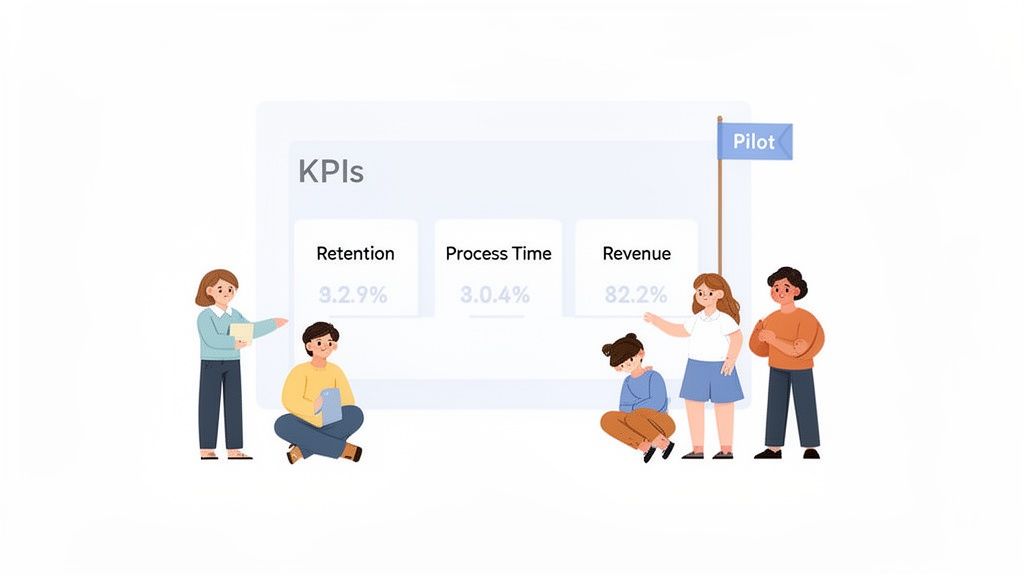
The biggest mistake I see businesses make is trying to do everything at once. A "big bang" approach is risky, expensive, and a surefire way to overwhelm your employees. The smarter path is to start small, build momentum, and let your early wins fund the next steps.
Start with a Pilot Project
Instead of a full-scale, company-wide deployment, kick things off with a pilot project. Think of it as a small, controlled test of a new tool or process with a limited group of users. A pilot is your proof-of-concept, letting you work out the kinks, gather real-world feedback, and build a solid case for a bigger rollout.
For example, don't force a new CRM on the entire company from day one. Instead, test it with just your top two salespeople for a month. Let them use it to manage their daily leads and customer interactions. This contained experiment will give you priceless insights without disrupting your entire operation.
Get Your Team Onboard with the Change
Technology is only half the equation; your people are the other, more important half. If your team doesn't understand, trust, or know how to use the new tools, your investment will fall flat. It's telling that over 60% of small businesses worry about cybersecurity, and a lot of that risk comes down to human error—which really highlights how critical proper training is.
Effective change management is all about clear communication and real, hands-on support.
- Explain the "Why" Repeatedly: Don't just show them the new software. Constantly communicate why the change is happening and what's in it for them. Talk about less tedious data entry, faster access to information, or fewer customer complaints.
- Provide Practical Training: Host hands-on workshops, not boring lectures. Give your team a safe space to practice with the new tools on the real-world tasks they perform every single day.
- Celebrate Early Adopters: Find the employees who are excited about the new process and turn them into internal champions. Their enthusiasm and peer-to-peer support are far more powerful than any top-down directive.
The goal is to make your team feel like they are part of the transformation, not victims of it. When they see the direct benefits to their daily work, adoption happens naturally.
Measure Your Return on Investment
You can't manage what you don't measure. To justify your digital investments and guide future decisions, you have to track the right Key Performance Indicators (KPIs). These are the metrics that connect your digital projects directly to tangible business outcomes, proving their value in dollars and cents.
The KPIs you choose should link directly back to the goals you set in your roadmap. If your goal was to improve customer service, then you need to be watching metrics like response time and customer satisfaction scores. If efficiency was the target, then process completion time is your north star.
To give you a better idea, here are some sample KPIs for a few common digital initiatives.
Sample KPIs for Digital Transformation Initiatives
| Initiative Area | Primary KPI | Secondary KPI |
|---|---|---|
| New CRM System | Customer Lifetime Value (CLV) | Lead Conversion Rate |
| Automation Software | Average Process Time | Employee Time Saved (Hours) |
| Website Redesign | Website Conversion Rate | Bounce Rate |
| Online Booking Tool | Number of Online Bookings | Reduction in No-Shows |
Tracking these numbers does more than just prove ROI; it gives you the data you need to tweak your approach. If you see a jump in your Lead Conversion Rate after implementing the CRM, you know you're on the right track. If a metric isn't moving, it’s a clear signal to investigate what's not working and make adjustments.
This continuous feedback loop is what turns a one-time project into a sustainable engine for growth.
Clearing Up the Common Questions on Digital Transformation
When you're running a small business, every dollar and hour is precious. So it's no surprise that the idea of "digital transformation" brings up a lot of practical questions. You need clear answers before you commit.
Let's tackle some of the most common hurdles I see business owners run into. These aren't just abstract ideas; they're the real-world concerns you're probably wrestling with right now.
How Much Should a Small Business Budget for This?
There's no single magic number, and anyone who gives you one is guessing. The cost depends entirely on what you're trying to achieve. The best way forward for a small business is to forget the idea of a massive, one-time overhaul.
Instead, think in smaller, focused phases.
Start by budgeting for a single pilot project that can deliver a clear and quick return. A good rule of thumb is to set aside 3-5% of your annual revenue for technology and process improvements. This approach lets you fund the next steps with the ROI you generate from your early wins, creating a self-sustaining cycle of improvement.
The rise of subscription-based software is a massive advantage for small businesses. Predictable monthly fees give you access to incredibly powerful tools without having to sink your capital into huge upfront license costs.
Can I Do This Myself, or Do I Need an Expert?
This is a classic "it depends" situation. You can absolutely tackle many smaller initiatives in-house. Things like setting up a social media scheduler, getting started with a basic email marketing tool, or configuring a simple CRM are well within reach for a tech-savvy owner.
However, for more complex projects, bringing in a specialist is a smart move. Think about projects like:
- A complete website overhaul with integrated e-commerce.
- Building out a serious SEO strategy in a crowded market.
- Connecting different software systems so they can share data automatically.
A good partner saves you from making costly rookie mistakes. They'll help you pick the right tech from the get-go and get you to your goals much faster. That efficiency often ends up saving you more money than the expert costs in the first place.
What’s the Biggest Mistake to Avoid?
The single biggest mistake I see is treating digital transformation as just a technology project. Buying shiny new software won't magically fix a broken process. In fact, it often just makes a bad process run faster.
Real transformation starts with your business goals. It's about making things better for your customers and your employees. Technology is simply the tool that helps you execute your strategy—it’s not the strategy itself. Always start by defining the "why" before you even think about the "what." This simple discipline ensures every dollar you spend is tied directly to creating real business value.
At Magic Logix, we specialize in guiding businesses through this process, ensuring your technology investments deliver real, measurable growth. Discover how our digital marketing and technology solutions can accelerate your transformation.