

For most B2B companies the answer is not SEO or paid search. It is paid search first for speed and learning, SEO alongside it for compounding returns, and one shared revenue report that judges both over the same time window. Paid search buys visibility in an auction and stops when the budget stops. SEO earns visibility that keeps working after the work is done, but it takes longer to show up in your pipeline.
This guide explains how the two channels differ, what each costs and returns, how to measure them fairly, and how to decide the mix for your stage of growth.
TL;DR
- Paid search delivers traffic as soon as campaigns go live and ends when spend ends. SEO builds slowly and keeps paying back once pages rank.
- Published 2026 benchmarks put B2B Google Ads cost per lead well above mature organic cost per lead, but organic needs many months to reach meaningful volume.
- Judge both channels on pipeline and revenue over the full sales cycle, not on clicks or last-month leads.
- Early-stage or launching a new offer: lead with paid search. Long sales cycles and a content-rich site: invest steadily in SEO. Most teams end up running both.
- SEO is not part of paid media. It is an organic channel, and paid ads do not improve your organic rankings.
Table of Contents
- What is the difference between SEO and paid search?
- Speed: how long until each channel produces leads
- What each channel costs
- Lead quality and pipeline contribution
- How to measure SEO and paid search fairly
- When to choose paid search, SEO, or both
- Common mistakes
- Where Magic Logix fits
- Perspective
- FAQ
- Sources
What is the difference between SEO and paid search?
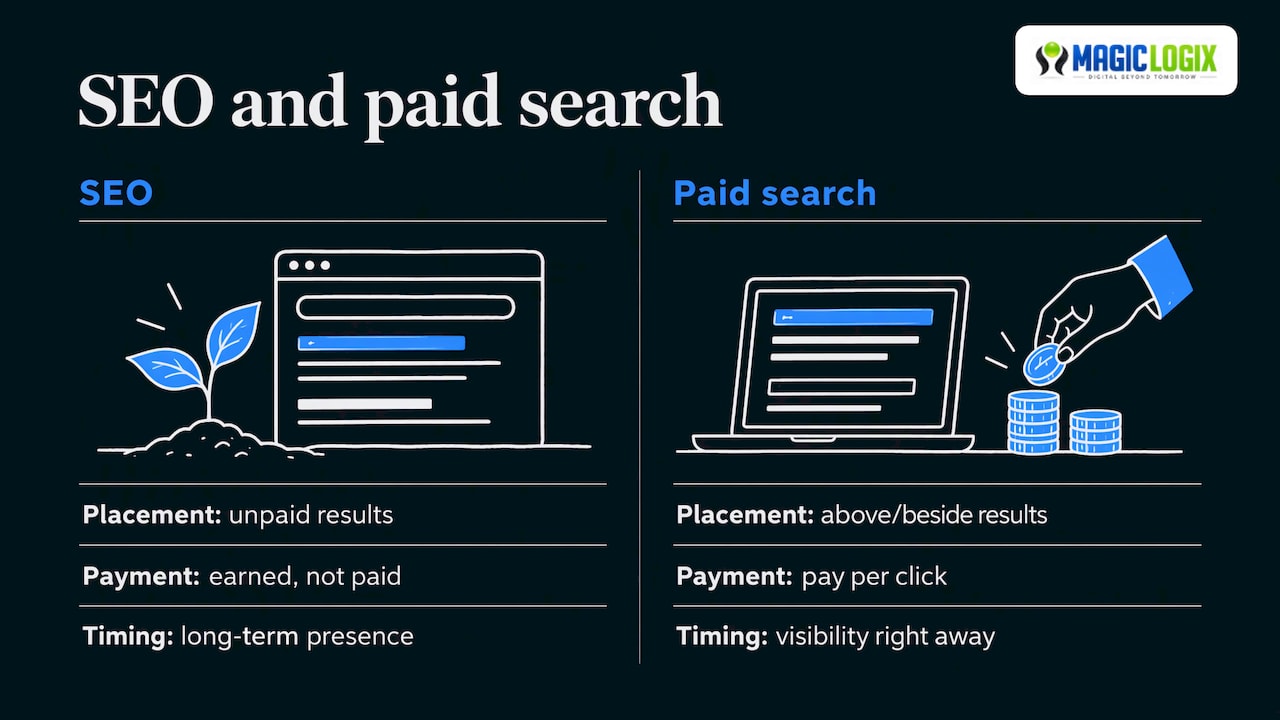
Search engine optimization (SEO) is the work of making your site easier to find in the unpaid results: useful content, a technically sound site, and credibility from other sites. Paid search, also called pay-per-click (PPC) or search engine marketing, means bidding on keywords so your ad appears above or beside the results, and paying when someone clicks.
Google’s own guidance for advertisers describes the split this way: PPC costs money and contributes to visibility right away, but it does not improve your organic rankings. Its advice is to choose PPC for short-term traffic, SEO for a long-term online presence, or both for a well-rounded strategy.
That also answers a common question: is SEO part of paid media? No. Paid media covers anything you pay to place, including search ads, social ads and display. SEO is earned. The two share keywords and landing pages, which is why they work best when planned together, but they sit on different budget lines and behave differently over time.
How each channel works in a B2B context
B2B search behavior differs from consumer search. Buying groups include several people, research happens in stages, and a deal can take months. A buyer might read an explainer in the research phase, compare vendors later, and search your brand name just before a call. Each stage rewards a different channel:
| Buyer stage | Typical search | Where SEO helps | Where paid search helps |
|---|---|---|---|
| Problem awareness | “why are our leads stalling” | Educational articles, guides | Rarely worth the click cost |
| Solution research | “how to choose a [category] vendor” | Comparison and framework content | Targeted ads to capture active researchers |
| Vendor evaluation | “[category] for mid-market manufacturers” | Service and industry pages | High-intent ads to specific landing pages |
| Ready to buy | “[your brand] pricing”, “[category] consultation” | Brand and product pages | Brand and bottom-funnel ads |
The pattern matters more than any single statistic: paid search is strongest where intent is highest and the keyword list is narrow. SEO is strongest where you need to be present across a long, research-heavy journey.
Speed: how long until each channel produces leads
Paid search can generate clicks the day a campaign is approved. The catch is that early results are rarely the best ones. The first weeks go to learning which keywords, ad messages and landing pages convert, and bids and negatives get adjusted constantly. Our guide to paid search management covers what profitable account management looks like, and keyword research for search campaigns shows how to build the list that decides your cost per lead.
SEO moves on a different clock. A 2026 benchmark roundup from DemandGen Insider says mature organic search takes roughly 9 to 18 months to reach meaningful lead volume. Treat that as a range reported by one publisher, not a promise: your timeline depends on competition, site authority, content quality and how technically healthy your site is today.
Why so slow? Search engines need to discover and evaluate new pages, and credibility builds as other sites reference you. B2B adds a second lag: even when a page ranks, the visitor may not become a sales-qualified lead for weeks or months.
Practical rule: if you need pipeline this quarter, paid search is the faster lever. If you need a cheaper pipeline in 12 to 24 months, start SEO now, because the work you delay is the work you cannot get back.
What each channel costs
Costs vary widely by industry, deal size and keyword competition, so use benchmarks to set expectations, not budgets.
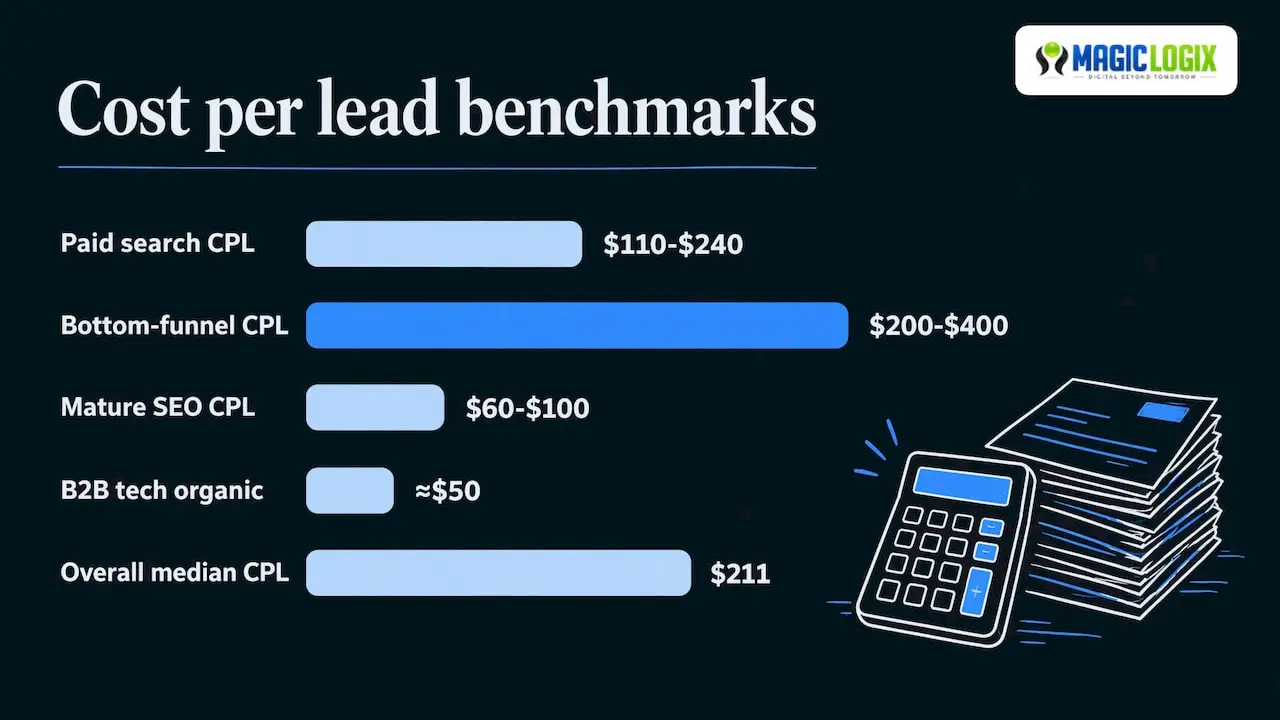
Paid search. You pay per click, and B2B keywords can be expensive. The same DemandGen Insider benchmarks put B2B Google Ads cost per lead at roughly $110 to $240, with bottom-of-funnel keywords at $200 to $400, and report B2B cost per click rising 12 to 18 percent in 2025 as competition increased. Click costs move with auctions, so recheck any figure against your own account.
SEO. There is no per-click charge, but there is a production cost: strategy, content, technical work and links or digital PR. The same benchmark roundup puts mature organic cost per lead at about $60 to $100. That figure reflects an established program, not the first year, when you are investing before returns arrive. For a fuller breakdown of what SEO engagements involve and why a single average price misleads, see SEO costs in 2026.
An older survey points the same direction. LeanData’s 2022 benchmarking study found organic search cost per lead was more than 50 percent below the overall median, and in B2B technology it was about $50 against a $211 overall median.
A worked example
The numbers below are illustrative, not client results or industry averages.
Suppose a mid-market software firm spends $12,000 a month on paid search at a $200 cost per lead. That produces 60 leads a month. If 20 percent become sales-qualified and 1 in 5 of those closes, that is about 2.4 deals a month, and you can calculate cost per deal directly. Now suppose the same firm adds $8,000 a month for SEO. For the first six months or so the organic leads may be few, so the combined cost per lead looks worse. If organic starts delivering 40 leads a month at a lower cost per lead in year two, the blended cost falls, and some of those leads would otherwise have required paid clicks.
The lesson: evaluate SEO on cumulative cost and cumulative pipeline over a long window, and paid search on marginal cost per qualified opportunity.
Lead quality and pipeline contribution
Cheap leads are not always good leads. Two findings from the LeanData survey (311 respondents, 2022) illustrate the tension:
- 27 percent of companies said SEO delivers more than 30 percent of their total sales pipeline, while only 6 percent said that of paid search.
- Median lead-form conversion was 4 percent for paid traffic and 2 percent for organic traffic.
Read together, they suggest paid traffic often converts a visit to a form fill more readily, since ad copy and landing pages are built for one action, while organic search tends to contribute a larger share of pipeline overall. The study is a few years old and covers a specific respondent group, so use it as direction, then check your own data.
What improves both channels is the page the visitor lands on. A strong offer, clear proof and a short form lift paid and organic conversion alike. Our guide to conversion rate optimization for B2B websites walks through that work, and a buyer-focused content strategy shows how content supports pipeline rather than just traffic.
How to measure SEO and paid search fairly
Most bad channel decisions come from comparing the two on the wrong timeline. Paid search shows results at once. SEO shows them later. If you review both after 90 days, SEO will always look like the loser.
Use this framework:
- Track from click to closed deal. Connect your analytics, CRM and ad platforms so each lead carries its source. Report marketing-qualified leads, sales-qualified leads, opportunities and revenue by channel.
- Match the window to your sales cycle. If deals take six months, give each channel at least a full cycle before judging it. A B2B SaaS pipeline guide from TheSaaSLibrary recommends reading both channels cumulatively over at least twelve months, with a lag added for SEO.
- Use three review rhythms. Monthly for operational checks such as spend, rankings, conversion rate and tracking errors. Quarterly for business impact: pipeline, cost per opportunity, revenue influenced. Annually for strategy and budget mix.
- Pair cost per lead with downstream conversion. A $300 lead that closes at a high rate can beat a $100 lead that never reaches sales. Segment by deal size and rebaseline your targets each quarter.
- Count assisted influence. B2B buyers often touch several channels. Look at first touch, last touch and assisted conversions so SEO content that educated a buyer before a paid click gets visibility.
Metrics to watch
| Metric | SEO | Paid search |
|---|---|---|
| Leading indicators | Rankings for target terms, organic impressions, indexed pages | Impression share, click-through rate, quality score |
| Efficiency | Cost per organic lead over 12+ months | Cost per lead and cost per opportunity |
| Quality | MQL to SQL rate, organic opportunity value | MQL to SQL rate, pipeline per dollar |
| Outcome | Revenue sourced and influenced | Revenue sourced and payback period |
When to choose paid search, SEO, or both
Use the situation, not a slogan, to decide.
Lead with paid search when:
- You are launching a new product or entering a market and need data on what messages work.
- You have a short window, such as an event, seasonal demand or a quarter-end target.
- Your site is new and has no authority yet.
- You need to test whether a keyword or segment is worth building content for.
Lead with SEO when:
- Your sales cycle is long and buyers research heavily before contacting anyone.
- Paid click costs in your category are high enough to squeeze margins.
- You have deep expertise worth publishing, and a site that can host it.
- You want demand that does not vanish when spend pauses.
Run both when:
- You want to own a results page: an ad for a high-intent term plus an organic listing for the same query.
- You can use paid search data to choose which terms deserve long-form content.
- You can use SEO insights, such as which pages convert, to improve ad landing pages.
A simple starting split
There is no universal ratio, and any fixed percentage you read online is a rule of thumb. A reasonable approach for a team with a modest budget is to begin weighted toward paid search for fast feedback, then shift a growing share to SEO as organic traffic and conversions prove out. Revisit the split every quarter against pipeline, not traffic.
Common mistakes
- Judging SEO on a paid timeline. Early months are an investment period. Set milestones such as indexed pages, ranking movement and qualified organic sessions before revenue shows up.
- Sending paid traffic to a generic page. Ads work best with a dedicated landing page that matches the query and the offer.
- Ignoring the website. Slow pages, confusing navigation and weak proof waste both organic rankings and ad spend. If your site is the bottleneck, a B2B website redesign strategy that protects existing rankings should come first.
- Treating the channels as rivals. Separate teams or vendors with separate dashboards often bid on and publish for the same terms without coordination.
- Chasing volume. B2B needs the right accounts, not the most clicks. Segment by industry, company size and role; our guide to B2B marketing segmentation helps with that.
- Forgetting AI search. Buyers increasingly ask AI tools for vendor suggestions. Best practices here are still evolving and no one can promise citations, but clear, well-structured, expert content supports both classic search and AI answers.
Where Magic Logix fits
If you want one team to plan both channels against the same revenue targets, Magic Logix offers SEO, paid media management, web development and analytics as custom projects or ongoing retainers. You can read more about our SEO optimization service or our marketing and growth systems work, or start a conversation about which channel mix suits your sales cycle.
Perspective
Under the banner of Digital Beyond Tomorrow, we look at search as one system, not two budgets. Paid search tells you quickly which queries, messages and landing pages bring in buyers. SEO turns that knowledge into assets you keep: pages, topic coverage and a site that is easy for people and search engines to use.
The teams that get the most from both agree on one thing before they spend: what a qualified lead is, and how it gets tracked to revenue. Our approach pairs search strategy with data analytics and web development, so tracking, landing pages and content are built to support each other rather than patched together later.
We would rather set honest expectations than promise rankings or citations. Platforms change, AI answers are still evolving, and the right mix shifts as your pipeline grows. Measure, learn quarterly and adjust.
Hassan Bawab
FAQ
Is SEO cheaper than paid search for B2B?
Per lead, mature SEO usually costs less than paid search, according to published benchmarks. But it requires upfront investment in content and technical work and takes months to build, while paid search has no ramp-up cost beyond the ad budget. Compare cumulative cost over 12 months or more.
Can I stop paid search once SEO starts working?
Often you can reduce it, but not always safely. Paid search still captures high-intent queries, competitor and brand searches, and new offers that have no organic content yet. Lower spend gradually and watch total pipeline, not just organic traffic.
Is SEO part of paid media?
No. Paid media is anything you pay to place, such as search ads and social ads. SEO is the organic side of search. Google notes that running ads does not improve your organic rankings, so the two need their own plans, even if they share keywords.
How do I know if my SEO is working?
Look first at leading signals: rankings and impressions for target terms, and organic sessions on pages written for buyers. Then check organic leads, sales-qualified leads and revenue in your CRM over a window that matches your sales cycle.
Sources
- SEO vs. PPC: Understanding the Difference, Google Ads
- Cost Per Lead Benchmarks by Channel for B2B in 2026, DemandGen Insider
- 2022 Inbound & Outbound Sales Pipeline Performance Benchmarking Report, LeanData
- SEO vs Paid Acquisition for B2B SaaS: Pipeline Guide, TheSaaSLibrary