
Most businesses budget between $500 and $10,000 a month for ongoing SEO retainers, with the average practitioner reporting around $2,917 monthly, while one-time projects like audits or technical fixes typically run $1,000 to $30,000 depending on scope. Your actual number depends on your industry, your site’s current health, and how fast you need results. The sections below break down exactly why.
TL;DR:
- Local businesses often spend $1,557 or less monthly, while middle market firms budget $5,000 to $10,000 and enterprises exceed $10,000 as scope expands.
- Choose hourly billing for a narrow diagnosis, a fixed project for migrations, and a retainer for ongoing work; retainers commonly require six to twelve months.
- Legal, finance, healthcare, SaaS, and ecommerce work often costs more because competition is stronger, content standards are higher, and technical or geographic scope can expand.
- Technical fixes may show movement within four to eight weeks, while content often takes three to six months and link building six to twelve months.
- Check whether migration work, ecommerce optimization, content, and link building are included, then require reports that connect organic traffic and conversions to leads or revenue.
Table of Contents
- 1. Representative 2026 pricing bands: monthly retainers, hourly, and one-time project fees
- 2. SEO pricing models explained: hourly, retainer, project, performance-based
- 3. How costs change by business size and industry
- 4. Factors that drive SEO pricing
- 5. What’s included in an SEO retainer or project
- 6. Budgeting, ROI estimation, and realistic timelines for SEO results
- 7. How we think about SEO pricing and measurable value
- Getting started with SEO services built around your budget
- FAQ
- Sources
1. Representative 2026 pricing bands: monthly retainers, hourly, and one-time project fees
Pricing for SEO work still falls into familiar bands, but the spread between the low end and the high end has widened as agencies specialize by industry and company size. Knowing where you sit on this spectrum helps you spot a proposal that’s priced fairly versus one that’s padded or underscoped.
Monthly retainers break down roughly like this:
- Entry-level or local SEO retainers often land near $1,557 per month, according to practitioner survey data, covering basic on-page work, citations, and light content.
- Typical small-to-midsize business retainers run between $1,500 and $5,000 a month, covering ongoing optimization, content production, and monthly reporting.
- Mid-market retainers commonly stretch from $5,000 to $10,000 a month, adding deeper technical work and more aggressive content and link programs.
- Enterprise retainers frequently exceed $10,000 a month once multiple locations, large product catalogs, or international markets enter the picture.
Average monthly cost across all business types sits around $2,917, according to a survey of 439 SEO practitioners, though the full range runs from $250 to $10,000 depending on the provider and the scope. That wide spread exists because a freelancer doing light keyword optimization and an agency running full technical audits, content teams, and digital PR campaigns are both technically selling “SEO,” just at very different depths.
Hourly billing is less common for ongoing work but still shows up for audits, consulting, or fixed-scope technical projects. The average hourly rate for SEO work is roughly in the triple-digit range, and a meaningful share of specialists charge significantly higher hourly rates, particularly for technical SEO, migrations, or enterprise consulting.
One-time project fees cover work that has a clear start and finish rather than ongoing optimization:
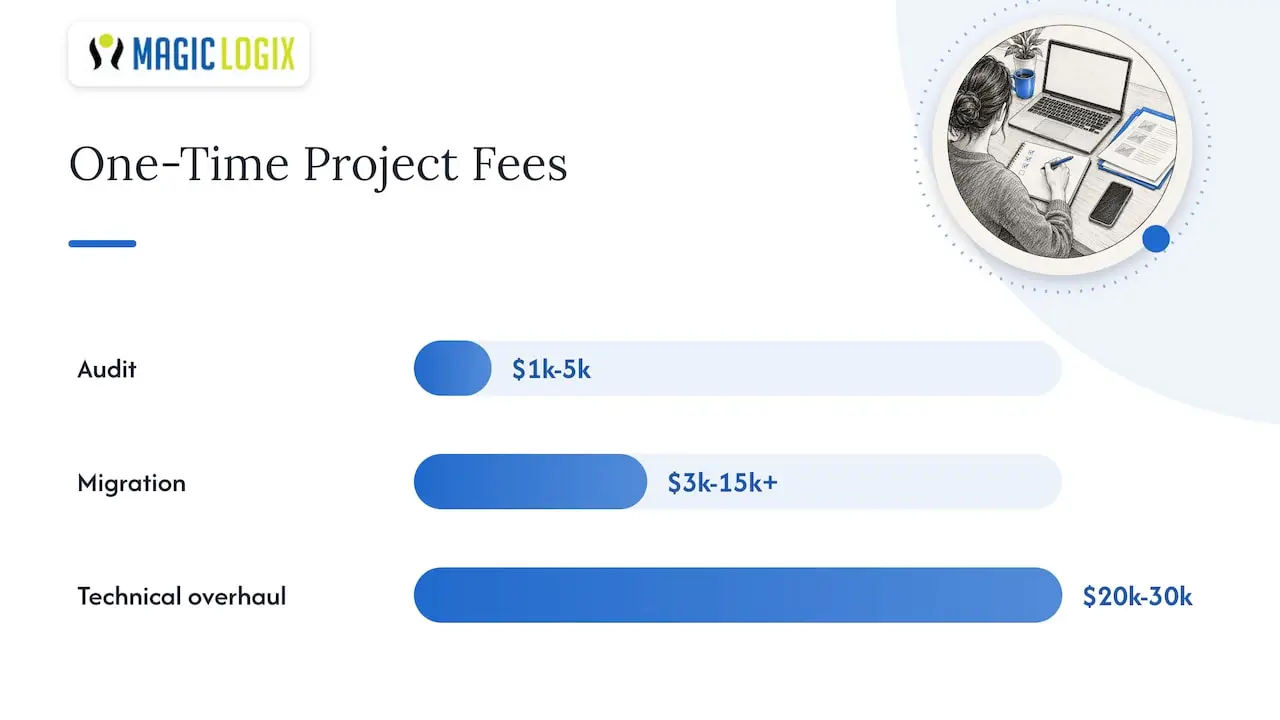
- A standalone technical or content audit often runs $1,000 to $5,000, depending on site size.
- Site migrations (domain changes, platform switches, URL restructuring) typically cost $3,000 to $15,000 or more, since mistakes here can tank rankings overnight.
- Larger one-time engagements, like a full technical overhaul paired with content strategy, can reach $20,000 to $30,000 for complex sites.
One useful benchmark worth keeping in mind: agencies tend to charge noticeably more than freelancers on average, according to the same practitioner survey, which makes sense given the overhead of specialized teams versus a single contractor. That gap is not automatically a reason to choose one over the other, but it does explain why two quotes for “the same” work can look wildly different on paper.
If you want a concrete sense of what a mid-range monthly budget actually buys in deliverables, this breakdown of $1,000 to $5,000 retainers walks through typical scopes at that price point.
2. SEO pricing models explained: hourly, retainer, project, performance-based
Before you compare quotes, it helps to understand that you’re not just comparing prices, you’re comparing four fundamentally different ways of buying the same service. Each model fits a different kind of buyer and a different stage of business.
-
Hourly billing suits businesses with a narrow, well-defined need, like a one-time technical audit or a consulting session to diagnose a ranking drop. You pay for time spent, nothing more, which makes it easy to control spend but harder to predict total cost if the scope creeps. Contracts are usually short, sometimes a single engagement with no renewal.
-
Monthly retainers fit businesses that need continuous work: content production, link building, technical monitoring, and reporting that compounds over months. This is the most common model for small businesses and mid-market companies because SEO results build gradually and benefit from sustained effort. Retainers typically run six to twelve months minimum, billed monthly, with deliverables and KPI reports delivered on a set cadence.
-
Project-based pricing works well for a defined deliverable with a clear end point, like a site migration, a Core Web Vitals overhaul, or a content hub build. A startup launching a new product line or a company replatforming its ecommerce store often prefers this model because it has a fixed total cost and a fixed timeline. Deliverables are usually itemized in a statement of work, and billing often splits into milestones rather than monthly installments.
-
Performance-based pricing ties fees to results, like ranking improvements or traffic gains, and appeals to businesses that want to de-risk spend. It’s less common than the other three models because ranking outcomes depend on factors outside any single provider’s control (algorithm changes, competitor actions, seasonal demand), so performance contracts tend to carry higher base fees or narrower guarantees to compensate for that risk. SaaS companies and ecommerce brands sometimes negotiate hybrid versions that blend a smaller retainer with bonus payments tied to traffic or revenue milestones.
A local service business fixing a Google Business Profile and a handful of location pages usually fits best with a modest monthly retainer. A SaaS company scaling content across dozens of product pages tends to need a larger retainer with dedicated content resources. An enterprise brand managing a migration across thousands of URLs is a textbook project-based engagement, at least for that initial phase, before shifting into an ongoing retainer once the technical foundation is stable.
3. How costs change by business size and industry
The same label, “SEO,” covers wildly different workloads depending on who’s buying. A single-location coffee shop and a national law firm are not competing for the same budget, the same keywords, or the same level of competition, and their SEO costs reflect that gap.
Representative monthly budgets by business type:
- Local businesses (single location, service-area focused) commonly spend $1,557 or less per month, according to survey data on local SEO averages, covering citations, review management, and basic on-page work.
- Small businesses with a regional footprint typically land between $1,500 and $5,000 monthly for ongoing optimization and content.
- Mid-market companies with multiple product lines or locations often budget $5,000 to $10,000 monthly to cover broader keyword coverage and technical depth.
- Enterprise organizations frequently exceed $10,000 monthly, sometimes well into five figures, once international markets, large catalogs, or hundreds of location pages enter the equation.
Industry matters just as much as company size. Legal, finance, healthcare, SaaS, and ecommerce consistently command higher budgets than, say, a local home services business, for a simple reason: the keywords are more competitive, the content has to clear a higher credibility bar, and the cost of a wrong move (a compliance issue in finance, a misleading health claim) is higher. A personal injury law firm competing for a handful of high-value local search terms is fighting dozens of well-funded competitors for the same clicks, which pushes both content and link-building budgets up. SaaS companies often need ongoing content investment to compete for buyer-intent keywords throughout a longer sales cycle, and ecommerce brands need SEO work spread across thousands of product and category pages rather than a handful of service pages.
What that budget buys also shifts with the number. A lower-tier retainer tends to cover the basics well: technical health monitoring, on-page optimization, and modest content output, often one to two pieces a month. A higher retainer usually adds dedicated content teams, structured digital PR or outreach campaigns, deeper technical audits, and more frequent reporting cycles. Local service businesses can see strong ROI even on modest budgets, partly because most consumers rely on search engines to find local business information, which keeps competition for hyper-local terms more manageable than national keyword battles. If local visibility is your main goal, these local SEO practices outline where a smaller budget tends to deliver the most impact.
4. Factors that drive SEO pricing
Every proposal price traces back to a handful of concrete variables. Understanding these lets you evaluate a quote on its merits instead of just comparing a single dollar figure.
- Keyword and competitive difficulty: Ranking for “plumber near me” in a mid-sized city costs far less effort than ranking for “business insurance” nationally, and pricing reflects that gap directly.
- Technical health of your site: A site built on an outdated platform with crawl errors, slow load times, or duplicate content needs upfront technical work before content or links can do much good, which adds cost early in an engagement.
- Content needs: Thin or outdated content requires either a rewrite or a buildout from scratch, and content production (research, writing, editing) is one of the largest recurring line items in most retainers.
- Link-building requirements: Earning authoritative backlinks takes outreach, relationship building, or digital PR campaigns, and that labor-intensive work tends to carry some of the highest hourly costs in the whole discipline.
- Geographic scope: A single-location business needs far less work than a multi-location chain or a company targeting several countries, each with its own language and search behavior considerations.
- Urgency: Needing results in three months instead of twelve usually means paying for a larger team working in parallel, which raises the monthly rate even if the total scope is similar.
Pro Tip: Ask whether link-building and content can be scoped as a separate add-on rather than bundled into the base retainer. Unbundling those line items often reveals that you can run a leaner core retainer and add a one-time content or outreach sprint only when you actually need the push, rather than paying for capacity you don’t use every month.
Link acquisition in particular has gotten more expensive as editorial placements become scarcer and demand for credible digital PR coverage rises. If outreach and placement costs are a major driver in your quote, it’s worth understanding how a digital PR approach to link building differs from cold outreach, since the two can carry very different price tags for similar end results.
5. What’s included in an SEO retainer or project
Not every retainer includes the same deliverables, which is exactly why two proposals at the same price point can represent very different amounts of actual work. Knowing the standard inclusions helps you spot gaps before you sign anything.
Core deliverables you should expect in most retainers:
- Technical audits and fixes: crawlability, site speed, mobile usability, structured data, and indexing issues.
- On-page optimization: title tags, meta descriptions, header structure, internal linking, and keyword targeting across existing pages.
- Content briefs and production: research-backed outlines and, often, the actual writing and publishing of new pages or blog content.
- Link acquisition or digital PR outreach: building authoritative backlinks through guest content, partnerships, or earned media coverage.
- Reporting: monthly or biweekly updates on rankings, organic traffic, and conversions tied to SEO activity.
Reporting cadence matters more than it sounds. Monthly reports are standard, but the KPIs inside them vary: some providers report only keyword rankings, which is a thin measure of progress, while stronger reporting ties organic traffic and conversions back to business outcomes like leads or revenue. If you’re evaluating proposals, ask to see a sample report before signing, not just a description of what gets tracked.
Several services commonly sit outside the base retainer and get quoted as add-ons: local citation building and listing management for multi-location businesses, ecommerce-specific SEO work like product schema and category page optimization, and site migrations, which almost always carry a separate project fee given the risk involved. Technical fixes on a site with deep structural problems, like poor server-side rendering or slow Core Web Vitals scores, can also push into add-on territory if they go beyond a standard audit. If your site runs on WordPress or another common CMS, platform-specific technical debt is a frequent source of scope creep in proposals, and it’s worth reading up on what a platform specialist typically handles before you assume a generic retainer covers it.
For businesses with deeper technical problems, a focused technical SEO engagement sometimes makes more sense as a standalone project before committing to an ongoing retainer, since fixing the foundation first tends to make every dollar spent afterward go further.
6. Budgeting, ROI estimation, and realistic timelines for SEO results
Setting an SEO budget works best as a three-step exercise rather than picking a round number and hoping it’s enough.
- Define the outcome you actually need. More organic leads, more ecommerce revenue, or better visibility in a new market all call for different activity mixes and different budget sizes.
- Map that outcome to specific activities. A lead-generation goal usually means content plus local optimization; a revenue goal for ecommerce usually means product page optimization plus technical performance work; new-market visibility usually means a mix of content and link building aimed at that region.
- Estimate cost from those activities, using the pricing bands above as your starting point, then adjust up for competitive industries or tight timelines and down for narrower, well-defined scopes.
Timelines vary by the type of work you’re funding. Technical fixes (speed improvements, fixing crawl errors, cleaning up duplicate content) can show measurable movement within four to eight weeks, since search engines often re-crawl and re-index fairly quickly once issues are resolved. Content-driven growth takes longer, typically three to six months before new pages gain meaningful traction, because new content needs time to earn authority and rankings. Link-driven authority building is the slowest lever, often six to twelve months before the cumulative effect of earned backlinks shows up clearly in rankings for competitive terms.
KPIs should tie directly back to business results, not just vanity metrics. Tracking keyword rankings alone tells you very little about whether the work is paying off. Better KPIs include organic traffic growth segmented by page type, conversion rate from organic visitors, and, where possible, revenue or lead value attributed to organic channels. Setting these KPIs at the start of an engagement, before any work begins, makes it far easier to judge ROI honestly six or twelve months later rather than retroactively picking metrics that happen to look good.
Two numbers worth anchoring your expectations around: the average monthly SEO retainer sits near $2,917, according to practitioner survey data, and local SEO specifically averages closer to $1,557 per month, per the same survey. If your quote is dramatically below either figure for comparable scope, ask what’s being left out; if it’s dramatically above, ask what’s being added that justifies the premium. For reporting that ties activity back to revenue rather than rankings alone, a structured approach to agency reporting can help you figure out which metrics actually matter before you commit to a budget.
7. How we think about SEO pricing and measurable value
We approach SEO pricing the way we think most decision-makers want to be treated: by scoping work to the outcome you’re actually trying to hit, not to a generic package. We lean on data analytics and AI-driven insights to figure out where a site’s biggest gaps are and to build the retainer or project around closing those specific gaps rather than selling a one-size-fits-all bundle.
That approach comes out of work for businesses ranging from small operations to large corporations, which has shaped how we think about scoping and measurement. We treat reporting as a tool for accountability, not just a monthly check-in, which means tying activity back to traffic, conversions, and revenue wherever the data supports it.
If you’re evaluating any SEO proposal, including ours, a few questions tend to separate a well-scoped engagement from a vague one:
- What specific technical issues were found on your site, and how will they be prioritized?
- What does the content production schedule look like, and who owns the strategy behind it?
- How is link building approached, and what does “quality” mean in that context?
- What KPIs will be reported monthly, and how do they connect to business outcomes rather than just rankings?
- What’s the minimum timeline before you’d expect to see measurable movement?
We answer those questions directly in every proposal we put together, because a budget you can’t map to specific deliverables and milestones is a budget you can’t evaluate fairly.
— Hassan
Getting started with SEO services built around your budget
Whatever band your budget falls into, the goal is the same: make sure every dollar is mapped to a deliverable you can see and measure. We offer Search Engine Optimization services scoped to fit the ranges discussed throughout this guide, whether you’re a local business working with a leaner monthly budget or an enterprise brand managing a multi-location or international footprint.
Getting started typically begins with a conversation about your current site health, your competitive landscape, and the business outcome you’re trying to hit, whether that’s more leads, more ecommerce revenue, or stronger visibility in a new market. From there, we can scope a retainer, a project, or a hybrid of the two that matches the budget ranges covered above rather than a generic package that may not fit your situation.
If your SEO needs are tangled up with a broader site overhaul, like a migration, a redesign, or ecommerce platform work, our digital marketing and web development teams coordinate directly with SEO planning so technical fixes and optimization work happen in the right order instead of undoing each other.
The next step is simple: reach out through our Search Engine Optimization page to request a proposal scoped to your site, your industry, and the timeline you’re working with.
FAQ
Does SEO still work in 2026?
Yes. Search engines remain a primary way consumers find local businesses, and most consumers use search engines for local business information, which keeps organic visibility valuable for businesses that depend on being found. SEO’s role has shifted somewhat as AI-driven search features expand, but ranking well in organic results still drives meaningful traffic and leads.
What is the 80/20 rule in SEO?
In SEO, the principle that a small share of pages, keywords, or fixes tends to drive most of the results means prioritizing high-impact technical fixes or top-performing content pages often matters more than spreading effort evenly across a whole site. Definitions vary across practitioners, but the core principle is focusing budget on the highest-leverage work first.
How much does it cost to make a website in 2026?
Website costs vary widely based on complexity, platform, and whether you need ecommerce functionality, custom design, or ongoing maintenance, and pricing is typically quoted per project rather than as a fixed industry rate. We offer web design and web development services scoped to your specific requirements, with pricing available on request based on project scope.
Can ChatGPT do SEO?
AI tools like ChatGPT can help with tasks such as drafting content outlines, generating meta description ideas, or summarizing research, but they don’t replace the technical audits, strategic prioritization, and link-building work that drive actual ranking improvements. Most SEO engagements in 2026 use AI tools to speed up specific tasks within a broader strategy rather than as a standalone substitute for professional SEO work.
Sources
- SEO Pricing: How Much Does SEO Cost? 439 People Polled
- Share of consumers using search engines to find local business information