In an increasingly crowded online space, a generic website experience is no longer enough to capture and retain customer attention. The solution is website personalization: the practice of creating customized experiences for visitors based on their data, such as their behavior, location, or demographics. By delivering content and offers that are directly relevant to each individual, businesses can significantly increase engagement, conversions, and customer loyalty.
This article provides a deep dive into real-world website personalization examples, showcasing how leading platforms enable brands to connect with their audiences on a one-to-one basis. We will move beyond surface-level descriptions to offer a detailed analysis of each example. You will find screenshots, strategic breakdowns of the techniques used, and specific, actionable takeaways that you can apply to your own digital properties. For those specifically focused on retail, exploring these top ecommerce personalization examples for success offers additional strategies for driving sales and customer satisfaction.
Our goal is to give you a clear, practical understanding of what’s possible with modern personalization tools. For each platform covered, we will examine:
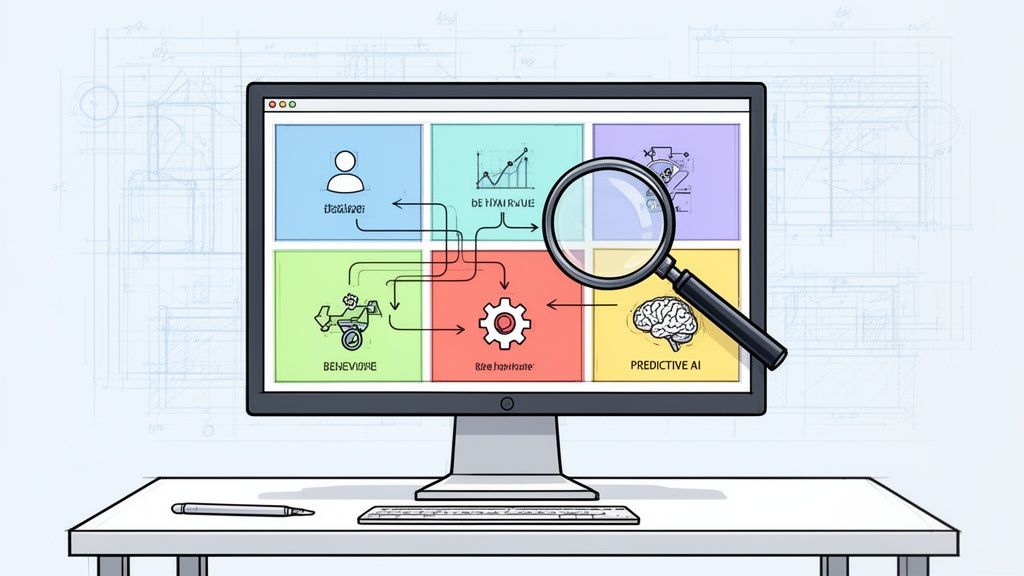
- The Personalization Technique: Is it rule-based, behavioral, or predictive?
- Implementation Details: What data sources, tools, and integrations were involved?
- Measured Outcomes: How did the personalization impact key metrics like conversion rates or engagement?
- Actionable Takeaways: What replicable strategies can your marketing and technical teams use?
This guide cuts through the noise, offering a curated collection of proven strategies from platforms like Optimizely, Adobe Target, Dynamic Yield, and more. Let's explore how you can transform your website from a static brochure into a dynamic, responsive experience that drives business growth.
1. Optimizely Personalization
Optimizely offers a mature, end-to-end personalization platform designed for organizations that prioritize structured, data-driven marketing programs. Rather than just offering simple pop-ups, Optimizely provides a full suite for experimentation, allowing teams to tie every personalization effort to statistically sound outcomes. This focus on governance and measurement makes it a standout choice for enterprises needing to prove ROI.
The platform's strength lies in its integration of experimentation and personalization. Marketers can create and deploy personalized experiences using a visual editor or through more complex rule-based and AI-driven targeting. A key feature is the built-in holdback control, which allows teams to measure the causal impact of their campaigns by withholding the personalized experience from a control group. This is a critical component for any serious website conversion optimization program.
Strategic Analysis & Implementation
Optimizely’s approach is particularly well-suited for teams that need to manage personalization at scale. Its server-side testing capabilities give technical teams the flexibility to personalize complex back-end logic, API responses, or entire user journeys beyond simple front-end changes.
Key Insight: The platform's true value is in its unification of A/B testing and personalization. This allows businesses to not only ask "What experience is best?" but also "Which experience is best for this specific audience segment?" and have the data to back it up.
| Feature Breakdown | How It Enables Personalization |
|---|---|
| Visual Editor & Rules Engine | Allows marketers to create audience segments based on behavior, firmographics, or custom data and deliver targeted content without code. |
| AI-Assisted Recommendations | Uses machine learning to suggest relevant products, content, or offers, automating a key part of the personalization process. |
| Full-Stack Experimentation | Empowers developers to run tests on server-side logic, personalizing everything from pricing models to feature flags. |
| GA4 Integration | Connects personalization campaign data directly to Google Analytics 4, providing a unified view of performance and user behavior. |
Pros, Cons, and Takeaways
Pros:
- Strong Governance: Excellent for teams needing structured programs and clear, measurable outcomes.
- Deep Functionality: Combines client-side, server-side, and recommendation features in one suite.
- Industry Recognition: A long-standing leader in analyst reports for experimentation and personalization.
Cons:
- Complex Pricing: Pricing is quote-based and can be a significant investment, potentially out of reach for smaller businesses.
- Learning Curve: The depth of features means there can be a steeper learning curve to master the platform.
For marketers looking for robust website personalization examples, Optimizely demonstrates how to build a scalable and accountable program. It moves beyond basic tactics to create a framework for continuous improvement.
Website: https://www.optimizely.com/products/personalization
2. Adobe Target (Adobe Experience Cloud)
Adobe Target is an enterprise-grade optimization and personalization engine designed to work seamlessly across web, mobile apps, and other digital touchpoints. Part of the broader Adobe Experience Cloud, it’s built for large organizations that need omnichannel scale, robust security, and deep integrations. Its key differentiator is its native connection to the Adobe ecosystem, particularly the Adobe Experience Platform (AEP), which allows for real-time audience activation.

The platform’s power comes from its AI-driven capabilities, branded as Adobe Sensei. Features like Automated Personalization and Auto-Target move beyond simple A/B testing by algorithmically determining the best experience for each individual user, rather than just for a predefined segment. This makes it an excellent choice for businesses looking to scale their personalization efforts without manually creating hundreds of rules. The platform also has a well-documented developer ecosystem, making it adaptable for complex single-page applications (SPAs) and server-side implementations.
Strategic Analysis & Implementation
Adobe Target is ideal for businesses already invested in the Adobe Experience Cloud, as it creates a unified profile that combines data from multiple sources. This allows marketers to orchestrate a consistent user journey from an initial ad click through to website interaction and post-purchase communication. The tight integration with AEP means that businesses can act on rich, real-time customer data, a crucial element for impactful personalization. Understanding the nuances of first-party data is fundamental to getting the most out of this system.
Key Insight: Adobe Target's main advantage is its ability to centralize personalization decisions. By connecting to a real-time customer data platform (RT-CDP), it ensures that an experience delivered on the website is consistent with what the user sees in an email or mobile app, creating a truly unified customer view.
| Feature Breakdown | How It Enables Personalization |
|---|---|
| A/B & MVT Testing | Provides foundational tools for testing hypotheses and optimizing experiences before scaling them through personalization. |
| AI-Assisted Decisioning (Sensei) | Automatically identifies and serves the best-performing offer or content for each visitor, maximizing conversion uplift with minimal manual oversight. |
| Rules-Based Personalization | Allows for granular targeting using visitor profiles, behavior, location, and data from Adobe Analytics or other sources. |
| Omnichannel & Server-Side Support | Extends personalization beyond the web to mobile apps, email, IoT devices, and call centers through robust SDKs and APIs. |
Pros, Cons, and Takeaways
Pros:
- Broad Channel Coverage: Delivers consistent experiences across web, mobile, and other digital properties.
- Mature Enterprise Features: Strong security, compliance, and governance controls suitable for large, regulated industries.
- Well-Documented Ecosystem: Extensive training resources and a strong developer community make implementation more manageable.
Cons:
- Opaque Pricing: Pricing is quote-based and represents a significant enterprise investment; not suitable for small businesses.
- Implementation Complexity: Achieving the full potential often requires specialized skills or professional services, especially for deep AEP integrations.
For organizations seeking powerful website personalization examples, Adobe Target shows how to unify customer data for true omnichannel personalization. It is a formidable tool for enterprises committed to a data-first marketing strategy.
Website: https://business.adobe.com/products/target/adobe-target.html
3. Dynamic Yield (by Mastercard)
Dynamic Yield, now part of Mastercard, is an experience optimization platform with a strong commerce heritage. It is designed for brands that need a comprehensive suite of tools for onsite targeting, recommendations, and sitewide experience management. The platform is known for its extensive library of use-case playbooks and templates, which help marketing teams deploy proven personalization strategies quickly.

The platform’s power comes from its ability to build affinity-based audiences and use predictive targeting to automate personalization. Instead of relying solely on manual rules, Dynamic Yield's algorithms analyze user behavior to identify interests and intent, then automatically serve the most relevant content or products. This approach is particularly effective for large retailers and content-rich sites where manual segmentation becomes impractical.
Strategic Analysis & Implementation
Dynamic Yield's approach is ideal for ecommerce businesses aiming to manage the entire customer experience from a single platform. It supports personalization across various touchpoints, including single-page applications (SPAs), which are often a challenge for other tools. Understanding the user's path is central to its methodology, aligning well with the principles of customer journey analytics to deliver cohesive experiences.
Key Insight: Dynamic Yield's true strength is its collection of pre-built "recipes" and templates. This allows teams to launch sophisticated campaigns, such as urgency messaging or social proof notifications, without starting from scratch, dramatically reducing the time to value.
| Feature Breakdown | How It Enables Personalization |
|---|---|
| Affinity & Predictive Targeting | Automatically segments audiences based on inferred interests and predicted behavior, enabling real-time, one-to-one personalization. |
| Product & Content Recommendations | Offers multiple recommendation algorithms (e.g., "viewed together," "trending") to increase cross-sells, upsells, and engagement. |
| Sitewide Experience Management | Provides overlays, notifications, and other templates to manage promotions and messaging across the entire website consistently. |
| Use-Case Playbooks | Delivers a rich library of proven strategies and case studies, giving teams a clear roadmap for what to test and why. |
Pros, Cons, and Takeaways
Pros:
- Deep Ecommerce Heritage: Rich templates and features are purpose-built for retail, speeding up implementation.
- Proven ROI: A broad catalog of public case studies demonstrates quantifiable lifts for well-known brands.
- Automated Targeting: Affinity-based targeting reduces the manual effort required to manage complex audience segments.
Cons:
- Enterprise Focus: Pricing is quote-based and typically premium, making it less accessible for very small teams or startups.
- Potential for Complexity: The platform's wide scope means it can be a significant undertaking for businesses without dedicated optimization resources.
For those looking for website personalization examples with a clear path to execution, Dynamic Yield offers a powerful framework. It is especially well-suited for established ecommerce brands that need to scale their optimization efforts efficiently.
Website: https://www.dynamicyield.com/web
4. VWO Personalize (VWO Platform)
VWO Personalize carves out a niche by offering a powerful yet accessible personalization engine as part of its broader conversion optimization platform. It’s designed for marketing teams, especially in SMBs and mid-market companies, who need to implement targeted experiences without a heavy reliance on developers. VWO combines a user-friendly visual editor with robust rule-based targeting, making it an excellent starting point for businesses serious about personalization.

The platform's strength lies in its balance of simplicity and capability. Users can quickly create audience segments based on a wide array of conditions-from geographic location and device type to on-site behavior and referral source. A standout feature is the native integration with VWO’s A/B testing and analytics tools, which allows teams to measure the true uplift of their personalization campaigns with built-in holdbacks and a centralized metrics architecture. This focus on measurement and ease of use makes VWO a formidable player.
Strategic Analysis & Implementation
VWO's approach is ideal for teams aiming for quick wins and scalable programs without the enterprise-level complexity or cost. The platform empowers marketers to independently launch campaigns, such as displaying a unique promotion to first-time visitors from a specific marketing channel or customizing homepage banners based on past purchase history. This autonomy accelerates the pace of experimentation and personalization.
Key Insight: VWO's value is in democratizing personalization. It provides the tools for marketers to directly create, deploy, and measure targeted campaigns, turning complex website personalization examples from theory into practice with minimal friction.
| Feature Breakdown | How It Enables Personalization |
|---|---|
| WYSIWYG Visual Editor | Lets non-technical users build and launch personalized experiences by pointing and clicking, with a code editor available for advanced changes. |
| Audience Builder | Provides a clear interface for creating granular segments based on predefined or custom data attributes for precise targeting. |
| Campaign Holdbacks | Measures the direct impact of personalization by automatically reserving a control group, ensuring statistically valid results. |
| Integrated VWO Platform | Connects personalization efforts with A/B testing, heatmaps, and analytics, creating a unified view of user behavior and campaign performance. |
Pros, Cons, and Takeaways
Pros:
- Accessible User Experience: Praised for its intuitive interface, good documentation, and playbooks that get marketers up and running quickly.
- Strong Value for SMBs: Offers transparent platform packaging and a strong feature set at a price point that is often more attainable for lean teams.
- Unified CRO Suite: A key part of a complete conversion rate optimization toolkit, making it one of the better customer engagement platforms for a single-vendor solution.
Cons:
- Limited Public Pricing: Specific pricing for the Personalize SKU is quote-based, requiring direct contact for a detailed proposal.
- Tiered Advanced Features: Some of the most advanced capabilities may be reserved for higher-tier plans, which could be a consideration for growing teams.
For organizations looking for tangible website personalization examples they can implement themselves, VWO Personalize provides a clear and effective path. It bridges the gap between basic tools and overly complex enterprise systems.
Website: https://vwo.com/personalization
5. Insider (Insider One / Individualize)
Insider presents a unified, AI-driven platform that integrates customer data platform (CDP) functions with multi-channel journey orchestration. Marketed as Insider One, its Individualize product suite is built for speed and breadth, allowing brands to connect with users across web, mobile apps, email, and messaging channels like WhatsApp and SMS. The platform is particularly strong in retail and e-commerce, where its ability to quickly unify data and activate personalization campaigns makes it a powerful tool for driving engagement and sales.

Its core differentiation comes from this all-in-one approach. Unlike tools that require separate CDP and personalization engine integrations, Insider brings them together. This architecture supports real-time, cookieless personalization and predictive segmentation, which are critical as marketers move away from third-party cookies. The inclusion of features like immersive "story" experiences and over 20 pre-built recommendation strategies gives marketers a wide creative and tactical palette right out of the box.
Strategic Analysis & Implementation
Insider's platform is designed for marketing teams that need to execute complex, cross-channel campaigns without being overly dependent on IT. The tight coupling of its CDP and personalization tools means that a customer segment created from website behavior can be immediately targeted with a personalized push notification or WhatsApp message. This shortens the time from insight to activation considerably.
Key Insight: Insider's value lies in its 'single platform' philosophy. By managing data and execution in one place, it removes the common friction points between data collection, segmentation, and multi-channel campaign delivery, offering a more agile personalization framework.
| Feature Breakdown | How It Enables Personalization |
|---|---|
| Unified Customer Profile | Combines data from all touchpoints into a single view, enabling true cross-channel personalization and journey building. |
| AI-Powered Predictive Segments | Automatically identifies audiences with a high likelihood to purchase, churn, or engage, allowing for proactive targeting. |
| Broad Channel Orchestration | Delivers consistent, personalized messages across web, app, email, SMS, and WhatsApp from a single journey builder. |
| In-Story & Site Search Personalization | Creates engaging, social media-style story experiences on-site and personalizes search results to improve product discovery. |
Pros, Cons, and Takeaways
Pros:
- Speed to Value: The integrated nature of the platform often allows for faster implementation and campaign activation.
- Breadth of Channels: Offers one of the widest sets of native channel integrations, including popular messaging apps.
- Built-in CDP: Eliminates the need for a separate CDP for many organizations, simplifying the tech stack and reducing integration costs.
Cons:
- Enterprise Pricing: The cost is quote-based and aimed at mid-market to enterprise clients, making it a significant investment.
- Potential Complexity: The sheer number of features can feel overwhelming for smaller teams without a dedicated owner.
For businesses looking for website personalization examples that extend beyond the website itself, Insider is an excellent case study. It shows how a unified data and execution platform can create a continuous, personalized conversation with customers, no matter where they interact with the brand.
Website: https://useinsider.com/individualize
6. Mutiny (MutinyHQ) — B2B Website Personalization
Mutiny is a no-code personalization platform specifically built for B2B marketers who need to implement account-based marketing (ABM) strategies directly on their websites. It enables teams to move beyond one-size-fits-all messaging and deliver tailored experiences based on firmographic data, visitor intent signals, and CRM information. The platform's core value is its speed and accessibility, allowing marketers to launch campaigns without heavy reliance on development resources.

Unlike general-purpose experimentation tools, Mutiny is purpose-built for the B2B buyer’s journey. It integrates with data providers like Clearbit and 6sense to identify anonymous visitors by company, industry, and size. This allows for immediate on-page personalization, such as swapping out headlines, logos, and case studies to match the visitor's profile, making the value proposition instantly more relevant.
Strategic Analysis & Implementation
Mutiny's approach is designed for rapid deployment and quick wins, making it a powerful tool for marketing teams measured on pipeline generation and lead quality. The platform's playbooks and visual editor lower the barrier to entry, guiding users through proven ABM personalization tactics. This focus on execution allows teams to test and validate audience-specific messaging with minimal friction.
Key Insight: Mutiny shifts the personalization focus from broad behavioral segments to specific, high-value accounts. It answers the question, "How can we make our website speak directly to a decision-maker from a target account right now?"
| Feature Breakdown | How It Enables Personalization |
|---|---|
| Visual Editor & Playbooks | Allows non-technical marketers to change website content, CTAs, and social proof based on pre-built, B2B-focused campaign templates. |
| Firmographic Identification | Integrates with IP intelligence and intent data providers to segment anonymous traffic by industry, company size, and tech stack. |
| Personalized Microsites | Generates unique landing pages for top-tier accounts, creating a 1:1 experience for strategic sales and marketing motions. |
| CRM & MAP Integration | Connects with Salesforce, HubSpot, and others to align website experiences with known customer and prospect data in the CRM. |
Pros, Cons, and Takeaways
Pros:
- Fast Time-to-Value: Purpose-built for B2B ABM, allowing marketers to launch targeted campaigns quickly.
- No-Code for Marketers: The visual editor and guided playbooks reduce dependency on engineering teams.
- Strong Data Integrations: Natively connects to the essential B2B data ecosystem (Clearbit, 6sense, G2).
Cons:
- Opaque Pricing: Quote-based pricing can vary and may be a considerable expense for smaller organizations.
- Data Dependency: The effectiveness of personalization is directly tied to the quality and accuracy of the underlying firmographic data.
For teams looking for actionable website personalization examples in a B2B context, Mutiny provides a clear model for implementing account-based strategies. It demonstrates how to turn a static website into a dynamic asset that adapts to high-value visitors in real time.
Website: https://www.mutinyhq.com
7. Salesforce Marketing Cloud Personalization
Salesforce Marketing Cloud Personalization, formerly known as Interaction Studio, is an integrated solution designed for organizations deeply embedded within the Salesforce ecosystem. Its core purpose is to unify customer data across various Salesforce clouds, creating a single, coherent profile (Data 360) that powers real-time personalization across web, mobile, and email channels. This native integration is its primary differentiator, allowing businesses to activate data from sales, service, and marketing interactions to deliver highly contextual experiences.

The platform goes beyond simple content swaps, offering robust tools for experimentation, AI-driven recommendations, and complex journey-based decisioning. By connecting directly to the Salesforce data model, it enables marketers to target users based on their full customer lifecycle, from anonymous web visitor to loyal, high-value customer. This makes it a powerful choice for businesses aiming to break down data silos and orchestrate personalization across all touchpoints.
Strategic Analysis & Implementation
Salesforce's approach is ideal for enterprises that view personalization as a company-wide initiative, not just a marketing function. Its ability to pull data from Sales Cloud (e.g., lead status, account type) and Service Cloud (e.g., support case history) means that web experiences can be tailored with a level of context that standalone tools often cannot match. For instance, a B2B website could show a different hero message to a prospect from a target account versus an existing customer with an open support ticket.
Key Insight: The true advantage of Salesforce Personalization is its ability to close the loop between marketing, sales, and service. It turns the CRM from a system of record into an engine for real-time action, allowing for personalization that reflects the complete customer relationship.
| Feature Breakdown | How It Enables Personalization |
|---|---|
| Unified Customer Profile (Data 360) | Aggregates data from all Salesforce clouds to build a complete view of the customer for deep segmentation and targeting. |
| Einstein-Powered Recommendations | Uses AI to analyze user behavior and profile data, automatically suggesting the next-best products, content, or offers. |
| Cross-Channel Activation | Deploys personalized experiences not just on the web but also within mobile apps and through Marketing Cloud email campaigns. |
| A/B/n Testing & Experimentation | Allows teams to test different personalization rules, content, and recommendations to measure their impact on key business goals. |
Pros, Cons, and Takeaways
Pros:
- Native Salesforce Integration: Unmatched alignment with the Salesforce ecosystem provides a single source of truth for customer data.
- True Cross-Channel Capability: Orchestrates personalization across web, email, and mobile from one platform.
- Transparent Pricing Tiers: Public pricing for certain editions is available, which is uncommon for enterprise-grade tools.
Cons:
- Ecosystem Lock-in: The platform's value is significantly reduced for businesses not heavily invested in other Salesforce products.
- High Total Cost of Ownership: Requires Data 360, and costs can escalate with higher tiers, add-ons, and necessary "Success Plan" support.
For organizations committed to the Salesforce platform, these website personalization examples demonstrate how to unify data for maximum impact. It excels at delivering experiences that acknowledge the customer's entire history with the brand, not just their recent web activity.
Website: https://www.salesforce.com/marketing/personalization/pricing
Top 7 Website Personalization Tools Comparison
| Solution | Implementation complexity 🔄 | Resource requirements 💡 | Expected outcomes ⭐ | Ideal use cases 📊 | Key advantages ⚡ |
|---|---|---|---|---|---|
| Optimizely Personalization | Moderate–High — full‑stack & governance features | Cross‑functional teams: dev, analytics, product | High ⭐⭐⭐⭐ — experiment-backed, causal measurement | Enterprises tying personalization to rigorous experimentation | Strong governance, deep CMS/commerce integrations |
| Adobe Target (Experience Cloud) | High — enterprise integrations and AI tuning | Specialist skills, Adobe stack & security/compliance resources | High ⭐⭐⭐⭐ — scalable omnichannel personalization | Organizations on Adobe Experience Cloud needing enterprise scale | Broad channel coverage, AEP/Adobe Sensei integration |
| Dynamic Yield (by Mastercard) | High — sitewide templates and complex targeting | Dev + ecommerce ops, catalog/data integration | High ⭐⭐⭐⭐ — proven commerce lifts via playbooks | Large retailers and brands managing catalog-driven experiences | Ecommerce heritage, templates and rich case studies |
| VWO Personalize (VWO Platform) | Low–Moderate — visual editor for marketers | Lightweight for SMBs; optional dev for advanced cases | Medium–High ⭐⭐⭐ — good value and measurable gains for SMBs | SMBs and lean teams needing easy-to-use personalization | Accessible UX, clear packaging, strong documentation |
| Insider (Insider One / Individualize) | Moderate–High — unified CDP + orchestration | Data engineers, cross‑channel ops, real‑time event setup | High ⭐⭐⭐⭐ — fast activation, multi‑channel impact | Retail/commerce needing cookieless, real‑time personalization | Built‑in CDP capabilities and broad channel orchestration |
| Mutiny (B2B Website Personalization) | Low — no‑code, ABM‑focused workflows | Marketing teams primarily; relies on firmographic data | Medium ⭐⭐⭐ — quick ABM wins when intent/firmographics are solid | B2B ABM, targeted account microsites and page swaps | No‑code ABM focus, fast time‑to‑value, CRM/intent integrations |
| Salesforce Marketing Cloud Personalization | Moderate–High — integrates with Data 360 & clouds | Investment in Salesforce ecosystem, data & admin teams | High ⭐⭐⭐⭐ — unified profiles and cross‑cloud activation | Organizations invested in Salesforce seeking unified personalization | Native Salesforce alignment, cross‑cloud activation, known pricing tiers |
Final Thoughts
Throughout this detailed exploration, we've dissected numerous real-world website personalization examples, moving beyond surface-level observations to uncover the strategic thinking and technical execution behind them. We've seen how industry leaders like Netflix, Amazon, and Spotify, alongside innovative B2B players, use powerful tools like Optimizely, Adobe Target, and Mutiny to create profoundly relevant user experiences.
The core lesson from these examples is clear: effective personalization is not about guesswork or deploying flashy technology for its own sake. It is a calculated, data-driven discipline that aligns business goals with user needs. Each successful campaign, whether it’s a rule-based homepage banner or a complex, predictive product recommendation engine, starts with a deep understanding of the audience.
Key Takeaways from Our Analysis
The most impactful website personalization examples share several common threads. They begin with a specific hypothesis about customer behavior and use segmentation to deliver a targeted message. They are built on a solid foundation of clean, accessible data and are continuously measured and refined.
- Start with the "Why": Before choosing a tool or a tactic, define what you want to achieve. Are you trying to reduce cart abandonment, increase lead quality, or improve user onboarding? Your objective will guide your strategy.
- Data is Your Foundation: The quality of your personalization is directly tied to the quality of your data. Focus on unifying data from various sources-CRM, analytics, user behavior-to build a complete picture of your customer.
- Segmentation is Strategy: Moving beyond basic demographic splits is critical. The examples from Dynamic Yield and Insider demonstrate the power of behavioral, contextual, and predictive segmentation to deliver experiences that resonate on an individual level.
- B2B Requires a Unique Approach: As seen with Mutiny, B2B personalization thrives on firmographic data and account-based marketing (ABM) principles. Identifying a visitor's company, industry, and stage in the buying journey allows for hyper-relevant content that speaks directly to their business challenges.
Choosing Your Personalization Engine
The tools we've covered, from VWO Personalize to Salesforce Marketing Cloud Personalization, offer a spectrum of capabilities. Selecting the right one depends entirely on your team's maturity, technical resources, and specific business needs.
An enterprise with a dedicated data science team might find Adobe Target's AI-powered capabilities essential for operating at scale. A mid-market B2B company focused on generating high-quality leads could achieve significant results with a more focused platform like Mutiny. A smaller business just starting its journey might find the integrated testing and personalization features of a platform like VWO to be the most practical entry point.
Strategic Consideration: Your choice of tool should be seen as a long-term partnership. Evaluate not just the features but also the integration ecosystem, support quality, and the platform's future roadmap. A tool that grows with your personalization program is far more valuable than one that only solves today's immediate problem.
Ultimately, the most sophisticated website personalization examples prove that technology is an enabler, not the entire solution. The strategy-the human element of understanding customer psychology and crafting a compelling value proposition-is what turns a generic website visit into a memorable brand interaction. The journey begins not with a massive software investment, but with a single, well-reasoned test. Start small, measure your impact, learn from the results, and build from there. Your customers will thank you for it.
Feeling inspired by these examples but unsure where to begin with your own complex technology stack? Magic Logix specializes in integrating disparate systems and implementing advanced personalization strategies. We help you connect the dots between your data and your customer experience, turning your vision into a reality. Learn how Magic Logix can build your personalization foundation.