

Most US small businesses pay between $3,000 and $15,000 for a professionally built website, mid-size companies commonly pay $15,000 to $60,000, and enterprise builds start around $50,000. Those ranges come from published 2025 and 2026 cost guides, not from a fixed price list. The final number depends on the build path, the number of pages, the features you need and who maintains the site afterward. This guide shows what drives each part of a quote, so you can set a budget and judge bids with confidence.
The figures here are market estimates. Your own scope decides your price, and a written proposal based on your requirements is the only number that counts. If you want one for a new site or a rebuild, Magic Logix builds custom websites for small businesses, mid-market companies and enterprise brands.
TL;DR
- A professional small business website typically lands between $3,000 and $15,000. In one 2026 survey, 61% of small businesses spent under $10,000 on their most recent site.
- The build path sets the price more than the project does. The same brochure site can cost about $200 a year on a DIY builder or $12,000 at an agency, and the two are not the same product.
- Ongoing costs (hosting, security, updates, support) run roughly $600 to $6,000 a year for a small business site, and most quotes leave them out.
- Page count, custom design, integrations (CRM, payments, booking) and ecommerce functionality are the biggest price drivers.
- Compare quotes line by line: scope, exclusions, revision rounds, change-order terms and post-launch support.
Table of Contents
- How much does web development cost in the US?
- Web design cost vs. web development cost
- What drives the price of a custom website
- Which build path fits your business
- Ongoing costs: what you pay after launch
- How to read a website development quote
- Budget checklist before you request proposals
- Is $1,000 a good price for a website?
- Plan the build with Magic Logix
- FAQ
- Sources
How much does web development cost in the US?
The honest answer is a range, and it is wide. One 2026 guide puts the cost of building a website at about $200 a year on a DIY builder, $1,500 to $8,000 with a freelancer, and $6,000 to $35,000 or more at an agency. A web app MVP (a first working version of a software product) starts around $18,000 in the same guide.
A second guide breaks the cost down by the size of the business:
| Business size | Typical website cost | What it usually includes |
|---|---|---|
| Small business | $2,000 to $15,000 | Custom or heavily customized design, core pages, basic SEO setup, contact and lead forms |
| Mid-size company | $15,000 to $60,000 | Larger page counts, CRM integration, content systems, more complex user journeys |
| Enterprise | $50,000 and up | Multiple integrations, security and compliance needs, large content libraries, many stakeholders |
Source: HubSpot’s 2025 website cost guide. These are ranges reported by the publisher, not quotes from any single provider.
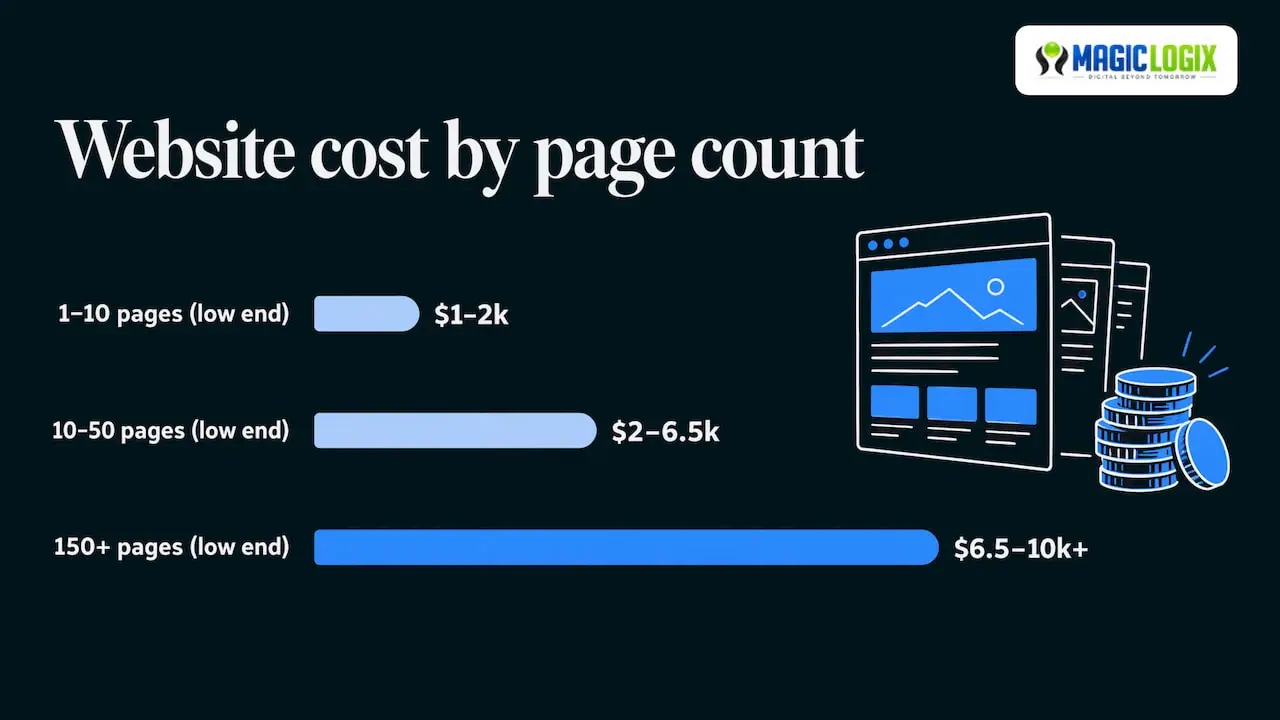
The same guide ties price to page count: 1 to 10 pages at $1,000 to $2,000, 10 to 50 pages at $2,000 to $6,500, and 150 or more pages at $6,500 to $10,000 or higher. Treat those as the low end. They describe template-style work, and custom design, strategy and integrations push a project well past them.
Web design cost vs. web development cost
Two words get mixed up in quotes, and it matters which one you are paying for.
- Design covers how the site looks and feels: layout, branding, user experience (UX, how easy the site is to use) and user interface (UI, the screens and controls people click).
- Development covers how the site works: the code, the content management system (CMS, the dashboard where you edit pages), integrations, speed, security and any custom functionality.
Small sites often bundle both into one price. Larger projects split them into phases, which is useful because you can see where the money goes. A quote that shows only one number for “design and development” tells you little. Ask for the phases, the deliverables in each and the hours or fixed fees behind them.
The labor behind these phases is skilled work. The US Bureau of Labor Statistics reports a 2025 median pay of $99,520 per year for web developers and digital designers, compared with $50,980 for all occupations. That is salary, not billing rate, and agency prices also carry project management, QA testing and support. It does explain why a custom build does not cost a few hundred dollars.
What drives the price of a custom website
When two quotes for “a business website” differ by $20,000, the gap almost always sits in these areas.
Scope and page count
A 10-page marketing site and a 150-page site with resource libraries and location pages are different projects. More pages mean more design templates, more content and more testing. Count the unique page types (home, service, location, blog, case study), because each type needs its own design, while repeating a type is cheaper.
Custom design versus templates
A template starts with a pre-built layout and adapts it to your brand. Custom design starts from your customers, your competitors and your conversion goals, and produces layouts built for them. Custom costs more upfront and typically fits better when the website is a main source of leads or revenue.
Functionality and integrations
Every connection to another system adds work: a CRM, a booking tool, payment processing, inventory, a customer portal, marketing automation. Integrations also add testing and ongoing maintenance. If your marketing team needs leads to flow into a CRM correctly, mapping the lead path before choosing tools keeps the integration budget from growing mid-project.
Ecommerce
An online store adds product catalogs, carts, checkout, tax and shipping logic, and payment security. The cost climbs with the number of products, variants, payment options and connected systems. Magic Logix handles ecommerce development as its own service, separate from standard brochure sites.
Content, SEO and migration
New copy, photography and video are often priced separately from the build. If you are replacing an existing site, URL redirects and content migration protect the search traffic you already have. Skipping them is a common reason a redesign loses visibility. Our guide to four deliverables that protect traffic and revenue in a redesign covers what to lock down before launch.
Timeline
Rush schedules usually cost more because they pull in extra people at once. Planning a realistic timeline with phases for discovery, design, build, content and testing is cheaper than compressing everything at the end.
Which build path fits your business
There are five common routes. They differ in cost, control and who is responsible when something breaks. The ranges below are from a 2026 build-path comparison.
| Path | Typical cost | Best fit |
|---|---|---|
| DIY website builder | $16 to $50 per month | Simple brochure sites on tight budgets |
| AI website builder | Free to about $50 per month | A fast first version for non-technical owners |
| Self-hosted WordPress, DIY | $100 to $500 per year | Owners comfortable with a learning curve |
| Freelancer | $1,500 to $8,000 one-time | Custom branding without agency overhead |
| Boutique or full-service agency | $6,000 to $35,000 or more | Strategy, custom design, integrations and ongoing support |
The path to match to your goals is the one that covers what the site must do for revenue. If the website is your main lead source, needs integrations, or must rank in search and in AI answers, a team that covers strategy, design, development and search visibility together keeps those pieces working as one system. That is the case for an agency build, and it is the work Magic Logix does in website design and development.
Ongoing costs: what you pay after launch
Launch day is not the end of the budget. A site needs hosting, a domain, security, software updates, backups and someone to fix problems. One 2026 guide estimates total ongoing costs for a small business site at roughly $600 to $6,000 per year. It also reports full-service maintenance plans commonly at $95 to $195 per month, and says custom web apps need 15% to 25% of the build cost every year.
Budget for these lines:
- Hosting and domain: the recurring infrastructure fees.
- Security and backups: SSL certificates, monitoring and restore points.
- Updates: CMS, plugin and framework patches, plus browser and device compatibility.
- Content changes: new pages, offers, team updates, blog posts.
- Performance and analytics: speed checks, tracking, conversion reporting.
- Search visibility: ongoing SEO and, increasingly, optimization for AI answer engines. Our breakdown of why one average figure should not set your SEO budget explains how those costs are built.
A useful rule: when you compare quotes, add the first-year build cost to the first-year running cost. A cheaper build with no support plan can cost more by month 12 than a fuller one that includes it.
How to read a website development quote
A quote is a scope document with a price on it. A good one lets you predict the final invoice. A 2026 estimate guide recommends that a quote include these elements, per its checklist of what an estimate should contain:
- Full project scope and an itemized cost breakdown
- Phase-by-phase timelines
- Stated assumptions and exclusions
- A change-order clause (how added work is priced and approved)
- A limit on revision rounds
- An expiration date, commonly 30 to 90 days
Add these questions of your own:
- Who owns the code, design files and content at the end? Ownership should be written down.
- What is excluded? Copywriting, photography, migration, training and third-party licenses are the usual surprises.
- What happens after launch? Look for a warranty period, a support option and a named contact.
- How is the price built? Fixed project fees give you predictability, while hourly or day-rate pricing gives flexibility but needs tighter scope control. If you want to understand how those models compare, this explanation of day rate versus project rate pricing helps you line up quotes that are priced differently. Our overview of marketing agency pricing models covers project, retainer and hybrid structures.
- How will success be measured? Agree on metrics such as lead form submissions, page speed and organic traffic before the build starts, so results can be evaluated afterward.
Budget checklist before you request proposals
Use this to get comparable quotes instead of a spread of guesses.
- Write down the business goal of the site (leads, sales, bookings, recruiting).
- List the page types and the rough number of each.
- List required integrations (CRM, payments, scheduling, email).
- Decide who writes and supplies copy, images and video.
- Note any existing site to migrate, with its top-traffic URLs.
- Set a first-year budget that includes ongoing costs, not only the build.
- Name one decision-maker and a feedback timeline to prevent scope creep.
- Ask each provider to quote the same scope in the same format.
If your current site is aging rather than missing, a rebuild may be a better use of budget than starting from zero. Redesigning a website for business growth walks through that decision.
Is $1,000 a good price for a website?
For a very small site, $1,000 can buy a simple template-based brochure site of a few pages, which sits at the low end of the published page-count ranges above. It is not typically enough for custom design, integrations, ecommerce or a search strategy. Decide by what the site must do: if it is a basic online listing, a small budget can fit. If it must generate leads and compete in search, plan for the small business ranges above.
Our view: price the whole system, not just the build
We see a website as the center of a larger system: design, development, search visibility, analytics and automation all need to work together. A site priced only on pages and templates can look complete at launch and still fail to bring in customers, because nobody planned how people find it, how the leads move on, or how results get measured.
That is why we scope projects around business outcomes and the connected pieces: UX and UI design, development, SEO, AEO and GEO (optimizing for answer engines and generative AI search), and marketing automation. Our approach is built on data analytics and creative design, delivered under one team so the pieces do not drift apart. For a decision-maker, the useful budget question is what the site must do for the business in its first year, then which scope delivers it.
We also advise against promising rankings or AI citations from any build. Search platforms change, and guidance on AI search is still evolving, so a good plan sets measurable goals and reviews them on a schedule.
Hassan Bawab
Plan the build with Magic Logix
Magic Logix offers website design and development, ecommerce development, mobile apps and custom development, UI/UX design and search and AI visibility under the positioning “Digital Beyond Tomorrow.” We do not publish fixed prices, because each project is scoped to its goals. If you have a page list, a set of integrations and a goal, tell us about your project and we will scope it with you.
FAQ
How much does a custom website cost for a business?
Published guides put custom builds at roughly $5,000 to $50,000 or more, with small business projects commonly between $3,000 and $15,000. The final figure depends on page count, design depth, integrations and ecommerce needs. A written scope is the only way to get a price specific to your site.
How much should I pay someone to build a website for me?
Match the budget to the site’s job. A freelancer-built site is reported at $1,500 to $8,000, and agency builds at $6,000 to $35,000 or more. Whichever route you take, add the first-year running costs and make sure the quote lists exclusions and post-launch support.
What are the ongoing costs of a business website?
For a small business site, one 2026 guide estimates about $600 to $6,000 per year covering hosting, security, updates and support. Maintenance plans are commonly $95 to $195 per month. Larger or custom applications typically need 15% to 25% of the build cost each year.
Is web development still worth it in 2026?
Yes, for businesses that depend on online discovery. The Bureau of Labor Statistics projects 5% growth in web developer and digital designer jobs from 2025 to 2035, faster than average. For you, the practical point is that a well-built site also needs to be visible in search and AI answers, so budget for both.
Sources
- Cost to Build a Website or Web App in 2026
- How Much Does a Website Cost? (HubSpot)
- Web Developers and Digital Designers, Occupational Outlook Handbook (US Bureau of Labor Statistics)
- Website Development Estimate Template: What to Include
- Day Rate vs Project Rate: How to Price and Compare Quotes