A real social media marketing strategy for a small business isn't about chasing likes or posting on a whim. It's a deliberate system designed to attract actual customers. This means truly understanding your audience, picking the right platforms to reach them, and creating content that actually connects. It's about smartly blending your organic and paid efforts and, most importantly, measuring what really matters for your bottom line.
This guide is your blueprint for building a plan that does more than just make noise—it builds loyalty and drives revenue.
Building Your Social Media Blueprint for Growth
The first real step toward growing your business with social media is to stop posting randomly. I've seen so many small businesses jump online without a clear plan, and it almost always leads to wasted time, frustration, and minimal results. The goal here is to create a system where every single action has a purpose.
You want to transform your social channels from simple broadcasting tools into powerful engines for finding and keeping customers. This is less about just creating a few posts and more about building a solid framework that ties directly back to your bigger business goals. It's the difference between throwing seeds in the wind and planting a well-planned garden.
For a deeper look into creating A Modern Social Media Strategy for Small Businesses that generates real engagement and sales, this guide is an invaluable resource.
The Core Pillars of a Winning Strategy
To get this right, you have to focus on three pillars that work together in a continuous cycle. Get these down, and you're well on your way.
- Understand Your Audience: This is more than just knowing their age and location. You need to pinpoint their real challenges, their online habits, and the kind of content they genuinely want to see. This single step informs every other decision you'll make.
- Create Valuable Content: Your plan should be built around content that educates, entertains, or inspires. The goal is to serve your audience's needs first. When you do that, you build trust and position your brand as a go-to resource, not just another company trying to sell something.
- Measure and Optimize: Forget vanity metrics. Track the numbers that actually impact your business, like engagement rates, click-throughs, and conversions. Use this data to figure out what's resonating with your audience, then double down on it and refine your approach over time.
This visual shows exactly how these pillars—Audience, Content, and Measurement—form a nonstop loop.

Here's the key takeaway: a good strategy isn't something you set and forget. It's a dynamic process of listening, creating, and refining. A strong social presence is built on this iterative cycle, which guarantees your efforts stay aligned with both your audience and your business goals.
To see how this fits into the bigger picture, check out our guide on how to write a marketing plan for a complete overview.
To help you keep these essentials in mind, here’s a quick summary of the framework we'll be building.
Core Pillars of Your Social Media Strategy
| Pillar | Objective | Key Action |
|---|---|---|
| Audience Definition | To deeply understand who you're talking to. | Create detailed buyer personas based on real data and customer feedback. |
| Content Creation | To provide genuine value that builds trust. | Develop a content calendar with topics that solve your audience's problems. |
| Measurement & Refinement | To ensure your efforts are driving business results. | Track KPIs that align with your goals and use the insights to optimize. |
Treating these pillars as an interconnected system, rather than a checklist, is what separates a strategy that works from one that just keeps you busy.
Finding Your Audience and Where They Are Online
Every great social media strategy starts with one simple, non-negotiable step: knowing exactly who you're talking to. Before you even think about posting, you have to get a crystal-clear picture of your ideal customer. And I'm not just talking about basic demographics like age and location.
What really keeps them up at night? What are their biggest frustrations that you, and only you, can solve? When you know the answers to these questions, you stop creating ads and start having conversations. That's how you build a real community around your brand.

Crafting Your Customer Persona
Think of a customer persona as a character sheet for your ideal buyer. This isn't just some fluffy creative exercise; it's a powerful tool that will guide every single piece of content you create from here on out.
The best way to start is by looking at the data you already have. Dig into your existing customer list, send out a few simple surveys, and—most importantly—read the comments and DMs you're getting.
To build a persona that's actually useful, you need to answer a few key questions:
- Goals: What are they genuinely trying to achieve in their life or work?
- Challenges: What specific pain points or roadblocks are standing in their way?
- Content Preferences: Are they binge-watching quick video tutorials, diving deep into detailed blog posts, or just looking for a good laugh with funny memes?
- Online Habits: Which platforms are they scrolling through every day? When are they most likely to be online?
Answering these questions gives you a massive advantage. For example, if you find out your audience is mostly busy parents who finally get a moment to scroll Instagram after 9 PM, you know exactly what to post and when to schedule it for the biggest impact.
A huge mistake I see people make is creating a persona that’s way too generic. 'Small business owner' tells you nothing. Get specific: 'Sarah, a 35-year-old owner of a local bakery, struggles to find time for marketing and needs quick, visual tips she can use right on Instagram.' See the difference?
Choosing the Right Social Media Platforms
Once you’ve nailed down the ‘who,’ you can confidently figure out the ‘where.’ Let me be clear: the goal is not to be on every single platform. That’s a one-way ticket to burnout with very little to show for it.
Your mission is to pick the one or two platforms where your ideal customer is already hanging out.
Each social media channel has its own vibe, user base, and content style. A B2B consulting firm is going to kill it on LinkedIn, but they’d probably get crickets on TikTok.
Here’s a quick rundown of the major players:
- Facebook: Still a giant. It’s incredibly versatile for building communities (think Facebook Groups) and sharing a mix of content, from videos to local event announcements.
- Instagram: The undisputed king of visual-first brands. If you're in fashion, food, travel, or anything else that looks good on camera, this is your playground. Reels and Stories are where the action is.
- LinkedIn: This is the B2B powerhouse. It's built for professional networking, sharing industry insights, and positioning your brand as the go-to authority in your field.
- TikTok: If you want to show off your brand's personality, this is the place. It’s all about creative, entertaining, and trend-driven short-form video, especially if you’re trying to reach a younger audience.
Making a smart choice here is critical for any small business. It ensures you're investing your limited time and money where it will actually make a difference. This targeted approach is a cornerstone of any good customer acquisition strategy.
The way people discover new products has totally changed. A recent Sprout Social report shows that platforms like TikTok, Instagram, and YouTube now drive over 60% of product discovery—beating out Google. Roughly one in three consumers now starts their search on social media, not a search engine. This means a solid social presence isn't just nice to have; it's as vital as having a website.
Planning Content That Actually Connects
You’ve figured out who you’re talking to and where they hang out online. Now for the fun part: deciding what you’re actually going to say. A solid content plan isn't just a to-do list for your social media; it’s the engine that turns casual scrollers into a community that genuinely cares about your brand.
The best place to start is by defining your content pillars. These are the big-picture themes your brand will own. Think of them as the 3-5 core topics you want to be known for. They should spring directly from the problems and passions you identified when you were getting to know your audience.
Let's imagine a local coffee shop. Their pillars might look something like this:
- Coffee Education: Simple brewing guides, a peek into the roasting process, or explaining the difference between a single-origin and a blend.
- Community Spotlight: Featuring the local artists whose work is on the walls or giving a shout-out to other small businesses in the neighborhood.
- Behind the Counter: Introducing the baristas, sharing their favorite off-menu drink creations, and showing the day-to-day life of the café.
Having these pillars makes brainstorming a thousand times easier. They act as a guardrail, ensuring every piece of content feels consistent, on-brand, and genuinely useful to your followers.
Pick Your Plays: Choosing the Right Content Formats
Not all content is created equal. The trick is to match the format to the message and to how your audience likes to consume information. A good mix keeps your feed from getting stale.
Short-Form Video (Reels & TikToks)
This is your scroll-stopper. It's perfect for showing off a process, sharing a quick tip, or just letting your brand's personality shine. A local bakery could post a 15-second hyper-lapse of a baker flawlessly decorating a wedding cake, all set to a trending song. The goal here is pure, delightful entertainment.
Carousels (Multi-Image Posts)
Carousels are absolute gold for teaching something. You can break down a complicated idea into a series of easy-to-digest, swipeable graphics. A financial advisor could create a carousel titled "5 Mistakes First-Time Homebuyers Make," dedicating one slide to each point. This format is a magnet for saves and shares, which is great for your visibility.
User-Generated Content (UGC)
There's no better social proof than a happy customer. UGC is simply you resharing content your customers have already made that features your product or service. A clothing boutique could repost a customer’s photo of them looking amazing in one of their dresses. It builds trust and a sense of community in a way that branded content just can't.
If I can offer one piece of advice, it’s this: start small. You don’t need to be a master of all formats on day one. Pick one or two that feel like a natural fit for your business and get really good at them. Once those are running smoothly, you can branch out and experiment.
A Simple Brainstorming Framework
We've all been there—staring at a blank calendar, waiting for inspiration to strike. I find it helps to use a simple framework that balances your content. Every post should have one of three jobs: Educate, Entertain, or Build Trust.
- Educate: Teach your audience something they’ll find valuable. This immediately positions you as a helpful expert. A local hardware store could post a quick video on the right way to patch a hole in drywall.
- Entertain: Make them smile, laugh, or feel something. This is where you build a human connection and show off your brand’s unique personality. Think of a pet groomer posting hilarious "before and after" photos of their fluffiest clients.
- Build Trust: Pull back the curtain and show the real people behind your business. Share customer testimonials, introduce your team, or tell the origin story of your brand.
By planning your content mix around these three goals, you create a well-rounded feed that does more than just sell. Your content starts to reflect your brand's true value, a core idea we explore in our guide on the definition of brand positioning.
Ultimately, a sustainable content plan is about building a system. It's the critical piece of any small business social media strategy that turns followers into fans and drives real, tangible growth.
Integrating Paid Ads with Your Organic Strategy
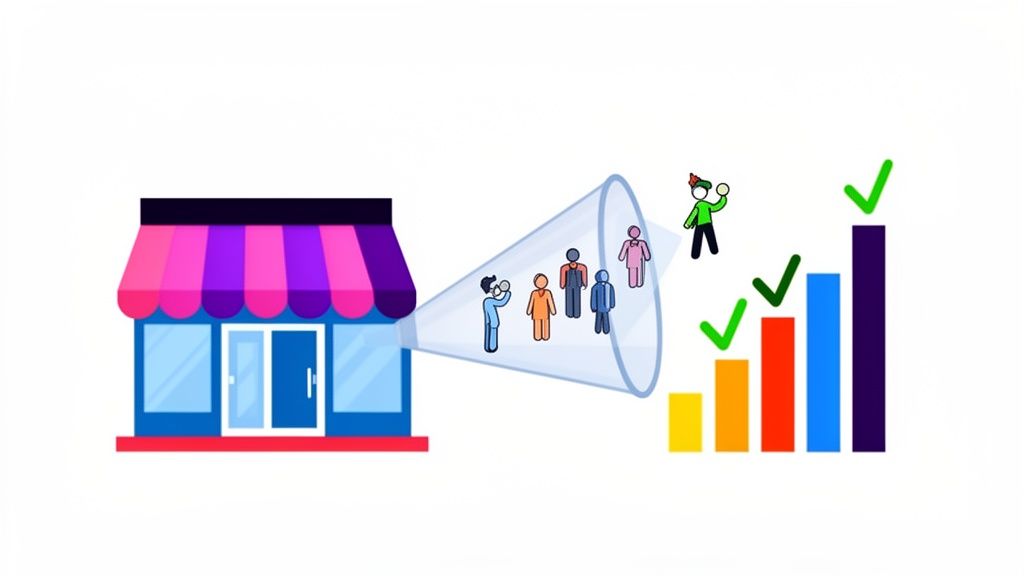
Let's think of your social media presence like a storefront. Your organic posts are the amazing window displays and the friendly welcome you give to people who walk in. They build a loyal community and nurture relationships over time. But sometimes, you need to put a sign out on the main street to bring in new crowds.
That’s exactly what paid ads do.

In a crowded feed, even your best organic content can struggle to get seen by new eyes. Combining your unpaid efforts with a smart, budgeted ad strategy is the real key to breaking through. It’s not about choosing one over the other; it’s about making them work together as a powerful growth engine for your business.
Your organic content builds trust and authenticity with your current followers. Paid ads, on the other hand, act as a megaphone, amplifying that trusted message to a much wider, highly targeted audience that doesn't even know you exist yet. This one-two punch is a cornerstone of any truly effective social media strategy for a small business.
Setting a Realistic Ad Budget
The idea of "paid advertising" can feel intimidating, but you don't need a huge budget to see results. The secret is to start small, be incredibly strategic, and focus on crystal-clear objectives.
Many small businesses find their footing by starting with just $5 to $10 per day on a couple of well-chosen campaigns, like driving local awareness or retargeting recent website visitors. While you can often see initial engagement within a few weeks, it's important to set realistic expectations. Getting meaningful results—qualified leads and actual sales—typically requires three to six months of consistent testing and tweaking. You can find some great advice on getting started with social ads on wearetg.com.
Your budget should always map directly to your campaign goals. Here’s a simple way to think about it:
- Brand Awareness: The goal here is simple: get seen. You might run a campaign showing your best introductory video to a broad local audience.
- Lead Generation: Now you're after contact info. This could be an ad that offers a free downloadable guide in exchange for an email address.
- Conversions: This is about driving a sale. These ads often retarget people who have already visited your website or, even better, abandoned a shopping cart.
Boosted Posts vs. Full Ad Campaigns
This is a big one. It's absolutely crucial to understand the difference between hitting that easy "Boost Post" button and setting up a full ad campaign in a platform's Ads Manager. They serve very different purposes.
Boosted Posts
A boosted post is the most basic form of advertising. You simply take an existing organic post that’s already doing well and pay to show it to a wider audience.
- Best for: Increasing the reach of your top-performing organic content and driving more engagement (likes, comments, shares).
- Example: A local restaurant posts a picture of its new seasonal menu, and it's getting a ton of love from current followers. They can boost it to reach thousands of other foodies in their city who don't follow them yet.
Full Ad Campaigns (Using Ads Manager)
Creating a campaign through a tool like Meta Ads Manager gives you an entirely different level of control and incredibly advanced targeting options.
- Best for: Hitting specific business goals like driving website traffic, generating leads, or making sales.
- Example: An e-commerce boutique wants to sell a specific dress. They can use Ads Manager to create a carousel ad that targets users based on their online shopping behavior, interests, and even whether they've visited that specific product page before.
The most powerful strategy? Use insights from your organic content to fuel your paid campaigns. If a particular educational post gets a ton of saves and comments, that’s a direct signal from your audience. Turn that exact concept into a full-fledged ad campaign—it’s already been market-tested for you.
Measuring What Matters for Business Growth
If you're not tracking your results, you're not marketing—you're just guessing. A real social media strategy for a small business means getting past the vanity metrics, like follower counts, and zeroing in on the numbers that actually move the needle for your business.
It’s the only way to know if all your hard work is actually paying off.
This isn’t about drowning yourself in spreadsheets. It’s about learning to read the story your data is telling you. Once you figure out which posts drive website traffic or which ads actually lead to sales, you can stop wasting time and money on what isn't working and double down on what is.
Moving Beyond Vanity Metrics
The first thing we need to do is redefine what "success" on social media looks like. A post with a thousand likes feels good, but if none of those people ever click over to your website or buy a product, what did it really accomplish for your business?
We have to focus on Key Performance Indicators (KPIs) that are directly tied to your business goals.
Here are the metrics I see making the biggest difference for most small businesses:
- Engagement Rate: This is the percentage of your audience that actually interacts with your content—the likes, comments, shares, and saves. A high engagement rate is a huge signal that your content is hitting the mark and building a real community.
- Click-Through Rate (CTR): This number tells you how many people clicked a link in your post, bio, or ad. CTR is your bridge from social media to your website or product page, making it a critical measure of how well you're driving action.
- Return on Ad Spend (ROAS): When it comes to your paid campaigns, this is the metric that matters most. It calculates how much revenue you brought in for every dollar you spent. A 4:1 ROAS means you made $4 for every $1 spent—a crystal-clear sign of a profitable campaign.
Getting a handle on these metrics is fundamental. To see how they fit into a bigger picture, you can explore our detailed guide on digital marketing performance metrics.
Using Platform Analytics to Your Advantage
You don't need to shell out for expensive third-party tools, especially when you're starting out. Every major social platform has incredibly powerful (and free) analytics built right in. Tools like Meta Business Suite for Facebook and Instagram or TikTok Analytics give you a goldmine of information.
Spend a little time just clicking around in these dashboards. You’ll be surprised at what you can find:
- Audience Demographics: See the age, gender, and location of your followers. Does it match the customer persona you built?
- Peak Activity Times: Find out the exact days and hours your audience is most active. Now you know the best times to post for maximum reach.
- Top-Performing Posts: Quickly see which content formats—Reels, carousels, static images—are getting the most love from your audience.
My best advice is to block off 30 minutes at the end of every week to dive into your analytics. Look for the patterns. Did that behind-the-scenes video get twice as many shares as your polished product shots? That’s not a coincidence; it's a powerful clue about what your audience truly wants to see.
This isn't just theory; it has a direct impact on your bottom line. Research has shown that customers who engage with a brand on social media spend 35-40% more with that business. This proves that engagement isn't just a feel-good number—it's a real driver of revenue. You can discover more insights about these social media findings.
Creating a Simple Feedback Loop
The real magic happens when you turn measurement into a simple, repeatable process for getting better. Think of it as a cycle: Measure, Analyze, and Optimize.
- Measure: At the end of each month, pull your key metrics. Track your engagement rate, CTR, and ROAS in a simple document.
- Analyze: Look at the numbers and ask, "Why?" Why did one post get so many clicks while another fell flat? What topics or themes sparked the most conversation?
- Optimize: Use what you learned to inform next month’s content plan. If videos are clearly crushing it, make more Reels. If a certain ad creative has a killer ROAS, use it as a template for your next campaign.
This simple feedback loop is what separates an okay strategy from a truly effective one. Each month, you get a little bit smarter, and your results get a little bit better. This is how you build a sustainable growth engine for your business.
Answering Your Biggest Social Media Questions

Even with the best-laid plans, you're going to have questions. It’s just part of the process when you're building a social media strategy from the ground up. Let's tackle some of the most common hurdles I see small businesses face, so you can move forward with confidence.
How Often Should a Small Business Post?
This is probably the question I get asked most often. The answer is simpler than you'd think: consistency will always beat frequency. Seriously. It's so much better to share three fantastic, high-value posts every week than to burn yourself out churning out seven mediocre ones.
A sustainable schedule is your best friend here. It prevents burnout and ensures the quality of your content stays high. For most small businesses, a great starting point on platforms like Instagram and Facebook is 3-5 quality posts per week.
Of course, the ideal cadence depends on where you're posting and how your audience behaves.
- Facebook & Instagram: Aiming for 3-5 times a week is a solid goal. It keeps you visible without flooding people's feeds.
- LinkedIn: If you're in the B2B world, 2-3 thoughtful posts per week about industry insights or company news usually hits the sweet spot.
- X (formerly Twitter): This one moves fast. You might find yourself posting daily, or even several times a day, if you're jumping into real-time conversations or have timely updates to share.
The secret? Let the data be your guide. Dive into your platform's analytics to see when your audience is most active, then schedule your posts for those peak times. Don't be afraid to experiment with different frequencies and pay close attention to what your engagement numbers tell you.
What Are the Most Important Metrics to Track?
It’s incredibly easy to get hung up on follower counts and likes. But these "vanity metrics" don't actually pay the bills. To figure out if your social media is truly growing your business, you need to track the numbers that connect directly to your bottom-line goals.
Instead of drowning in a sea of data, just focus on these three powerhouses to start:
- Engagement Rate: Calculate this by taking a post's total engagements (likes, comments, shares, saves) and dividing it by your follower count. This is the single best sign of whether your content is actually resonating with people. A high engagement rate means you're building a real community, not just an audience.
- Click-Through Rate (CTR): This tells you what percentage of people who saw your post actually clicked the link. Your CTR is the bridge between your social media and your website. When it's strong, it's a clear signal of genuine interest in what you're offering.
- Conversion Rate: This is the ultimate metric. It tracks how many people who came from social media took the action you wanted—signing up for your newsletter, downloading a guide, or, the big one, making a purchase. This number directly ties your social activity to real business results.
Chasing followers is a fool's errand. I would rather have 500 highly engaged followers who love what I do and buy my products than 10,000 who passively scroll by. Focus on the metrics that prove you're building a valuable audience, not just a big one.
How Should I Handle Negative Comments?
Sooner or later, it happens to everyone. That first negative comment pops up. Your gut reaction might be to get defensive or just delete it and pretend it never happened. Don't do it. A negative comment isn't a crisis; it’s a golden opportunity to show everyone watching how seriously you take customer satisfaction.
Ignoring feedback makes you look like you don't care. Deleting it makes you look like you have something to hide. But a professional, thoughtful response? That can turn a frustrated customer into your biggest fan.
Just follow this simple, but incredibly effective, process:
- Respond Promptly and Publicly: Acknowledge their comment as soon as you can. A simple, "We're so sorry to hear about your experience," shows you’re paying attention and validates their feelings.
- Take the Conversation Private: The goal of your public reply is to move the conversation offline. End your comment with a clear next step, like, "Please send us a DM with your order number so our team can make this right for you." This takes the heated discussion out of the public square while showing everyone else you're proactively solving the problem.
- Learn From the Feedback: Every complaint is free market research. Is there a recurring issue with a specific product? A snag in your shipping process? Use this direct feedback to find and fix the weak spots in your business.
When you handle it this way, a potential negative becomes a masterclass in great customer service.
At Magic Logix, we help businesses turn these strategies into real-world success stories. We combine data, technology, and creativity to build marketing solutions that drive growth. Discover how we can transform your digital presence by visiting us at https://www.magiclogix.com.