When you hear the term long-form content, what comes to mind? A lot of people immediately think of a massive word count, something epic like a novel. While length is part of the equation—typically anything over 1,200 words—the real story is about depth and value.
It's the difference between a quick social media post and a definitive guide that actually solves a problem. One is a snack; the other is a full, satisfying meal.
What Is Long Form Content and Why It Wins

Let's look past simple word counts for a second. True long-form content is a strategic choice to go deep on a topic. Think of it like a quick text versus a thoughtful, detailed letter. The text is great for a fast update, but the letter is what builds a real relationship and shows you genuinely care. That's precisely why both search engines and human audiences reward it.
This kind of content isn't just limited to blog posts. It can take many forms: an in-depth guide, a pillar page, an e-book, a detailed case study, or even a podcast episode. The main goal is always the same: to be the single most helpful and authoritative resource someone can find on that subject. No stone left unturned.
Long-form content isn’t just about being long; it's about being the most complete answer to a user's problem. When you become the go-to destination for comprehensive solutions, you build lasting authority and trust.
Understanding the Strategic Differences
Choosing between long- and short-form content all comes down to your goal. One is built for quick engagement and brand awareness, while the other is designed for education, building authority, and generating leads. Getting this distinction right is crucial for any effective content strategy. For a deeper look, check out our insights on why https://www.magiclogix.com/theories/blogging-important-for-marketing/.
While there's no magic number for length, data shows a sweet spot emerging. By 2026, the average article length landed at 1,333 words, pulling back from a trend of ever-longer pieces. This suggests a smart balance between providing real depth and keeping the reader's attention, which tends to drift after about seven minutes.
Long Form vs Short Form Content At A Glance
Knowing when to deploy each content type is the key to making your marketing efforts count. This quick table highlights their core differences and best uses.
| Attribute | Long Form Content | Short Form Content |
|---|---|---|
| Primary Goal | Educate, build authority, generate leads | Entertain, inform quickly, drive awareness |
| Word Count | Typically 1,200+ words | Typically under 1,000 words |
| Audience Intent | Seeking deep understanding and solutions | Looking for quick updates and fast info |
| SEO Impact | High potential for ranking, backlinks | Lower, more for social signals |
| Best For | Complex topics, guides, white papers | Social media, news, quick announcements |
Ultimately, long-form content is no longer a "nice-to-have" tactic; it's a core asset for building a real, lasting competitive advantage in the market. And it's not just about text—understanding how to start winning with long form video is just as critical for engaging different parts of your audience.
How Long Form Content Drives Real Business Growth
Creating in-depth content is far more than just a writing task; it's a direct investment in your company’s future. While short, snappy posts are great for a quick flash of engagement, long form content is the powerful engine working behind the scenes, driving sustainable, long-term business results.
Think of it this way: short content is like handing out flyers on a busy street. You might get a few glances. But long form content is like hosting an expert workshop where you solve real problems. People who attend will remember you, trust you, and ultimately want to work with you.
Fueling Your SEO and Attracting Authority
The most immediate and powerful benefit of long form content is its impact on search engine optimization (SEO). Search engines like Google are designed to reward pages that provide the most thorough answers to a user's question. Detailed articles naturally cover a topic from every angle, weaving in a wide range of related keywords and phrases along the way.
This depth signals to search engines that your page is a high-value resource. In fact, the average word count for a top-ranking page on Google is around 1,447 words, showing a clear preference for content that leaves no stone unturned. This thoroughness leads to some serious perks:
- Higher Rankings: Comprehensive articles are far more likely to satisfy what a user is looking for, pushing them higher in search results for even the most competitive keywords.
- Increased Organic Traffic: Better rankings mean more visibility. More visibility directly translates to a steady stream of relevant visitors finding their way to your site.
- Backlink Magnetism: Real, authoritative content gets noticed. Other websites are much more likely to link to a definitive guide than a brief summary, earning you valuable backlinks that further boost your site's authority.
Building Unshakeable Brand Authority and Trust
In a crowded marketplace, trust is your most valuable currency. When you consistently publish detailed, well-researched content, you aren't just sharing information—you are proving your expertise. Your website transforms from a simple digital brochure into an essential industry library.
This shift has a profound effect on how customers see you. Instead of viewing you as just another vendor, potential clients start to see your brand as a trusted advisor they can rely on.
By becoming the go-to source for reliable information in your niche, you build an audience that actively seeks out your perspective. This authority is something competitors cannot easily replicate, creating a durable competitive advantage that pays dividends for years.
Driving High-Quality Leads and Sales
Long form content is a cornerstone of modern lead generation. It’s exceptionally good at attracting prospects who are actively researching a problem—people who have moved beyond casual browsing and are on the hunt for real solutions. This is where your detailed guides, white papers, and e-books become powerful conversion tools.
Imagine a potential client digging into a complex issue. They find your in-depth article that not only explains the problem but also outlines a clear path to a solution. By offering even more value right there—like a downloadable checklist or a free consultation—you capture a highly qualified lead. This strategy aligns perfectly with achieving sustained digital marketing for business growth, as it naturally nurtures prospects through the sales funnel.
Your Framework for High-Impact Long-Form Content
You know those exceptional, authoritative articles that you bookmark and return to again and again? They don’t happen by accident. They're the result of a repeatable system, a solid framework that takes an idea from a rough concept to a polished, powerful final product.
Think of it as building a house. You'd never just start hammering boards together without a blueprint. This framework is your blueprint for content, guiding you from topic selection all the way to a finished piece that will stand the test of time and drive real business results.
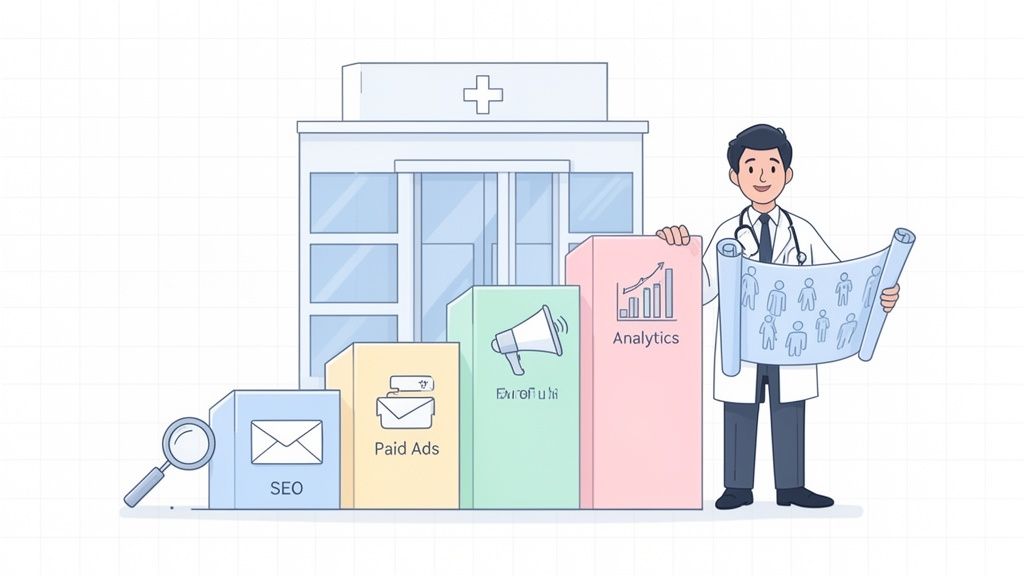
This visual breaks down the growth process. It all starts with attracting traffic, then building authority, and ultimately, driving revenue.

The key takeaway? Each stage is a building block for the next, turning a reader's initial curiosity into a tangible business asset.
Identify High-Potential Topics
The foundation of any great piece of long-form content is a topic that genuinely resonates with your target audience. You're looking for that sweet spot where what your audience is searching for overlaps with what your business is all about. This isn't guesswork; it's strategic listening.
Start by digging into keyword research. You want to understand the exact questions and problems your audience has. Look for queries with strong informational intent—phrases like "how to," "what is," or "a guide to." These are clear signals that people are actively seeking deep knowledge, creating the perfect opening for you to step in with a comprehensive resource.
Don't forget to listen to your audience directly. What questions are constantly popping up in sales calls? What are people asking on social media or in community forums? These conversations are goldmines for content ideas you already know will hit the mark.
Adopt the Pillar and Cluster Model
Once you've got your core topics, the next step is structuring them for maximum SEO impact and a fantastic user experience. The "pillar and cluster" model is an incredibly powerful way to get this done.
Picture a central "pillar" page—this is your comprehensive, in-depth guide on a broad topic (like "A Complete Guide to Digital Marketing"). This page becomes your main hub of authority. From there, you create several smaller "cluster" articles that dive deeper into specific subtopics mentioned in the pillar (for example, "SEO for Beginners," "Social Media Advertising," or "Email Marketing Basics").
Each cluster article then links back to that main pillar page. This simple structure accomplishes two critical things:
- For Users: It creates an organized, easy-to-navigate library of resources, guiding them from a general overview down to the specific details they need.
- For Search Engines: It signals that your pillar page is a definitive authority on the topic, which can seriously boost its ranking potential for those high-value keywords.
By organizing your content into pillars and clusters, you create a powerful internal linking structure that reinforces your expertise. This transforms your site from a collection of random posts into an interconnected web of valuable information.
Outline, Write, and Edit for Engagement
With a solid topic and structure in place, it's time to bring the content to life. A detailed outline is your best friend here. It should break down the article into logical sections with clear headings, ensuring a smooth, progressive flow for the reader.
When you start writing, think beyond just a wall of text. Weave in elements that make the information stick. Storytelling is a fantastic tool for making complex ideas relatable and memorable. Use real-world examples, case studies, or anecdotes to illustrate your points and show, not just tell.
Finally, editing is about much more than just catching typos. It’s about refining the entire piece for maximum readability and engagement.
- Break up long paragraphs: Keep them short and punchy, ideally 1-3 sentences.
- Use visual elements: Incorporate images, charts, and blockquotes to create visual breaks and draw the eye to key points.
- Incorporate expert insights: Including quotes from industry leaders or internal experts adds a layer of credibility that’s hard to beat.
As you build out your framework, it's also worth exploring innovations that can help streamline the process. For example, some teams are finding success with new methods of AI-powered long-form article writing to assist with first drafts. By following a structured approach, you ensure every piece of content you create is an unforgettable resource for your audience.
Unlocking Long-Form Content for Social Media Success

One of the biggest myths in marketing is that social media is only for fleeting, bite-sized updates. While platforms like TikTok and Instagram certainly built their empires on brevity, a powerful shift is happening right now. Users are getting hungry for depth, and savvy brands are figuring out that social media is an incredible distribution engine for their most valuable long-form content.
Think of it like a restaurant. Your complete, comprehensive guide or white paper is the satisfying main course. Your social media posts? They're the enticing appetizers that give your audience a taste of the value you offer and make them eager for the full meal. The goal isn't to cram a 3,000-word article into a single post, but to strategically slice it up to capture attention and drive traffic back to where the real value lives—your website.
Beyond the Myth of Short Attention Spans
There's a popular belief that attention spans are just getting shorter and shorter. The truth is, they're becoming more selective. People will gladly invest time in content that provides real value, whether that's through education or entertainment. The data actually confirms this shift away from purely short-form content.
Take TikTok, for instance. Videos over 60 seconds have been shown to get 95.7% more reach than short 5-10 second clips and an astonishing 264.5% more watch time. On LinkedIn, video watch time grew 36% year-over-year, with comments jumping 37%. This signals a clear appetite for more substantial, educational content on professional platforms.
This data paints a very clear picture: When content is compelling and valuable, audiences will not only watch but actively seek out longer formats, even on platforms known for speed. The key is to match the format to what the audience expects on that platform.
Repurposing Your Cornerstone Content for Social Feeds
The real secret to social media success with long-form content is smart adaptation. You have to translate your in-depth assets into formats that feel native to each platform, creating a trail of breadcrumbs that all lead back to your original piece. This approach respects the user's context while still promoting your deep-dive resources.
Here are a few actionable ways to get started:
Create Educational Video Teasers: Pull out a compelling statistic, a key takeaway, or a fascinating anecdote from your article. Turn it into a 60-second Instagram Reel or TikTok video that hooks the viewer and ends with a call to action like, "Read our full guide to learn more—link in bio!"
Craft Insightful LinkedIn Threads: LinkedIn is the perfect home for professional, text-based deep dives. You can break down the main sections of your long-form article into a multi-post thread. Each post can tackle one sub-topic, building on the last and encouraging comments and discussion along the way.
Develop Shareable Infographics: Identify the most powerful data points or steps in your guide. Work with a designer to create a visually appealing infographic that summarizes the core information. This is a highly shareable format that works wonders on platforms like Pinterest and LinkedIn.
By using these tactics, you transform your social channels from simple announcement boards into powerful tools for content discovery. A truly comprehensive social media marketing strategy for a small business or a large enterprise has to include promoting this kind of deep-dive content.
Measuring the True ROI of Your Content
Putting together a powerful piece of long-form content is a serious investment of time and resources. So, how do you actually prove it was worth it? Simply pointing to page views and time on page isn't going to convince anyone. To show real business impact, you have to connect your content directly to revenue and growth.
Think about it like this: judging a piece of content by its page views is like trying to measure the health of a fruit tree by counting its leaves. Sure, the leaves show activity, but they don't tell you if you'll have any fruit to harvest. True ROI comes from measuring the actual fruit—the leads, sales, and brand authority your content generates.
Moving Beyond Surface-Level Metrics
To get a real sense of your long-form content's value, we have to move past those surface-level "vanity metrics" and start focusing on Key Performance Indicators (KPIs) that mean something to the business. These are the numbers that get a stakeholder's attention because they reflect the bottom line. They tell a story of growth, not just website traffic.
You need to focus on metrics that bridge the gap between how your content is performing and what your business is trying to achieve. It’s the only way to build a solid case for your content strategy and justify future investment. For a deeper dive, our guide on measuring digital marketing effectiveness offers a lot more context.
Here are the KPIs that really matter:
- Lead Generation and Quality: How many marketing qualified leads (MQLs) came from a specific article? You can track this by looking at downloads of gated content like e-books or white papers, or by counting sign-ups for webinars you promoted in the post.
- Conversion Rate: Of all the people who read your long-form piece, what percentage actually took the next step? This could be signing up for a newsletter, requesting a demo, or even making a purchase.
- Customer Acquisition Cost (CAC) from Content: By tying new customers back to the content they read, you can figure out how much it costs to acquire a customer through your articles compared to paid ads. You'll often find that content-driven acquisition is much more cost-effective in the long run.
Attributing Revenue to Your Content
The ultimate goal is to pin a specific dollar amount to your content. This isn't guesswork; it just requires setting up proper tracking. Using UTM parameters in your links and configuring conversion goals in your analytics platform are the foundational first steps.
The most powerful statement you can make isn't, "This article got 10,000 views." It's, "This article generated $15,000 in new sales last quarter." That's how you shift the conversation from content being a cost center to content being a profit driver.
Think of each piece of long-form content as a digital salesperson working for you 24/7. Your job is to give it the right tools to not only attract and educate prospects but also to help close deals. By tracking which "salesperson" is performing best, you can double down on what works and refine your entire strategy for even better returns.
Building Your Business Case for Long-Form Content
The wider industry trends really hammer home the importance of this kind of detailed tracking. Globally, the content marketing industry is expected to reach $107 billion in revenue by 2026. What's more, blogging and SEO consistently deliver the highest ROI of all formats.
However, the real separation happens with measurement. Marketers who analyze the performance of every single article—a practice only about one-third currently follow—are far more likely to report strong results. You can discover more insights about these content marketing statistics on ahrefs.com.
By measuring the right KPIs, you transform your content from a creative exercise into a predictable growth engine. You can confidently show how your long-form content strategy directly fuels the business by attracting high-value traffic, building brand equity that competitors can't copy, and nurturing leads into loyal, high-value customers.
Your Questions About Long Form Content Answered
Even with the best strategy in hand, actually creating long-form content can feel a bit daunting. Practical questions always pop up. Let's tackle the most common ones head-on so you can move forward with confidence.
How Long Should Long-Form Content Actually Be?
While there isn't a magic number, most pieces that perform well start somewhere above 1,200 words. But getting fixated on word count is the wrong game to play. The real goal is to create the single most complete, authoritative resource for a given topic.
Instead of chasing an arbitrary number, think about depth. Your job is to anticipate and answer every single question a reader might have.
Your content needs to be the "one-stop shop" for that subject. If a reader finishes your article and still has to go back to Google for more answers, you haven't gone deep enough. Quality and total comprehensiveness will always win out over a simple word count.
Can a Small Business Realistically Compete?
Absolutely. In fact, long-form content is one of your secret weapons for leveling the playing field against bigger, more established competitors. Large corporations may have massive budgets, but they often lack agility, authenticity, and a true connection with a niche audience.
This is exactly where you come in. As a small business, you can own a specific niche. You can bring genuine, firsthand expertise to the table and build a loyal following around a voice that's uniquely yours.
Your deep understanding of a very specific person and their problems isn't a limitation; it's your most powerful asset. Big companies often water down their message to appeal to everyone. You don't have to. You can go deep, proving you’re the go-to expert in your corner of the world.
How Do You Keep Readers Engaged in a Long Article?
Holding a reader's attention through a 3,000-word piece isn't about the words alone. It's about structure, flow, and visual storytelling. A solid wall of text is a guaranteed way to send visitors running for the back button. Engagement comes from turning your content into a journey, not a lecture.
Here’s how you can keep readers hooked from the first sentence to the last:
- Break Up That Text: Use super short paragraphs (just 1-3 sentences), clear subheadings, and bullet points. This makes the page feel less intimidating and easy to scan.
- Bring in Visuals: Don't just tell them; show them. Strategically place relevant images, custom infographics, or embedded videos to illustrate your points and give their eyes a break.
- Be Their Guide: A good story always beats a dry explanation. Use real-world examples and a narrative flow to guide the reader logically from one idea to the next.
- Spotlight Key Takeaways: Pull out juicy stats or powerful quotes using blockquotes. This technique draws the eye to the most important information you want them to remember.
When you structure your content for readability, it becomes an inviting, valuable resource that people will actually want to finish.
Ready to transform your content strategy with data-driven insights? Magic Logix combines analytics, automated immersion marketing, and business intelligence to ensure your long form content delivers maximum ROI. Discover how we can help you build authority and drive growth at https://www.magiclogix.com.