
A lead nurturing workflow is an automated sequence of triggers, segments, content, cadence, and exit rules that moves a lead from first contact to sales-ready. The result you’re actually after is more qualified conversations and stronger pipeline contribution, not more email opens. Build one around those five anatomy pieces and it runs the follow-up work your sales team doesn’t have time for.
TL;DR:
- Workflows should have clear exit rules to prevent over-emailing leads who have already booked meetings or become inactive.
- Using multiple channels like chat or SMS alongside email can help re-engage leads who ignore initial contact methods.
- The most reliable metrics for success are pipeline created and revenue attributable, rather than open rates or clicks alone.
- Testing should focus on sales response times, call-to-action clarity, and timing, rather than just subject line or content tweaks.
- Ensure compliance with CAN-SPAM requirements, including accurate headers, a functioning opt-out, and responsible third-party vendors.
Table of Contents
- What Are the Core Components of a Lead Nurturing Workflow?
- How Do You Build a Lead Nurturing Workflow Step by Step?
- What Do Copy-Ready Lead Nurturing Workflow Templates Look Like?
- Which Metrics Actually Show a Workflow Is Working?
- How Do You Test and Optimize a Nurture Workflow?
- What Compliance Rules Apply to Lead Nurturing Emails?
- What Does a Lead Nurturing Governance Checklist Look Like?
- Where Most Lead Nurturing Workflows Actually Fail
- How Magiclogix Helps You Build Workflows That Convert
- Sources
- FAQ
What Are the Core Components of a Lead Nurturing Workflow?
Every working workflow, regardless of industry or channel mix, is built from the same five parts. Skip one and the workflow either sends to the wrong people or never knows when to stop.
- Trigger: the event that enrolls a lead, such as a form fill, a pricing page visit, or a trial signup.
- Segment: the filter that decides which version of the workflow a lead sees, based on persona, industry, deal size, or behavior.
- Exit rules: the conditions that pull a lead out immediately, such as conversion, unsubscribe, or a set period of inactivity.
Map your current setup against this list before you touch anything else. If you’re still fuzzy on how nurturing fits into the broader funnel, our breakdown of what lead nurturing actually does for conversion is worth a read first.
How Do You Build a Lead Nurturing Workflow Step by Step?
Building a workflow is a sequence, not a single design session. Skipping steps is exactly where most workflows start leaking leads.
- Define the persona and the objective. Tie the objective to a real revenue metric, like pipeline created or MQL acceptance, not “engagement.”
- Map content to funnel stage. Assign one goal per workflow. A workflow trying to educate, sell, and re-engage at once confuses everyone, including your automation platform.
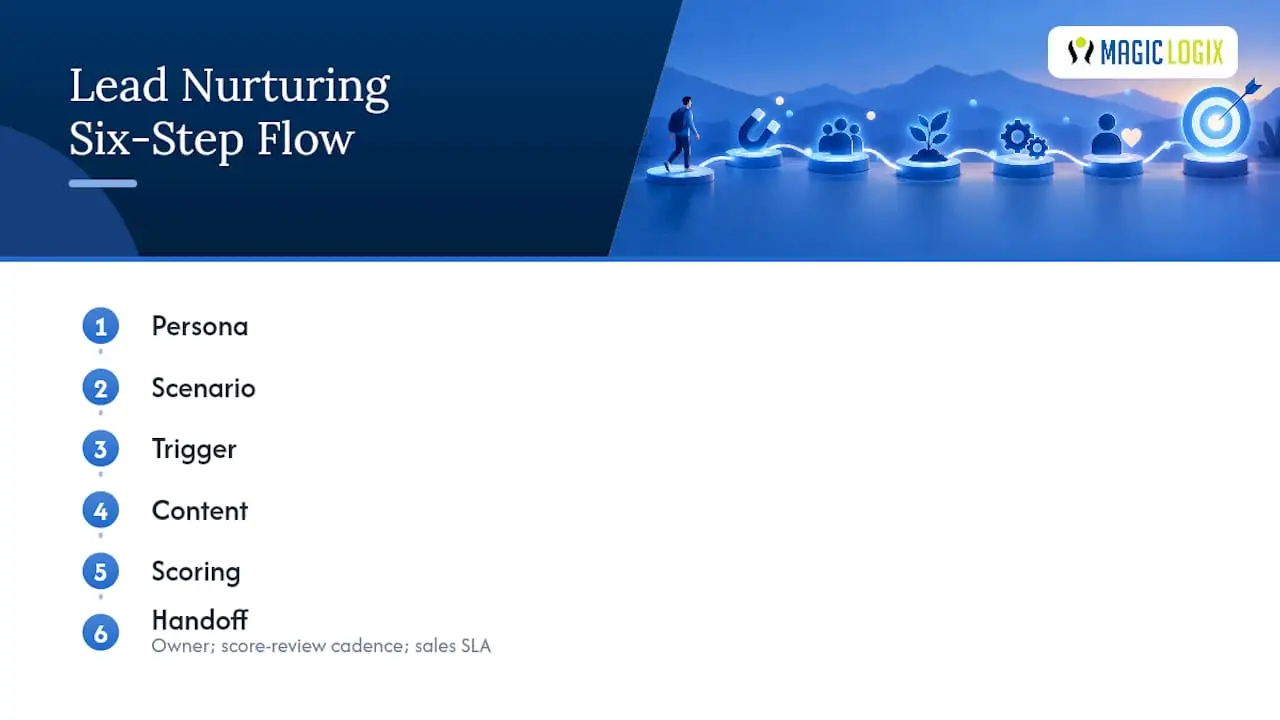
- Design the logic. Set triggers, branches, scoring thresholds, and the point where a lead hands off to sales. The strongest designs follow a persona to scenario to trigger to content to scoring to handoff pattern.
- Run a pre-launch QA pass. Check every link, walk every branch manually, confirm suppression lists are attached, and verify the opt-out link actually works.
- Monitor the first two weeks closely. Launch to a pilot segment, check in every few days, and be ready to pause any branch producing complaints or zero engagement.
Pro Tip: Never let the first message in a sequence pitch anything. Practitioners who build these workflows for a living recommend one message per email, one call-to-action link, and no selling in email number one — it protects both your reply rates and your sender reputation.
What Do Copy-Ready Lead Nurturing Workflow Templates Look Like?
You don’t need to design from a blank page. These four structures cover most B2B and ecommerce scenarios, and each one adapts to your sales cycle by simply stretching or compressing the day intervals.
- Email-only welcome-to-MQL. Day 0 welcome, day 3 case study, day 7 objection-handling, day 10 to 12 meeting request, exiting immediately once a meeting is booked. This matches a common cadence structure used across industries.
- Multichannel re-engagement. Starts on email, but switches to chat or SMS the moment a lead revisits your site without converting, catching people who never open email at all.
- SaaS trial-to-paid. Branches based on product usage. Active users get feature-adoption tips; inactive users get a check-in email; power users trigger a sales notification for upgrade conversations.
- Cart-recovery cadence. Segment by cart value. Lower-value carts get a reminder and a small incentive; high-value carts skip discounting and route straight to a sales or support touch.
| Template | Best for | Typical trigger |
|---|---|---|
| Email-only welcome-to-MQL | Long B2B sales cycles | Form fill or content download |
| Multichannel re-engagement | Leads with low email engagement | Site return visit |
| SaaS trial-to-paid | Product-led growth teams | Trial signup and usage events |
| Cart-recovery cadence | Ecommerce | Abandoned checkout |
Adjust the day spacing by persona: a $500 impulse purchase moves in days, a $50,000 enterprise deal moves in weeks. The template structure stays the same; only the clock changes.
Which Metrics Actually Show a Workflow Is Working?
Open rates tell you almost nothing about revenue. Treat them as a diagnostic, not a scoreboard.
- Primary metrics: enrollment-to-qualified-conversation rate, MQL acceptance rate, pipeline created, and closed-won revenue attributable to the workflow.
- Diagnostic metrics: opens, clicks, replies, unsubscribe rate, and spam complaints. These flag problems but don’t prove business impact on their own.
The most reliable way to prove a workflow works is a control group or a comparable pre-launch cohort measured against the same time window, segment, and offer. Comparing a nurtured group’s conversion rate against a matched group that received no workflow is what actually separates a working sequence from one that just feels active. Report results by trigger, content path, and exit reason so you know which piece of the workflow is doing the work and which is dead weight. For teams that want the scoring layer built out properly, our governance-first lead scoring guide walks through signal selection in more depth.
How Do You Test and Optimize a Nurture Workflow?
Testing should target revenue levers, not vanity wins. Prioritize experiments in this order:
- Sales handoff SLA. Test how fast sales responds after a lead crosses the scoring threshold. Speed to response often moves pipeline more than any email edit.
- CTA clarity. Test one clear call-to-action against a softer one, not five variables at once.
- Cadence timing. Test spacing, not just subject lines. A three-day gap versus a seven-day gap can shift reply rates more than copy changes.
Run pilots on a segment large enough to produce a real signal, not a handful of leads. Change segment definitions when the wrong people are entering the workflow; change message content when the right people enter but don’t respond. Document every test and its result so the next person building a workflow isn’t repeating a failed experiment blind.
What Compliance Rules Apply to Lead Nurturing Emails?
Every workflow that sends commercial email in the United States has to follow CAN-SPAM’s compliance requirements, and this isn’t optional legal boilerplate. It’s operational.
- Use accurate headers and subject lines, and include a valid postal address in every message.
- Provide a clear opt-out mechanism, honor opt-out requests within 10 business days, and keep that mechanism functional for at least 30 days after sending.
- Never charge a fee or require extra steps to opt out. The Can-SPAM Rule text explicitly prohibits both.
- If you outsource sending to a vendor or agency, you remain responsible. The FTC has held both the promoter and the sender accountable when a third party violates the rules.
Skip purchased lists. Permission-based acquisition costs more upfront but avoids the deliverability damage a purchased list almost always causes.
Pro Tip: Set up SPF, DKIM, and DMARC authentication before you launch any high-volume workflow, and warm up new sending domains gradually. Inbox providers throttle unfamiliar senders long before any legal issue ever comes into play.
What Does a Lead Nurturing Governance Checklist Look Like?
Workflows are often built on a six-step process: persona, scenario, trigger, content, scoring, handoff. Governance matters just as much as design. Assign an owner for the workflow, set a score review cadence, and define an SLA for how fast sales responds to a qualified lead. Our marketing automation playbooks for agencies cover this in more detail.
Where Most Lead Nurturing Workflows Actually Fail
Missing exit rules cause more damage than bad copy. Over-emailing a lead who already booked a meeting is the fastest way to lose sales trust in your automation. Your first month should focus on one pilot workflow, working lead scoring, and a real SLA with sales, not five workflows launched at once. Scale channel by channel, checking deliverability at each step, so growth doesn’t quietly undo the trust you built.
— Hassan
How Magiclogix Helps You Build Workflows That Convert
Magiclogix approaches nurturing the way the workflow anatomy above demands: audit the triggers and scoring you already have, then build the handoff logic and content mapping that most in-house teams don’t have time to finish properly.
If you’ve read this far, you already know the gap usually isn’t strategy. It’s execution: someone has to build the branching logic, wire up the scoring thresholds, connect the CRM handoff, and QA every exit rule before launch. That’s the work Magiclogix’s marketing automation and digital marketing services are built to handle, alongside the analytics and email marketing capabilities that make measurement possible instead of guesswork. A discovery call covers your current setup, a sample workflow built around your actual funnel, and a rough sketch of what pipeline impact might look like once it’s live. Book a consultation through the Magic Logix site to get a workflow built or scaled properly.
Sources
For the legal source material behind the compliance section, read the FTC’s CAN-SPAM compliance guide and the full eCFR rule text. For deeper scoring templates, see the B2B nurturing playbook and, for AI-driven follow-up mechanics, this follow-up automation guide.
- CAN-SPAM Act: A Compliance Guide for Business | Federal Trade Commission
- eCFR :: 16 CFR Part 316 – Can-SPAM Rule
- The B2B Lead Nurturing Playbook: Process Templates, Scoring Models, and Sales Handoff Design (2026) | Terasu Blog
FAQ
What Is a Lead Nurturing Workflow?
A lead nurturing workflow is an automated sequence of triggers, segments, content, cadence, and exit rules that moves a lead from first contact toward becoming sales-ready. It’s the operational engine behind a broader lead nurturing strategy, not the strategy itself.
What Is the Nurturing Process for Leads?
The process typically follows a pattern of persona, scenario, trigger, content, scoring, and handoff, where each lead gets scored on attributes and behavior until they cross a threshold for sales follow-up. Scoring requires defined thresholds, decay rules, and a handoff SLA to actually function.
What Is an Example of a Lead Nurturing Strategy?
A common example is a welcome-to-MQL email sequence: a welcome message on day 0, a case study on day 3, objection-handling content on day 7, and a meeting request around day 10 to 12, exiting the moment a meeting is booked. Cart-recovery sequences for ecommerce and trial-to-paid sequences for SaaS follow the same trigger-and-branch logic with different content.
What Is a Lead Nurture Sequence?
A nurture sequence is the specific set of messages and timing inside a single workflow, such as the 6 to 8 email cadence common in B2B nurturing. It’s one component of the larger workflow, which also includes segmentation, channel logic, and exit rules around that sequence.
How Fast Must Opt-Out Requests Be Honored?
Opt-out requests must be honored within 10 business days under CAN-SPAM, and the opt-out mechanism itself must stay functional for at least 30 days after a message is sent. Charging a fee or requiring extra steps to opt out is not allowed.