
The three highest-impact moves in Google Ads B2B campaigns are mapping every campaign type to a specific funnel stage, measuring revenue rather than form fills through a GCLID-to-CRM-to-offline-import chain, and running Performance Max with real audience signals plus a verification step before you trust its results. Get those three right and everything else, from keyword lists to landing page copy, becomes easier to optimize.
Here is the short version you can hand to whoever runs your account today:
- Tag every campaign by funnel stage (awareness, consideration, decision) before touching bids.
- Pass GCLID into your CRM so every closed deal traces back to a specific ad.
- Import offline conversions into Google Ads so bidding optimizes for revenue, not clicks.
- Give Performance Max real audience signals (Customer Match, site visitors, CRM lists) instead of letting it guess.
- Verify every AI-suggested optimization against a sales outcome before you accept it.
These three moves matter because B2B deals close slowly, involve several people, and generate outsized revenue per win. A platform optimizing for cheap leads without knowing which leads become customers will happily fill your pipeline with the wrong ones.
Key Takeaways
Google Ads works for B2B lead generation when campaigns are mapped to funnel stage, conversions are verified against CRM revenue data, and Performance Max runs on real audience signals instead of default automation.
| Point | Details |
|---|---|
| Map funnel to campaign type | Use Performance Max/Display for awareness, Search plus PMax audiences for consideration, and Search plus remarketing for decision stage. |
| Build the GCLID-to-CRM chain | Capture GCLID on-site, map it into your CRM, and import offline conversions so bidding optimizes for revenue. |
| Feed Performance Max real signals | Add Customer Match, CRM lists, and site-visitor audiences instead of letting PMax run on default targeting. |
| Track quality metrics, not just conversions | Watch cost per opportunity and time-to-close, not raw form-fill counts, to judge real performance. |
| Verify before you trust the platform | Magiclogix builds measurement first and treats every AI-driven Ads recommendation as a hypothesis to confirm against closed deals. |
Table of Contents
- What Makes Google Ads for B2B Different From B2C?
- How Do You Map the Buyer Funnel to Campaign Types?
- How Should You Target B2B Buyers in Google Ads?
- How Do You Structure Keywords and Accounts for B2B?
- How Do You Measure Lead Quality, Not Just Conversions?
- What Ads and Landing Pages Convert B2B Buyers?
- How Should You Run 90-Day Tests and Ongoing Optimization?
- How Do You Hand Off Google Ads Leads to Sales?
- What Framework Turns Ad Spend Into Verified Pipeline?
- Common Mistakes I See and How to Avoid Them
- How Magic Logix Runs B2B Google Ads Programs
- Sources
- FAQ
What Makes Google Ads for B2B Different From B2C?
B2B buying involves longer sales cycles, multiple stakeholders, and account-level decisions instead of a single impulse click. A consumer buying running shoes decides in minutes. An operations director evaluating a $60,000 software contract loops in procurement, IT, and a finance approver, often over 60 to 120 days. That gap changes what “success” looks like in your account.
COREPPC’s comparison of B2B and B2C Google Ads makes a point worth repeating: neither model is universally better, and the right structure depends on your audience’s intent, your budget, and how much creative testing you can support. A SaaS company selling a self-serve tool with a free trial can lean on Search and Performance Max to capture people already comparing options. A firm selling custom implementation services needs more brand trust built through case studies and longer nurture before anyone fills out a form.
A few things stay constant no matter the offer:
- Lead quality outweighs lead volume, since one bad-fit lead wastes a sales rep’s time for weeks.
- Deal value varies widely inside the same account, so a flat cost-per-lead target misses the point.
- Attribution windows need to stretch well past Google Ads’ default 30 or 90 days for enterprise deals.
The tools that make this workable in 2026 are the same core set most B2B accounts already touch: Google Ads itself, Performance Max, GCLID for click-level tracking, Customer Match for first-party audience targeting, and offline conversion import to close the loop between ad clicks and signed contracts. Everything in this guide builds around those five.
How Do You Map the Buyer Funnel to Campaign Types?
Assign a campaign type to each stage of the funnel before you assign a budget. Awareness-stage prospects don’t know your product exists yet, consideration-stage prospects are comparing options, and decision-stage prospects are ready to talk to sales. Treating all three the same way inside one campaign is the single most common structural mistake in B2B accounts.

Awareness stage. Use Performance Max or Display campaigns aimed at broad but relevant audiences: job-title based in-market segments, industry publication readers, and lookalikes built from your best customers. The offer here should be low-commitment. A whitepaper, an industry benchmark report, or a webinar invite works better than a demo request, because nobody who has never heard of your company is ready to talk to a salesperson yet.
Consideration stage. Search campaigns targeting comparison and “best X for Y” queries, paired with Performance Max campaigns fed by audience signals from your awareness-stage engagers, do the heavy lifting here. The right offer shifts toward a case study, a comparison guide, or a short recorded demo. Someone who has already read your whitepaper is warmer, but still not ready for a sales call.
Decision stage. Search campaigns bidding on branded and high-intent terms, plus remarketing lists built from site visitors and content downloaders, belong here. This is where you ask for the real commitment: a demo request, a trial signup, or a direct sales conversation. If your conversion funnel isn’t mapped this explicitly, you’re likely burning decision-stage budget on people who aren’t ready and awareness-stage budget on an offer nobody wants yet.
Pro Tip: Don’t treat Performance Max as a black box that magically finds your best customers. Feed it audience signals deliberately, then check weekly which signal groups are actually driving conversions that show up later as closed deals, not just clicks.
A software company selling project management tools might run Performance Max with in-market audiences at the top, Search campaigns on “[competitor] alternative” queries in the middle, and branded Search plus a 90-day remarketing list at the bottom. A consulting firm selling custom implementation work might skip broad Display entirely and put most of the budget into Search plus LinkedIn-style role targeting, since their buyers rarely browse casually for consulting services.
How Should You Target B2B Buyers in Google Ads?
Building an ideal customer profile (ICP) before you touch targeting settings saves you from spending against the wrong accounts entirely. Your ICP should define industry, company size band, buyer role, and the trigger event that pushes someone to start looking (a new hire, a compliance deadline, a contract renewal). Once you have that profile, translate it into targeting through three mechanisms: Customer Match, custom intent audiences, and remarketing.
Set up your audience layer in this order:
- Export a clean list of closed-won customers and current sales-qualified leads from your CRM, then upload it to Customer Match to build a seed audience and a “similar audiences” expansion.
- Build custom intent audiences around the search terms and URLs your ICP actually visits: competitor sites, industry publications, and review platforms like G2 or Capterra.
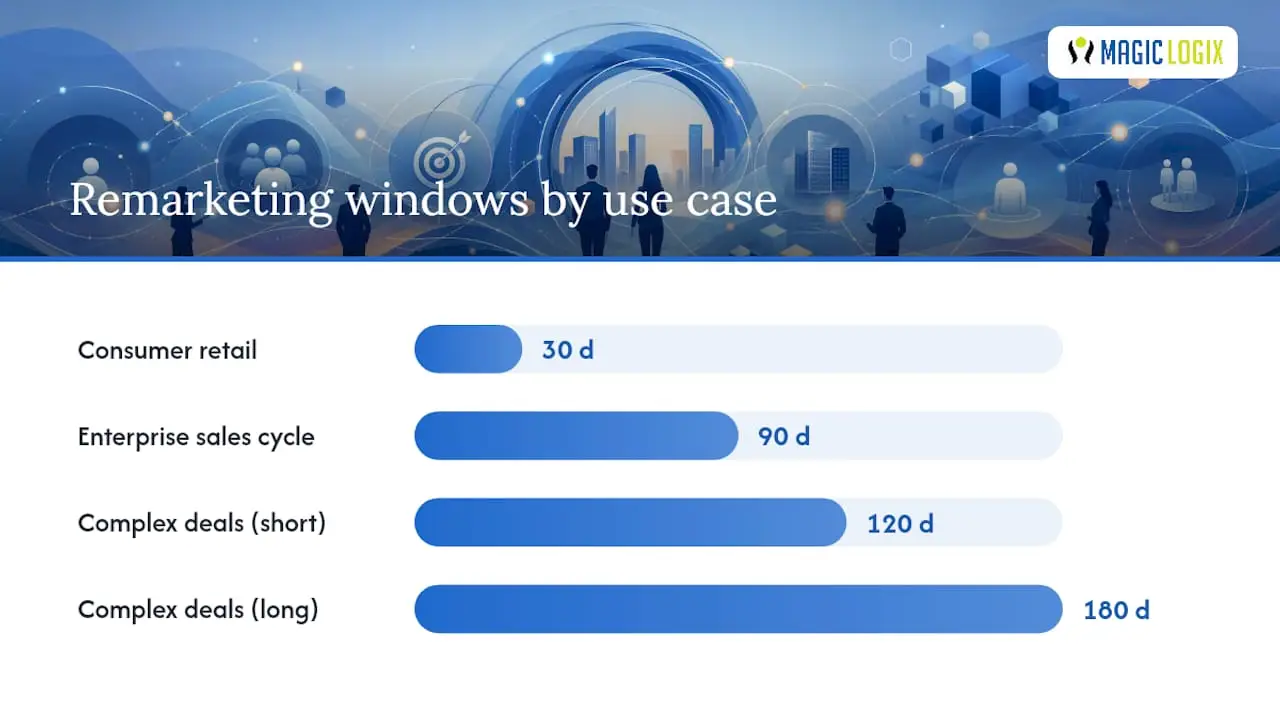
- Layer remarketing lists with tiered windows, since a 30-day window that works for consumer retail is far too short for a 90-day enterprise sales cycle. Extend remarketing windows to 120 or 180 days for complex deals.
- Segment lists by funnel engagement (whitepaper downloader vs. demo requester) rather than lumping every site visitor into one bucket.
A well-built B2B marketing segmentation model does most of the heavy lifting for step one. The signals worth prioritizing include job-title patterns pulled from your CRM data, firmographic lists built from company domains you sell into, and prior demo visitors who didn’t convert.
One caution worth taking seriously: Customer Match and several conversion import workflows depend on properly captured consent. The TCF consent framework defines the purposes that govern how you’re allowed to use audience data for targeting and measurement, and building your consent capture correctly before you rely on these signals avoids both compliance headaches and wasted list-building effort.
How Do You Structure Keywords and Accounts for B2B?
Organize your account around intent and ICP segment, not around every possible keyword variation. A typical B2B account tree runs campaign (by funnel stage or product line) → ad group or asset group (by intent cluster) → keywords or creative assets. If you’re running Performance Max, asset groups replace traditional ad groups but the same logic applies: group by theme, not by individual term.
Keyword strategy for B2B favors long-tail, intent-heavy phrases over broad head terms. “Marketing automation software” pulls in a flood of irrelevant traffic; “marketing automation software for mid-market manufacturers” pulls in people closer to your actual buyer. Broad match paired with strong negative keyword lists and Smart Bidding can work, but only once you’ve built enough negative keyword history to keep it honest.
Single Keyword Ad Groups (SKAGs) fell out of favor for a reason: Google’s algorithms reward thematic breadth inside an ad group more than they reward hyper-granular control. A cleaner asset-group or tightly-themed ad group approach, built around a handful of closely related terms, generally outperforms the old SKAG method in 2026 accounts.
A workable negative keyword process looks like this:
- Pull search term reports weekly for the first month of a new campaign, then biweekly after that.
- Flag any term connected to job seekers, free tools, or student research (all common B2B waste categories).
- Add negatives at the campaign level for terms that apply account-wide, and at the ad group level for narrower exclusions.
- Re-check Performance Max search term insights separately, since it surfaces different waste patterns than standard Search.
Grounding your keyword list in solid keyword research for SEM before launch cuts the cleanup work in half.
How Do You Measure Lead Quality, Not Just Conversions?
Chasing form fills without tracing them to revenue is the fastest way to waste a B2B budget. The fix is a tracking chain that connects an ad click to a closed deal, and it takes three steps to build correctly.
- Capture the GCLID. Every ad click carries a Google Click ID. Your website needs to grab it and store it, either in a hidden form field or through your tag manager, the moment a visitor lands.
- Map it into your CRM. When a lead fills out a form, the GCLID should travel with them into Salesforce, HubSpot, or whatever CRM your sales team runs, tied to that contact record.
- Import offline conversions back into Google Ads. Once a deal closes (or reaches a qualified stage you’ve decided matters), push that outcome back into Google Ads using offline conversion import, tagged with the GCLID and, ideally, the deal value.
Skip any one of these three steps and your bidding algorithm is optimizing against the wrong signal. It will happily deliver more of whatever generates form fills, even if those form fills never turn into revenue.
On bidding strategy: value-based bidding, where Google’s algorithm bids more for signals linked to higher-value historical conversions, tends to outperform flat target CPA once you have enough offline conversion data flowing in. Before that data volume exists, Maximize Conversions with a realistic budget cap is the safer starting point. Target ROAS makes sense once deal values vary enough between segments that a single CPA target would misallocate spend.
Dreamdata’s 2024 B2B Google Ads benchmarks found that Google Ads often accounts for a significant share of the average paid media budget among B2B marketers, which underscores why getting this measurement chain right matters more here than in almost any other channel.
Metrics worth tracking beyond raw conversions include cost per opportunity (not cost per lead), conversion-to-opportunity rate, and time-to-close by campaign. If your attribution window is set to 30 days but your average sales cycle runs 90, you’re closing the reporting window before half your pipeline has had a chance to convert. Google Analytics paired with GCLID data gives you the multi-touch view that single-platform Google Ads reporting can’t provide alone.
What Ads and Landing Pages Convert B2B Buyers?
Match your creative to the funnel stage or you’ll confuse a cold prospect with a sales pitch, or bore a ready-to-buy prospect with generic education. Awareness-stage ads should teach something (a statistic, a trend, a problem framing) rather than sell. Consideration-stage ads should invite comparison: “See how [category] leaders evaluate vendors” performs better here than a generic feature list. Decision-stage ads can go direct: “Book a 20-minute demo” or “See pricing for teams like yours.”
Landing pages need to match that same discipline:
- The offer on the page must match the promise in the ad exactly, since a mismatch kills conversion rate faster than almost anything else.
- Trust signals belong above the fold for decision-stage pages: client logos, a specific case study result, or a review platform badge.
- Demo request forms should stay short (name, work email, company) with progressive profiling added later in a nurture sequence rather than crammed into the first form.
- Test lead form extensions inside Google Ads itself for consideration-stage offers, since they reduce friction even though they typically produce lower-intent leads than a full landing page.
A pattern worth adapting: pair a headline naming the specific pain point (“Cut deployment time for enterprise rollouts”) with a description line naming a concrete proof point, then close with a CTA matched exactly to the funnel stage rather than a generic “Learn More.”
How Should You Run 90-Day Tests and Ongoing Optimization?
Run a structured 90-day test cycle instead of tweaking bids weekly based on gut feel. Vanity metrics like click-through rate can look great while pipeline stays flat, so the roadmap needs to prioritize experiments that actually move revenue.
- Weeks 1 to 4: Audit existing audience signals feeding Performance Max, add any missing Customer Match or CRM-based lists, and run a full negative keyword sweep across all campaigns.
- Weeks 5 to 8: Test one bidding change at a time, such as shifting from Maximize Conversions to a value-based strategy, and test one landing page offer variation per funnel stage.
- Weeks 9 to 12: Run a conversion-quality audit by sampling 20 to 30 recent leads and checking with sales whether they were sales-qualified, then adjust targeting or negative keywords based on what you find.
Ongoing optimization beyond that cycle should include monthly query-level audits, quarterly audience pruning to remove segments that never convert to opportunities, and a conversion-quality check that cross-references Google Ads leads against actual CRM outcomes rather than trusting the platform’s own conversion count.
The KPIs worth watching closely are cost per opportunity, opportunity-to-close rate, and average deal size by campaign. A KPI signals real success when it correlates with closed revenue over at least one full sales cycle; a KPI is noise when it moves week to week without any connection to pipeline. Deeper tactics for this stage are covered in how to optimize PPC campaigns for ROI.
How Do You Hand Off Google Ads Leads to Sales?
Retargeting for B2B needs longer windows and staged creative, since a prospect who downloaded a whitepaper in month one might not be ready for a demo pitch until month three. Layering channels helps here: Google Ads captures intent-driven search behavior, while a platform like LinkedIn handles role-based targeting that Google can’t match as precisely. Examples of that kind of role-based LinkedIn ad targeting pair well with a Google Ads remarketing layer running in parallel.
The handoff to sales needs clear rules or leads sit untouched:
- Require job title, company size, and the specific offer downloaded on every lead form, not just name and email.
- Score leads before they reach a rep, weighting recent high-intent actions (demo request, pricing page visit) above older, lower-intent ones (whitepaper download from six months ago).
- Set a firm SLA, ideally under 24 hours for decision-stage leads, since B2B response speed correlates directly with connect rates.
- Build a feedback loop where sales reports back which leads were actually qualified, so that data can refine your Customer Match and remarketing lists.
The full workflow runs: ad click, tracked lead, CRM scoring, sales contact, and then feedback back into your audience lists. Leads that never convert should feed a suppression list; leads that close should feed your next Customer Match seed audience. A solid lead nurturing sequence fills the gap for leads that aren’t sales-ready yet but shouldn’t be dropped either.
What Framework Turns Ad Spend Into Verified Pipeline?
Magiclogix runs every B2B Google Ads engagement through a five-step, verification-first framework built specifically because AI-driven recommendations and Performance Max outputs need a human check before anyone trusts them with real budget.
- Discovery and ICP definition. Build the account’s targeting foundation from real CRM data on closed-won deals, not assumptions about who “should” buy.
- Measurement specification. Define exactly which events count as conversions, how GCLID flows into the CRM, and what offline conversion import will track before a single ad goes live.
- Campaign design. Map funnel stages to campaign types and offers using the structure outlined earlier in this guide.
- Verified deployment. Launch, then check every AI-suggested Performance Max recommendation and every automated bid adjustment against actual outcomes rather than accepting them on faith.
- ROI recheck. Revisit cost per opportunity and closed-deal attribution on a set cadence (monthly at minimum) to confirm the numbers Google Ads reports match what’s actually landing in the CRM.
Pro Tip: Ask any agency running your account for a specific proof point: “show me the imported offline conversions and the closed deals they’re tied to.” If they can’t produce that link, they’re optimizing on faith, not evidence.
This verification habit isn’t paranoia. Search Engine Land’s reporting on AI-assisted ad workflows makes the case directly: AI-driven recommendations inside Ads and Analytics platforms need a deliberate check before you treat them as finished work, especially as Performance Max takes on more autonomous decision-making in 2026 accounts.
Common Mistakes I See and How to Avoid Them
The mistake I see most often is treating Performance Max as a black box you set and forget. It rewards the accounts that keep feeding it fresh audience signals and checking outcomes weekly, not the ones that walk away after launch.
The second is optimizing toward form fills with no offline verification loop, which quietly trains your bidding algorithm to find more of exactly the wrong leads. The third is spreading a small budget across four or five channels at once instead of concentrating it where your ICP actually spends time, which starves every channel of the volume it needs to optimize well.
Before accepting any AI-generated bid suggestion or audience recommendation, check it against a real business outcome first, whether that’s a closed deal, a qualified opportunity, or at minimum a sales-accepted lead.
How Magic Logix Runs B2B Google Ads Programs
Magiclogix builds the tracking chain first and the campaigns second, which is the reverse order most in-house teams and generalist agencies default to. That sequence exists because a B2B account with no GCLID-to-CRM pipeline is optimizing blind no matter how clever the ad copy is.
A typical engagement starts with a measurement audit: confirming whether GCLID is being captured, whether your CRM can receive it, and whether offline conversion import is even feasible with your current sales stack. From there, Magiclogix designs the funnel-to-campaign map, sets up Customer Match and audience signal groups, and builds the verification cadence that checks Performance Max output against real pipeline data every month rather than trusting the dashboard at face value.
| Service | What it delivers |
|---|---|
| Paid media management | Campaign structure across funnel stages, ongoing bid and creative optimization |
| Measurement engineering | GCLID capture, CRM mapping, and offline conversion import setup |
| ROI verification | Monthly recheck tying ad spend to closed deals, not just conversion counts |
A first audit typically produces a clear picture within one to two weeks: what’s tracked correctly, what’s leaking, and where budget is likely being wasted on the wrong funnel stage. If your account has been running on gut feel or platform-reported conversions alone, that’s usually the fastest way to find out what digital marketing built for business growth can add. Reach out to start with a measurement audit and see exactly where your current setup stands.
Sources
FAQ
Are Google Ads Good for B2B Lead Generation?
Yes, particularly for capturing active buying intent, since Google Ads reportedly accounts for more than half of average paid media budgets among B2B marketers. Results depend heavily on whether conversions are tracked back to actual revenue, not just form fills.
Is $20 a Day Good for Google Ads in a B2B Account?
A $20 daily budget can work for a narrow, high-intent test campaign in a low-competition niche, but most B2B keywords carry high cost-per-click rates that eat that budget within a handful of clicks. It’s a reasonable starting point for testing, not a sustainable volume driver.
Is $10 a Day Enough for Google Ads?
For most B2B keyword categories, a very low daily budget is too thin to generate meaningful data, since a single competitive click can cost more than that. It can work for a very tightly scoped branded or long-tail test, but expect limited conversion volume.
What Is the Rule of 7 in B2B Marketing?
The rule of 7 is a marketing heuristic suggesting a prospect typically needs multiple touchpoints with your brand before they’re ready to buy. In practice for B2B Google Ads, that means building remarketing sequences and multi-stage nurture rather than expecting a single ad click to close a deal.
How Does Magiclogix Verify That Google Ads Leads Turn Into Revenue?
Magiclogix builds a GCLID-to-CRM-to-offline-import chain first, then checks every closed deal against the ad campaign that originated it, rather than relying on Google Ads’ self-reported conversion counts alone.