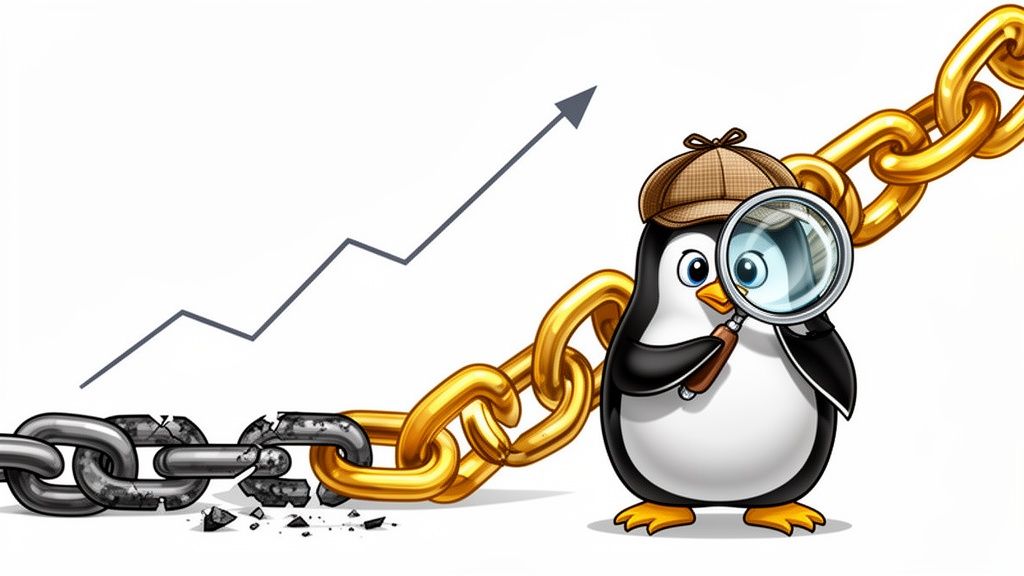
Let's get one thing straight: if you don't know what it costs to land a new customer, you're flying blind. That number is your Customer Acquisition Cost, or CAC, and it’s the total sales and marketing spend required to win over a single customer.
This metric is all over the map depending on the business. For some retail shops, it might be under $100. For complex B2B services, it can easily soar past $1,000. The first real step toward profitable growth is figuring out where your industry stands and how you measure up.
Understanding Customer Acquisition Cost

Before we start throwing around industry-specific numbers, it's critical to agree on what Customer Acquisition Cost actually is. At its heart, CAC is a checkup on the financial health and efficiency of your entire marketing and sales engine. It answers a deceptively simple question: How much are we really spending to get each new customer in the door?
To truly get it, you need to know what goes into the calculation. For a deeper dive, it’s worth learning more about what Cost Per Acquisition is and how to lower it. Trust me, getting this number right is non-negotiable if you want to build a sustainable business.
Calculating Your CAC
The standard formula for CAC is pretty straightforward, but the devil is in the details. You need to be meticulous about tracking all your expenses over a set period, like a month or a quarter.
(Total Sales & Marketing Costs) / (Number of New Customers Acquired) = Customer Acquisition Cost
The trick is to include every single relevant cost. So many businesses make the classic mistake of only counting direct ad spend. This gives you a dangerously low—and completely wrong—CAC.
A proper calculation must include:
- Advertising Spend: All your paid channels, from Google Ads and social media campaigns to sponsored content.
- Team Salaries: The full cost of your sales and marketing teams, including salaries and commissions.
- Tool Subscriptions: Don't forget the costs for your CRM, analytics platforms, and any other marketing tech you use.
- Content & Creative: Any money spent on blog posts, videos, design assets, and other creative production.
Why CAC Matters More Than Ever
Getting in front of new audiences has gotten wildly expensive. In fact, one of the biggest shifts in modern marketing is the dramatic rise in acquisition costs. Over the last eight years, customer acquisition costs have skyrocketed by a staggering 222%, completely changing how companies have to think about their budgets and strategies.
What's really worrying is that this extra spending hasn't always paid off. The average financial loss per acquired customer jumped from $9 in 2013 to a projected $29 by 2025. This trend makes understanding—and more importantly, optimizing—your CAC an absolute necessity for survival.
Key Factors Driving CAC Across Industries
Ever wonder why a SaaS company might drop over a thousand dollars to land one customer, while an e-commerce brand can do it for less than a hundred? The answer isn't just one thing. It's a mix of a few core factors that really shake up the customer acquisition cost by industry.
Getting a handle on these drivers is your first step to seeing how your own performance stacks up and where you can start to optimize. Let's break down the biggest reasons CAC can swing so dramatically from one business to another.
Sales Cycle Length
The time it takes to turn a curious prospect into a paying customer is a huge driver of cost. A longer sales cycle nearly always inflates CAC because it demands more touchpoints, more follow-ups, and more resources just to nurture a single lead.
- Short Sales Cycles: Industries like consumer e-commerce or mobile apps have it good. They often cash in on impulse buys where the decision-making process is lightning-fast—sometimes just a few minutes. This high-volume, low-touch model is great for keeping acquisition costs down.
- Long Sales Cycles: On the flip side, think about B2B enterprise software or high-end professional services. These deals involve a whole committee of decision-makers, drawn-out evaluations, and tough negotiations. This high-touch process can drag on for months, demanding a serious investment in a dedicated sales team, demos, and marketing automation—all of which send CAC climbing.
Customer Lifetime Value (LTV)
Customer Lifetime Value (LTV) is the total amount of money you can realistically expect to earn from a single customer over their entire relationship with you. It makes sense, then, that industries with a high LTV can justify a much higher CAC and still turn a healthy profit. This balance is absolutely fundamental to growing sustainably.
A company selling a $10,000 annual software subscription can easily afford to spend $3,000 to acquire that customer. But a brand selling $50 t-shirts? Not a chance. That's why high-LTV industries like finance, insurance, and B2B SaaS naturally operate with a much higher ceiling for their acquisition spending.
The real goal isn't just a rock-bottom CAC; it's a healthy LTV to CAC ratio. A widely accepted benchmark is at least 3:1, meaning a customer's total value is at least three times what it cost you to bring them on board.
Market Saturation and Competition
The sheer level of competition in your industry has a direct line to your advertising costs. When dozens of companies are all bidding on the same keywords and fighting for the same audience's attention, the cost per click (CPC) and cost per mille (CPM) inevitably go through the roof.
In a packed market like online retail or consumer finance, businesses have to spend more just to get noticed and capture their slice of the pie. This environment forces companies to get really creative with their marketing and obsess over efficiency. One powerful way to fight back is by improving on-page elements; you can learn more about how a higher conversion rate directly impacts your bottom line and helps you compete more effectively.
Product Complexity and Price Point
Finally, how complex and expensive your product is plays a massive role. A simple, low-cost item needs very little customer education. A complex, high-ticket product or service, however, demands a much more involved educational journey to prove its value and build trust.
Just think about selling a coffee mug versus selling a mortgage. The mug needs a decent photo and a clear "buy now" button. The mortgage? That requires detailed guides, one-on-one consultations, and a whole lot of trust-building content—all of which add up to a higher CAC.
2026 Customer Acquisition Cost Benchmarks by Industry
It's one thing to understand the theories behind customer acquisition cost, but seeing the real-world numbers is what really puts things into perspective. The customer acquisition cost by industry can vary dramatically, and knowing these benchmarks is crucial for setting realistic marketing budgets and goals.
This section will give you a clear, data-driven reference for average CACs across several key industries. Think of it as your guide for benchmarking your own performance and understanding what it really costs to compete in your specific market.
The key drivers behind these cost differences—things like sales cycle length, customer lifetime value (LTV), and market saturation—are what create such wide variations from one sector to the next.

As you can see, these factors all work together, either pushing up the cost to win a new customer or helping to bring it down. That's why industry-specific benchmarks are so incredibly important.
Average Customer Acquisition Cost (CAC) by Industry for 2026
The table below lays out the projected average customer acquisition costs for 2026. Keep in mind, these figures are benchmarks meant to provide a general frame of reference. Your own CAC will ultimately depend on your business model, marketing efficiency, and target audience.
| Industry | Average CAC (2026) | Common Acquisition Channels | Key Cost Drivers |
|---|---|---|---|
| B2B SaaS | $900 – $1,500+ | Content Marketing, SEO, Paid Search, LinkedIn Ads | Long sales cycles, high-touch sales teams, high product complexity. |
| B2C E-commerce | $80 – $250 | Social Media Ads, Influencer Marketing, PPC, Email | High market saturation, reliance on paid ads, lower average order values. |
| Finance & Fintech | $400 – $800 | Affiliate Marketing, Paid Search, Content Marketing | High LTV, intense competition, strict regulations, and trust-building. |
| Healthcare | $350 – $700 | SEO (Local & Organic), PPC, Doctor Referrals | Patient privacy concerns, regulatory compliance, long decision process. |
| Education | $300 – $600 | Social Media, SEO, Paid Search, Email Marketing | Seasonality of enrollment, long consideration periods, competition. |
| Professional Services | $500 – $1,200+ | Networking, Referrals, LinkedIn, Content | High-value clients, long sales process, need for demonstrated expertise. |
These numbers really tell a story about the unique challenges and opportunities brewing within each sector. Let’s dig a little deeper into the context behind them.
Analyzing the Industry Benchmarks
A high CAC isn't automatically bad, just as a low one isn't always good. The whole game is about understanding the "why" behind your number and how it relates to Customer Lifetime Value (LTV).
Important Takeaway: A "good" CAC is always relative to LTV. The goal isn't just a low CAC but a healthy LTV:CAC ratio, ideally 3:1 or higher. This means for every dollar you spend bringing a customer in the door, you should expect to get at least three dollars back over their lifetime with your business.
B2B SaaS: The high CAC here makes sense when you consider the product. We're talking about complex, high-value software that often demands a long, educational sales process. Companies are willing to spend more because a single enterprise client can generate tens of thousands in recurring revenue, easily justifying that initial acquisition cost.
Finance & Fintech: This industry is a battleground for high-value customers—think mortgages or investment accounts—who can be incredibly profitable over many years. But the fierce competition for keywords and the need to build significant audience trust drive acquisition costs way up. Some innovative fintech companies like Trust Bank have managed to lower their CAC to 1/7th the industry norm by focusing heavily on powerful customer referral programs.
B2C E-commerce: In this incredibly crowded space, brands are in a constant fight for attention on paid social and search channels. The lower CAC is really a necessity, driven by smaller average order values and thinner margins. Success here is a game of volume and relentlessly optimizing conversion rates to make the numbers work.
A Deep Dive into B2B SaaS Customer Acquisition
The Business-to-Business (B2B) Software-as-a-Service (SaaS) world is a unique and often tough place to operate. It’s notorious for having some of the highest customer acquisition costs in any industry, and if you're in the SaaS game, you need to understand exactly why.
The biggest culprit behind these high costs is the long, complex B2B sales cycle. Think about it: acquiring an enterprise client isn't like a quick online purchase. It involves convincing multiple decision-makers, running countless product demos, and enduring drawn-out contract negotiations. This high-touch process requires a serious investment in a skilled sales team, top-notch marketing materials, and sophisticated lead nurturing systems.
Enterprise Vs. SMB Focused Acquisition
Of course, not all B2B SaaS companies are built the same. Who you sell to—a small business or a massive enterprise—completely changes your acquisition strategy and your costs.
SMB-Focused SaaS: These companies typically go for a lower-touch, higher-volume model. They rely on things like self-service trials, content marketing, and digital ads to keep their CAC from getting out of control. The name of the game is scalability through automated, efficient funnels.
Enterprise-Focused SaaS: This is where you see the high-touch, dedicated sales force in action. Strategies like account-based marketing (ABM), highly personalized outreach, and relationship-building are everything. For example, a well-executed campaign on professional networks can work wonders. You can see how this plays out in our guide on creating effective LinkedIn ads for B2B engagement.
The math is simple: landing a few big-ticket enterprise clients can be far more profitable than signing up hundreds of smaller ones. That's why the higher initial spend is often justified, a fact that's backed up by industry data.
Business-to-business SaaS companies face among the highest customer acquisition costs, averaging an estimated $1,200 per customer in 2025. This expense is a direct result of the complex challenges inherent to B2B software sales.
The Critical LTV to CAC Ratio in SaaS
For any SaaS business, the real health metric isn't just CAC, it's the Lifetime Value (LTV) to CAC ratio. The entire subscription model is built on recurring revenue, so a high upfront acquisition cost is perfectly fine—as long as the customer sticks around long enough to generate a healthy profit. The widely accepted benchmark for a healthy SaaS business is an LTV to CAC ratio of 3:1 or higher.
But rising costs are starting to squeeze this model. New data reveals that the median new customer acquisition cost ratio for SaaS has hit $2.00. That means companies are spending $2 to acquire every $1 of new annual recurring revenue. For the bottom-quartile performers, it's even worse, at $2.82 for that same dollar of revenue. You can dig into more of these CAC trends for growth-stage companies from Phoenix Strategy Group. It’s a clear signal that efficiency is more critical than ever.
To fight back, smart SaaS companies are embracing predictive analytics and marketing automation. These tools help them spot high-value leads much earlier and automate the intricate nurturing process. Ultimately, it’s about streamlining the journey from a curious prospect to a loyal, profitable customer.
Proven Strategies to Lower Your Customer Acquisition Cost

Knowing your industry’s average customer acquisition cost is just the starting point. The real work begins when you take decisive action to bring your own CAC down. This isn't about blindly slashing your budget; it’s about making your marketing spend smarter and more efficient, squeezing more value out of every single dollar.
To really impact your bottom line, you have to move from simply analyzing the numbers to putting practical strategies into play. Here are a few proven, hands-on tactics you can use to lower your CAC, give your ROI a healthy boost, and build a more sustainable path to growth.
Optimize Your Conversion Rates
Think of your website and landing pages as your digital storefronts. If visitors are walking in but not buying, you’re effectively burning your ad spend and sending your CAC through the roof. This is precisely where Conversion Rate Optimization (CRO) becomes your most valuable weapon.
The entire point of CRO is to find and eliminate the friction points that stop a potential customer from taking action. You'd be surprised how even tiny tweaks in your conversion rate can have an outsized impact on your total acquisition cost.
A simple A/B test on a call-to-action button—say, changing the color from blue to green—can sometimes lift conversion rates by double-digit percentages. When you're spending thousands on a campaign, that small change translates into massive savings.
To get going with CRO, start by focusing on these key areas:
- A/B Testing: Don't guess what works. Constantly test different versions of your headlines, copy, images, and page layouts to discover what truly connects with your audience.
- Improve Page Speed: Nothing kills a conversion faster than a slow-loading page. You should be aiming for a load time of under three seconds to keep potential customers from bouncing.
- Simplify Forms: Every extra field in a signup or checkout form is another reason for a user to give up. Only ask for the information you absolutely need to get the job done.
Refine Your Audience Targeting
One of the fastest ways to waste your marketing budget is to show your ads to the wrong people. The more precise you can get with your targeting, the less you'll spend on clicks that were never going to convert anyway. It’s time to move beyond broad demographics and get into the nitty-gritty of segmentation.
A great place to start is by building out detailed buyer personas based on your best current customers. Dig into their behaviors, their pain points, and where they hang out online. This data is pure gold; it’s your roadmap to finding more people just like them.
For instance, a B2B software company might realize its most profitable clients are marketing managers in the tech space who follow certain thought leaders on LinkedIn. That single insight allows them to craft laser-focused ad campaigns that speak directly to that niche, which drastically cuts down on wasted ad spend and improves CAC.
Invest in Long-Term Organic Channels
Paid advertising gets you results right now, but it's like renting an apartment—the payments never stop. To build a truly sustainable and low-CAC growth machine, you need to own your traffic by investing in organic channels that keep delivering value over the long haul.
Search Engine Optimization (SEO) and content marketing are hands-down two of the most effective long-term plays. Yes, they require an upfront investment of time and resources, but they create assets that can pull in customers for years to come at a marginal cost.
- SEO: By ranking for high-intent keywords, you can attract a steady, predictable stream of qualified traffic straight from search engines.
- Content Marketing: When you create valuable blog posts, in-depth guides, and videos, you build trust and establish your brand as an authority, drawing customers in naturally.
These organic efforts create a powerful flywheel. The more top-notch content you publish, the stronger your SEO becomes, leading to more traffic and, ultimately, more customers—all without a corresponding jump in your ad spend. If you want to dig deeper, you can find a number of powerful customer acquisition strategy examples that center on this kind of sustainable, long-term growth.
Enhance Customer Lifetime Value (LTV)
Finally, one of the most powerful ways to offset a high CAC is simply to increase the value of each customer you bring in. When your Customer Lifetime Value (LTV) increases, you can afford to spend more to acquire a customer and still maintain a healthy LTV:CAC ratio.
This means putting a serious focus on retention and loyalty. After all, it's almost always cheaper to keep an existing customer happy than to go out and find a new one.
Implement strategies that actively encourage repeat business:
- Email Marketing: Nurture the relationships you already have with personalized follow-ups and exclusive offers.
- Loyalty Programs: Give your repeat customers a good reason to keep coming back by rewarding them for their business.
- Exceptional Customer Service: Go the extra mile to create positive experiences that turn one-time buyers into lifelong brand advocates.
By raising your LTV, you give your business more breathing room to invest in your acquisition channels and effectively out-compete others in your industry.
How to Measure and Track CAC for Business Growth
Accurate measurement is the foundation of any smart business move. It’s simple, really: if you don’t know your numbers, you can’t improve them. Tracking your Customer Acquisition Cost isn't just an accounting chore; it's a strategic necessity for intelligent, sustainable growth.
When you put a solid measurement framework in place, you transform your CAC from a static number into an actionable insight. This is the first real step toward making data-driven decisions that actually improve your marketing performance.
Defining Your Measurement Framework
Before you can calculate anything, you need to set some clear boundaries. The first and most critical step is to define the time period you want to look at. Are you calculating CAC for last month? The previous quarter? Or maybe the entire year?
This decision dictates the scope of data you’ll need to gather. A shorter period, like a month, offers more immediate feedback, which is great for agile teams. A longer period, like a year, helps smooth out any seasonal bumps and gives you a more stable picture of your customer acquisition cost by industry benchmarks.
Your CAC is a crucial metric because it shines a light on potential inefficiencies in your sales funnel. By tracking acquisition costs across different stages or channels, you can pinpoint exactly which parts of your process have the most room for improvement.
Essential Tools for Accurate Tracking
You can't track what you can't see. Modern marketing runs on a stack of tools working in concert to give you a complete picture of the customer journey, from that very first touchpoint all the way to the final sale.
Here are the core platforms you’ll need for accurate CAC tracking:
- Customer Relationship Management (CRM) Software: Think of your CRM as the central nervous system for all customer data. It tracks interactions, manages leads, and tells you the precise moment a prospect becomes a paying customer. This is absolutely critical for the "Number of New Customers Acquired" part of your CAC formula.
- Analytics Platforms: Tools like Google Analytics are indispensable for understanding where your traffic is coming from and how users behave on your site. They help you attribute conversions back to specific channels, whether it's organic search, paid ads, or social media.
By integrating these tools, you can follow a customer's entire path and correctly attribute their acquisition to the right marketing channel. You can dive deeper into this process by exploring our guide on measuring digital marketing effectiveness.
Avoiding Common Measurement Pitfalls
Many businesses stumble when it comes to tracking CAC, which unfortunately leads to inaccurate data and flawed decisions. One of the most common mistakes we see is misattribution, where the credit for a new customer is handed to the wrong marketing channel.
For instance, a customer might first find your brand through a blog post (content marketing), click a retargeting ad on social media a week later (paid social), and finally convert by typing your URL directly into their browser (direct traffic). A basic last-click attribution model would wrongly give 100% of the credit to direct traffic, completely ignoring the vital roles your content and social ads played.
To get around this, you should use a more sophisticated attribution model that assigns partial credit to multiple touchpoints along the customer journey. This gives you a far more realistic view of how all your marketing efforts work together to bring in new business.
Answering Your Top Questions About CAC
As you get deeper into managing your marketing budget, you’ll inevitably run into some thorny questions about Customer Acquisition Cost. Getting the nuances of this metric right is critical for making smart, profitable decisions that actually fuel your business growth.
We hear the same questions come up time and time again. Think of this section as your quick-reference guide to bust some myths and get straight answers to the most common concerns.
What Is a Good Customer Acquisition Cost?
There's no magic number here. A “good” CAC is completely relative to your industry, your business model, and, most importantly, your Customer Lifetime Value (LTV). A $500 CAC could be a huge win for a software company with an LTV of $5,000, but it would spell disaster for an e-commerce store with an LTV of just $100.
The real benchmark to watch is the LTV to CAC ratio. A healthy, sustainable business should aim for a ratio of at least 3:1. This means for every dollar you spend acquiring a customer, you should be getting at least three dollars back over their lifetime. That ratio, not the CAC number in a vacuum, tells you if your acquisition strategy is truly working.
How Do I Calculate CAC with Salaried Employees?
You absolutely have to include their salaries. A proper CAC calculation sums up all your sales and marketing expenses over a set period. That means everything:
- Ad spend
- Campaign-specific costs
- Software subscriptions and tools
- Agency fees
- And yes, the full salaries—including commissions and bonuses—of your entire sales and marketing team.
Once you have that total cost, you simply divide it by the number of new customers you brought in during that same timeframe. Forgetting salaries is one of the most frequent and dangerous mistakes we see. It gives you an artificially low CAC and a false sense of profitability.
A flawed CAC calculation is worse than no calculation at all. Including all costs, especially salaries, gives you the unvarnished truth you need to make sound business decisions.
Should I Calculate CAC by Channel?
Yes, without a doubt. A blended, company-wide CAC is a fine starting point for a 30,000-foot view. But the real magic happens when you calculate CAC on a per-channel basis—think Google Ads, organic search (SEO), content marketing, social media, and so on.
This granular view is where true optimization begins. It immediately shows you which channels are your workhorses and which are just draining your budget. By understanding exactly what it costs to land a customer through each marketing activity, you can strategically shift your spend to the most profitable channels. That’s how you lower your overall CAC and seriously boost your marketing ROI.
How Does CAC Relate to Customer Lifetime Value?
CAC and LTV are two sides of the same coin; you can't understand the health of your business without looking at them together. CAC tells you the upfront cost to get a customer, while LTV tells you the total value that customer brings over their entire relationship with you.
The LTV to CAC ratio is the ultimate health metric for your business's profitability and scalability. When that ratio is healthy (again, shooting for 3:1 or better), it’s a strong signal that your business model is sustainable and ready for growth. If your CAC is consistently higher than your LTV, you’re literally paying to lose money on every new customer—a clear sign that something in your strategy is broken and needs an immediate fix.
At Magic Logix, we specialize in creating data-driven marketing strategies that optimize your acquisition funnel and lower your CAC. Discover how our unique blend of analytics and creativity can drive sustainable growth for your business at https://www.magiclogix.com.