

B2B content syndication means republishing or distributing content you already own (an ebook, report, case study, webinar or article) through third-party sites, publishers, platforms or networks, so that relevant business buyers see it outside your own channels. Done well, it extends the reach of assets you have already paid to create. Done carelessly, it fills your CRM with contacts who never wanted to hear from you, and it can muddy your search visibility. This guide covers how a campaign works, what to syndicate, how to protect your SEO, and how to tell good leads from noise.
TL;DR
- Syndication reuses existing content on third-party properties to reach buyers you do not yet reach. It is not guest blogging, and it is not curation.
- Plan from the audience backward: define the accounts and roles you want, then choose the asset, the gate and the channel.
- Protect search visibility with canonical tags or noindex on republished copies, and keep email follow-up inside CAN-SPAM rules.
- Judge success by sales-accepted leads, pipeline and cost per qualified opportunity, not raw lead volume.
- Start small, test one asset and one channel, and set the evaluation rules before you spend.
Table of Contents
- What B2B content syndication is (and is not)
- How a syndication campaign works, step by step
- Choosing formats and channels
- Planning around audience, accounts and goals
- Protecting your search visibility
- Privacy and email rules in the US
- Measuring lead quality and results
- Where syndication fits with the rest of your marketing
- Perspective: Digital Beyond Tomorrow
- Ready to build a syndication plan that connects to revenue?
- Frequently asked questions
- Sources
What B2B content syndication is (and is not)
The Content Marketing Institute describes content syndication as republishing previously published content on third-party sites. The content can be blog posts, infographics, videos, social posts and other media. In B2B, the term also covers distribution of gated assets through publisher networks that deliver form-fill leads back to you.
It helps to separate it from three neighbors:
| Approach | What happens | Where the content lives | Main goal |
|---|---|---|---|
| Content syndication | Existing content is republished or promoted by a third party | Third-party properties, often with a link back | Reach and leads |
| Guest blogging | A new article is written for another site | Another site only | Authority and referral traffic |
| Content curation | You assemble other people’s material with commentary | Your own channels | Thought leadership |
| Owned distribution | You share content through your own email, social and site | Your properties | Engagement with existing audience |
The distinction matters because each one has different costs, risks and measurement. Syndication is the only one of the four where you hand your asset to someone else’s audience and, often, pay per outcome.
How a syndication campaign works, step by step
Most campaigns follow the same path, whether you work through a publisher, a media network, a social platform or your own partnerships.
- Pick the asset. Choose something that already earns attention on your own site, such as a research report, a buyer’s guide or a customer story.
- Decide on the gate. A form in front of the asset turns readers into leads. No form means you are buying exposure, not contacts.
- Define the audience. Job titles, company size, industries and, if you run account-based marketing, a target account list.
- Choose the channel. A publisher network, a social platform, a trade site, a webinar partner or an industry association.
- Set delivery. Leads can arrive by CSV, API or direct CRM integration, and the cadence can range from real time to weekly batches depending on the network, according to Octave’s 2026 guide. Ask which applies before you sign.
- Follow up fast. A person who downloaded something on a third-party site may not remember your brand. Your first message should name the asset and the site where they found it.
- Review and adjust. Compare lead quality by source and asset, then keep, change or drop each one.
Each step is a decision point, and skipping one is the usual reason campaigns disappoint. The most common skipped step is the third: without a clear audience definition, even a well-run network will fill your pipeline with contacts that look plausible but do not fit.
Choosing formats and channels
Common syndicated formats include short articles or posts, videos, case studies or customer stories, ebooks or white papers, and research reports. A December 2024 survey summarized by MarketingCharts lists organic social media, in-person events, webinars, social ads or promoted posts, search marketing, display ads and sponsorships among the channels marketers use to distribute content, with organic social the most used.
A practical way to match format to funnel stage:
- Early stage (problem aware): short articles, infographics, video explainers. Usually ungated, aimed at awareness.
- Middle stage (solution aware): ebooks, white papers, original research, webinar recordings. Usually gated.
- Late stage (vendor aware): case studies, comparison guides, ROI worksheets. Gate with care, because buyers at this stage are already looking for you.
Case studies deserve special mention. They carry proof, and they work on third-party sites because they answer the question a skeptical buyer asks next. If you do not have strong ones, our guides on writing B2B case studies and scaling case study marketing show how to build them.
Gated or ungated?
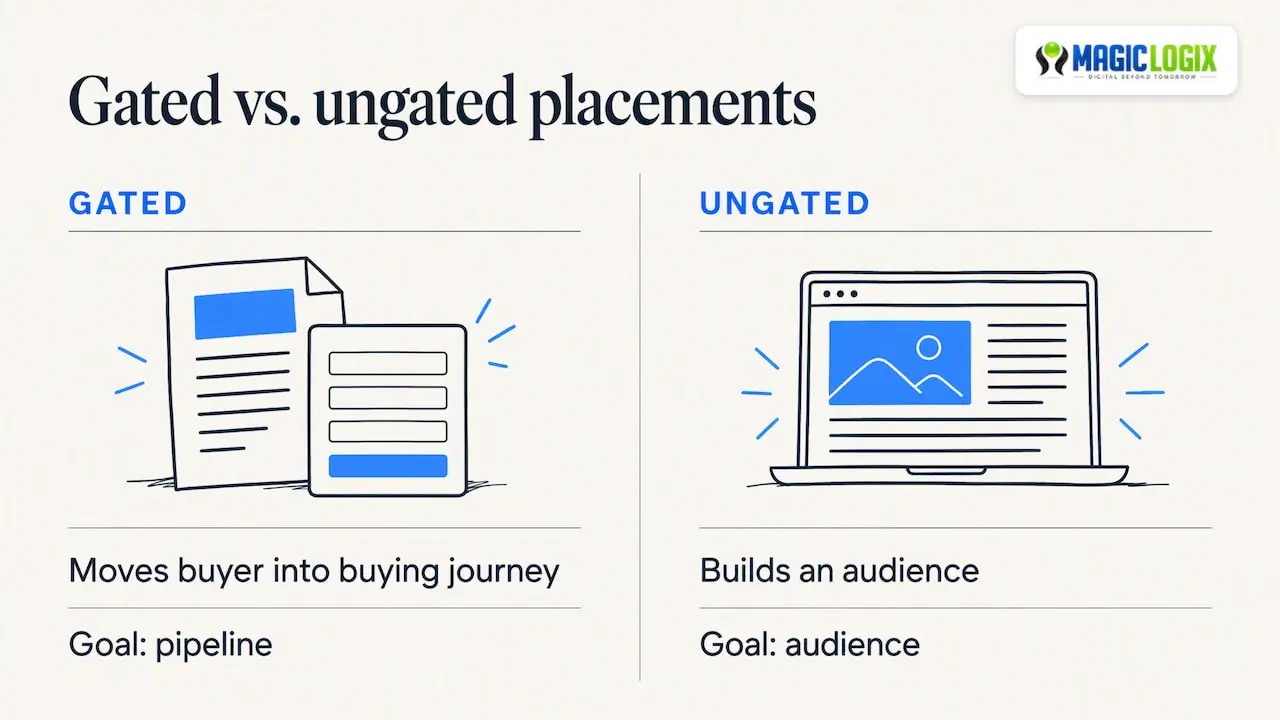
Content Marketing Institute contributor Robert Rose argued in a September 2023 column that gating should reflect the relationship you want: a gated asset can move a buyer into a buying journey, while ungated content builds an audience, and treating every converter as both a lead and a subscriber weakens the strategy. That is a useful rule for syndication. Decide in advance whether each placement is for audience or for pipeline, and gate accordingly.
Planning around audience, accounts and goals
Planning is where most of the value is created. Before you contact any network or publisher, write down five things.
- The buyer roles. Who signs, who influences and who uses the product? Syndication tends to reach the researcher first, so plan for how that person brings others in.
- The accounts. If you sell to a defined list, say so. If your market is broader, name the firmographic filters: industry, employee range, region.
- The goal. Pipeline, meetings, newsletter growth, or awareness. One campaign, one primary goal.
- The asset-to-stage fit. Match the content to what that buyer needs right now.
- The acceptance rules. What makes a lead acceptable? Write it down: title match, company size, valid business email, relevant geography. Share it with the vendor and with your sales team.
A simple decision framework:
| If your goal is… | Lead with… | Gate? | Judge by… |
|---|---|---|---|
| Pipeline from target accounts | Research, buyer’s guide | Yes | Meetings and opportunities from named accounts |
| Broad awareness | Short articles, video | No | Qualified traffic, branded search, return visits |
| Nurture-ready contacts | Ebook, webinar | Yes | Engagement after the first follow-up |
| Sales enablement | Case study, ROI sheet | Sometimes | Influence on open opportunities |
A content strategy built on buyer questions makes every syndicated piece stronger, which is why we start with that foundation in our seven-step B2B content strategy.
Protecting your search visibility
Syndication creates duplicate or near-duplicate copies of your content on other domains. That is not automatically a problem, but you control the risk with a few habits.
- Use canonical tags where the partner allows it. Google documents how to specify a canonical URL for duplicate or very similar pages. Ask the publisher to point the republished copy at your original.
- Use noindex when the partner will not set a canonical. Google explains that a noindex rule can keep a page out of Search, but the page must stay crawlable. Blocking it in robots.txt stops Google from seeing the noindex directive.
- Publish on your site first. Let your original be crawled and indexed before copies appear elsewhere.
- Add a link back to the original within the republished piece.
- Avoid scaled republishing. Google’s spam policies warn against reproducing content feeds or compiling third-party content without unique user benefit, and against using third-party content mainly to exploit a host site’s ranking signals. Syndication that gives readers direct value is a different thing from replicating content to manipulate rankings.
Gated assets add a separate benefit here: the PDF itself sits behind a form, so there is usually no duplicate page to worry about. The landing page that promotes it is the part to manage.
If your syndicated content also feeds AI answer engines, be realistic. Nobody can guarantee that a placement leads to a citation in an AI-generated answer, and platform behavior is still changing. What you can do is keep your original page clear, well structured and authoritative, which is the same work that supports traditional search. Our Search & AI Visibility work is built around that foundation.
Privacy and email rules in the US
Most syndication ends with someone emailing a person who gave their details to a third party. In the United States, the CAN-SPAM Act sets the rules for commercial email, including requirements for commercial messages and a right for recipients to stop receiving them. The FTC’s guide is the place to confirm current requirements, and your counsel should review how you handle leads from third parties. In practice:
- Make sure the sender name, reply address and subject line are accurate. The FTC has long treated false or misleading headers as a violation; a 2006 federal court order defines commercial email by its primary advertising or promotional purpose and bars misleading headers.
- Include a working opt-out and honor it.
- Ask the vendor how consent was captured on the form and what the form said about sharing data with sponsors.
- Keep records of source, asset and date for each lead.
Sender reputation matters too. If a batch of syndicated leads produces bounces and spam complaints, it can hurt delivery for the rest of your email program. Read our guide on email deliverability and bulk sender rules before your first import, and consider warming those contacts with a low-volume, relevant first message rather than a hard pitch.
State privacy laws and, for contacts outside the US, other regimes may also apply. Treat this section as a starting checklist, not legal advice, and bring in a privacy attorney when you plan to scale.
Measuring lead quality and results
The most important shift is to stop treating a syndicated lead as a finished lead. It is a signal of interest from someone who has not yet talked to you. Measure what happens next.
Metrics worth tracking
| Metric | What it tells you | How to calculate |
|---|---|---|
| Lead acceptance rate | How many delivered leads meet your rules | Accepted leads / delivered leads |
| Valid email rate | Data hygiene | Delivered emails that do not bounce / total |
| Engagement rate | Whether people care after the download | Replies, clicks or visits from the first sequence |
| MQL to SQL rate | Whether marketing and sales agree on quality | SQLs / MQLs, by source |
| Cost per sales-accepted lead | Efficiency that sales respects | Spend / leads accepted by sales |
| Cost per opportunity | Real commercial value | Spend / opportunities created |
| Pipeline and revenue sourced or influenced | The outcome | From CRM, by campaign and asset |
Track every one by source and by asset, not just in aggregate. A campaign that looks fine overall can hide one asset that generates all your opportunities and three that generate nothing.
The reasoning behind these metrics is simple. Lead volume is cheap to inflate. Sales-accepted leads, opportunities and pipeline are expensive to fake. Our overview of digital marketing performance metrics goes deeper on tying channel data to revenue.
A measurable test plan
- Choose one asset and one channel.
- Set a fixed budget and a fixed window, agreed in advance.
- Write the acceptance rules and share them with the vendor.
- Tag every lead with a source and asset in your CRM.
- Review with sales after the first batch, before the second.
- Decide the thresholds for continue, change or stop. For example: stop if sales accepts fewer than the share of leads you set as a minimum, or if cost per opportunity exceeds what your average deal can support.
The thresholds are yours to set. They depend on your deal size, close rate and sales cycle, and any figure we gave would be a guess. The discipline is writing them down before the data arrives.
Common failure patterns
- Lead volume without fit. The cure is stricter filters and a sales review loop.
- Slow follow-up. If the first email goes out weeks later, the lead has forgotten you.
- Wrong asset for the stage. An early-stage ebook rarely produces meetings on its own.
- No attribution. If you cannot see which source produced the opportunity, you cannot decide where to spend.
- One-and-done. Buyers who engage once often need several relevant touches over time.
Where syndication fits with the rest of your marketing
Syndication works best as one part of a connected system. Your own site has to convert the traffic it sends, your email has to nurture it, and your sales team has to know what each lead read. Related channels support each other:
- Paid social. Promoting an asset on a professional network is a form of distribution too. Our look at LinkedIn ad examples for B2B shows how creative and offer fit together.
- Events. A webinar recording can be syndicated for months. See how virtual event marketing builds pipeline.
- Influencer and partner voices. Industry voices can carry your asset to their audience, as we describe in B2B influencer marketing.
- Your website. Landing pages for syndicated assets need to be fast, clear and consistent with the promise made on the partner site. If yours need work, our website design and development team can help.
Perspective: Digital Beyond Tomorrow
At Magic Logix, we see syndication as a distribution decision, not a shortcut. The content has to earn its place first, and the measurement has to be honest after.
We have found that the businesses who benefit most treat each placement as a test. They define the buyer, set the acceptance rules with sales, tag the source in the CRM, and review results by asset. That is the same discipline we bring to analytics, content and automation work: connect the data to a decision.
We also believe the line between search and AI answers is getting thinner. Pages that are clear, well sourced and structured for people are the pages most likely to be useful to any system that summarizes them, though no one can promise a citation. Our approach to Digital Beyond Tomorrow is to build that foundation first, then extend it through channels such as syndication.
Hassan Bawab
Ready to build a syndication plan that connects to revenue?
If you want a second set of eyes on your content, your landing pages or your measurement setup, our Marketing & Growth Systems team can help you connect distribution to pipeline. You can also reach out through our site to talk through where syndication fits in your plan. We will start with your goals and your sales process, not a package.
Frequently asked questions
What is B2B content syndication in simple terms?
It is the practice of republishing or promoting content you already own on third-party sites and networks so that business buyers outside your own audience can find it. Often the content is gated, so interested readers fill out a form and you receive their details. The goal is reach, leads or both.
Does content syndication hurt SEO?
It does not have to. Ask partners to use a canonical tag pointing to your original, or to noindex the copy, and publish on your own site first. Google’s guidance treats syndication that gives readers value as acceptable and focuses its spam policies on replicating content to manipulate search visibility.
Is syndicated content the same as guest blogging?
No. Guest blogging usually means writing a new article for another site. Syndication generally republishes or distributes an existing piece, which makes it faster and cheaper to produce but means you need to manage duplicate-content and attribution issues.
How do I know if syndicated leads are good?
Check them against rules you wrote before the campaign: title, company size, region and email validity. Then track sales acceptance, MQL to SQL rate, cost per opportunity and pipeline by source and asset. Raw lead counts alone say very little.
Do I need to worry about email laws when I follow up?
Yes. In the US, commercial email falls under CAN-SPAM, which covers accurate headers and a working opt-out, among other requirements. Review the FTC’s compliance guide and have counsel check how third-party leads and consent are handled.
Sources
- Content Syndication Explained, Content Marketing Institute
- The GTM Engineer’s Guide to Content Syndication, Octave
- Content Quality Isn’t the Challenge, Conversion Is, MarketingCharts
- With Gated Content, Trust Goes Both Ways, Content Marketing Institute
- How to specify a canonical URL, Google Search Central
- Block Search Indexing with noindex, Google Search Central
- Spam Policies for Google Web Search, Google Search Central
- CAN-SPAM Act: A Compliance Guide for Business, FTC
- Final Judgment and Order, William Dugger et al., FTC