
The best approach to local SEO for multi location businesses treats every branch as its own searchable entity, with a unique Google Business Profile and a dedicated landing page, all governed by one set of centralized standards. Three priorities come first: verified, accurate Google Business Profiles, a unique page per location, and a working review pipeline. Get those right before anything else.
TL;DR:
- Brands with 10 or more locations can use Google Business Profile bulk management through business groups, provided they meet Google’s eligibility and quality guidelines.
- Give each branch a distinct landing page with accurate name, address, and phone details, local services, photos, access notes, and matching profile information.
- Before launching pages or campaigns, assign each location UTM links and trackable phone numbers, connect GA4 to its profile, and measure calls, directions, and conversions.
- Create a review link for each location and automate requests through the POS or CRM; monitor Google, Yelp, Facebook, and industry sites centrally.
- Test page templates with a small group of branches before rollout, adding details unique to each address so pages do not compete as near duplicates.
Table of Contents
- Quick Multi Location SEO Checklist to Start Now
- Corporate vs Local Content: Stop Competing With Yourself
- Build Location Landing Pages That Actually Rank
- Optimize and Operationalize Google Business Profiles
- Reviews, Citations, and Building Local Prominence
- Scale Operations: Templates, Automation, and Governance
- Tracking, Attribution, and KPIs by Location
- Local Backlink and Community Tactics Each Branch Can Run
- Handling Duplicate Content Issues Across Multiple Location Pages
- Managing Reviews and Reputation Across Multiple Platforms
- Integrating Multi Location SEO With Corporate SEO Strategy
- Leveraging Schema Markup for Local Search Visibility
- How We Approach Multi Location SEO Programs
- Ready to Scale Your Multi Location SEO With Magic Logix
- FAQ
- Sources
Quick Multi Location SEO Checklist to Start Now
Before diving into strategy, here’s the short version your team can act on this week. Each step below has a natural owner, so assign names, not just tasks.
- Audit your Google Business Profiles. Confirm one profile exists per physical address and check eligibility for bulk verification if you manage 10 or more locations. Owner: local SEO lead or franchise marketing manager.
- Build or fix location landing pages. Every address needs its own page with matching NAP (name, address, phone) data. Owner: web team or agency partner.
- Set up tracking before you launch anything else. Unique phone numbers, UTMs, and review links per location let you measure what’s actually working. Owner: analytics or marketing operations.
Most teams can complete this first pass in a few weeks depending on location count. The sections below walk through why each step matters and how to do it without burning out your team.
Corporate vs Local Content: Stop Competing With Yourself
One of the biggest barriers to scaling multi location SEO is internal competition: two pages from the same brand fighting for the same search intent. Search Engine Land’s multi-location guide points to this as a primary reason branch pages underperform, and the fix starts with a clear division of labor.
Corporate pages should own brand pillars, national promotions, and company-wide service explanations. Local pages should own neighborhood-specific details: which services that branch offers, local events or sponsorships, staff names, and parking or access notes that only make sense to someone standing nearby.
- Corporate owns brand story, pricing philosophy, and national campaigns.
- Local pages own address, hours, local reviews, neighborhood context, and location-specific offers.
- A master NAP sheet acts as the single source of truth that both teams pull from.
- Set a review cadence (monthly or quarterly) so local pages don’t go stale between corporate updates.
Pro Tip: If two location pages could swap city names and still make sense, they’re too similar. Add a local detail that only applies to that one branch.
Governance matters as much as content here. Decide who can edit local pages, how often updates happen, and who approves changes before they go live. Without that structure, local pages drift out of sync with the real world fast.
Build Location Landing Pages That Actually Rank
A location page earns its rank by being genuinely useful to someone searching near that address, not by swapping a city name into a templated paragraph. The page needs real substance tied to that specific branch.
Every location page should include:
- A unique title tag and H1 with the local modifier, not a copy-pasted template.
- LocalBusiness schema markup with accurate address, phone, and hours.
- Current hours, parking or access notes, and a list of services that branch actually offers.
- Local photos of the storefront, team, or interior, not stock imagery.
- An embedded reviews widget pulling from that location’s own Google Business Profile.
- A map and a clear call to action, whether that’s booking, calling, or getting directions.
Decide early which parts get templated and which get handcrafted. A pilot with a small control group of branches, testing both approaches, tells you whether automation alone produces pages good enough to rank or whether certain markets need custom copy. Search Engine Land’s scalable local SEO playbook recommends exactly this kind of small-scale test before a full rollout.
For URL structure, keep patterns consistent across the site (domain.com/locations/city-name works well) and interlink through a store locator and an HTML sitemap so search engines and visitors can find every branch. If your CMS can’t support dynamic templating with manual override fields, that’s worth fixing before you scale past a handful of locations. Our local SEO best practices guide covers more of the on-page details that apply here.
Optimize and Operationalize Google Business Profiles
Your Google Business Profile often functions as a location’s real homepage in search results, so it deserves the same attention as your website. Name, address, phone, primary category, hours, photos, and services all need to match what’s on the landing page exactly.
For brands with 10 or more locations, Google allows bulk creation, verification, and management through business groups, provided you meet its quality guidelines for eligibility. This saves enormous time compared to verifying each profile one by one, and it keeps your team working from a consistent process instead of ad hoc fixes.
Beyond initial setup, profiles need ongoing care:
- An image library so every location posts fresh, approved photos instead of reusing the same three shots.
- Q&A templates that answer the questions customers actually ask, written once and adapted per branch.
- Review response templates that stay on brand while sounding human, not copy-pasted.
- A regular posting cadence for GBP updates, offers, and events.
Google’s guidelines for representing your business require one profile per physical location with consistent naming and categories across the brand. Duplicate or mismatched profiles risk suspension or ranking problems, so this is worth getting right the first time. Our piece on Google Map SEO services goes deeper into profile optimization if you want the full breakdown.
Reviews, Citations, and Building Local Prominence
Prominence, one of Google’s core local ranking factors, comes from consistent citations and a steady stream of fresh, location-level reviews according to Backlinko’s multi-location SEO research. Volume matters less than accuracy and recency.
Build a review pipeline that doesn’t depend on someone remembering to ask:
- Generate a unique review link or QR code for each location and put it on receipts, follow-up texts, or counter displays.
- Automate review requests through your POS or CRM so timing is consistent.
- Centralize monitoring in reputation software so one person can see every location’s reviews without logging into dozens of dashboards.
- Embed fresh reviews directly on each location page so visitors see current, location-specific social proof.
Pro Tip: Run a NAP audit every quarter across your top directories. A phone number that changed six months ago and never got updated on Yelp is still costing you trust signals today.
Pursue both structured citations (directories like Yelp and industry-specific listings) and unstructured mentions (local news, community blogs) since both contribute to how search engines judge a location’s legitimacy in its area.
Scale Operations: Templates, Automation, and Governance
Scaling multi location SEO without losing quality means building the operational backbone before you build more pages. A master spreadsheet is the unglamorous foundation that makes everything else possible.
Track these fields for every location:
- Location ID, business name, and tax or registration identifier
- NAP (name, address, phone) exactly as it should appear everywhere
- GBP profile URL and verification status
- Landing page URL and last-updated date
- Assigned local manager or point of contact
- Run a pilot with a small control group of locations to test your templates and citation tactics before committing resources brandwide.
- Measure results against a baseline, then refine the playbook based on what actually moved rankings or calls.
- Roll the proven playbook out to all remaining locations using the same templates, timelines, and ownership structure.
Search Engine Land’s scalable practices guide backs this pilot-first approach as the way to avoid flooding your site with hundreds of low-quality pages at once. On the tooling side, look for bulk GBP upload capability, a CMS that supports dynamic templating with manual overrides, a citation and reputation management platform, and alerting so your team knows immediately when a listing changes or a review needs a response.
Tracking, Attribution, and KPIs by Location
You can’t optimize what you can’t attribute to a specific branch. Set up tracking before you launch new pages or campaigns, not after.
Use UTM parameters on every link pointing to a location page, connect GA4 to each Google Business Profile, and assign unique, trackable phone numbers per location so calls get credited correctly. Backlinko’s research emphasizes that call tracking and attribution are essential for measuring branch-level return, since phone calls often outnumber form fills in local search.
Watch these metrics per location:
- Search impressions and map pack ranking position
- Phone calls and direction requests from the GBP listing
- Website visits and form conversions attributed to that specific branch
- Review volume and average rating trend over time
Pull all of this into a single dashboard that unifies GBP insights, GA4, call tracking, and CRM data so you can compare locations side by side instead of checking four separate tools. Our guide to digital marketing performance metrics walks through building that kind of unified reporting.
Local Backlink and Community Tactics Each Branch Can Run
Local backlinks come from being genuinely present in a community, not from mass outreach emails. Each branch can run small, repeatable tactics that build real relevance.
- Sponsor a local event, youth sports team, or school fundraiser and ask for a link on the organization’s site.
- Pitch local press on a story angle tied to that specific branch, like a hiring milestone or community partnership.
- Partner with nearby community organizations or chambers of commerce for joint resource pages.
- Create a scholarship or local resource page that naturally attracts links from schools and civic sites.
Centralize prospect discovery and outreach logs in one shared system so corporate can see what’s been tried and avoid duplicate pitches to the same contact. Prioritize municipal sites, chamber of commerce pages, and local news outlets first since they carry the strongest relevance signals for a specific address. Teams dealing with cannibalized rankings from overlapping local content might find this guide to fixing keyword cannibalization a useful supplementary resource.
Handling Duplicate Content Issues Across Multiple Location Pages
Duplicate content is the most common technical trap in multi location SEO, and it usually happens by accident. A team under deadline pressure copies one location’s page, swaps the city name, and ships it. Google sees dozens of nearly identical pages and struggles to decide which one deserves to rank for a given search, which often means none of them rank well.
The fix starts with genuinely unique input per page: local photos, specific services offered at that address, staff or manager names, and neighborhood context that wouldn’t make sense anywhere else. A template can structure the page, but the content inside each section needs branch-specific substance.
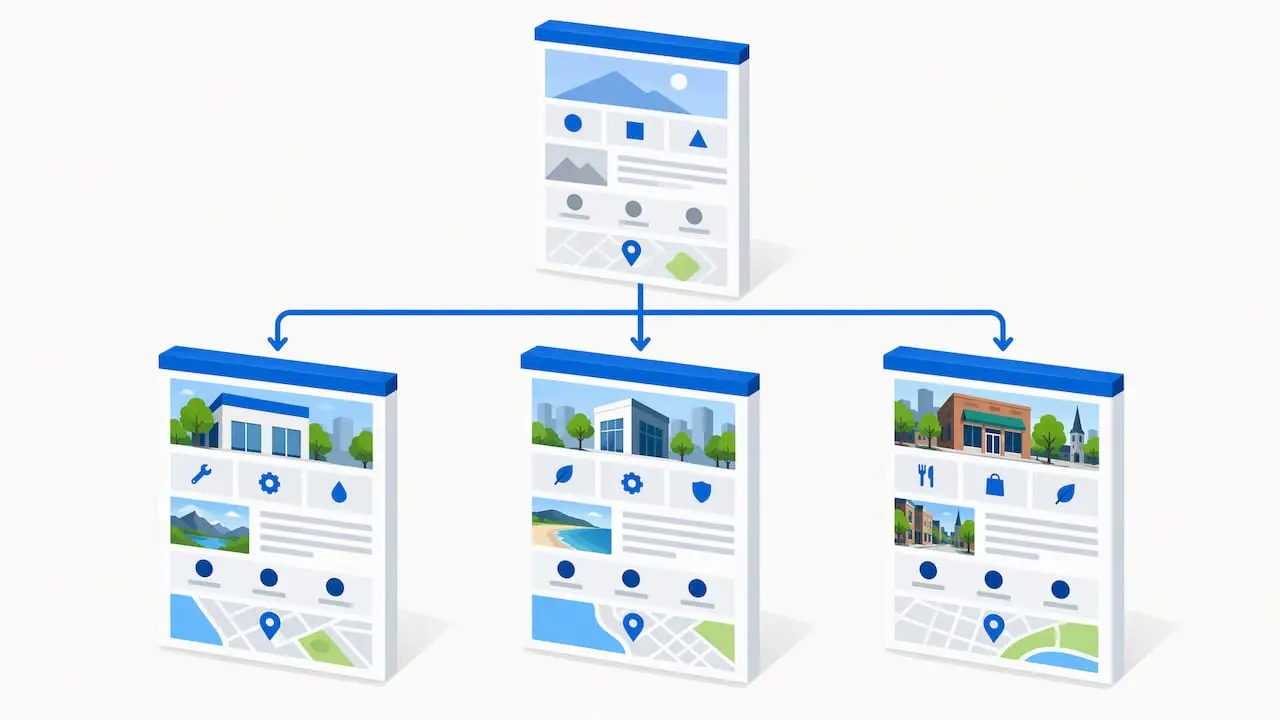
Canonical tags help when you have near-duplicate pages for legitimate reasons, like a seasonal promotion page that exists for every location. Point search engines to the primary version so ranking signals consolidate instead of splitting across copies.
Avoid separate mobile URLs or printer-friendly duplicates without proper canonicalization, since those compound the problem. And resist the temptation to create a page for every possible neighborhood or service combination. A location serving three nearby towns doesn’t need three separate landing pages that say almost the same thing. One well-built page mentioning all three service areas usually outperforms three thin ones competing against each other.
Managing Reviews and Reputation Across Multiple Platforms
Reviews don’t live on one platform anymore. Google, Yelp, Facebook, and industry-specific sites all carry weight, and a location with great Google reviews but ignored Yelp complaints still has a reputation problem.
Centralize monitoring so one dashboard or tool surfaces new reviews from every platform as they come in, rather than requiring someone to check five sites per branch. Response speed matters: a prompt, specific reply to a negative review often does more for trust than a dozen five-star reviews with no engagement at all.
Standardize response templates across locations while leaving room for a manager’s own voice. A generic “we’re sorry to hear that” copied across every negative review reads as hollow. Train local managers on tone so responses sound consistent with the brand without sounding robotic.
Watch for patterns across locations, not just individual reviews. If three branches mention the same complaint about wait times, that’s an operational signal worth escalating beyond the marketing team. Google’s content policies also prohibit fake or incentivized reviews, so any review generation program needs to stay within those guidelines to avoid removals or profile penalties.
Integrating Multi Location SEO With Corporate SEO Strategy
Multi location SEO works best when it’s not a side project running separately from the brand’s main SEO strategy. The two need shared infrastructure and shared goals.
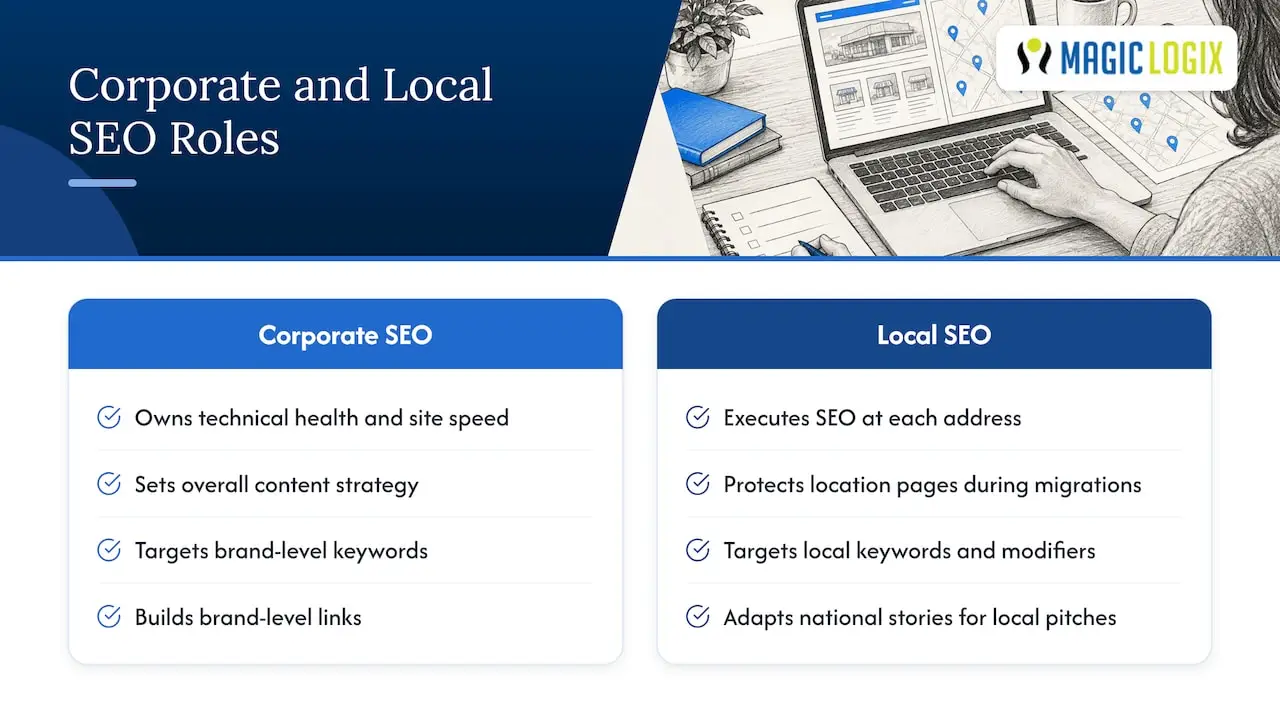
Corporate SEO typically owns the domain’s technical health, site speed, overall content strategy, and brand-level keyword targeting. Multi location SEO owns the execution at each address. When these two efforts run in silos, you get problems: corporate launches a site redesign that breaks location page templates, or local teams target keywords that compete with a national campaign corporate just launched.
The fix is a shared content calendar and a shared technical roadmap. Before corporate ships a site migration, local SEO needs a seat at the table to confirm location pages and their URL structures survive the move intact. Our guide on engineering rules for SEO during site migration covers the redirect mapping work that protects location page rankings during exactly this kind of change.
Brand-level link building and local link building should also be visible to each other. If corporate lands a national press mention, local teams can use that same story angle for local press pitches. Keyword research should flow both directions too: corporate’s national keyword data can reveal which service terms matter most, while local search data reveals which neighborhoods or modifiers actually get searched.
Leveraging Schema Markup for Local Search Visibility
Structured data gives search engines a direct, unambiguous read on what a page represents, which matters enormously when you have dozens or hundreds of near-identical pages that need to be told apart.
Every location landing page should carry LocalBusiness schema with accurate name, address, phone, hours, and geo-coordinates. This isn’t optional polish. It’s the clearest signal you can send that a given page represents one specific address, not a generic brand page or a duplicate.
Beyond the basics, add schema for reviews (AggregateRating), specific services offered at that location, and any events or offers unique to that branch. If a location has particular business hours during holidays, structured data can reflect that too, reducing customer confusion and support calls.
Keep schema consistent with what’s visible on the page itself. Search engines cross-check structured data against visible content, and mismatches (like schema listing hours that don’t match the text on the page) can undermine trust in the markup entirely. A centralized template with per-location fields populated from your master spreadsheet keeps this consistent at scale without requiring manual markup on every single page.
How We Approach Multi Location SEO Programs
Multi location programs are built around the operating model this guide describes: unique profiles and pages per branch, governed centrally, measured individually. The approach pairs structured data analytics with the creative and technical work each location needs. A typical engagement starts with discovery, moves into a pilot across a handful of locations, then scales once the templates and tracking prove out.
— Hassan
Ready to Scale Your Multi Location SEO With Magic Logix
Rolling out local SEO across dozens of locations takes more hours than most marketing teams have to spare, which is exactly where a structured partner earns its keep. Data analytics, technical SEO, and creative execution come together so each location gets a page and profile that actually represents it, built on templates that scale without turning into copy-paste duplicates.
If you’re managing multiple locations and want a second set of eyes on your current setup, our SEO services page is the place to start a conversation about a site and Google Business Profile audit or a pilot program across a few branches first. From there we can map out what scaling the full playbook looks like for your specific footprint.
FAQ
What’s the biggest mistake brands make with multi location SEO?
The most common mistake is letting location pages become near-duplicates of each other, which creates internal competition for the same search intent. Search Engine Land’s guide identifies this cannibalization as a primary barrier to ranking well across multiple branches.
How many locations do I need for bulk Google Business Profile verification?
Google allows bulk creation, verification, and management through business groups once you have 10 or more locations, provided your business meets its quality guidelines. Below that threshold, profiles are typically verified individually.
Should every location have its own landing page?
Yes, each physical location needs its own unique landing page with matching name, address, and phone details that align with its Google Business Profile. A single page trying to cover multiple nearby locations tends to underperform compared to one well-built page per address.
How do I track which location is driving leads?
Use unique UTM parameters on location page links, connect GA4 to each Google Business Profile, and assign a trackable phone number per branch. Backlinko’s analysis notes that call tracking is essential since calls are often undercounted without it.
Can one team manage SEO for 50 or more locations?
It’s possible with the right operational setup: a master tracking spreadsheet, templated pages with manual override fields, bulk GBP tools, and a tested pilot playbook rolled out in phases. Attempting it without templates and centralized tracking usually leads to inconsistent quality across branches.
Sources
- Multi-Location SEO: Boost Local Visibility for Each Location
- Multi-Location SEO
- Bulk location management overview – Google Business Profile Help