
A B2B content strategy is the plan that turns your expertise into the proof business buyers need to trust you and convince their colleagues to say yes. The single principle that matters most is this: measure content by the buyer confidence and pipeline it influences, not by clicks or downloads. Only a minority of B2B marketers rate their own content strategy as highly effective, and the gap usually comes down to unclear goals rather than lack of effort, according to the Content Marketing Institute’s benchmarks.
TL;DR:
- A B2B content strategy should focus on influencing pipeline and buyer confidence rather than just clicks or downloads.
- Content must support multiple decision moments, such as building trust, enabling consensus, and reducing risks, with original research and role-specific proof excelling in each.
- Clear ownership, purpose-driven pillars, and distribution planning are critical to operationalize an effective strategy that scales and remains credible.
- Formatting content for each buying stage—research for early trust, case studies for evaluation, and technical assets for closing—maximizes impact.
- Measurement should track influenced pipeline and stakeholder engagement within target accounts, not just traffic metrics, to demonstrate real ROI.
Table of Contents
- What a B2B content strategy actually covers
- Why B2B buyers make content strategy non-negotiable
- Step-by-step: building an operational B2B content strategy
- Which content formats actually move B2B buyers forward
- Mapping content to roles and helping champions build consensus
- Getting your content into the hands of the right buying teams
- Governance and production: making content repeatable at scale
- Measurement and ROI: proving content earns its budget
- Using AI in content production without losing credibility
- Proof in practice: how this framework plays out for real teams
- Legal and compliance considerations every B2B content team should know
- A few quick wins and the mistake to avoid
- How we help you put this strategy to work
- FAQ
- Sources
What a B2B content strategy actually covers
A B2B content strategy is the documented plan connecting what you publish to the jobs your buyers need to do: evaluate options, justify a budget, and bring skeptical colleagues on board. It is not a content calendar. A calendar tells you what posts to publish on what days. A strategy explains why those pieces exist, who they serve, and what business outcome they are supposed to move.
This is where B2B content diverges sharply from B2C. A consumer buyer often decides alone, in minutes, based on price or convenience. A B2B buyer rarely decides alone. Purchases move through committees, legal reviews, and budget cycles that stretch for months. Your content has to work for a champion who needs to defend the choice to a finance director who never read your blog.
Ownership matters just as much as strategy. Some teams centralize content under one marketing leader who sets pillars and approves every asset. Others distribute production across product marketing, sales enablement, and demand generation, with a central editor holding the line on quality and voice. Neither model is automatically right, but someone has to own the connection between content and revenue, or the work drifts into vanity output.
A working strategy typically assigns these roles:
- A strategy owner who sets goals and approves the content pillars.
- Subject matter contributors (sales, product, customer success) who supply raw expertise.
- An editor or content lead who maintains quality, consistency, and the publishing calendar.
- An analyst who tracks performance against the business goals, not just traffic.
Get this scaffolding right and every later decision, from topic selection to distribution, gets easier.
Why B2B buyers make content strategy non-negotiable
B2B buyers do not behave like a single decision-maker clicking “buy.” Gartner’s research shows buyers consult several information sources and typically involve close to seven stakeholders during a purchase decision, and 69% of B2B buyers prefer to validate AI-generated insights with a human sales representative before trusting them. That single number explains why content built purely to rank in search, without a plan for human follow-up, leaves deals stuck.
69% of B2B buyers want a sales rep to confirm what an AI tool told them, according to Gartner’s survey. Content that gives your sales team something credible to validate wins more of these moments than content built only for algorithms.
That buying complexity creates three distinct moments where content changes outcomes:
- Building confidence. Buyers need proof your approach works before they will spend internal credibility championing it.
- Enabling consensus. A champion has to convince peers who never spoke to your sales team, often using your content as their argument.
- Sealing the deal. Late-stage buyers need risk-reducing detail: implementation specifics, security answers, pricing logic.
The practical implication is that original research and role-specific proof outperform generic blog posts at every one of these moments, because they give buyers something concrete to carry into a room you are not in.
Step-by-step: building an operational B2B content strategy
A strategy only works once it is operational, meaning someone can follow it without needing you in the room. Here is the order that holds up across most B2B teams.
- Set goals tied to the business, not the content team. Pick outcomes like influenced pipeline or sales cycle velocity instead of page views. If leadership cannot connect a goal to revenue, rewrite the goal.
- Define your ideal customer profiles and buying groups. Map the jobs each stakeholder (finance, IT, procurement, the economic buyer) needs content to help them do. Our guide on B2B marketing segmentation walks through building these profiles in detail.
- Build content pillars around buyer problems, not product features. Three to five pillars is usually enough to cover a full buying committee without spreading the team thin.
- Develop role-specific assets inside each pillar. A pillar on implementation risk might produce a technical FAQ for IT and a cost-of-delay model for finance.
- Plan distribution before you plan production. Decide where each pillar’s content will live and travel. A flagship report with no distribution plan is wasted budget.
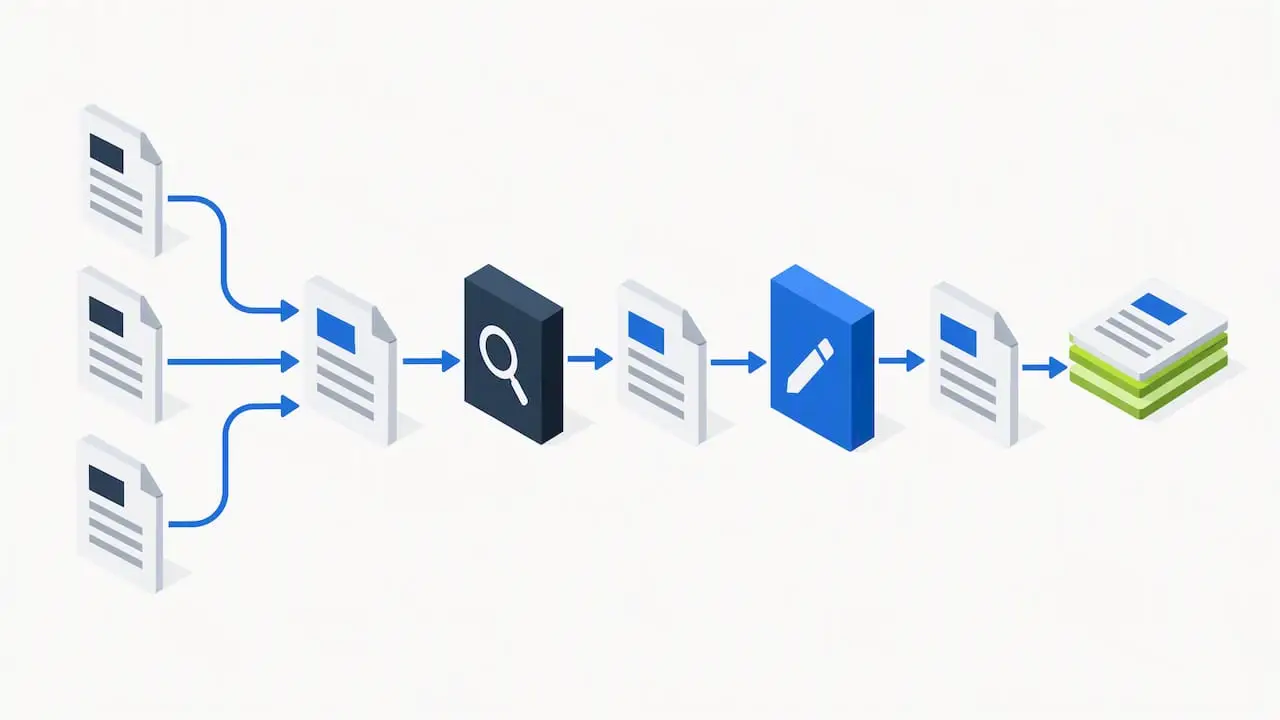
- Document governance: briefs, review gates, and SEO checks. Write the SOP once and reuse it for every asset, so quality does not depend on who is writing that week.
- Close the loop with measurement and revision. Review what influenced pipeline every quarter and retire or rework what did not.
Pro Tip: Write your content brief backward: start from the objection or question a buyer raises in week eight of their evaluation, then work out what asset answers it.
Top performers in the Content Marketing Institute’s research share three traits regardless of industry: a documented strategy, measurable outcomes tied to revenue, and a production model that scales without heroics, according to the CMI benchmarks report. Teams without a written strategy almost always default to whatever topic feels urgent that week, which is how content calendars fill up with posts nobody asked for and nobody in finance can tie to a dollar figure.
The research and buying-group steps deserve more time than the others. Jobs-to-be-done mapping sounds academic until you realize most B2B content fails because it answers a question marketers find interesting rather than one a buyer is actually asking. Sit down with your sales team and ask what question killed the last three deals that stalled. That question is your next content pillar.
Governance deserves the same seriousness. A brief template, a style guide, and a two-step review process (subject matter accuracy, then editorial polish) sound bureaucratic until you are three writers deep and every piece reads differently. Document it once, and new contributors ramp up in days rather than months.
Which content formats actually move B2B buyers forward
Different formats earn their keep at different points in a long buying cycle, and matching format to stage is where most strategies either click or stall.
- Early stage (problem awareness): original research reports and thought leadership that name a problem the buyer has not fully articulated yet. Research and peer-oriented formats consistently rank among the most influential for building early trust, according to Redpoint Insights.
- Middle stage (evaluation): case studies, ROI calculators, and comparison guides that help a buyer build a shortlist and justify it internally.
- Late stage (risk reduction): live demos, technical documentation, and buyer playbooks that answer the implementation and security questions that stall signatures.
- Repurposing layer: one flagship research report can seed a dozen smaller assets, email excerpts, LinkedIn carousels, short video clips, without rebuilding from scratch each time.
Original research earns a disproportionate amount of trust because buyers will exchange personal information for a data-rich report far more readily than for a generic guide, and brands that publish research on a regular cadence, quarterly or more, build stronger visibility with executive buyers over time, per Redpoint Insights. Our breakdown of long-form content strategy covers how to structure a flagship report so it survives the repurposing process without losing its substance.
The repurposing matrix matters more than most teams admit. A 40-page report that only ever exists as a PDF is underused. The same findings, broken into a three-slide executive summary, a two-minute video walkthrough, and five LinkedIn posts, reaches people who would never download the original.
Mapping content to roles and helping champions build consensus
Your champion inside the buying committee is doing unpaid sales work on your behalf, and the single highest-leverage thing you can do is make that job easier.
- Build role-specific one-pagers. A finance one-pager leads with cost of delay and payback period. An IT one-pager leads with integration requirements and security posture. A procurement one-pager leads with contract terms and vendor comparison criteria.
- Create shareable proof, not just shareable links. A two-slide excerpt from your research report, formatted for a committee meeting, gets used far more than a link to a full article nobody has time to read.
- Write executive summaries as a standalone asset, not an afterthought bolted onto a long report. Executives often read only the summary before deciding whether to engage further.
- Build account-based cadences for named accounts. Personalize timing and sequencing to where a specific account sits in its evaluation, not a generic drip schedule.
Pro Tip: Ask your champion directly what their CFO or legal team will ask before approving the deal, then build the one-pager that answers exactly that question.
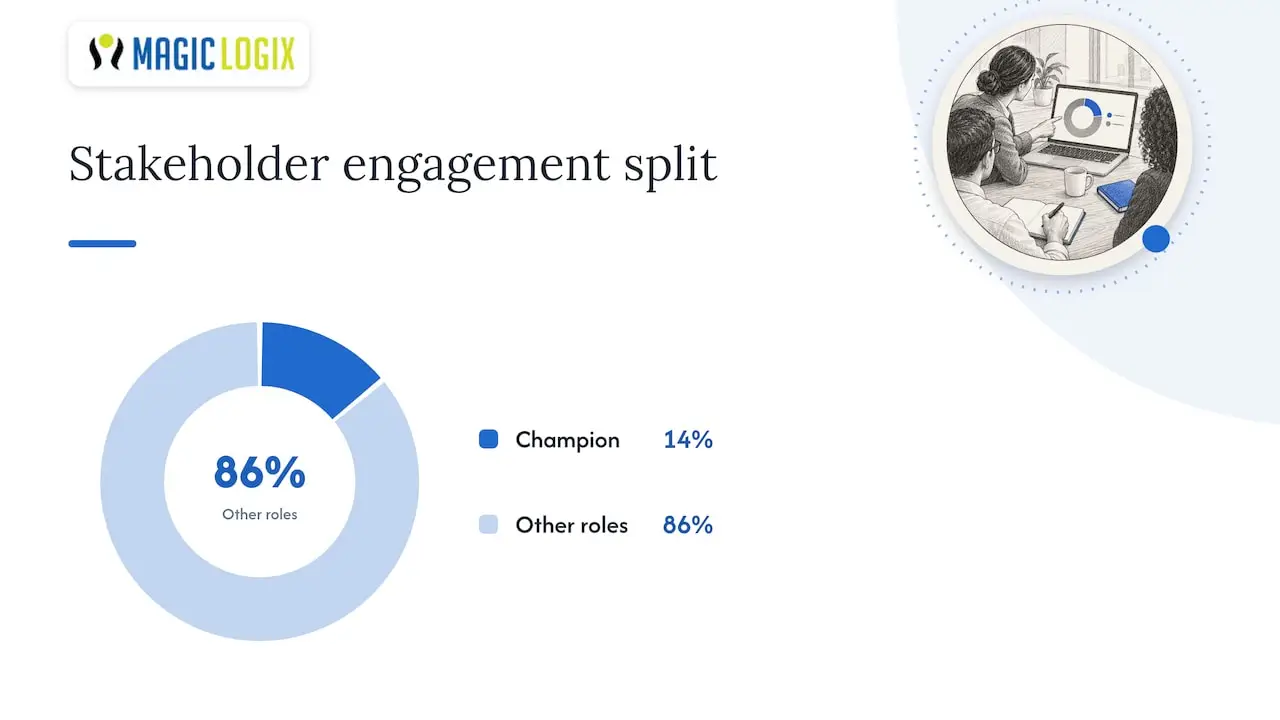
Account-based measurement looks different from funnel measurement. Instead of counting leads, track how many stakeholders within a target account have engaged with your content and whether coverage across the buying group is growing. A deal with one engaged champion and no visibility among the other six stakeholders is a deal at risk, not a deal in progress. Our guide to B2B marketing segmentation includes a framework for mapping which roles still need content coverage before a deal can close.
Getting your content into the hands of the right buying teams
Great content with no distribution plan behind it is a wasted asset, and distribution deserves its own line item in the budget, not leftover time at the end of production.
- Structure for both humans and AI readers. Clear headings, concise summaries, and explicit citations make content easier for a time-pressed executive to skim and easier for AI tools to summarize accurately when buyers use them for early research.
- Use LinkedIn for reach among decision-makers, email and newsletters for nurturing warm leads, and industry media for third-party credibility you cannot manufacture yourself.
- Reserve paid social and paid search for your highest-converting assets, where the cost per engaged buyer is easiest to justify.
- Activate employee advocacy. Sales and leadership sharing content under their own names consistently reaches audiences brand accounts cannot.
- Pursue syndication partnerships with industry publications to put flagship research in front of readers who trust that publication’s editorial judgment more than a vendor’s.
Buyers increasingly research vendors through AI tools before they ever visit your site directly, which raises the value of structured, citation-backed content that an AI model can parse reliably, according to Redpoint Insights’ buyer research. A technical SEO foundation that supports both search engines and AI summarization is no longer optional infrastructure, it is a distribution channel in its own right, and our SEO services are built around exactly that shift.
Governance and production: making content repeatable at scale
Content quality degrades fast without clear ownership of each step, and the fix is less about hiring more writers and more about removing ambiguity from the process.
- Assign a RACI for every asset type. Name who is responsible for drafting, who is accountable for final approval, who is consulted for subject matter accuracy, and who simply needs to be informed.
- Standardize briefs. Every asset starts from the same template: audience, buyer question answered, proof points required, and the call to action.
- Build a two-stage QA gate. Check facts and claims first, then check SEO and style second, so editorial polish never overrides accuracy.
- Create a reusable editorial hub. Store pillar content, brand guidelines, and approved proof points in one place so new contributors are not starting from zero.
- Design for modularity from the start. Write flagship assets with repurposing in mind, clear sections, pull-quotes, and data points that lift cleanly into other formats.
A minimal governance checklist beats an elaborate one that nobody follows. The goal is removing bottlenecks, not adding approval layers for their own sake. Our customer engagement strategy template includes operational templates that map well onto this kind of production workflow.
Measurement and ROI: proving content earns its budget
The KPIs that matter in B2B content rarely match the metrics content teams default to. Page views and downloads are easy to count and tell you almost nothing about pipeline.
- Influenced pipeline, meaning deals where a buyer engaged with your content at any stage, is the single most useful top-line metric.
- Content-assisted opportunities show which specific pillars correlate with deals progressing, not just deals closing.
- Conversion velocity, how much faster deals move after a buyer engages with a specific asset type, often reveals which formats are doing real work.
Teams with a documented, measurable strategy consistently outperform those without one, a pattern the Content Marketing Institute’s benchmarks attribute to clearer goals and more disciplined production, not bigger budgets.
Attribution is where most teams overcomplicate things. Full multi-touch attribution sounds rigorous but requires data infrastructure most B2B teams do not have.
A fully-burdened ROI calculation has to include every real cost: agency fees, internal labor hours, executive review time, production costs, and paid amplification. Skip any of those and the ROI number looks better than it is. Report both short-term lead volume and longer-term influenced pipeline, since content’s biggest impact often shows up months after publication. Our guide to measuring digital marketing effectiveness walks through building this kind of model step by step, and conversion tracking fundamentals matter here too.
Using AI in content production without losing credibility
AI tools speed up parts of content work and create real risk in others, so the line between the two needs to be explicit on your team, not left to individual judgment.
- Use AI for ideation, outlining, and first-draft assistance, where speed matters more than final polish.
- Keep human review mandatory for claims, statistics, and anything attributed to a named source, since AI tools routinely invent plausible-sounding but false specifics.
- Disclose AI involvement where your audience or industry expects it, and run a bias check on anything AI-assisted before it reaches a buyer.
- Evaluate tools by category, not by hype: drafting assistants, personalization engines, and workflow automation serve different needs and rarely come from the same vendor.
- Integrate chosen tools with your CMS and analytics stack before scaling usage, or you end up with content nobody can trace back to performance.
Human validation still matters more than ever here. Recall that 69% of buyers want a sales rep to confirm AI-generated insights before trusting them, per Gartner, which means your content strategy needs a plan for that handoff, not just a plan for producing more words faster. Tools that help humanize AI-assisted drafts and restructure them for natural readability, like the approach covered in this guide to building authority with content, can help close that credibility gap before a human reviewer ever sees the draft.
Proof in practice: how this framework plays out for real teams
These principles have been tested across many projects in businesses of various sizes, and the pattern holds regardless of company size: content built around a specific buyer question outperforms content built around a keyword.
- Problem: A mid-market software buyer’s sales cycle stalled at the IT review stage with no technical content to answer security questions.
- Approach: A role-specific technical brief answering the five most common security objections, distributed directly to the IT stakeholder through the sales team.
- Result: The review stage moved forward within the same evaluation cycle instead of resetting to a new quarter.
A second pattern shows up often with original research:
- Problem: A B2B service provider had thought leadership content but no way to prove industry-specific expertise to a skeptical buying committee.
- Approach: A sector-specific research report, repurposed into role-based one-pagers for each committee member.
- Result: Multiple stakeholders engaged with the same core findings, each through the format suited to their role.
Our healthcare B2B marketing guide shows how these same principles adapt to a regulated industry’s specific proof requirements, which is a useful template if your sector carries its own compliance weight.
Legal and compliance considerations every B2B content team should know
Content that collects buyer information or makes factual claims carries legal exposure that marketing teams sometimes underestimate until a buyer’s legal team flags it during due diligence.
Gated content that captures email addresses, job titles, or company data has to comply with data privacy rules in the regions your buyers sit in. A form that collects data from a buyer in the European Union triggers GDPR obligations regardless of where your company is based, and California’s privacy law creates its own disclosure requirements for buyers based there. Check with counsel on which regimes apply before scaling a gated-content program across regions.
Claims about performance, savings, or outcomes need support you can produce if challenged. A case study citing a result should reflect what actually happened, not a rounded-up or generalized version of it. If your industry carries sector-specific regulation (financial services, healthcare, legal), run claims past compliance before publication, not after.
Original research built on survey data needs a clear methodology disclosure: sample size, collection period, and how respondents were selected. Buyers increasingly scrutinize research credibility before citing it internally, and a report without a visible methodology loses credibility fast with a skeptical buying committee.
Finally, attribution matters legally as well as ethically. Quoting a third-party source, a competitor’s publicly stated figure, or a client testimonial requires getting the wording and context right. Misattributing a claim to a source that never made it is both an accuracy problem and a liability one.
A few quick wins and the mistake to avoid
Thirty days in, audit your last ten published assets against actual buyer questions your sales team hears, not against what felt timely to write. Sixty days in, build one role-specific one-pager for the stakeholder your deals stall on most often. Ninety days in, publish one piece of original research and track which accounts engage with it.
The pitfall to avoid: chasing content volume before you have a measurement system that tells you what is working. More output without feedback just means more noise to sort through later. Build the measurement habit first, even a rough one, and let it tell you where to invest next.
— Hassan
How we help you put this strategy to work
We build B2B content strategies the same way we approach every engagement: start with your buyer’s actual questions, then build the research, production, and measurement system around them. Our team handles content strategy and marketing automation as an integrated service, so original research, role-specific assets, and the distribution plan behind them come from one coordinated effort instead of disconnected vendors.

Most engagements start with an assessment of what you are already publishing and where your buying committee is losing momentum, followed by a pilot built around one content pillar before expanding into a full retainer. That staged approach means you see results from the first pillar before committing to the whole system.
- Strategy and research: defining pillars, ICPs, and the original research that builds early trust.
- Production and distribution: role-specific assets built for the channels your buyers actually use.
- Measurement: KPIs tied to influenced pipeline, not vanity metrics.
If your content has stopped converting into pipeline, see what our digital marketing team can build for you and start the conversation with an assessment.
FAQ
What is a B2B content strategy?
A B2B content strategy is a documented plan connecting published content to specific buyer problems and business outcomes, such as influenced pipeline or sales velocity. It differs from a content calendar because it defines why each asset exists and who inside a buying committee it serves, not just when it publishes.
What makes B2B content effective?
Effective B2B content answers a specific stakeholder’s question with evidence a buyer can defend internally, often original research or role-specific proof. Research and peer-oriented formats are among the most influential for building that trust, according to Redpoint Insights, because they give buyers something concrete to share with colleagues.
What are the 4 C’s of B2B marketing?
Definitions of the “4 C’s” vary across marketing frameworks, so there is no single agreed version specific to B2B content. A common interpretation centers on content, context, channel, and conversion, meaning the right material delivered in the right buyer context through the right channel to drive a measurable action.
What are some B2B strategies?
Effective B2B strategies include publishing original research on a regular cadence, building role-specific assets for each buying committee stakeholder, and measuring success through influenced pipeline rather than page views. Account-based approaches that personalize cadence and messaging to named accounts also consistently outperform generic broadcast content.
How do I measure B2B content success beyond traffic?
Track influenced pipeline, content-assisted opportunities, and conversion velocity rather than views or downloads alone. Teams with documented, measurable strategies consistently outperform those without one, per the Content Marketing Institute’s benchmarks, largely because clear goals shape better content decisions upstream.
Sources
- B2B Content Marketing: 2025 Benchmarks & Trends
- Gartner buyer research on AI and buying behavior (press release)
- The 2024-2025 Blueprint for High-Impact Content – Redpoint Insights