

A content pillar strategy is a hub-and-spoke system where one authoritative page owns a core topic and a set of linked articles cover its subtopics in depth, building the topical authority that search engines and AI tools reward with visibility. The outcome is a steadier content pipeline and better search and AI citation performance. Your first move: pick one topic your buyers actually struggle with, and build outward from there.
TL;DR:
- Building a content pillar involves creating a hub page linked to several detailed cluster articles to establish topical authority and improve search and AI visibility.
- Start with 3 to 5 core topics based on customer questions, and develop a set of 5 to 8 related clusters with targeted keywords and clear problem-solving angles.
- Launch one fully linked pillar with multiple clusters simultaneously to maximize coverage density and avoid slow content drip that hampers search momentum.
- Regularly review pillar performance quarterly by tracking combined traffic, conversions, and academic citations, and update clusters to prevent decay and cannibalization.
- Small teams should focus on one pillar at a time, and repurpose cluster content across multiple channels like social media, videos, and emails to maximize return on effort.
Table of Contents
- What Is a Content Pillar Strategy, and Why Does It Matter?
- What Are the Main Types of Pillar Pages?
- How Do You Build a Content Pillar Strategy Step by Step?
- What’s the Launch Checklist for a New Pillar?
- How Should You Measure and Govern a Content Pillar?
- What Does Real-World Pillar Execution Look Like?
- Should You Build One Pillar or Five?
- How Magiclogix Turns Pillar Strategy Into Execution
- Where to Learn More About Pillar and Cluster SEO
- Sources
- FAQ
What Is a Content Pillar Strategy, and Why Does It Matter?
Picture a wheel. The pillar page is the hub, broad enough to introduce a topic fully. The cluster pages are the spokes, each answering one narrower question that a buyer would type into Google or ask an AI assistant. Every spoke links back to the hub, and the hub links out to every spoke.
That structure creates what SEO practitioners call coverage density. When you publish ten related articles that all point to and from one authoritative center, search engines and AI systems read that as a signal you actually understand the topic, not just one corner of it. Pillar pages plus interlinked cluster pages build the coverage density that drives topical authority, and that density is increasingly what determines whether a tool like ChatGPT or Perplexity cites your business as a source.
You don’t need a pillar for everything. A single well-optimized article is enough when a topic is narrow, low-volume, or peripheral to your core offer. Build a pillar when:
- The topic maps to a real buyer problem with room for several related questions.
- Search volume and competition justify sustained investment.
- The subject connects directly to a service or product you sell.
What Are the Main Types of Pillar Pages?
Not every pillar should look the same, and choosing the wrong format wastes effort. Three formats cover most business needs.
- Guide pillars work best for broad, multi-step topics where the reader needs a full framework, not a quick answer. A long-form page titled something like “The Complete Guide to Email Marketing Automation” typically supports 10 to 15 cluster articles covering tools, segmentation, deliverability, and metrics.
- What-Is pillars target definitional and educational intent, the searches where someone is still learning the basics. These often work well as a downloadable playbook or explainer, paired with 6 to 10 clusters that answer adjacent “how does X work” questions.
- How-To pillars serve readers ready to execute, and they pair naturally with a short video series alongside the written page. Expect multiple supporting clusters, each walking through one step of the larger process in more detail than the pillar itself has room for.
Enterprise teams often run 3 to 6 pillars with 10 to 15 clusters each. A small business rarely has that capacity, and shouldn’t try to match it out of the gate.
How Do You Build a Content Pillar Strategy Step by Step?
Start narrow. Trying to launch five pillars at once with a two-person marketing team is the single most common reason pillar programs stall halfway through. Pick 3 to 5 candidate topics tied directly to the problems your best customers describe before they buy, then rank them by how closely they align with what you actually sell.
Step 1: Choose your pillar topics. Look at your sales team’s most-asked questions, your support tickets, and your positioning statement. A topic that shows up in all three is a strong candidate.
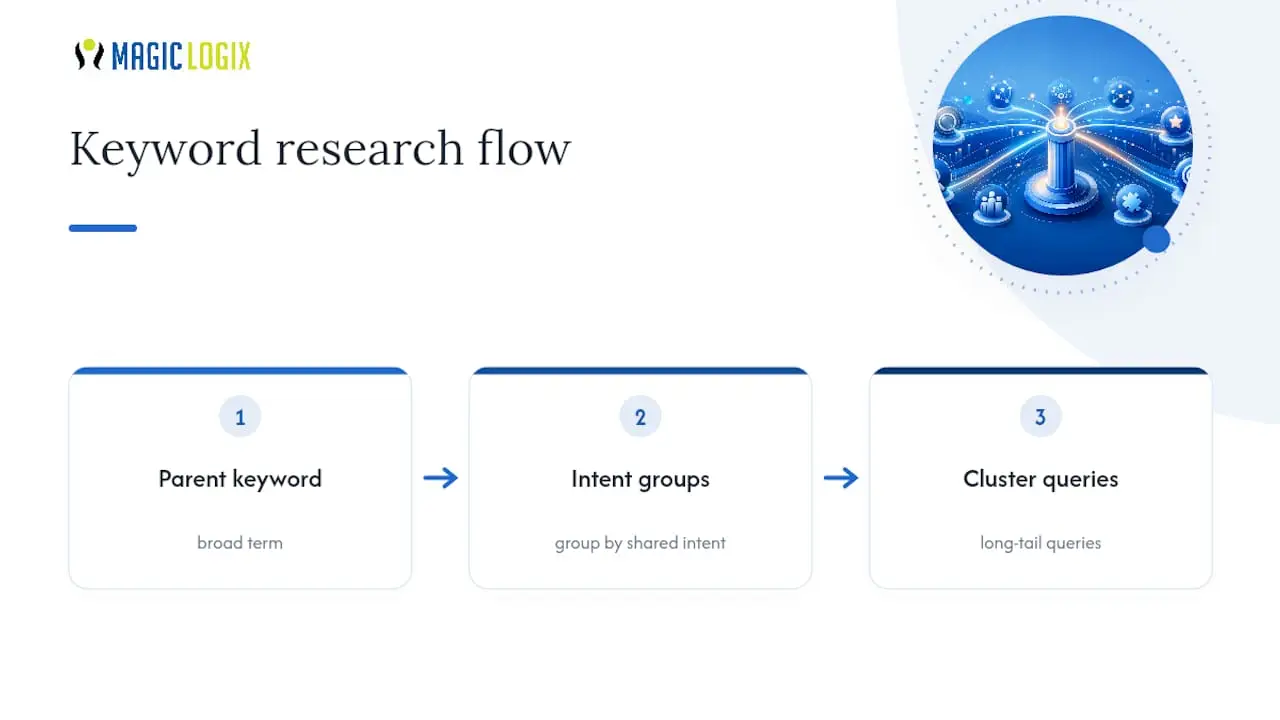
Step 2: Do keyword research in two layers. Find the broad “parent” term for the pillar itself (something with real search volume, like “content pillar strategy” or “email marketing automation”) and a batch of long-tail, specific queries for the clusters underneath it. Group queries by shared intent rather than by keyword similarity alone. A tool like Babylovegrowth’s cluster mapping approach walks through this grouping process in more technical detail.
Step 3: Audit what you already have. Most SMBs are sitting on old blog posts that partially cover the pillar topic already. Sort them into three buckets: upgrade (the content is close but thin or outdated), merge (multiple posts covering the same narrow point should become one cluster), or archive (irrelevant or off-strategy, unpublish it).
Step 4: Map several cluster topics per pillar. For each one, assign a target keyword, a search intent, and a one-sentence angle so writers know exactly what problem that page solves.
Step 5: Build a brief template. Every cluster brief should specify the H2 structure, where the pillar link goes (early, ideally in the first paragraph or two), which other clusters it should cross-link to, and what call to action closes the page.
Pro Tip: Draft the pillar’s outline before you write a single cluster. If you can’t sketch eight H2s under the pillar topic without straining, the topic is either too narrow for a pillar or you need to split it into two.
Tie your pillar topics back to your actual positioning before you commit resources; a clear marketing strategy foundation keeps pillar selection from drifting into topics that generate traffic but never generate leads.
What’s the Launch Checklist for a New Pillar?
The single biggest mistake in pillar building is publishing the hub page alone and adding spokes over the following months. Search engines and AI crawlers reward topical momentum, and a pillar with one link and no supporting content looks unfinished because it is.
Before you publish anything, triage your existing library with a simple rubric:
- Keep as-is if the page already ranks and needs no structural change.
- Upgrade if the content is accurate but shallow, missing sections, or has weak internal links.
- Merge if two or more pages compete for the same query.
- Delete or redirect if the page serves no strategic purpose anymore.
Internal linking rules matter more than most teams give them credit for. Every cluster should link up to the pillar, the pillar should link down to every cluster, and related clusters should cross-link to each other. Place those links in the first 30% of the content, not buried in a “related posts” box at the bottom, and use descriptive anchor text rather than “click here” or “read more.”
| Launch step | Action |
|---|---|
| Content ready | Pillar page plus several cluster articles drafted and edited |
| Linking | Bidirectional links added on day one, not after the fact |
| Technical | Sitemap updated, schema markup added to pillar and clusters |
| Promotion | Shared via email, social, and any partner or community channels |
Launching a pillar alongside multiple cluster pages signals topical momentum in a way that a lone hub page never will, no matter how good that hub page is.
How Should You Measure and Govern a Content Pillar?
Track pillar performance as a unit, not page by page. Aggregate organic traffic across the hub and all its spokes, watch leads and conversions attributed to that group, and where you can measure it, track share of AI citations for the topic. A tool like predictive analytics for marketing can help you spot which pillars are trending before the quarterly numbers confirm it.
Tag every pillar and its clusters with a shared content grouping or custom dimension in your analytics platform so the roll-up is automatic rather than manually assembled every reporting cycle.
- Organic traffic and ranking movement for the pillar and each cluster combined
- Leads and conversions attributed to pages within the pillar group
- Engagement metrics: time on page, scroll depth, internal click-through to related clusters
- Cannibalization checks: are two clusters competing for the same query
Measuring at the pillar level rather than the individual article level gives you a clearer signal for where to invest the next quarter’s content budget. Review each pillar on a quarterly cadence, and republish or consolidate clusters that have gone stale rather than letting them decay quietly.
What Does Real-World Pillar Execution Look Like?
Magiclogix has run more than 35,000 client projects, and the pattern that shows up again and again is simple: businesses that launch a pillar and its supporting clusters together see topical visibility build faster than those that trickle content out over months.
Coordinated launches, where a pillar page and its full set of spokes go live within the same window and link to each other immediately, consistently outperform a slow drip of individual articles because the coverage density is there from day one instead of building gradually.
What that looks like in practice for a small team:
- One pillar mapped to a core service, launched with 6 to 8 clusters simultaneously
- Internal links added before publish, not retrofitted weeks later
- Analytics tagged from the start so pillar-level results are visible immediately, not reconstructed after the fact
Should You Build One Pillar or Five?
Build one pillar first, with several spokes around it, and get that fully linked and published before you touch a second topic. Most small teams that try to run multiple pillars at once end up with half-finished ones, and a half-finished pillar generates less authority than a complete one on a smaller topic.
Repurpose aggressively. A cluster article can become three social posts, a short video, and an email send without extra research time, which is where a lot of SMB content budget gets recovered. Assign one named owner to each pillar. Pillars that belong to “the team” tend to drift; pillars that belong to a specific person get updated on schedule.
— Hassan
How Magiclogix Turns Pillar Strategy Into Execution
Reading a framework and staffing it are two different problems, and the second one is where most SMB pillar programs actually die. Magiclogix operationalizes the whole thing: topic and keyword mapping, a realistic content calendar, production of the pillar and its launch batch of spokes, and the analytics setup to track it as a group instead of a scattered pile of URLs.

That last part matters more than teams expect. A content calendar built around cluster publication dates keeps a pillar program from stalling after the initial launch excitement fades, which is the single most common way these programs quietly die around month three. Magiclogix builds that calendar, writes the briefs, produces the content, and sets up the reporting so you can see pillar-level results without assembling a spreadsheet by hand every quarter.
If you’re weighing whether to build this in-house or bring in help, start with a digital marketing strategy built for small business growth and request a scope for one pillar and its launch batch. That’s a concrete, bounded first step, not an open-ended commitment.
Where to Learn More About Pillar and Cluster SEO
- Ahrefs on building and launching content pillars
- Semrush’s guide to high-performing pillar structures
- QuickSEO’s cluster planning and review cadence guide
- WordPress support docs for sitemap and permalink setup
Sources
- High-Performing Content Pillars: The Complete Guide
- Content Pillars: What They Are & How to Build Them for SEO & AI Visibility
- B2B Pillar Page Strategy: How to Build Topical Authority | Rudo
FAQ
What Is a Content Pillar Strategy?
It’s a hub-and-spoke content model where one authoritative pillar page covers a broad topic and multiple linked cluster articles cover its subtopics in depth, building the topical authority that search engines and AI tools use to judge expertise.
What Are the Main Types of Content Pillars?
The three practical formats are Guide pillars (comprehensive, multi-step topics), What-Is pillars (definitional and educational intent), and How-To pillars (execution-focused, often paired with video).
What Are the Basic Steps of a Content Strategy?
Choose strategic pillar topics tied to buyer problems, do layered keyword research for the pillar and its clusters, audit existing content for what to upgrade or merge, then map and brief out the cluster pages before publishing pillar and spokes together.
How Many Cluster Pages Should Each Pillar Have?
Small teams should aim for 5 to 8 spokes per pillar to start; larger enterprise programs often run 10 to 15 clusters per pillar once resources allow.
How Often Should You Review a Pillar Page?
Review pillar performance on a quarterly cadence, checking aggregated traffic, leads, and any cannibalization between clusters before deciding whether to republish, consolidate, or add new spokes.