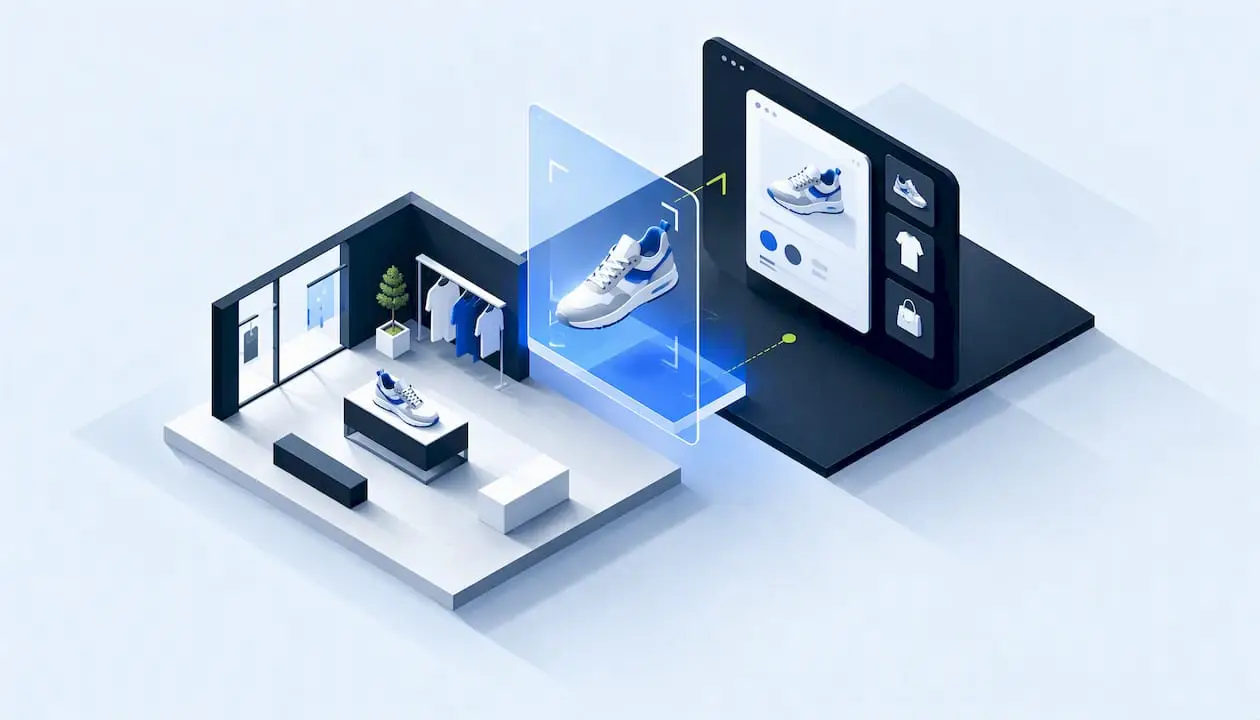
Augmented reality marketing uses a phone, tablet or headset camera to place digital content, such as a 3D product, a try-on effect or a guided overlay, into the customer’s real surroundings. It works best when it solves a buying problem: “Will this fit?”, “Will this look right in my room?”, “How does this work?” It works poorly when it is a novelty with no job to do. This guide explains how AR marketing works, what peer-reviewed research says about it, how to plan and measure a campaign, and where the risks are.
TL;DR
- AR marketing blends virtual content with the physical world to help people evaluate, understand or enjoy a product before they buy.
- Research points to realism as the lever: the more convincingly virtual objects merge with the real scene, the more present and informed shoppers feel.
- Lead with utility (try-on, placement, sizing) for new users, then add enjoyment to keep repeat users engaged.
- Build a fallback for devices that cannot run AR, measure against a baseline, and treat privacy as a design requirement, not an afterthought.
- Nobody can promise AR results in advance. Pilot a narrow use case, measure it, then scale.
Table of Contents
- What augmented reality marketing actually is
- Why it works: what the research says
- Where AR fits in the customer journey
- Practical AR marketing formats
- How to plan an AR campaign: seven steps
- AR marketing examples by business type
- Measuring AR marketing
- Disadvantages and risks of AR marketing
- AR and search: where discoverability fits
- Our perspective
- Build AR into a larger digital plan with Magic Logix
- A pre-launch checklist
- FAQ
- Sources
What augmented reality marketing actually is
AR integrates virtual content into a consumer’s physical environment. Academic research published in 2025 describes the key quality as “augmentation quality”: how well the virtual and real worlds appear to merge. That definition is useful because it separates AR from a video or a flat image. The customer is not watching your content. They are placing it in their own kitchen, on their own face, or in front of their own storefront.
A few terms are worth keeping straight:
- Augmented reality (AR): digital content layered over a live camera view of the real world.
- Virtual reality (VR): a fully digital environment, usually requiring a headset.
- Virtual try-on (VTO): AR that shows apparel, eyewear or cosmetics on the shopper.
- Web AR: AR launched from a browser link, with no app download.
- Spatial or immersive marketing: the broader category that includes AR, VR and mixed reality. Our overview of immersive media strategy covers how these formats fit together.
For most brands, AR is the more practical of the two. Industry experts quoted in a Pew Research Center canvassing expected AR to have broader daily use than VR because it rides on smartphones and, eventually, eyewear. Your customers already carry the hardware.
Why it works: what the research says
Marketing teams often ask whether AR moves buying behavior or simply earns a few seconds of attention. Several recent studies give a more specific answer than the usual vendor claims. These are academic findings in controlled or survey settings. They are not guarantees for any one campaign.
Realism creates presence, and presence creates information value
The 2025 study in the Journal of the Academy of Marketing Science found that higher augmentation quality strongly increased “local presence”, the feeling that a virtual object is really in the room. That presence in turn raised the perceived informational value of the experience and strengthened purchase intent. In plain terms: a couch that casts a believable shadow on your floor tells you more about the couch than a polished photo does.
Two pathways: rational and emotional
Researchers Peng He and Jing Zhang examined AR advertising in 2025 and described a dual-pathway model. One path is cognitive: the shopper evaluates product attributes and judges the information credible. The other is affective: the interaction is enjoyable. Flow, a state of deep absorption, helps connect both paths to purchase intent. Good AR needs to inform and to be pleasant to use. A lovely effect that teaches nothing, or a useful tool that is tedious, covers only half the job.
Utility first, enjoyment later
A 2024 study in the Journal of Business Research looked at AR marketing through the lens of cue utilization and habituation. Its practical lesson, as we read it: for first-time AR users, usefulness and vividness matter most, while enjoyment becomes the bigger factor for habitual users. So your first AR moment should do something helpful. Playful extras can come later for returning customers.
Virtual try-on and apparel
A 2025 study of 388 U.S. participants on AR virtual try-on for apparel found that perceived usefulness, ease of use, fit confidence and body esteem all shaped attitudes and purchase intent. The authors point to convenience, personalization and inclusive design as ways to encourage adoption. If your try-on tool shows only a narrow range of body types or skin tones, you are leaving part of your audience out and weakening the very confidence the tool is meant to build.
Where AR fits in the customer journey
AR is not a channel you bolt on. It earns its place at specific points in the journey.
| Journey stage | AR use | Example format | What to measure |
|---|---|---|---|
| Awareness | Shareable, location-based or social effects | Camera filter, poster that comes alive | Opens, shares, new visitors |
| Consideration | Product visualization and demonstration | “View in your space” 3D model, virtual try-on | Interaction time, product page depth |
| Purchase | Fit and size confidence | Try-on, scale preview | Conversion rate, add-to-cart rate |
| Post-purchase | Setup, how-to and support | Overlay instructions on the product | Support contacts, returns |
| Loyalty | Seasonal or collectible experiences | Limited-run effects tied to events | Repeat sessions, repeat orders |
Most small and mid-sized businesses should start in the consideration and purchase rows. That is where AR answers a real question and where the impact is easiest to measure against a baseline.
Practical AR marketing formats
Product visualization in the browser
The lowest-friction option is a “view in your space” button on a product page. Google’s Scene Viewer lets Android users preview, place and interact with web-hosted 3D models from a website or app, and Apple’s AR developer resources describe the tools on the iOS side. You need a clean 3D model of each product, a page that loads fast, and a clear button. No app download is required, which removes the biggest barrier.
Virtual try-on
Try-on suits eyewear, cosmetics, jewelry, apparel and footwear, where fit and appearance drive hesitation. It usually requires face or body tracking and careful tuning for lighting and different users. It costs more to build than a placement viewer, so it fits brands whose returns or abandoned carts clearly trace to “I couldn’t tell how it would look.”
Interactive print, packaging and signage
A QR code or image trigger on packaging can launch instructions, a recipe, a demonstration or a product story. This is a good fit for consumer goods and retail, and for events and trade shows, because the physical object you already produce becomes the entry point.
Location-based and real estate experiences
AR can overlay floor plans, finishes or neighborhood information on a site visit. Property marketers are an obvious fit. Our guide to real estate digital marketing strategies shows where this sits among other tactics.
In-app AR
A custom mobile app can use native frameworks for more advanced features, such as persistent objects or complex tracking. Google’s comparison of WebXR and ARCore is a helpful read here: it frames the choice around the target user experience, with an Android app on ARCore offering a richer feature set than a browser experience. Choose an app only when the experience needs repeated use or deeper capability. Otherwise stay on the web.
How to plan an AR campaign: seven steps
- Name the customer question. Write one sentence: “AR will help customers decide X.” If you cannot, the idea is a gimmick.
- Pick one product or one moment. A single best-seller or a single high-return category gives you a clean test.
- Set a baseline. Record current conversion rate, return rate, time on product page and average order value for those products before launch.
- Choose the lightest format that works. Web AR before an app. A placement viewer before full try-on.
- Produce assets to a realism standard. Accurate dimensions, textures and lighting are not polish. Per the research above, realism is the mechanism.
- Build the fallback. Plan what happens on devices that cannot run AR (see below).
- Launch, measure, decide. Compare against the baseline for a defined window, then expand, adjust or stop.
Make the assets believable
The hardest technical problem is not drawing the object. It is making it look as if it belongs in the room. Apple’s engineers have long stressed that virtual content interacts with the real world in ways other media never face, so lighting, scale and shadows need testing in real environments. Tools such as Apple’s Reality Composer and Google’s Scene Viewer let you preview how a model scales and sits before launch.
Creative direction matters as much as modeling. Product visuals that carry texture, color and mood translate into better 3D references and better campaign pages. Teams that want a polished look for the surrounding imagery can study how fine art editorial campaign photography handles light, movement and storytelling, then bring that same discipline to AR reference shots.
Plan the fallback
Not every shopper has a recent phone. Treat that as the normal case. With Scene Viewer, the model-viewer web component can fall back to a 3D viewer automatically if ARCore is not supported, and Scene Viewer’s launch modes let you set AR-preferred or 3D-only behavior. A shopper who sees a rotatable 3D model still gets value. A shopper who sees a broken button leaves.
AR marketing examples by business type
The scenarios below are illustrative models of how the formats apply. They are not Magic Logix client results.
- Furniture or home decor retailer: A “view in your room” button on each product page. The goal is fewer returns caused by size or color surprises. Track return rate and conversion for AR-enabled products versus a comparable set without it.
- Eyewear or cosmetics brand: A try-on tool built into the product page. Test with a diverse set of faces and lighting conditions, and measure add-to-cart rate among users who tried a product versus those who did not (keeping in mind that people who try are already more interested).
- Local home services or contractor: A before-and-after visualization of a finished project, launched from a QR code on a yard sign or estimate. Measure quote requests per scan.
- B2B equipment manufacturer: A life-size 3D model of a machine that sales reps place on a customer’s floor to check clearances. Measure sales cycle length and quote-to-close rate.
- Consumer packaged goods: Packaging that launches a recipe or usage guide. Measure scan rate and repeat scans.
Notice the pattern: each example has an owner, a question, a single metric and a comparison group.
Measuring AR marketing
AR vendors tend to report engagement time, which flatters the format. Use a layered scorecard instead.
| Layer | Metric | Why it matters |
|---|---|---|
| Adoption | Share of product-page visitors who launch AR | Shows whether the button is visible and compelling |
| Engagement | Median session length, interactions per session | Signals real use, not accidental taps |
| Conversion | Conversion rate versus a control group | The core business question |
| Quality | Return rate, support contacts on AR-enabled products | Shows whether AR set accurate expectations |
| Cost | Production plus maintenance per product | Needed to judge payback |
A few cautions. First, people who choose AR are self-selected, so compare against matched products or run an A/B split where the button appears for half of visitors. Second, keep your measurement window long enough to cover a full buying cycle. Third, record what you could not measure. If you cannot separate AR’s effect from a concurrent promotion, say so.
Disadvantages and risks of AR marketing
Searchers often ask about the downsides. They are real, and most are manageable with planning.
- Production cost and upkeep. 3D assets for every product add up. Start with best-sellers and build a repeatable pipeline.
- Device and browser variation. Experiences behave differently across phones and operating systems. Test on real devices and build fallbacks.
- Novelty without utility. An effect people try once and forget does not move revenue. The research above favors usefulness first.
- Slow pages. Heavy 3D files can hurt load speed and search performance. Compress models and load them on demand.
- Accessibility and inclusion. Camera-based experiences can exclude people. Offer an alternative path and test with varied users.
- Privacy exposure. Camera, face, body and location data are sensitive.
Privacy and regulation
If your AR tool touches face geometry, body measurements or location, treat it as a privacy project from day one. At the FTC’s 2022 PrivacyCon, agency officials said they were studying immersive technologies, including biometric and geospatial data collection and immersive advertising, to spot harms before harmful practices settle in. The same discussion urged companies not to wait for the sector to mature before addressing privacy and ethics.
That transcript is a 2022 statement of regulatory attention, not a rulebook, and U.S. state laws on biometric and consumer data differ and keep changing. Practical steps that hold up either way:
- Process camera frames on the device whenever possible, and store nothing you do not need.
- Tell users clearly, at the moment of use, what is collected and why.
- Collect the minimum data the experience requires.
- Ask your legal counsel to review any feature involving face, body or precise location data before launch. This is especially important if you operate in states with biometric privacy statutes.
AR and search: where discoverability fits
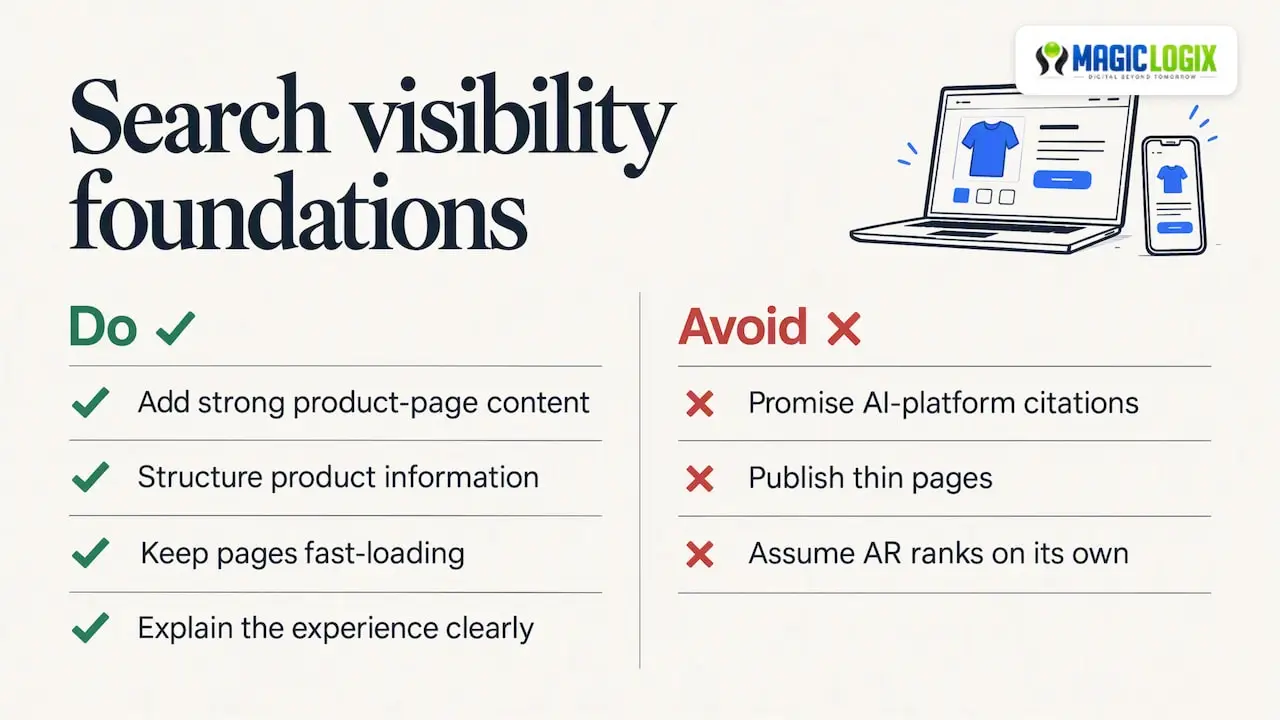
AR experiences do not rank on their own. People still find you through search and, increasingly, through AI answer tools. The product page that hosts the AR button needs strong content, structured product information, fast loading and clear explanations that a search engine or answer engine can read. Whether any given AI platform will cite your page is not something anyone can promise, and platform behavior is still evolving. What is well established is that crawlable, helpful, fast pages perform better than thin ones. Our Search & AI Visibility work covers that foundation, and our guide to ecommerce marketing strategies shows how product-page content, offers and AR can support one another.
Our perspective
We see AR marketing the way we see most emerging technology: as a tool that earns its place by solving a customer problem, not as a headline. The brands that get value from it tend to pick one decision customers struggle with, build an honest experience around it and measure it against a baseline.
Three convictions shape how we advise teams:
- Real and virtual should feel like one experience. That is the idea behind our work at Magic Logix, and the research on augmentation quality supports it. Half-believable overlays teach customers little.
- AR belongs inside the whole system. The product page, the site speed, the analytics, the email follow-up and the search visibility around an AR feature decide whether it pays off. An AR button on a slow, confusing page is wasted spend.
- Be candid about uncertainty. The evidence on AR is encouraging, but much of it comes from academic studies with specific product categories. We would rather help you run a measured pilot than promise a lift.
If you are weighing AR against other investments, ask a plain question: would a better product page, clearer photography or faster checkout answer the same customer question more cheaply? Sometimes the answer is yes. Sometimes AR is the only way to show what a photo cannot.
— Hassan Bawab
Build AR into a larger digital plan with Magic Logix
AR works when the website, content and measurement behind it are solid. At Magic Logix, under our “Digital Beyond Tomorrow” approach, we help businesses connect website design and development, eCommerce and custom development, and mobile app development with the analytics and search visibility that make those investments measurable. If you are exploring an AR pilot or want to know whether your product pages are ready for one, you can start a conversation with our team. Our guide to the interactive content playbook is also a good next read.
A pre-launch checklist
- One customer question and one primary metric are written down.
- Baseline numbers are recorded for the products involved.
- 3D models match real dimensions, materials and lighting.
- The experience works on current and older devices, with a 3D or image fallback.
- Page load speed is tested with the AR assets in place.
- Data collection is minimal, disclosed at the point of use and reviewed by counsel.
- Analytics events track launch, interaction and conversion separately.
- A review date is set to decide whether to scale, change or stop.
FAQ
What is augmented reality marketing?
Augmented reality marketing uses camera-enabled devices to overlay digital content on a customer’s real surroundings in order to inform, entertain or help them decide on a purchase. Common forms include product placement viewers, virtual try-on, interactive packaging and location-based overlays. The goal is to make a product easier to evaluate or a brand easier to remember.
What is an example of augmented reality advertising?
A typical example is a “view in your space” button on a furniture product page, where the shopper places a true-to-scale 3D model in their living room through their phone camera. Another is a virtual try-on for glasses or makeup. Both give the shopper information a flat photo cannot.
What are the disadvantages of AR marketing?
The main drawbacks are production and maintenance costs for 3D assets, inconsistent device support, the risk of novelty without real usefulness, heavier pages, and privacy obligations around camera, face and location data. Planning a fallback, starting with a narrow pilot and limiting data collection address most of these.
Do customers need to download an app to use AR?
Not always. Web-based AR can launch from a browser link on supported devices, and tools such as Google’s Scene Viewer can fall back to a 3D model viewer when AR is unavailable. A dedicated app makes sense mainly when the experience needs advanced features or repeat use.
How do you know if an AR campaign is working?
Compare AR-enabled products or visitors with a control group on conversion rate, return rate and support contacts, not just time spent. Record your baseline before launch and review after a full buying cycle.
Sources
- Unpacking augmentation quality and local presence, Journal of the Academy of Marketing Science (2025)
- Dual-Pathway Effects of Product and Technological Attributes on Consumer Engagement in AR Advertising (2025)
- AR marketing and consumer responses: cue-utilization and habituation, Journal of Business Research (2024)
- Does AR virtual try-on boost online apparel purchase intentions? (2025)
- FTC PrivacyCon 2022 transcript
- Pew Research Center, The Metaverse in 2040 (2022)
- Google for Developers: Scene Viewer
- Google for Developers: WebXR compared to ARCore
- Apple Developer: Augmented reality
- Apple Developer: Introducing RealityKit and Reality Composer, WWDC19