
Personalization at scale means using unified customer data, automated decisioning, and content systems to deliver relevant experiences to every individual customer across channels, without manually building each experience by hand. Three things separate teams that pull this off from teams stuck running one-off campaigns: they unify identity data before touching any AI tools, they start personalizing on the handful of pages that drive the most revenue, and they measure lift with real experiments instead of gut feel.
Here’s what should worry you: A majority of consumers now want personalized offers and proactive help from brands, but only a minority of brands actually deliver it, according to Adobe’s 2025 Digital Trends research. That 37-point gap is either your opportunity or your liability, depending on which side of it you’re standing on.
Your first 90 days should focus on three moves:
- Unify customer identity across at least your top two data sources (usually your CDP or CRM and your web analytics) before adding any AI layer.
- Pick two or three high-traffic pages, such as your homepage, pricing page, or a flagship product page, and personalize those first instead of spreading effort thin.
- Instrument measurement from day one with holdout groups, so you can prove lift instead of guessing at it later.
Key Takeaways
Personalization at scale succeeds when unified customer data, real-time decisioning, and disciplined governance work together, not when any single technology is deployed in isolation.
| Point | Details |
|---|---|
| Fix data before AI | Unify identity across your top data sources before layering on decisioning tools. |
| Start narrow | Pilot on two or three high-traffic pages instead of attempting a full rollout at once. |
| Measure with holdouts | Use holdout groups of at least 10% of traffic to prove real lift, not just engagement. |
| Governance prevents chaos | A small, cross-functional owner group resolves conflicts faster than ad hoc coordination. |
| Magiclogix supports execution | Magiclogix helps teams build the data, content, and decisioning pipeline personalization at scale requires. |
Table of Contents
- What Does Personalization at Scale Actually Require?
- Which Capabilities Make Personalization at Scale Possible?
- How Do You Build a Roadmap to Scale Personalization?
- What Technology Stack Supports Personalization at Scale?
- How Do You Measure Whether Personalization Is Working?
- What Blocks Most Personalization Programs, and How Do You Fix It?
- What Does a Real Personalization at Scale Rollout Look Like?
- What Should You Do in the First 90 Days?
- How Do You Keep Personalization Consistent Across Channels?
- Why Does Real-Time Data Matter for Scaled Personalization?
- How Do You Personalize Without Crossing Privacy Lines?
- Who Needs to Own Personalization Inside Your Organization?
- How Do You Manage Dozens of Customer Segments Without Losing Control?
- Where Is Personalization Actually Headed?
- How Magiclogix Helps You Scale Personalization Without the Guesswork
- Recommended Reading for Deeper Study
- Sources
- FAQ
What Does Personalization at Scale Actually Require?
Personalization at scale isn’t a bigger version of the “Hi [First Name]” email merge tag you’ve been running since 2015. It’s an operating system: unified data feeding automated decisions that get delivered consistently across web, email, ads, and in some cases sales conversations, all without a human manually configuring each variant.
The commercial case has stopped being theoretical. Industry reporting shows AI-driven personalization now accounts for roughly 45% of online conversions, and early adopters generate about 40% more revenue than companies that haven’t invested, according to Nexchron’s 2026 retail analysis. That’s not a marginal edge. That’s a structural advantage compounding every quarter you wait.
On the B2B side, the picture is similar but less mature. Most B2B teams have personalization somewhere on the roadmap, yet few have moved past basic segmentation into real one-to-one decisioning. Organizations that treat personalization as a genuine priority report measurable revenue lifts depending on how developed their personalization program is, per Markettailor’s 2026 State of B2B Personalization report. The wide range itself tells you something: maturity matters more than tooling.
Where the ROI concentrates:
- Homepage personalization based on visitor source, industry, or return-visit status often produces the fastest measurable lift because traffic volume is highest there.
- Pricing and plan pages benefit from segment-aware messaging (small business versus enterprise framing) since buyer intent is already high.
- Product recommendation modules on e-commerce sites remain one of the most-wanted innovations across generations, making them a reliable early win.
| Point | Details |
|---|---|
| Expectation gap is the opportunity | 71% of consumers want personalized offers; only 34% of brands deliver, leaving room to differentiate fast. |
| AI adopters pull ahead | Early adopters of AI-driven personalization report about 40% more revenue than non-adopters. |
| B2B lift scales with maturity | Revenue gains run 5% to 40% depending on how developed the personalization program is. |
| Start narrow, not wide | Homepage, pricing, and top product pages typically deliver the earliest ROI. |
Which Capabilities Make Personalization at Scale Possible?
Six pillars separate a scaled personalization program from a pile of disconnected tools. Skip any one of them and the whole structure wobbles, usually at the worst possible moment, like a product launch or a holiday traffic spike.
Data foundation and identity resolution. You cannot personalize what you cannot recognize. This pillar means stitching together a single customer view across devices, sessions, and channels, typically anchored by a customer data platform or a well-governed customer relationship management system.
AI decisioning. Once identity is solid, decisioning engines determine what each customer sees next: which offer, which message, which product. This is where machine learning earns its keep, but only after the data underneath it is trustworthy.
Omnichannel orchestration. Decisions mean nothing if they can’t reach the customer consistently on email, web, app, and paid media at the same time. Orchestration is the delivery layer that keeps experiences coherent instead of contradictory.
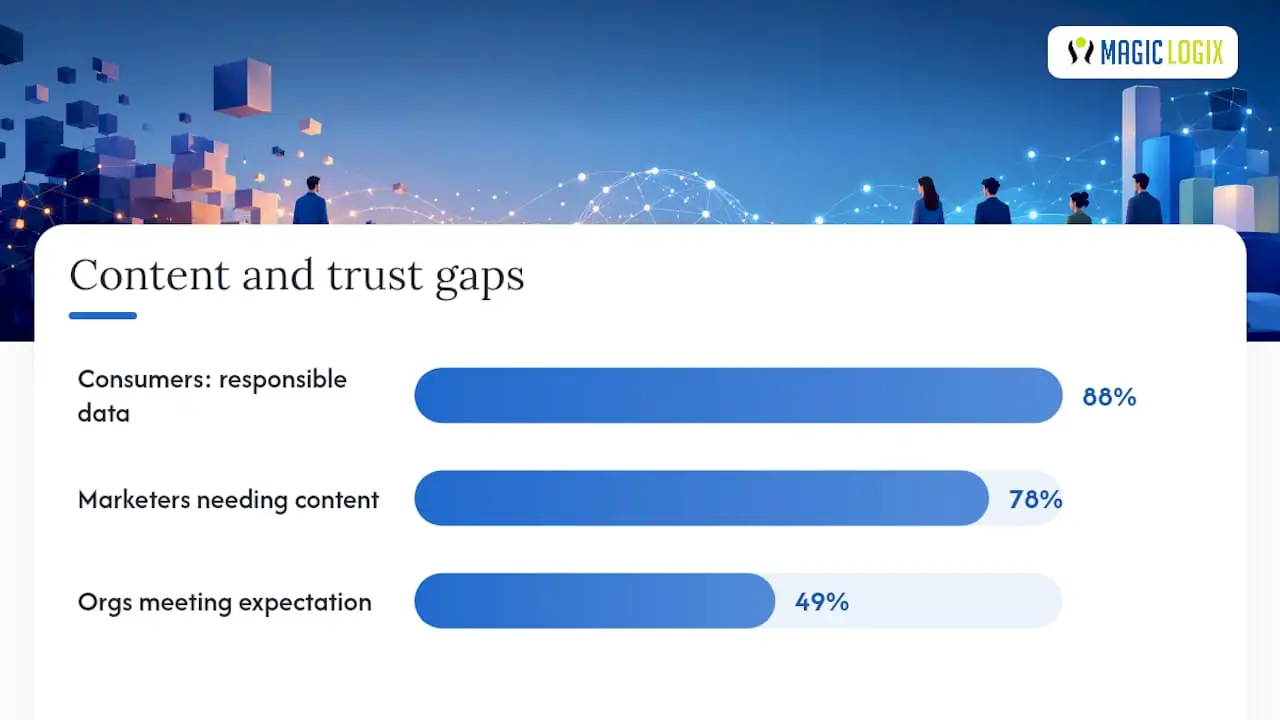
Content operations. Personalization at scale demands dozens or hundreds of content variants. This is the pillar most teams underfund, and it shows: 78% of marketers say they need more personalized content than they can currently produce, according to eMarketer.
Operations and governance. Someone has to own the roadmap, resolve conflicts between teams, and keep quality consistent. Without this, personalization degrades into competing one-off projects.
Trust and ethics. Consumers notice when data handling feels invasive. Adobe’s research found 88% of consumers expect responsible data handling, yet only 49% of organizations meet that expectation. That 39-point gap is a brand risk hiding in plain sight.
| Pillar | Core capability | Quick win to target first |
|---|---|---|
| Data foundation | Unified identity across channels | Merge your top two customer data sources |
| AI decisioning | Automated next-best-offer logic | Pilot on one high-traffic page |
| Orchestration | Consistent cross-channel delivery | Sync one email trigger with one web experience |
| Content operations | Scalable variant production | Build a modular template for your top page |
| Governance | Clear ownership and conflict resolution | Name one accountable owner per channel |
| Trust and ethics | Transparent, compliant data use | Publish a plain-language data policy |
Pro Tip: Rank your pillars by which one is weakest, not which one is trendiest. A brilliant decisioning engine sitting on fragmented data will make confidently wrong decisions faster than a human ever could.
How Do You Build a Roadmap to Scale Personalization?
Trying to personalize everything on day one is the single most common way these programs stall. A phased approach works better because each stage produces evidence that justifies investment in the next.
- Phase 0, Discovery (weeks 1 to 4). Audit your existing data sources, tag your highest-traffic pages, and identify which teams currently own customer data. Deliverable: a data and capability gap map.
- Phase 1, Foundation (weeks 4 to 12). Unify identity across your top two or three systems and establish a governance owner. Deliverable: a working single customer view, even if imperfect.
- Phase 2, Pilot (weeks 10 to 16). Launch personalization on two or three high-leverage pages with a defined holdout group for measurement. Deliverable: a documented lift result, positive or negative.
- Phase 3, Scale (weeks 16 to 26). Expand decisioning and content operations to additional channels and segments based on what the pilot proved. Deliverable: an expanded content template library and orchestration rules.
- Phase 4, Continuous improvement (ongoing). Build a regular cadence of experiments and retire tactics that stop performing. Deliverable: a quarterly experimentation calendar.
Immediate checklist to start this week:
- List every system currently holding customer data, even spreadsheets.
- Name one accountable owner for the personalization program, not a committee.
- Pick your two highest-traffic pages and sketch three variant ideas for each.
- Set up a basic dashboard to track conversion by segment before you launch anything new.
PwC’s research with Adobe found that scaling personalization successfully requires organizational capabilities like a personalization center of excellence and executive sponsorship, not just better software. Skipping that structural work is the fastest way to burn a good pilot’s momentum.
Pro Tip: Sequence data before AI, always. Teams that deploy machine learning decisioning on top of messy, duplicated customer records end up automating bad decisions faster instead of better ones.
What Technology Stack Supports Personalization at Scale?
The architecture underneath a scaled program has five functional layers, regardless of which specific products you choose. Think of it less like a shopping list and more like plumbing: each layer has to connect cleanly to the next or the whole system leaks.
Data ingestion and identity resolution collects behavioral, transactional, and profile data, then stitches it into one customer record. Look for real-time ingestion and clear rules for merging duplicate profiles.

Decisioning takes that unified profile and decides what to show next, whether that’s a product recommendation or a pricing message. Evaluate decisioning tools on latency (can it decide in milliseconds?) and explainability (can your team see why it made that choice?).
Orchestration delivers the decision consistently across web, email, app, and ads. The best customer engagement platforms handle this coordination without forcing separate configuration for each channel.
Experimentation runs the A/B and holdout tests that prove whether personalization is actually working, not just producing activity.
Privacy controls manage consent, data retention, and opt-outs in line with your compliance obligations.
| Component | Primary job | What to evaluate before buying |
|---|---|---|
| Identity resolution | Build one customer view | Match accuracy, real-time update speed |
| Decisioning engine | Choose next-best content or offer | Latency, explainability, integration depth |
| Orchestration layer | Deliver consistently across channels | Channel coverage, ease of rule-building |
| Experimentation platform | Prove lift with holdouts | Statistical rigor, sample-size guidance |
| Privacy and consent tools | Manage compliance and opt-outs | Audit trail, regional regulation support |
Buy versus build checklist: if your data volume is modest and your team is small, buy a platform that bundles identity, decisioning, and orchestration together. If you have unique data structures or regulatory constraints that off-the-shelf tools can’t handle, budget for custom integration work instead of forcing a square peg into a round hole.
Pro Tip: Sketch your architecture as a flow diagram before you evaluate a single vendor: data sources feeding identity resolution, feeding decisioning, feeding orchestration, feeding measurement. Vendors will happily sell you a piece that doesn’t fit if you don’t already know the shape of the puzzle.
How Do You Measure Whether Personalization Is Working?
Measurement separates programs that survive budget season from programs that get quietly shut down. The KPIs that matter fall into two tiers, and conflating them is a common mistake.
Primary KPIs tie directly to revenue: conversion rate lift, average order value, and customer lifetime value. Secondary KPIs indicate engagement health: click-through rate, time-to-value, and repeat visit frequency. Secondary metrics matter, but they should never substitute for proof of revenue impact when you’re reporting to leadership.
- Define your primary metric before launch, not after you see promising engagement numbers.
- Build a holdout group of at least 10% of traffic that receives no personalization, so you have a clean baseline for comparison.
- Run tests for a full business cycle where possible, since day-of-week and seasonal effects can distort short tests badly.
- Track statistical significance, not just directional movement, before declaring a win.
- Retire or iterate on any variant that underperforms its holdout for two consecutive measurement periods.
Customer journey analytics tools help attribute lift correctly when a customer touches multiple personalized moments before converting, which is increasingly the norm rather than the exception.
| KPI | What it measures | Realistic early benchmark |
|---|---|---|
| Conversion rate lift | Revenue impact of personalized experience vs. holdout | Varies by maturity; B2B programs report 5% to 40% overall revenue lift |
| Click-through rate | Engagement with personalized content | Directional signal, not a standalone success metric |
| Customer lifetime value | Long-term revenue per customer | Track quarterly, not weekly |
| Time-to-value | Speed of first meaningful conversion | Compare cohort-to-cohort, not universally |
AI-driven personalization now contributes to roughly 45% of online conversions, which makes conversion attribution a genuinely competitive skill, not a reporting formality.
What Blocks Most Personalization Programs, and How Do You Fix It?
Nearly every stalled personalization initiative traces back to one of three blockers, and the fix for each is more operational than technical.
Data silos. Customer data sitting in disconnected systems, marketing automation here, sales CRM there, support tickets somewhere else, is the top blocker teams report. The fix isn’t a bigger tool; it’s a governance decision to designate one system as the source of truth and build integrations toward it.
Content capacity. Nearly all marketers using AI for personalization report at least one major hurdle, and data silos plus poor data quality top that list, with content production close behind. Modular content templates, where a base layout accepts swappable headlines, images, and offers, solve this faster than hiring more writers.
Governance gaps. When no one owns cross-channel consistency, teams personalize in conflicting directions: the email team promotes one offer while the web team shows another to the same customer. A personalization center of excellence with clear decision rights resolves this faster than any technology purchase.
Fix these in this order:
- Resolve data silos first; everything downstream depends on data quality.
- Build content templates second, once you know which data fields you’re personalizing against.
- Formalize governance third, once real conflicts between teams start surfacing (they will).
Pro Tip: Watch for the trap of adding AI tooling to compensate for weak data. It doesn’t compensate. It amplifies the weakness, because a confident wrong recommendation erodes customer trust faster than no recommendation at all.
What Does a Real Personalization at Scale Rollout Look Like?
A mid-market retail client working with Magiclogix came in with a familiar problem: strong traffic, a decent product catalog, but a generic homepage experience for every visitor regardless of whether they’d bought once or ten times before. Their marketing team had the strategic vision for personalization but lacked the data infrastructure and content pipeline to execute it.
The engagement started with identity unification across their e-commerce platform and email marketing system, since those two data sources alone covered the majority of customer touchpoints. From there, the team built a modular homepage template capable of swapping hero banners, product recommendations, and promotional messaging based on visitor history, then piloted it against a holdout group before rolling it out broadly.
The clearest lesson from that rollout wasn’t about the technology. It was that the pilot with a proper holdout group gave the marketing team the internal credibility to secure budget for phase two, something a rushed, unmeasured launch never would have earned them.
Results the client tracked after the pilot period:
- Meaningfully higher conversion rate among returning visitors shown personalized homepage content versus the holdout group.
- Faster time-to-launch for subsequent campaign variants once the modular template was in place.
- Improved internal alignment, since governance meetings shifted from debating whose message wins to reviewing what the data showed.
The lesson other organizations can lift directly from this: pilot with a real holdout, keep your first scope narrow, and let the measured result, not internal opinion, decide what gets scaled next. Similar homepage-level tactics show up across other website personalization examples that have driven comparable results for other businesses.
What Should You Do in the First 90 Days?
A focused first 90 days beats a sprawling 12-month plan that never survives contact with quarterly budget reviews.
- Weeks 1 to 2: Audit data sources and appoint a single accountable owner for the personalization initiative.
- Weeks 3 to 6: Unify identity across your two highest-value data sources and document data quality issues you find.
- Weeks 7 to 10: Build your pilot content variants for two high-traffic pages, using modular templates rather than one-off designs.
- Weeks 11 to 13: Launch the pilot with a holdout group and begin tracking primary KPIs daily.
Roles to involve early:
- A data or analytics lead to manage identity resolution and reporting integrity.
- A content or creative lead to build the modular templates before launch, not during.
- An executive sponsor who can resolve cross-team disputes about priority and budget.
Quick wins to prioritize: homepage personalization by visitor history, pricing page messaging by segment, and one triggered email tied to on-site behavior. These three consistently produce measurable results within a single 90-day window, largely because the traffic volume behind them makes statistical significance achievable faster than on lower-traffic pages.
How Do You Keep Personalization Consistent Across Channels?
A customer who sees one offer on your homepage and a contradictory one in your retargeting ad doesn’t experience two campaigns. They experience one confusing brand. Channel integration is where orchestration earns its keep, because the goal isn’t personalizing each channel separately. It’s making sure the decisioning layer feeds every channel from the same source of truth.
Practically, this means your email platform, web personalization engine, and paid media retargeting should all query the same customer profile rather than maintaining separate, drifting copies of customer data. When a customer adds an item to their cart on mobile, that signal should influence the email they receive that evening and the ad they see the next day, not just the mobile session itself. Unifying customer experience across touchpoints requires this kind of shared data backbone more than it requires channel-specific cleverness.

The channels that matter most for a given business vary. A B2B software company might prioritize web and sales-enablement content consistency, while a retail brand needs tight coordination between email, app push notifications, and paid social. Either way, the integration principle holds: decide once, deliver everywhere, consistently.
Why Does Real-Time Data Matter for Scaled Personalization?
Batch-processed customer data, updated overnight or weekly, worked fine for the era of segment-based email blasts. It fails the moment you’re trying to react to a customer’s behavior within the same session, which is where most of the conversion opportunity actually sits.
Real-time processing lets a decisioning engine respond to what a customer just did, not what they did last week. Someone who abandons a cart ten minutes ago is a fundamentally different targeting opportunity than someone who did it three days ago, and the message that works for one often falls flat for the other.
This doesn’t mean every business needs millisecond-latency infrastructure from day one. It means evaluating your decisioning and orchestration tools honestly on how current their data actually is, and prioritizing real-time capability for your highest-value use cases (cart abandonment, browse abandonment, active session recommendations) before worrying about it everywhere else.
How Do You Personalize Without Crossing Privacy Lines?
The privacy conversation isn’t a compliance afterthought bolted onto personalization. It’s a design constraint that shapes which data you collect and how you use it from the start. Consumers have made their expectations explicit: 88% expect responsible data handling from brands, yet less than half of organizations currently meet that bar.
Practically, three principles keep personalization on the right side of that line. First, collect only the data you have a genuine use case for. A field sitting unused in your CDP is pure liability with no offsetting benefit. Second, make consent and data use transparent in plain language, not buried in a legal document nobody reads. Third, build opt-out mechanisms that actually work and that your team tests regularly, not just ones that exist on paper.
This is general guidance, not legal advice. Data privacy regulations vary significantly by jurisdiction and by industry, so confirm your specific obligations with your legal or compliance team before finalizing your data collection and personalization practices.
Who Needs to Own Personalization Inside Your Organization?
Technology rarely kills a personalization program. Organizational friction does. Marketing wants faster campaign turnaround, IT wants data governance rigor, and legal wants airtight compliance, and without a resolution structure, those three legitimate priorities grind against each other indefinitely.
The organizations that get past this typically build a small, cross-functional personalization center of excellence, exactly what PwC’s research identifies as a defining trait of programs that scale successfully. This group doesn’t need to be large. It needs clear decision rights: who approves a new content variant, who resolves a data quality dispute, who signs off on a new personalization use case from a privacy standpoint.
Executive sponsorship matters just as much as the operational structure. A program without a senior sponsor tends to lose budget priority the moment a competing initiative shows up, regardless of how strong its early results were. Change management here looks less like a training deck and more like a recurring governance meeting where real conflicts get resolved on a fixed cadence, not left to fester until they block a launch.
How Do You Manage Dozens of Customer Segments Without Losing Control?
The instinct to build a unique experience for every conceivable customer segment is understandable and almost always counterproductive early on. A better approach: build a smaller number of decisioning rules that combine dynamically, rather than a large number of static, hand-built segments.
Instead of manually creating one hundred segment-specific campaigns, define the handful of attributes that actually drive different behavior, such as purchase history, industry, and engagement recency, and let your decisioning engine combine them algorithmically. This is the practical difference between mass customization and old-fashioned segmentation: segmentation groups people into static buckets, while automated decisioning treats each customer as a unique combination of signals evaluated in real time.
Customer segmentation examples that scale well tend to start with three or four high-signal attributes rather than dozens of narrow buckets. Add complexity only after your decisioning engine and content templates prove they can handle the simpler version reliably. Complexity is easy to add and painful to remove once it’s baked into your operational workflow.
Where Is Personalization Actually Headed?
The next real shift in personalization isn’t a smarter recommendation algorithm. It’s the move toward agentic systems that don’t just suggest content but take limited actions on a customer’s behalf, rebooking a canceled appointment, adjusting a subscription tier based on usage, or proactively resolving a service issue before the customer notices it. That capability is closer than most marketing teams assume, and it will separate companies with genuinely unified data from companies still patching together spreadsheets and static segments.
My honest read: the winners over the next few years won’t be the teams with the flashiest AI model. They’ll be the teams that treated data unification and governance as seriously as they treated the shiny decisioning layer everyone wants to talk about in vendor demos. If you take one strategic priority from everything above, make it this: fix your identity resolution before you spend another dollar on AI tooling. Everything downstream depends on it.
How Magiclogix Helps You Scale Personalization Without the Guesswork
Building the pillars described above, unified data, decisioning, content operations, and governance, from scratch takes most internal teams far longer than they budget for, especially while running day-to-day campaigns at the same time. Magiclogix works alongside marketing teams to close that gap directly: integrating your data sources, setting up decisioning workflows, and building the content operations pipeline needed to run personalization at scale without hiring an entirely new department.
Our approach draws on data-driven customer insights and practical AI implementation to help you move from a stalled pilot to a program that actually produces measurable revenue lift, whether you’re a small business just starting your personalization journey or an enterprise team scaling an existing effort. If your team is ready to move past manual segmentation and into real decisioning, explore how digital marketing built for business growth can shorten that timeline, and reach out to Magiclogix to scope a diagnostic tailored to where your data and content operations currently stand.
Recommended Reading for Deeper Study
- Adobe’s Digital Trends research quantifies the gap between what consumers expect and what brands deliver on personalization and data trust.
- eMarketer’s coverage of content and data hurdles breaks down why content capacity and data quality remain the top blockers for AI-driven personalization.
- Markettailor’s State of B2B Personalization report offers benchmark revenue lift ranges tied to program maturity for B2B teams specifically.
- Statista’s e-commerce innovation data helps prioritize which personalization features matter most to different customer generations.
Sources
- Personalization at scale has never been more crucial for your business
- Personalization becomes key as customer demands surge, but data quality presents hurdles
- AI Personalization Drives 45% of Conversions in 2026
- The State of B2B Personalization 2026: 100 Insights from Markettailor | Markettailor
FAQ
What does personalization at scale mean?
Personalization at scale means using unified customer data and automated decisioning to deliver relevant, individualized experiences across every channel, without manually configuring each variant by hand.
What are the 4 D’s of personalization?
Definitions of the “4 D’s” vary across sources and aren’t consistently standardized; rather than repeat an unverified framework, focus on the pillars that consistently drive results: data, decisioning, delivery, and governance.
How do you measure personalization at scale?
Measure it with primary KPIs like conversion rate lift and customer lifetime value, tested against a holdout group, rather than relying solely on engagement metrics like click-through rate.
How much revenue lift can personalization realistically deliver?
Where should a company start with personalization at scale?
Start by unifying your top two customer data sources, then pilot personalization on two or three high-traffic pages, such as your homepage or pricing page, before expanding further. Magiclogix typically recommends this narrow, measured approach over an all-at-once rollout.