
A company-level digital marketing roadmap is one deliverable: a single document that ties one measurable business objective to a prioritized channel mix, a budget, quarterly milestones, and a measurement cadence covering 90 days to 12 months. According to a practical step-by-step framework, the most effective version is short, fill-in-the-blank, and built around one core 90-day objective with AI layered in for execution, not strategy.
Your first action: open a blank document right now and write three lines.
- Objective: What one business outcome do you want in 90 days? (e.g., 50 qualified demo requests per month)
- Primary KPI: The single number that proves you hit it
- Top channel + DRI: Which channel owns the objective, and who is accountable by name
That one-pager is your roadmap seed. Everything below shows you how to grow it into a full plan.
Key Takeaways
A company-level digital marketing roadmap works when it ties one SMART objective to a focused channel mix, a clear budget split, and a named DRI who owns the outcome metric every week.
| Point | Details |
|---|---|
| Start with one objective | Write one SMART goal before choosing any channel or tactic. |
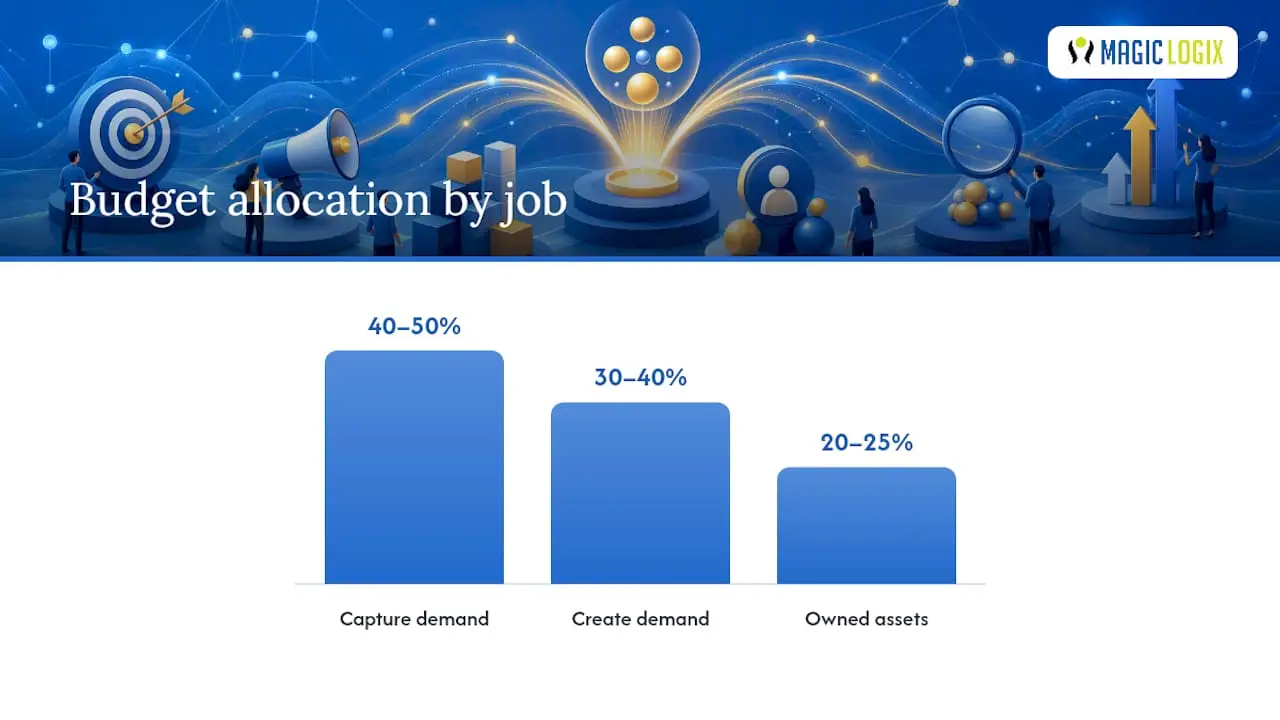
| Use the three-bucket budget | Allocate roughly 40–50% to capture, 30–40% to create, and 20–25% to owned assets. |
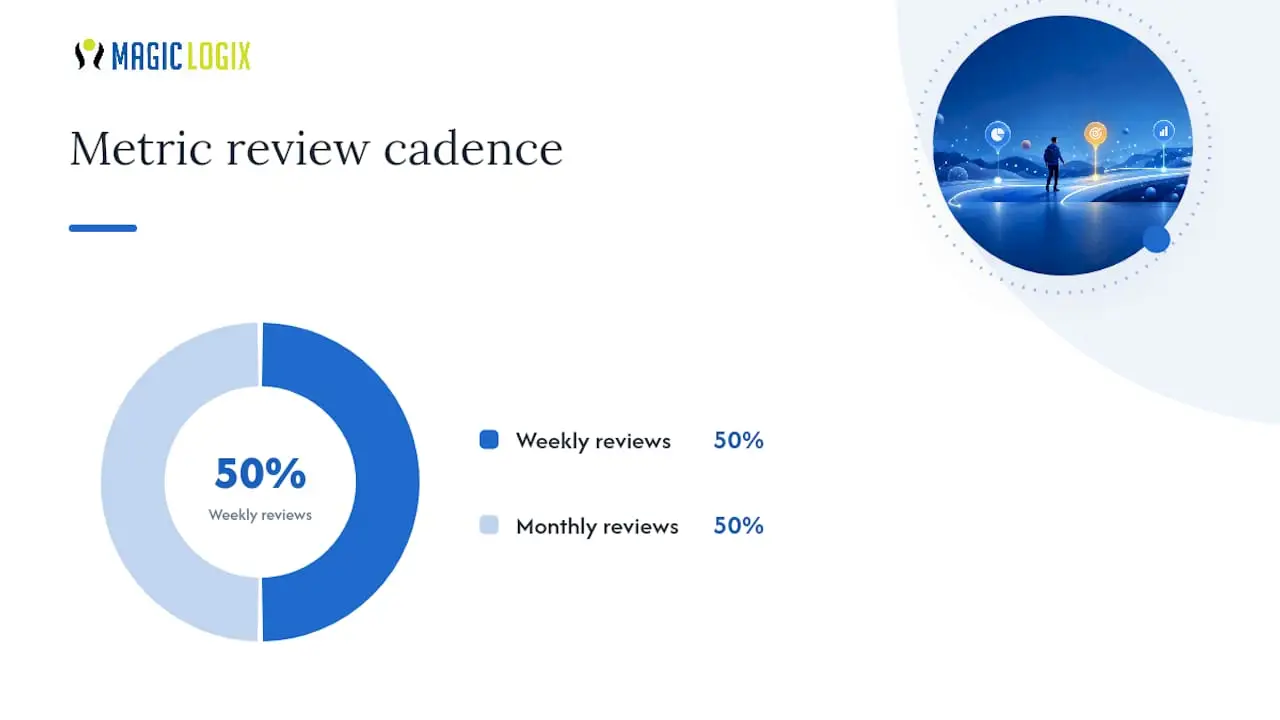
| Lock the quarter, review weekly | Run 7-day tactical checks and 30-day reviews; hold the plan unless a channel misses KPI by 30%+ for two weeks. |
| Assign a DRI, not a committee | One named person owns the primary KPI and chairs every review meeting. |
| Magiclogix delivers the plan | A roadmap workshop with Magiclogix produces a locked 90-day plan with channel mix, budget, and KPIs ready to execute. |
Table of Contents
- How to build a digital marketing roadmap that drives real results
- How to set a budget, timeline, and team structure
- How to measure performance and run your optimization cadence
- Your fill-in-the-blank roadmap template
- Risks, governance, and build vs. buy decisions
- How to run the roadmap week to week
- Magiclogix accelerates your roadmap from plan to results
- The roadmap only works if someone owns it
- Sources
- FAQ
How to build a digital marketing roadmap that drives real results
A digital marketing strategy separates three layers: strategy (objectives, audience, budget, metrics), campaigns (themed initiatives), and tactics (specific channel actions). Confusing the layers is the most common reason roadmaps stall. Keep strategy decisions at the top and let tactics follow.
Step 1: Define objectives and your measurement framework
Pick one primary outcome metric first. Revenue, net-new monthly recurring revenue, or qualified demo requests all work. Then choose one or two leading indicators that move before the outcome does, such as marketing-qualified leads or cost per landing-page visit.
Write your 90-day objective as a SMART goal: “Increase qualified demo requests from 20 to 50 per month by the end of Q3, measured weekly in Google Analytics 4 and our CRM.” That sentence alone eliminates ambiguity for every team member and every vendor.
| Layer | Metric | Example | Review frequency |
|---|---|---|---|
| Primary outcome | Revenue or pipeline | $200K new pipeline | Monthly |
| Channel KPI | Cost per lead | $45 CPL via paid search | Weekly |
| Leading indicator | Landing page CVR | 4.5% form completion | Weekly |
| Health check | Organic sessions | +15% MoM | Monthly |
Aligning marketing KPIs to business outcomes is what earns cross-functional buy-in from finance and the CEO. Without that alignment, budget conversations become guesswork.
Step 2: Map your audiences and the customer journey
Build a persona around five fields: role, decision context, primary goal, decision drivers, and preferred channels. A B2B buyer at a 200-person company deciding on marketing software has a different journey than a DTC consumer impulse-buying a $40 product. The fields force you to be specific.
Prioritize personas using a simple value-times-velocity rule: which persona converts fastest AND generates the highest lifetime value? Start there. Spreading effort across four personas in the first 90 days dilutes everything.
- Awareness: Organic search or paid social (highest-impact touchpoint for cold audiences)
- Consideration: Retargeting ads + comparison content (blog, landing page, case study)
- Decision: Demo, free trial, or sales call (direct conversion event)
- Post-purchase: Onboarding email sequence + customer journey analytics to reduce churn
Map one high-impact touchpoint per stage to your primary objective. More than one per stage is fine later; for the first sprint, one is enough.
Step 3: Choose your channel mix and tactics
Every dollar in your budget does one of three jobs: capture existing demand, create new demand, or build owned assets. A healthy program invests across all three concurrently, with suggested ranges of roughly 40–50% on capture, 30–40% on creation, and 20–25% on owned assets.
Sample mixes by objective:
- Demo requests (B2B): Branded + non-branded paid search (capture), LinkedIn thought-leadership content (create), SEO blog cluster (own)
- Trial signups (SaaS): Google Performance Max (capture), YouTube pre-roll (create), email nurture sequence (own)
- Local revenue (SMB): Google Local Services Ads (capture), Meta geo-targeted video (create), Google Business Profile + review program (own)
Separate branded and non-branded paid search campaigns from day one. Treat display primarily as retargeting unless you have tested it for incrementality. SEO is an 18-month horizon play, so start the content cluster now even if you won’t see full returns this quarter.
Pro Tip: Use AI in your marketing workflows to draft ad copy variations, summarize keyword research, and automate weekly reporting. Keep humans in charge of messaging strategy and creative judgment. AI accelerates; it does not replace strategic thinking.
How to set a budget, timeline, and team structure
Sample quarterly budget allocation
| Category | % of budget | What it funds |
|---|---|---|
| Paid media (capture) | 40–50% | SEM, paid social, retargeting |
| Content and creative | 20–30% | Copy, design, video, landing pages |
| Tech and data | 15–20% | CRM, analytics, automation tools |
| Experiments | 10–15% | New channels, A/B tests, pilots |
Timeline milestones follow a three-phase arc: Foundation (days 1–30, build tracking, launch one paid channel, publish first content assets), Scale (days 31–60, expand creative, add a second channel, review CPL weekly), Optimize (days 61–90, cut underperformers, reallocate to winners, lock Q2 plan).
Roles and RACI
Every roadmap needs a Directly Responsible Individual (DRI). One person owns the outcome metric. Supporting roles include a content lead, a paid media manager, a data analyst, and a web developer. External partners or agencies fill gaps where in-house capacity is thin.
- DRI: Owns the primary KPI, chairs weekly reviews, escalates to CEO
- Content lead: Owns editorial calendar and asset delivery dates
- Paid media manager: Owns channel budgets and bid strategy
- Data analyst: Owns dashboard, flags anomalies, runs experiment analysis
- External partner: Fills specialized gaps (creative production, technical SEO, CRO)
Using a collaborative roadmapping tool such as Notion, Airtable, or Asana keeps the plan versioned and visible to all stakeholders, which is a meaningful improvement over a static slide deck that goes stale the week after it is presented.
How to measure performance and run your optimization cadence
A practical measurement plan has three review rhythms.
| Cadence | Focus | Decision rule |
|---|---|---|
| 7-day tactical check | Spend pacing, CTR, CPL | Pause ads below 0.5% CTR after 500 impressions |
| 30-day performance review | Channel KPIs vs. target | Reallocate budget if a channel misses CPL by >20% |
| 90-day strategy lock | Primary outcome vs. SMART goal | Kill, scale, or pivot the channel mix for next quarter |
Measurement frameworks that pair one primary outcome metric with channel KPIs and leading indicators give you early signals before the quarter ends. Use predictive analytics to model whether your current trajectory reaches the 90-day goal, and adjust spend before it is too late.
For experiments, use a simple go/kill/scale rule: run for at least two weeks with a minimum of 200 conversions before calling a result.
Your fill-in-the-blank roadmap template
Copy this structure into Notion or Google Docs and share it with your team today. A well-structured marketing plan follows this exact one-page format.
One-page roadmap summary:
- Objective: [One SMART goal — outcome, number, deadline]
- Primary KPI: [Single metric that proves success]
- Top channel: [Channel name + budget %]
- 90-day milestones: [Month 1 / Month 2 / Month 3 deliverables]
- Budget slice: [$X total | Capture $X | Create $X | Own $X]
- DRI: [Name + review cadence]
Campaign brief — demo requests:
Objective: 50 qualified demo requests/month by [date] | Channel: Non-branded paid search + LinkedIn | Budget: $[X]/month | Creative: [Landing page URL] | Success metric: CPL under $[X]
Campaign brief — trial signups:
Objective: 200 trial signups/month by [date] | Channel: Google Performance Max + email nurture | Budget: $[X]/month | Creative: [Trial page URL] | Success metric: Trial-to-paid CVR above [X]%
Lock the plan at the start of each quarter. Mid-quarter changes require DRI sign-off and a documented reason. Version the document (v1.0, v1.1) so you can compare what changed and why.
Pro Tip: Use a campaign planning template to pre-populate the brief fields for each initiative. It cuts briefing time and prevents the “we forgot to define success” problem that derails most campaigns.
Risks, governance, and build vs. buy decisions
Common roadmap failure modes
- Under-resourcing: Assigning one person to own five channels simultaneously
- Attribution errors: Crediting last-click for conversions that required six touchpoints
- Scope creep: Adding new channels mid-quarter without removing something else
Build vs. buy decision guide
| Dimension | Build in-house | Buy / partner / acquire |
|---|---|---|
| Speed to market | Slower (3–6 months) | Faster (weeks) |
| Cost structure | Higher upfront, lower ongoing | Lower upfront, higher ongoing |
| Data ownership | Full control | Shared or licensed |
| Integration depth | Custom, tight | Dependent on vendor API |
Enterprise digital transformation succeeds when treated as a CEO priority and when it is domain-led rather than piecemeal. Technical debt in your website or CRM will undercut every channel investment above it.
Firms that pair a clear digital strategy with ESG alignment and pursue M&A or partnerships report higher returns from digital investments. If your roadmap includes a sustainability narrative, build it into the channel strategy from the start rather than adding it as a footnote.
Pro Tip: Before signing a new MarTech contract, ask three questions: Does it integrate with your CRM? Who owns the data if you leave? Can you measure its contribution to your primary KPI? If any answer is unclear, negotiate it into the contract.
How to run the roadmap week to week
Weekly tactics meeting (30 minutes):
Review spend pacing, flag creative fatigue, confirm DRI actions from last week, assign this week’s priorities.
Monthly performance review (60 minutes):
Compare channel KPIs to targets, review leading indicators, decide on budget reallocations, update the roadmap document.
Quarterly strategy review (half-day):
Assess primary outcome vs. SMART goal, present experiment results, lock the next quarter’s plan, confirm DRI assignments.
Stakeholder checklist:
- CEO or sponsor: approves primary objective and total budget quarterly
- CMO or marketing lead: approves channel mix and DRI assignments monthly
- CFO: reviews budget vs. actuals monthly
- DRI: signs off on any mid-quarter scope change
That threshold triggers a strategic reset conversation, not a unilateral change.
Magiclogix accelerates your roadmap from plan to results
Magiclogix works with business owners and marketing leaders who have a clear growth objective but need a structured plan and a capable team to execute it. The engagement path is straightforward: a discovery call to align on your primary objective, a focused roadmap workshop that produces a locked 90-day plan with channel mix, budget, KPIs, and DRI assignments, then a scoped pilot to prove the model before scaling.
Services span the full roadmap: paid media management, SEO, content production, marketing automation, web development, and AI-driven analytics. Whether you need a one-off workshop or a full managed retainer, Magiclogix matches the engagement model to your stage and budget. To get your roadmap workshop scheduled, visit the Magiclogix digital marketing services page and request a discovery call.
The roadmap only works if someone owns it
Most digital marketing plans fail not because the strategy is wrong, but because no single person is accountable for the outcome. The channel mix, the budget split, the experiment cadence — all of it is secondary to having a named DRI who shows up to the weekly review and makes the call. That is the insight most guides skip.
The second thing worth saying plainly: CEO sponsorship is not optional for enterprise-level transformation. A roadmap that lives only in the marketing department will lose budget battles, lose headcount, and lose momentum. Get the primary objective into the CEO’s quarterly goals, and the rest of the organization aligns around it.
If you want to move from plan to execution faster, request a roadmap workshop from Magiclogix or download the one-page template from the resources above and assign a DRI before the end of the week.
Sources
- Tomorrowsmarketer
- Digital marketing roadmap example | Milen Vasilev
- What is digital roadmap | airfocus
- Corporate Digital Transformation: 7 Pillars
- Crafting a digital marketing strategy that delivers results.
FAQ
What is a digital marketing roadmap?
A digital marketing roadmap is a company-level plan that ties one measurable business objective to a prioritized channel mix, budget, milestones, and a measurement cadence covering 90 days to 12 months.
How long does it take to create a marketing roadmap?
A focused one-page roadmap covering objective, KPI, top channel, budget split, and DRI can be drafted in an afternoon. A full quarterly plan with campaign briefs and a RACI typically takes one to two working days.
What should a digital marketing budget include?
How often should you review and update the roadmap?
Run 7-day tactical checks on spend and KPIs, 30-day performance reviews for budget reallocation decisions, and a 90-day strategy lock to set the next quarter’s plan.
How can Magiclogix help with a digital marketing roadmap?
Magiclogix offers a structured roadmap workshop that produces a locked 90-day plan with channel mix, budget, KPIs, and DRI assignments, followed by retainer or managed execution to implement it.