
For most mid-market and enterprise buyers, an independent demand-side platform (DSP) with strong identity resolution, CTV reach, and open-web inventory access is the best programmatic platform choice in 2026. The shortlist below covers the platforms Industry roundups consistently rank at the top, mapped to the use cases where each one actually earns its place.
Quick shortlist with one-line rationales:
- Google DV360 — Best for teams already inside Google’s ecosystem who need massive scale and YouTube access
- The Trade Desk — Best independent DSP for open-web, CTV, and data-driven campaigns with full transparency
- Amazon DSP — Best for retail, e-commerce, and brands that want Amazon’s first-party shopper data
- Adobe Advertising Cloud — Best for enterprise teams running Adobe Experience Cloud and needing cross-channel attribution
- StackAdapt — Best mid-market DSP for native, display, CTV, and video without enterprise minimums
- Simpli.fi — Best for local, geo-targeted, and addressable TV campaigns at the regional level
- Roku OneView — Best for CTV-first campaigns targeting streaming audiences on the Roku platform
- Criteo — Best for commerce retargeting and lower-funnel performance across retail media networks
- MediaMath — Best for enterprise buyers who need deep data integrations and custom bidding logic
- Quantcast — Best for AI-driven audience modeling and cookieless targeting on the open web
- AdLib — Best for teams that want a simplified, creative-first DSP with fast campaign setup
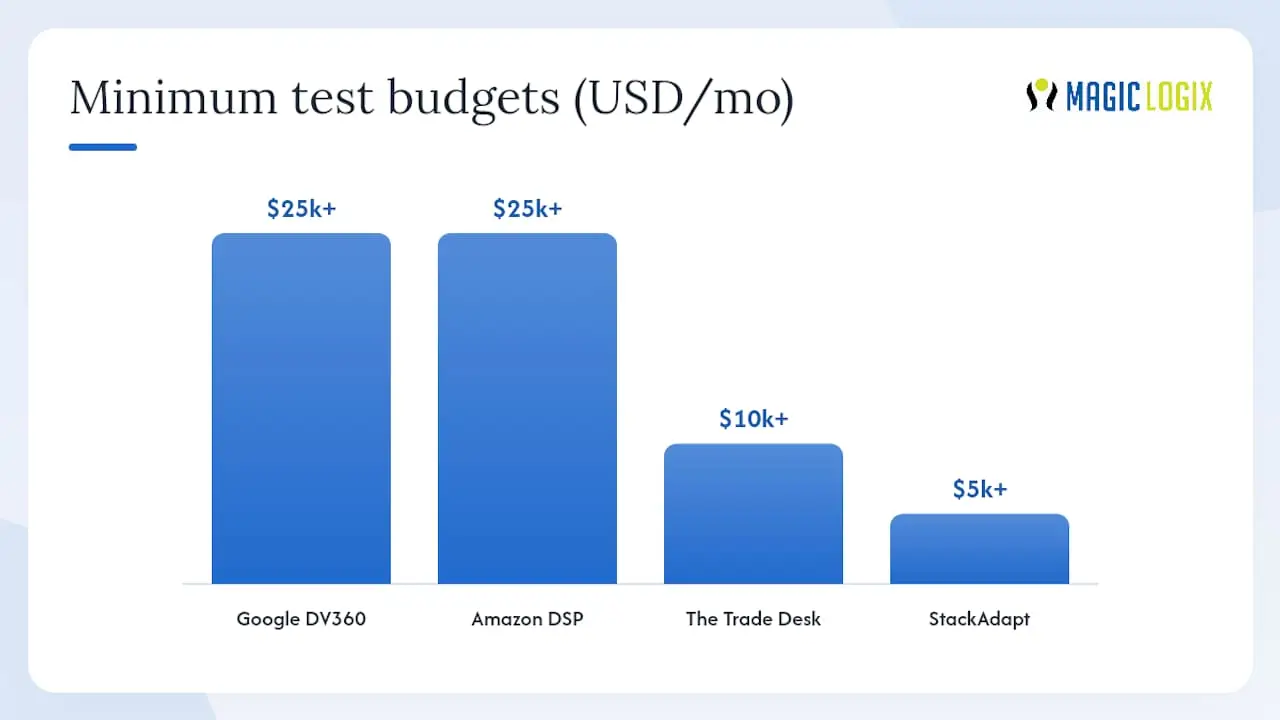
Two immediate disqualifiers worth flagging: DV360 and Amazon DSP both carry high minimum spend thresholds that put them out of reach for most small teams running test budgets under $25,000 per month. If your budget sits below that band, StackAdapt, Simpli.fi, or AdLib are more practical starting points.
| Platform | Best for | Channels | Inventory | Self-serve / Managed | Pricing shape |
|---|---|---|---|---|---|
| Google DV360 | Google ecosystem, YouTube scale | Display, video, CTV, audio, native | Walled garden + open exchange | Both | % of media; high minimums |
| The Trade Desk | Open-web, CTV, B2B, transparency | Display, video, CTV, audio, native, mobile | Open exchange + curated PMPs | Self-serve | % of media; ~$10K+ test |
| Amazon DSP | Retail, e-commerce, shopper data | Display, video, OTT/CTV, audio | Amazon-owned + open exchange | Both | % of media; managed minimums |
| Adobe Advertising Cloud | Enterprise cross-channel attribution | Display, video, search, social, CTV | Open exchange + walled gardens | Both | Platform fee + % of media |
| StackAdapt | Mid-market, native, CTV | Display, video, native, CTV, audio | Open exchange + PMPs | Self-serve | CPM-based; ~$5K+ test |
| Simpli.fi | Local, addressable TV, geo | Display, video, CTV, mobile | Open exchange + addressable | Both | CPM-based; flexible |
| Roku OneView | CTV-first, streaming audiences | CTV, OTT, display | Roku-owned + open exchange | Both | CPM-based; Roku inventory |
| Criteo | Commerce retargeting, retail media | Display, video, native, retail media | Retail media + open exchange | Self-serve | CPC/CPM; performance-based |
| MediaMath | Enterprise, custom bidding | Display, video, native, mobile, CTV | Open exchange + PMPs | Both | Platform fee + % of media |
| Quantcast | AI audience modeling, cookieless | Display, video, native | Open exchange | Self-serve | CPM-based |
| AdLib | Creative-first, fast setup | Display, video, CTV | Open exchange | Self-serve | CPM-based; low minimums |
Key Takeaways
The most effective programmatic platform strategy pairs the right DSP for your budget tier with a measurement architecture that connects impression data to pipeline outcomes from day one.
| Point | Details |
|---|---|
| Match platform to budget tier | Self-serve DSPs work for $5K–$25K/month; enterprise platforms require $100K+ annually. |
| Prioritize log-level exports | Platforms that provide log-level data exports enable attribution beyond dashboard reporting. |
| B2B needs a multi-layer stack | No single DSP solves B2B attribution; combine DSP reach with an ABM intelligence layer. |
| Negotiate pilot terms first | Request a 60–90 day pilot before any annual commitment; most vendors will accommodate this. |
| Magiclogix for managed execution | Magiclogix provides managed programmatic services with faster onboarding and cleaner attribution. |
Table of Contents
- What are the best programmatic platforms to consider in 2026?
- How we evaluated these programmatic platforms
- How to choose the right programmatic platform for your team
- What does programmatic advertising actually cost?
- What technical features should you validate before choosing a DSP?
- Which platform is right for your budget and use case?
- When does hiring an agency make more sense than running programmatic in-house?
- What contract terms should you expect from programmatic platforms?
- What does onboarding and customer support actually look like?
- How do these platforms handle privacy compliance?
- How transparent are these platforms about reporting and brand safety?
- Performance benchmarks and case studies across industries
- An honest practitioner view on platform choice
- Managed programmatic services that skip the learning curve
- Sources
- FAQ
What are the best programmatic platforms to consider in 2026?
Industry roundups and practitioner guides consistently name DV360, The Trade Desk, and Criteo among the most widely adopted DSPs, with independent platforms dominating open-web programmatic and walled gardens providing unique, exclusive inventory. Here is what each platform actually delivers for buyers.
Google Display & Video 360 (DV360)
DV360 is Google’s enterprise DSP, giving buyers access to YouTube, Google Display Network, and a broad open exchange through a single interface. It supports display, video, CTV, audio, and native channels, and its integration with Google Analytics 4, Campaign Manager 360, and BigQuery makes it the natural choice for teams already running inside Google’s stack.
The platform’s identity infrastructure leans heavily on Google’s own logged-in user data, which is a genuine advantage for reach but also a walled-garden constraint. You get scale; you give up some transparency on inventory sourcing.
Pricing shape: Percentage of media spend; enterprise minimums apply (commonly reported at $100K+ annually for managed service). Self-serve access is available through certified partners.
Pros:
- Unmatched YouTube and Google inventory access
- Deep integration with GA4, BigQuery, and Campaign Manager 360
- Strong brand safety controls via Google’s verification layer
Cons:
- Walled-garden inventory limits open-web flexibility
- High cost of entry for smaller teams
The Trade Desk
The Trade Desk is the leading independent DSP for open-web programmatic media buying. It covers display, video, CTV, audio, native, and mobile app inventory across open exchanges and curated private marketplace deals. Its identity solution, UID2 (Unified ID 2.0), is one of the most widely adopted cookieless identity frameworks in the industry, giving buyers a credible path through the post-cookie transition.
Transparency is a genuine differentiator here. The Trade Desk provides log-level data exports, granular reporting, and clear fee disclosure, which is why it consistently appears at the top of programmatic platform comparisons focused on advanced targeting, RTB, and channel breadth.
Pricing shape: Percentage of media spend; self-serve test campaigns commonly start around $10,000 or more.
Pros:
- Best-in-class open-web CTV and audio reach
- UID2 identity framework for cookieless targeting
- Log-level data export and transparent fee structure
Cons:
- Steeper learning curve for teams new to DSPs
- No proprietary walled-garden inventory
Amazon DSP
Amazon DSP gives buyers access to Amazon’s first-party shopper data, which is arguably the richest purchase-intent signal available in programmatic advertising. It supports display, video, OTT/CTV, and audio, and reaches audiences across Amazon-owned properties (Amazon.com, IMDb, Twitch, Fire TV) as well as third-party exchanges.
The platform is strongest for retail and e-commerce brands. If your product is sold on Amazon or your audience shops there frequently, the targeting precision is hard to match. Outside of retail, the value proposition weakens considerably.
Pricing shape: Managed service requires significant minimum spend (commonly reported at $35,000+ per month for managed campaigns); self-serve access is available for some advertisers.
Pros:
- Unmatched purchase-intent data from Amazon’s retail ecosystem
- Strong OTT/CTV reach via Fire TV and IMDb TV
- Closed-loop attribution for Amazon sales
Cons:
- Managed service minimums are high for most mid-market teams
- Attribution is strongest for Amazon-sold products; off-Amazon measurement is weaker
Adobe Advertising Cloud
Adobe Advertising Cloud (now part of Adobe Experience Cloud) is built for enterprise marketing teams that need cross-channel attribution across search, social, display, video, and CTV from a single platform. Its deepest strength is integration: it connects natively with Adobe Analytics, Adobe Audience Manager, and Adobe Experience Platform, making it the natural fit for organizations already running Adobe’s stack.
The platform supports both open exchange and walled-garden inventory, and its cross-device identity resolution draws on Adobe’s deterministic and probabilistic matching. For teams outside the Adobe ecosystem, the integration advantages largely disappear, and the cost structure becomes harder to justify.
Pricing shape: Platform fee plus percentage of media; enterprise-level pricing, not publicly listed.
Pros:
- Native integration with Adobe Analytics and Experience Platform
- Cross-channel attribution across search, social, and display
- Strong data management and audience segmentation
Cons:
- High cost and complexity for non-Adobe shops
- Onboarding requires significant technical resources
StackAdapt
StackAdapt is the mid-market DSP that consistently earns high marks for usability and channel breadth. It supports display, video, native, CTV, audio, and in-app inventory, and its self-serve interface is genuinely accessible for teams without dedicated ad ops staff. Native advertising is a particular strength: StackAdapt’s native inventory quality and targeting depth are among the best available outside enterprise platforms.
G2 reviews frequently cite StackAdapt’s onboarding support and customer success responsiveness as standout qualities, which matters for teams making their first DSP investment.
Pricing shape: CPM-based; test campaigns commonly start around $5,000 or more per month.
Pros:
- Strong native and CTV inventory with accessible self-serve UI
- Responsive customer support and onboarding
- Competitive pricing for mid-market budgets
Cons:
- Smaller data marketplace than enterprise DSPs
- Less suited for very large enterprise campaigns requiring custom bidding logic
Simpli.fi
Simpli.fi specializes in local, addressable, and geo-targeted programmatic campaigns. It supports display, video, CTV, and mobile, with particular depth in addressable TV and political/local advertising. If your campaigns need to reach specific households, zip codes, or congressional districts, Simpli.fi’s targeting granularity is hard to beat.
The platform serves both self-serve and managed service buyers, and its pricing is more flexible than most enterprise DSPs, making it accessible for regional advertisers and agency teams managing local clients.
Pricing shape: CPM-based; flexible minimums depending on campaign type.
Pros:
- Best-in-class local and addressable TV targeting
- Flexible pricing for regional and local campaigns
- Strong CTV and mobile inventory for geo-targeted buys
Cons:
- Less suited for national open-web campaigns at scale
- Data marketplace depth is narrower than larger DSPs
Roku OneView
Roku OneView is Roku’s own DSP, giving buyers direct access to Roku’s streaming inventory, which reaches a large share of U.S. streaming households. It supports CTV, OTT, and display, and its identity layer uses Roku’s logged-in user data for deterministic household targeting.
For CTV-first campaigns, Roku OneView offers something most DSPs cannot: direct, non-intermediated access to Roku’s owned-and-operated inventory. CPMs and unique reach differ materially between Roku, Fire TV, and YouTube/Google inventory, so asking for publisher lists and household reach proof during demos is worth the effort.
Pricing shape: CPM-based; Roku-owned inventory access is a key differentiator.
Pros:
- Direct access to Roku’s owned streaming inventory
- Deterministic household targeting via Roku login data
- Strong measurement for CTV campaign effectiveness
Cons:
- Inventory is heavily Roku-centric; limited open-web reach
- Less suited for multi-channel campaigns beyond CTV
Criteo
Criteo built its reputation on commerce retargeting and has since expanded into retail media networks, connecting advertisers to inventory across major retailer properties. It supports display, video, native, and retail media channels, and its performance-based pricing model (CPC or CPM) makes it accessible for teams focused on lower-funnel conversion.
The platform’s Commerce Audience and Commerce Grid products give buyers access to shopper data from Criteo’s retail media network, which is a meaningful differentiator for brands selling through retail partners.
Pricing shape: CPC or CPM; performance-based; self-serve access available.
Pros:
- Strong commerce retargeting and retail media network access
- Performance-based pricing reduces risk for conversion-focused campaigns
- Self-serve with accessible minimums
Cons:
- Less suited for brand awareness or upper-funnel campaigns
- Open-web reach is narrower than pure-play DSPs
MediaMath
MediaMath is an enterprise DSP with deep data integration capabilities and support for custom bidding algorithms. It covers display, video, native, mobile, and CTV, and its open API architecture makes it a strong fit for enterprise teams that want to bring their own data science and bidding logic to the platform.
The platform’s identity and data marketplace give buyers access to a wide range of third-party data segments, and its log-level reporting supports advanced in-house measurement workflows.
Pricing shape: Platform fee plus percentage of media; enterprise pricing, not publicly listed.
Pros:
- Deep API access for custom bidding and data integration
- Strong log-level reporting for advanced measurement
- Broad channel coverage including CTV and mobile
Cons:
- High complexity; requires dedicated ad ops or technical resources
- Enterprise pricing puts it out of reach for smaller teams
Quantcast
Quantcast’s core differentiator is its AI-driven audience modeling, built on its own real-time data from publisher integrations. It supports display, video, and native on the open web, and its cookieless targeting approach uses its own Quantcast Measure data rather than relying on third-party cookie pools.
For teams prioritizing privacy-forward targeting and open-web reach, Quantcast offers a credible alternative to platforms that still lean on third-party cookies.
Pricing shape: CPM-based; self-serve access available.
Pros:
- AI-driven audience modeling with cookieless targeting
- Privacy-forward approach using first-party publisher data
- Self-serve with accessible entry point
Cons:
- Narrower channel coverage (no audio or addressable TV)
- Smaller data footprint than enterprise DSPs
AdLib
AdLib positions itself as the creative-first DSP, designed for teams that want fast campaign setup without the complexity of enterprise platforms. It supports display, video, and CTV on the open exchange, and its interface is built to reduce the friction between creative production and media activation.
For teams that struggle with the gap between creative and media buying, AdLib’s workflow is genuinely different from most DSPs.
Pricing shape: CPM-based; low minimums make it accessible for test campaigns.
Pros:
- Fast, simplified campaign setup for creative-led teams
- Low minimum spend for test campaigns
- CTV access on the open exchange
Cons:
- Narrower data and inventory depth than enterprise DSPs
- Less suited for complex, multi-channel enterprise campaigns
Pro Tip: When evaluating any DSP, ask the vendor for a sample log-level export and a measurement API response during the demo. Platforms that can deliver these quickly are the ones that will actually support advanced in-house measurement workflows. Those that deflect or offer only dashboard screenshots are telling you something important about their transparency.
How we evaluated these programmatic platforms
The shortlist above reflects a structured evaluation across eight criteria, applied consistently to each platform. Evaluation frameworks used by practitioners consistently center on budget tiers, inventory access, channel mix, self-serve vs. managed service, and measurement complexity, and this review follows that structure.
Core evaluation criteria:
- Inventory access: Walled garden vs. open exchange vs. curated PMPs; publisher list transparency
- Identity and data: First-party data onboarding, UID2 or equivalent cookieless support, third-party data marketplace depth
- Reporting granularity: Log-level export availability, attribution model flexibility, API access
- Pricing shape and minimums: Platform fee structure, minimum spend thresholds, data costs
- Channel breadth: CTV, display, video, native, audio, mobile app coverage
- Integration and APIs: CRM, CDP, analytics, and data warehouse connectors
- Transparency and brand safety: Fee disclosure, fraud detection, brand safety controls
- Support and onboarding: Onboarding timeline, documentation quality, customer success availability
Test methods used:
- Feature walkthroughs and demo scorecards across each platform
- Third-party review signals from G2 and industry reports
- Sample measurement checks (log-level export requests, attribution model demos)
- Pricing signal cross-referencing across multiple industry write-ups
Platform features, minimums, and integrations change frequently. This evaluation reflects conditions as of early 2026; verify current pricing and feature availability directly with each vendor before committing.
Critical vendor questions to ask in an RFP or demo:
- Can you provide a sample log-level data export from a live campaign?
- What is your minimum spend for self-serve access, and what does managed service require?
- Which identity frameworks do you support (UID2, RampID, deterministic first-party)?
- How do you handle GDPR and CCPA consent signals in your bidding pipeline?
- What fraud detection and brand safety controls are applied by default, and which require add-ons?
- What is your standard onboarding timeline, and what resources are included?
- Can you share a case study from a buyer in our vertical with comparable budget?
How to choose the right programmatic platform for your team
Match your platform class to your team’s capability and budget tier first. Everything else follows from that decision.
Budget tiers and platform fit:
- Under $25K/month: Self-serve mid-market DSPs (StackAdapt, Simpli.fi, AdLib, Quantcast) are the practical options. Industry pricing signals show that meaningful test campaigns on self-serve platforms commonly start around $5,000–$25,000 per month; enterprise platforms require $100,000 or more annually.
- $25K–$100K/month: The Trade Desk, Criteo, and Roku OneView become viable. This range supports proper A/B testing, audience segmentation, and CTV pilots.
- $100K+/month: DV360, Amazon DSP, Adobe Advertising Cloud, and MediaMath are designed for this tier. Managed service relationships and custom integrations become cost-effective at this scale.
Decision flow for platform selection:
- Define your primary campaign goal (awareness, consideration, conversion, retargeting).
- Map required channels (CTV, display, native, audio, retail media).
- Estimate your monthly media budget and identify which platforms’ minimums you can meet.
- Validate identity and data needs: do you have first-party data to activate? Do you need cookieless targeting?
- Test reporting: request a sample report or log-level export before signing.
- Run a 60–90 day pilot before committing to a long-term contract.
Red flags to avoid:
- No log-level data export available (limits your ability to do independent measurement)
- Opaque fee structures (platform fee buried in managed service costs)
- No CTV access if CTV is a required channel
- Poor onboarding documentation or no dedicated customer success contact
- Minimum commitment of 12 months with no pilot option
For B2B buyers specifically, no single platform solves the full B2B attribution problem. The practical fix is combining a DSP for reach with an ABM or account-intelligence layer for pipeline attribution. Plan for a multi-platform stack from the start rather than expecting one DSP to do everything.
What does programmatic advertising actually cost?
Pricing for programmatic platforms typically combines five components: platform fees (percentage of media or flat monthly fee), minimum spend thresholds, third-party data costs, verification and fraud prevention fees, and implementation or onboarding costs. Understanding all five before you sign is the difference between a budget that works and one that surprises you mid-campaign.
Common pricing models:
- Percentage of media spend: The most common model; platform takes 10%–20% of total media spend as a fee.
- Flat platform fee: Some enterprise DSPs charge a monthly or annual platform fee on top of media spend.
- CPM-based: Mid-market self-serve DSPs often price on a CPM basis with no separate platform fee.
- Performance-based (CPC): Criteo and some retargeting-focused platforms offer CPC pricing for conversion campaigns.
Hidden cost checklist:
- Data onboarding fees (activating your CRM or CDP data on the platform)
- Third-party audience licensing (purchasing data segments from the platform’s marketplace)
- Impression verification fees (IAS, DoubleVerify, or MOAT integration costs)
- Ad serving fees (separate from media cost on some platforms)
- Creative production or dynamic creative optimization (DCO) fees
- Managed service markup (if you use the platform’s managed service team)
Illustrative budget examples:
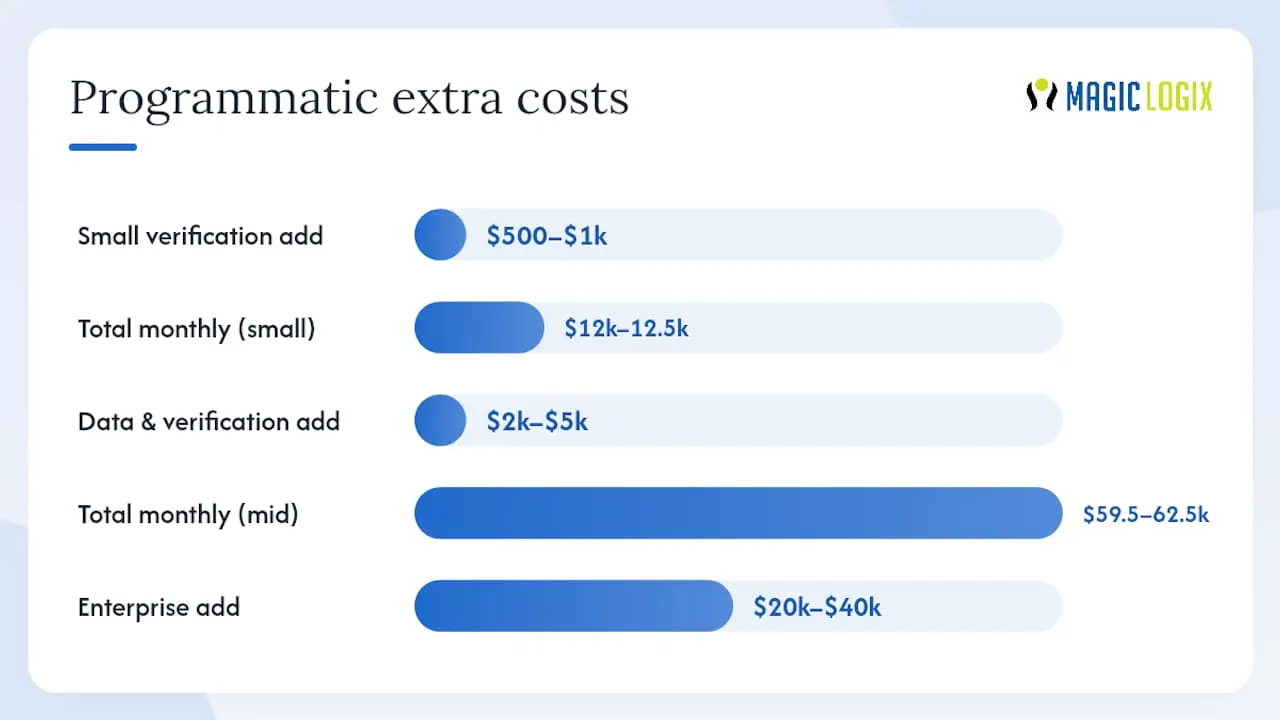
Add $500–$1,000 for verification and data costs. Total monthly outlay: approximately $12,000–$12,500.
Data licensing and verification add $2,000–$5,000. Total: approximately $59,500–$62,500 per month.
Enterprise ($250K/month media): Platform fees may shift to a flat monthly rate or negotiated percentage. Data, verification, and managed service costs can add $20,000–$40,000 per month on top of media. Total cost of ownership at this scale requires a detailed vendor negotiation.
The DSP market is projected to grow strongly through 2030, with open-web and CTV demand driving adoption. That growth is also driving pricing pressure, so negotiating annual contracts and bundled data access is increasingly viable for mid-market buyers.
What technical features should you validate before choosing a DSP?
Prioritize platforms that give you log-level data exports, support your CDP or CRM, and provide flexible attribution and reporting APIs. Everything else is secondary to those three capabilities, because without them you cannot do independent measurement or connect programmatic spend to pipeline outcomes.
Martech compatibility checklist:
- CRM connector (Salesforce, HubSpot, or custom API)
- CDP integration (Segment, Tealium, Adobe Real-Time CDP)
- Analytics platform connection (GA4, Adobe Analytics, Mixpanel)
- Data warehouse export (BigQuery, Snowflake, Redshift)
- API access for custom reporting and bidding logic
Identity and privacy considerations:
Identity resolution is one of the most consequential technical decisions in platform selection. The three main approaches each carry trade-offs:
- UID2 (Unified ID 2.0): The Trade Desk’s open-source framework, widely adopted across publishers and DSPs. Requires user email consent; strong for cookieless targeting on the open web.
- Deterministic first-party matching: Uses your own CRM or CDP data matched to platform IDs. Highest accuracy; requires a clean first-party data asset.
- Probabilistic resolution: Infers identity from device signals and behavioral patterns. Broader reach; lower accuracy; privacy risk varies by jurisdiction.
For GDPR and CCPA compliance, confirm that the platform processes consent signals in its bidding pipeline by default, not as an optional add-on. Ask specifically how the platform handles consent withdrawal and data deletion requests. Combining DSP reach with ABM intelligence layers closes the attribution gap that most standalone DSPs leave open, particularly for B2B buyers who need account-level reporting.
Measurement checklist:
- Offline conversion import (CRM deal data, in-store visits)
- Viewability and fraud reporting (IAS or DoubleVerify integration)
- Log-level export frequency (daily, hourly, or real-time)
- Attribution model support (last-touch, data-driven, custom)
- Cross-device and cross-channel path reporting
Understanding customer journey analytics is increasingly important here. Programmatic touchpoints rarely convert in isolation, and platforms that support multi-touch path reporting give you a much clearer picture of where media spend is actually driving pipeline.
Which platform is right for your budget and use case?
The right DSP depends on three things: your primary channel priority, your budget tier, and whether you need open-web reach or proprietary inventory. Here is a direct mapping.
| Use case | Recommended platform type | Action recommendation |
|---|---|---|
| Enterprise open-web and CTV | The Trade Desk or DV360 | Run a 90-day pilot with log-level reporting enabled |
| Mid-market native and display | StackAdapt | Start with a $5K–$10K test; evaluate native vs. display CPMs |
| Retail and e-commerce | Amazon DSP or Criteo | Test Amazon DSP for upper-funnel; Criteo for retargeting |
| CTV-first streaming | Roku OneView | Request household reach data and publisher list before committing |
| Local and addressable TV | Simpli.fi | Map geo targets first; test addressable TV vs. standard CTV |
| Privacy-forward open web | Quantcast | Validate cookieless audience match rates against your ICP |
| B2B account-based | The Trade Desk + ABM layer | Combine DSP reach with 6sense or Demandbase for account intelligence |
| Creative-first, fast launch | AdLib | Use for rapid creative testing; plan to migrate to a larger DSP at scale |
Quick implementation notes:
- For enterprise open-web campaigns, enable log-level exports from day one. Waiting until month three to set up measurement is the most common and most costly mistake.
- For retail and e-commerce, closed-loop attribution between your DSP and your product catalog is worth the setup time. It is the clearest signal of what is actually driving sales.
- For B2B buyers, platform comparisons consistently recommend mapping platform choice to your ICP, data strategy, and budget before selecting a DSP. Built-in DSPs with ABM capabilities offer different trade-offs than open-web DSPs, and the right answer depends on where your accounts actually spend time online.
When does hiring an agency make more sense than running programmatic in-house?
Hire an agency when you lack dedicated ad ops expertise, need fast CTV scale, or require white-glove identity integrations that your internal team does not have the bandwidth to manage. The honest answer is that most mid-market teams underestimate the operational overhead of running a DSP well, and the cost of that underestimation shows up in wasted spend during the first 60–90 days.
Agency evaluation checklist:
- Onboarding timeline: what is the expected time from contract to first live campaign?
- Case study evidence: can they share results from a buyer in your vertical with comparable budget?
- Data handling practices: how do they manage your first-party data, and who owns the audience segments at contract end?
- Escalation model: who is your day-to-day contact, and what is the escalation path if performance drops?
- Reporting access: do you get direct platform access and log-level data, or only agency-produced reports?
- Fee transparency: is the agency fee separate from media spend, or is it bundled in a way that obscures the true platform cost?
The hybrid model is worth considering for teams that want to build in-house capability over time. In this structure, your internal team owns strategy, audience definitions, and measurement frameworks, while an agency handles day-to-day campaign execution and platform management. This approach lets you learn the platform without paying the full cost of a learning curve in wasted media.
Pro Tip: During your pilot phase, request a weekly performance review that includes impression-level data, not just dashboard summaries. Any agency or platform that resists this request is signaling that their results may not hold up to scrutiny at the log level.
For teams that want a managed path with clear measurement accountability, integrated marketing campaign frameworks that connect programmatic to the broader channel mix tend to produce more defensible ROI than standalone DSP campaigns.
What contract terms should you expect from programmatic platforms?
Contract flexibility varies widely across the DSP market, and the terms you accept at signing have a direct impact on your ability to course-correct if performance disappoints.
Enterprise platforms like DV360, Adobe Advertising Cloud, and MediaMath typically require annual commitments with minimum spend guarantees. Managed service agreements often lock in both a platform fee and a media minimum, which means you are on the hook for spend even if campaign performance warrants a pause. Negotiating a 90-day pilot clause before a full annual commitment is standard practice and most enterprise vendors will accommodate it.
Mid-market self-serve DSPs like StackAdapt, Quantcast, and AdLib generally offer more flexibility. Month-to-month arrangements or short-term pilots are common, and minimum spend thresholds are lower. The trade-off is that you typically get less dedicated support and fewer custom integrations at the lower commitment level.
Scalability is a practical concern as well. Confirm that your contract allows spend increases without renegotiation, and that your data and audience segments are portable if you decide to switch platforms. Some managed service agreements treat audience segments built on the platform as platform property, which creates a switching cost that is easy to overlook at signing.
Key contract terms to negotiate: data portability at contract end, 30-day termination notice for month-to-month arrangements, pilot periods before annual commitments, and clear definitions of what counts toward minimum spend (media only, or media plus fees).
What does onboarding and customer support actually look like?
Support quality is one of the sharpest differentiators between DSPs at similar price points, and it is almost never visible in vendor marketing materials. The only reliable way to assess it is through G2 reviews, peer references, and direct questions during the sales process.
Enterprise platforms like DV360 and Adobe Advertising Cloud typically assign a dedicated customer success manager and a technical implementation team. Onboarding timelines for enterprise deployments commonly run four to eight weeks, depending on the complexity of data integrations and creative requirements. That timeline is worth building into your campaign planning.
StackAdapt consistently earns strong marks on G2 for onboarding responsiveness and customer success quality, which is a meaningful signal for mid-market teams making their first DSP investment. Simpli.fi and AdLib also receive positive feedback for accessibility and support speed, particularly for regional and local advertisers.
Self-serve platforms vary more. Quantcast and Criteo offer documentation and online resources, but dedicated support is typically reserved for higher-spend accounts. If your team is new to programmatic, factor in the cost of ramp-up time when comparing self-serve options.
Questions to ask during the sales process: What is the average onboarding timeline for a team at our spend level? Who is our day-to-day contact after launch? What training resources are included? What is the escalation path if campaign performance drops in the first 30 days?
How do these platforms handle privacy compliance?
GDPR and CCPA compliance is not optional, and the way a platform handles consent signals in its bidding pipeline is a direct indicator of its privacy maturity. Ask for specifics, not assurances.
The Trade Desk’s UID2 framework is built around email-based consent, and the platform processes consent signals at the bid request level. DV360 and Google’s broader infrastructure comply with GDPR through Google’s Consent Mode, which adjusts measurement and bidding behavior based on user consent status. Adobe Advertising Cloud integrates with Adobe’s consent management tools and supports IAB TCF 2.0 signals natively.
Mid-market platforms like StackAdapt and Quantcast also support IAB TCF 2.0 and CCPA opt-out signals, though the depth of implementation varies. Quantcast’s cookieless approach reduces reliance on consent-dependent identifiers, which is a practical advantage in markets with high consent refusal rates.
For any platform you evaluate, confirm these specifics: Does the platform process IAB TCF 2.0 consent signals in the bidding pipeline by default? How does it handle consent withdrawal and data deletion requests? What is the data retention policy for impression-level data? Who owns audience segments built on the platform, and what happens to them at contract end?
Marketing automation platform comparisons increasingly include privacy compliance as a core evaluation criterion, and the same logic applies to DSP selection. A platform that handles consent poorly creates legal exposure that no campaign performance can offset.
How transparent are these platforms about reporting and brand safety?
Transparency in programmatic advertising covers three distinct areas: fee disclosure, reporting granularity, and brand safety controls. Most platforms perform well on one or two of these and poorly on the third.
The Trade Desk leads on fee transparency and reporting granularity. Its log-level data exports give buyers access to impression-level data that can be joined to first-party CRM records in a data warehouse, enabling attribution models that go well beyond what any dashboard can show. Fee disclosure is clear and separate from media spend.
DV360 offers strong brand safety controls through Google’s verification layer, including integration with DoubleVerify and IAS, but its walled-garden structure limits the transparency of inventory sourcing. You know your ads ran on YouTube; you have less visibility into the long tail of the Google Display Network.
Criteo and Amazon DSP both operate within relatively closed ecosystems, which limits independent verification of impression quality. Both platforms offer fraud detection and brand safety controls, but buyers should request third-party verification integration (IAS or DoubleVerify) as a condition of any managed service agreement.
For fraud detection specifically, ask whether the platform applies pre-bid filtering (blocking fraudulent inventory before the impression is purchased) or post-bid filtering (crediting back fraudulent impressions after the fact). Pre-bid filtering is meaningfully better for budget efficiency.
Performance benchmarks and case studies across industries
Concrete performance benchmarks in programmatic advertising are notoriously difficult to generalize because CPMs, CTRs, and conversion rates vary by vertical, audience, creative format, and channel. That said, a few patterns hold consistently across industry reporting.
CTV campaigns typically carry higher CPMs than display or native, often in the $15–$40 range for premium streaming inventory, but deliver stronger brand recall and completion rates than pre-roll video on the open web. Roku OneView and Amazon DSP’s OTT inventory tend to command premium CPMs relative to open-exchange CTV.
Native advertising on platforms like StackAdapt consistently outperforms standard display on engagement metrics, with click-through rates that run two to three times higher than banner display in comparable placements. For mid-market teams running content-driven campaigns, native is frequently the highest-efficiency format.
Retargeting campaigns on Criteo’s commerce network show strong lower-funnel performance for retail and e-commerce brands, with conversion rates that reflect the high purchase intent of audiences already familiar with the brand. The trade-off is that retargeting alone does not build new audience reach.
For B2B buyers, the attribution challenge is real. DSPs provide reach but typically lack account-level reporting; ABM platforms provide account intelligence but limited media surfaces. The teams that report the strongest B2B programmatic results are those that join DSP impression data with CRM pipeline data in a data warehouse, rather than relying on either platform’s native attribution alone. Predictive analytics tools that score accounts by engagement signals can sharpen this further.
An honest practitioner view on platform choice
Platform choice shapes campaign outcomes more than most buyers expect, but not always for the reasons vendors emphasize.
The most common mistake is selecting a platform based on its feature list rather than its fit with your team’s actual operational capacity. A DSP with 200 targeting parameters is only valuable if someone on your team has the time and expertise to use them. For most mid-market teams, a platform with 20 well-implemented parameters and strong customer support will outperform a technically superior platform that sits underutilized.
The second pattern worth naming: the attribution gap in B2B programmatic is real, and most teams discover it after they have already committed to a platform. The fix is not a better DSP. It is a data architecture decision: joining impression logs to CRM data in a warehouse like BigQuery or Snowflake. Any team evaluating DSPs for B2B should build that data pipeline into their evaluation criteria from the start, not as an afterthought.
One practical tip that rarely appears in vendor literature: during your demo, ask the platform’s sales team to walk you through a real campaign’s log-level export, not a sample or a mock. The quality of that export, and the ease with which the sales team can produce it, tells you more about the platform’s measurement maturity than any feature comparison sheet.
Managed programmatic services that skip the learning curve
Running a DSP well takes time your team may not have. For marketing teams that want faster results without the ramp-up cost of self-serve platform management, a managed programmatic partner can reduce test time and lower wasted spend from the start.
Magiclogix offers managed paid media services that cover programmatic strategy, platform selection, campaign execution, and measurement, all connected to your broader digital marketing growth goals. Rather than handing you a platform login and a knowledge base, Magiclogix builds the campaign architecture, activates your first-party data, and delivers reporting that connects media spend to pipeline outcomes. Teams that work with Magiclogix typically see faster onboarding, cleaner attribution, and a lower cost per acquisition than they achieve managing platforms independently in their first 90 days. To get started, contact Magiclogix for a paid media consultation and a campaign readiness assessment tailored to your budget and channel priorities.
Sources
- Top 8 Programmatic Platforms 2026 | DSP Comparison
- The Ultimate 2026 Guide to B2B Programmatic Advertising: The Full Stack, The Real Gaps, and How to Win Multi-Channel
- 8 Best B2B Programmatic Advertising Platforms in 2026
- Adpushup
- Programmatic advertising platforms (Tenbound / CIENCE list)
FAQ
What are the most popular DSPs in 2026?
DV360, The Trade Desk, and Criteo are among the most widely adopted DSPs, with The Trade Desk leading independent open-web programmatic and DV360 dominating within Google’s ecosystem.
Who is the largest DSP?
Google’s Display & Video 360 (DV360) is the largest DSP by inventory access and advertiser adoption, given its integration with YouTube and the Google Display Network. The Trade Desk is the largest independent DSP outside of a walled garden.
What are the four types of programmatic advertising?
The four main types are real-time bidding (RTB) on open exchanges, private marketplace deals (PMPs), programmatic direct (guaranteed inventory at fixed CPMs), and preferred deals (non-guaranteed fixed-price inventory). Each type offers different trade-offs between price efficiency, inventory quality, and control.
What are the best programmatic platforms for mid-market teams?
StackAdapt, Simpli.fi, and Quantcast are the strongest options for mid-market teams, offering self-serve access, accessible minimum spends, and strong support without the complexity of enterprise platforms. Industry comparisons recommend mapping platform choice to your ICP and budget before committing.
Can Magiclogix manage programmatic campaigns for my team?
Yes. Magiclogix provides managed paid media services that cover programmatic strategy, platform selection, and campaign execution, with measurement frameworks that connect media spend to pipeline outcomes. Contact Magiclogix for a consultation at Magiclogix.