
Ad fatigue happens when your audience sees the same creative so many times that engagement drops and costs rise. The single most important thing you can do right now is pull your top-spend creatives and check whether CTR has fallen more than 10% week-over-week. If it has, rotate or pause that creative today.
Emergency 3-point check:
- CTR down more than 10% compared to last week
- Frequency above 2.5 per user in the past 7 days
- CPM rising more than 15% week-over-week with no budget change
If two of those three are true at the same time, you have early fatigue. Act before the algorithm concentrates more spend on a declining creative and your cost-per-acquisition climbs further.
Pro Tip: Set a weekly calendar reminder to run this three-point check every Monday morning. Catching fatigue on day 7 costs far less than catching it on day 21.
Table of Contents
- What ad fatigue actually means for your campaigns
- Why your audience tunes out: the psychology behind overexposure
- How to spot the signs of ad fatigue before costs spike
- How quickly does ad fatigue set in by channel?
- Your prevention and recovery playbook
- Testing and measuring your way back to performance
- Building a creative pipeline that stays ahead of fatigue
- When fatigue signals point to a bigger problem
- Key Takeaways
- The part most playbooks skip
- How Magiclogix helps you stay ahead of creative wear-out
- Useful sources
- FAQ
What ad fatigue actually means for your campaigns
Ad fatigue, sometimes called creative fatigue or advertising burnout, is the measurable decline in campaign performance that occurs when a specific audience sees the same creative too many times. The term is informal but widely used across paid media teams. The more precise industry term is creative wear-out, and it refers specifically to the point where additional exposures produce diminishing or negative returns.
The distinction between related terms matters for diagnosis. Ad fatigue is the umbrella condition. Creative fatigue is the per-asset version: one specific video or image losing effectiveness. Audience saturation is a different problem entirely, where you have genuinely run out of new people to reach, regardless of how fresh your creative is. Treating audience saturation as a creative problem wastes budget on new assets when you actually need to expand targeting.
A common real-world scenario: a Facebook video ad launches with strong initial CTR and CPA metrics. Over several weeks, as the algorithm serves it repeatedly to the same users, CTR slides and CPA climbs notably. Nothing changed in the offer, the landing page, or the market. The creative simply wore out.
| Term | What it describes | Primary fix |
|---|---|---|
| Ad fatigue | Broad performance decline from overexposure | Rotate creative, adjust frequency |
| Creative fatigue | Single asset losing effectiveness | Replace or refresh that asset |
| Audience saturation | Exhausted reach within a defined segment | Expand audience or targeting |
| Marketing ad weariness | General audience resistance to advertising | Diversify formats and channels |
Meta’s internal analysis found that at four repeated exposures to the same creative, the associated likelihood of a conversion drops by roughly 45%. That figure alone makes the case for proactive rotation.
Why your audience tunes out: the psychology behind overexposure
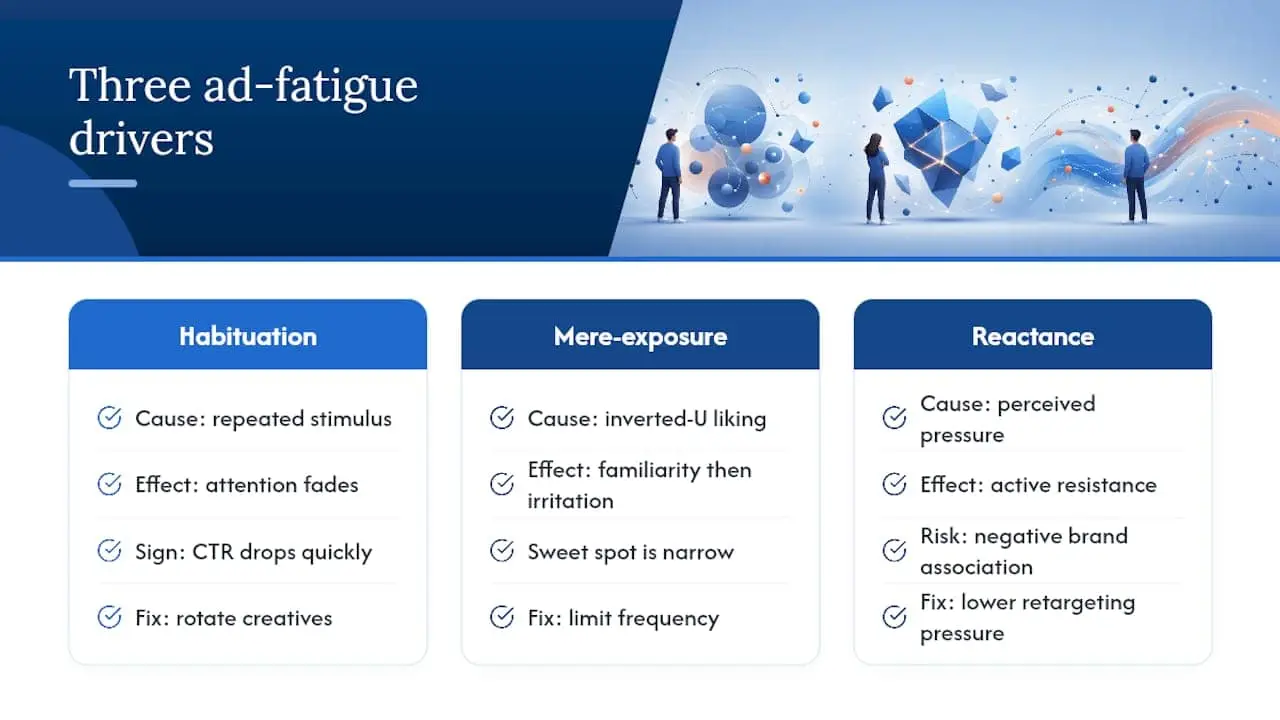
Three psychological mechanisms drive advertising burnout, and each one points to a different fix.
Habituation is the brain’s automatic response to repeated stimuli. When your audience sees the same ad multiple times, the brain stops allocating attention to it because it has already processed the information. Research on habituation and attention confirms that attention drops quickly with repeated exposures, a pattern that shows up clearly in click-through data.
The mere-exposure effect has an inverted-U relationship with liking. A little repetition builds familiarity and positive association. Too much flips that into irritation. The sweet spot is narrower than most advertisers assume, especially on high-frequency platforms like Meta and TikTok.
Psychological reactance is the active resistance that kicks in when people feel their autonomy is being pressured. A user who has seen your retargeting ad twelve times in a week is not just ignoring it; they may be developing a negative association with your brand. That is a harder problem to fix than a simple CTR drop.
Platform algorithms compound all three mechanisms. When a single creative wins the auction repeatedly, the system concentrates impressions on it. According to Wikipedia’s overview of ad fatigue, selective attention and habituation together explain why the same creative that drove strong early results can actively harm brand perception at high frequency. The result: fatigue often stems from scaling a single winner without building structural creative variation into the portfolio from the start.
Rapid fatigue on a new creative is not always a failure. If a well-produced ad fatigues in under two weeks at modest spend, that tells you the audience segment is small, the frequency is too high, or the message is not resonating beyond the first impression. Each scenario requires a different fix, and the speed of fatigue is the diagnostic clue.
Pro Tip: When a creative fatigues unusually fast, check the audience size first. A retargeting pool of fewer than 10,000 users will exhaust even a strong creative in days.
How to spot the signs of ad fatigue before costs spike
Early detection is where most teams leave money on the table. By the time ROAS collapses, the algorithm has already spent heavily on a declining creative. The goal is to catch fatigue at the signal stage, not the crisis stage.
Per-creative measurement against a 30-day baseline is the most reliable approach. Flag fatigue when two or more of the following metrics decline across two or more consecutive days within a 7-day window.
Leading signals (move first):
- Hook rate or 3-second video view rate falling
- Frequency crossing 2.5 per user in a 7-day window
- Unique reach declining while spend holds steady
Confirming signals (move next):
- CTR dropping more than 10% week-over-week
- CPM rising more than 15% week-over-week
- Spend share shifting away from the creative as the algorithm deprioritizes it
Lagging signals (move last, but confirm the problem):
- CPA rising 20% or more above the 30-day baseline
- ROAS falling below your target threshold
- Conversion rate declining on a stable landing page
The early-warning framework from Adrio recommends treating two or more concurrent signals as an early fatigue trigger, not waiting for all of them to move. That two-signal rule is the practical threshold for action.
Pro Tip: Never read a single metric in isolation. A CTR drop during a major news event or a competitor promotion is not fatigue. Confirm with at least one cost or exposure metric before pulling a creative.
Building a measurement framework for digital marketing that tracks these signals per creative, not just per campaign, is what separates teams that catch fatigue early from those that discover it in the monthly report.
How quickly does ad fatigue set in by channel?
The speed of wear-out varies significantly by channel, audience size, and spend rate. There is no universal timeline, but the patterns below hold across most accounts.
| Channel | Typical fatigue onset | Recommended refresh interval | Key driver |
|---|---|---|---|
| Paid social (Meta, TikTok, Instagram) | 1–3 weeks at moderate spend | Every 2–3 weeks for cold audiences | High frequency, small feeds |
| Display / programmatic | 3–6 weeks | Every 4–6 weeks | Lower attention, broader reach |
| CTV / connected TV | 6–10 weeks | Every 6 weeks | Higher recall, lower frequency |
| Paid search (display network) | 4 weeks | Every 4–6 weeks | Intent-driven, lower visual fatigue |
| Retargeting (all channels) | 5–10 days | Weekly rotation recommended | Small pool, high repetition |
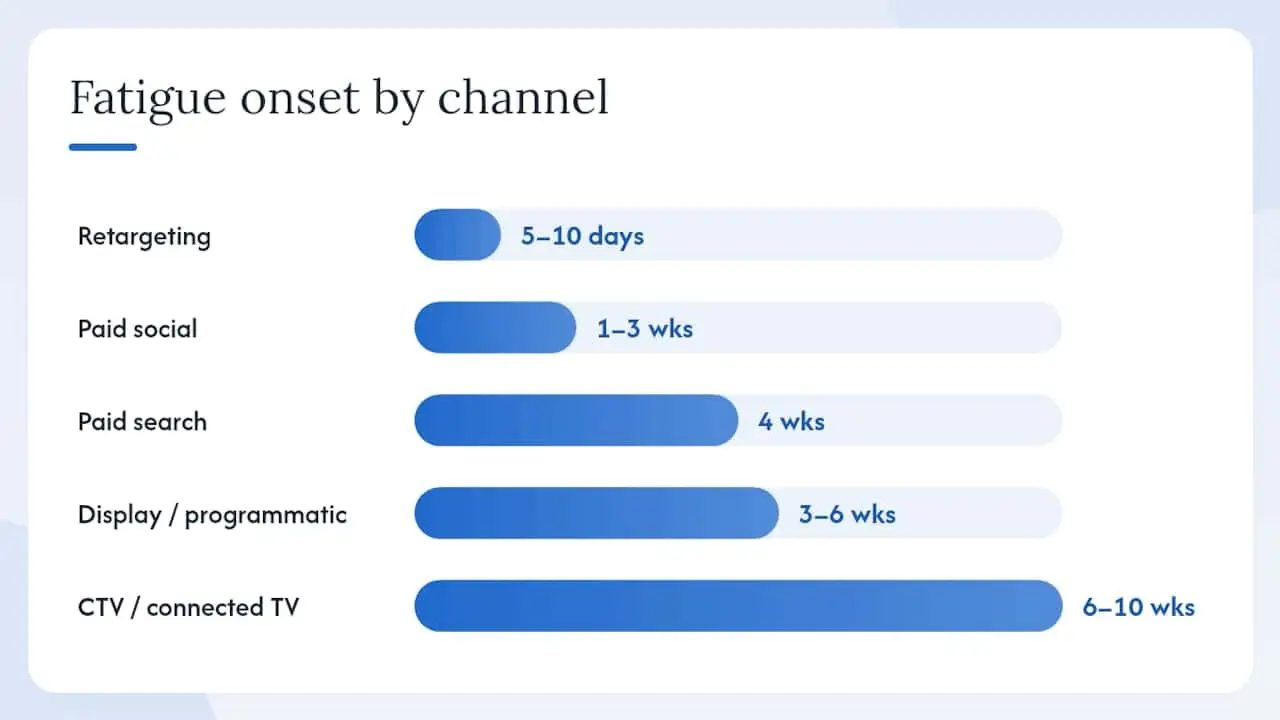
Retargeting audiences deserve special attention. A pool of 5,000 website visitors will see the same creative far more often than a cold audience of 500,000. Many teams apply the same rotation schedule to both, which is why retargeting campaigns often show the steepest CPA increases.
Meta’s platform data shows mean user/creative exposures around 4.2 over a 30-day window, with a significant share of impressions delivered to users who have seen the same creative five or more times. At that repetition level, the 45% conversion likelihood drop is not a theoretical risk; it is a predictable outcome.
CTV moves slower because users watch in a lean-back environment with higher attention and lower ad density. The tradeoff is that CTV fatigue, when it arrives, tends to carry stronger negative brand associations because the format is more immersive.
Your prevention and recovery playbook
Think of this as your operating manual, not a one-time fix. Reducing ad fatigue requires both immediate triage and a standing workflow.
Immediate triage (do this today):
- Pull all active creatives with spend above $500 in the past 7 days.
- Flag any creative where two or more early-warning signals are active.
- Pause flagged creatives or duplicate them under new ad IDs with a single meaningful change (new hook, new opening frame, new headline).
- Shift budget to creatives that are still within healthy frequency and CTR ranges.
Preventive tactics:
- Run at least 3–5 distinct creative concepts simultaneously per ad set, not just variations of one winner.
- Rotate hooks every two weeks for cold audiences; every week for retargeting.
- Use wave-based spending: scale a creative for two weeks, pull back for one week, then reassess before scaling again.
- Segment audiences by funnel stage and serve different creative to cold, warm, and retargeting pools.
Recovery tactics:
- Replace the hook and opening visual first. These are the highest-leverage elements for resetting novelty.
- Do not just resize or recolor an existing creative. Weber’s Law applies here: small changes fall below the threshold of noticeable difference and do not reset the brain’s habituation response. A new hook, a different visual composition, or a changed message register as genuinely new.
- Run a holdout experiment for one week after introducing the replacement creative to confirm lift before scaling.
Pro Tip: Experienced account teams often avoid strict frequency caps because they can restrict algorithmic learning. Managing creative supply through a healthy backlog is more effective than capping delivery.
See integrated marketing campaign examples for format and channel mix ideas that naturally reduce overexposure to ads by spreading impressions across multiple creative surfaces.
Testing and measuring your way back to performance
Proving that a creative rotation actually worked requires more than watching ROAS recover. Algorithmic variance, seasonality, and budget changes can all mimic a genuine lift. Structured testing removes that ambiguity.
- Incrementality and MMM integration: Short-term ROAS can hide fatigue because it credits conversions that would have happened anyway. Geo holdouts and incrementality testing reveal when a scaled creative is no longer driving new demand. Predictive analytics tools can integrate these fatigue signals into forward-looking models.
For brand campaigns, prioritize recall lift and brand search volume as recovery metrics rather than direct conversion rates. Direct response and brand objectives respond to fatigue differently, and measuring them the same way produces misleading conclusions.
Building a creative pipeline that stays ahead of fatigue
The best ad fatigue solution is never running out of fresh creative. That sounds obvious, but most teams only build new assets reactively, after fatigue has already hit.
Pipeline norms for high-performing accounts:
- Keep a 2-week backlog of ready-to-run creatives at all times. If you are scaling aggressively, extend that to three weeks.
- Produce 4–6 hook variants per core concept. The body of the ad can stay the same; the opening 3 seconds is what resets novelty for most users.
- Brief new creative before the current batch shows fatigue signals, not after.
Workflow stages:
- Brief: Define the core message, audience, and format. Set a KPI target and a fatigue threshold that will trigger replacement.
- Rapid prototype: Produce lightweight versions (static, short-form video, UGC-style) before investing in high-production assets.
- Live test: Run at modest spend for 7 days. Measure hook rate, CTR, and CPM against baseline.
- Scale or retire: Scale creatives that beat baseline by 15% or more. Retire anything that shows two or more fatigue signals within the first 7 days.
The teams that consistently outperform on paid social are not the ones with the biggest production budgets. They are the ones with the most disciplined creative pipelines: clear briefs, fast prototypes, and a standing rule that no single creative runs unopposed for more than two weeks.
Pro Tip: Balance templates and UGC carefully. Templates speed up production but can create a recognizable visual signature that fatigues faster because users learn to tune out your “look.” Mix template-based assets with raw, format-native content to extend creative lifespan.
For more on improving marketing efficiency through better pacing and operational discipline, the principles apply directly to creative pipeline management.
When fatigue signals point to a bigger problem
Not every performance decline is a creative problem. Swapping creative repeatedly without improvement is expensive and demoralizing. Before your fourth creative rotation in a month, run through this decision tree.
Check these signals for structural issues:
- Reach plateau: If your unique reach has stopped growing despite increased spend, you have audience saturation, not creative fatigue. New creative will not fix a depleted pool.
- First-time impression ratio falling: When a growing share of your impressions go to users who have already seen your ads many times, the audience is too small for your spend level.
- Broad ROAS decline across multiple creatives: If three or more different creative concepts all show declining ROAS simultaneously, the problem is likely the offer, the landing page, or the audience match, not any individual ad.
- Consistent drop-off at a specific funnel stage: High CTR but low conversion rate points to a landing page or offer problem, not an ad problem.
When structural issues are likely, take these steps:
- Pause scaling and run an offer test: change the pricing, the guarantee, or the primary value proposition on the landing page.
- Audit the landing page for load speed, mobile experience, and message match with the ad.
- Test a new audience segment or lookalike based on your highest-value customers rather than broad interest targeting.
- Check whether the market itself has shifted: new competitors, seasonal demand changes, or economic conditions can all produce patterns that look like ad fatigue but require a different response.
Recognizing the difference between a creative problem and a structural one is one of the most valuable diagnostic skills in paid media. A guide to diagnosing failed marketing campaigns can help you work through the broader set of systemic issues that sometimes hide behind fatigue symptoms.
Key Takeaways
Catching ad fatigue early and responding with a disciplined creative pipeline is the single most reliable way to protect campaign ROI and prevent advertising burnout from compounding into a structural problem.
| Point | Details |
|---|---|
| Two-signal rule | Flag fatigue when frequency exceeds 2.5 AND CTR drops more than 10% week-over-week. |
| 45% conversion drop | Meta’s analysis shows conversion likelihood falls roughly 45% at four repeated exposures to the same creative. |
| Measure per creative | Track each asset against its own 30-day baseline, not campaign averages, to catch wear-out early. |
| Pipeline before fatigue | Keep a 2-week backlog of ready-to-run assets and produce 4–6 hook variants per concept. |
| Magiclogix | Magiclogix’s paid media and creative services help teams build the pipeline and measurement systems that prevent fatigue from eroding campaign ROI. |
The part most playbooks skip
Most articles on ad fatigue treat it as a creative problem with a creative solution: make more ads, rotate faster, done. That framing is useful but incomplete, and it leads teams to spin their wheels on production when the real issue is upstream.
The accounts that handle fatigue best are not the ones with the largest creative libraries. They are the ones that have built measurement discipline into their weekly rhythm. They know their per-creative baselines. They have a standing brief process that starts before fatigue hits. And critically, they know the difference between a creative that has worn out and an offer that has stopped converting.
There is also a tendency to treat frequency caps as the primary lever. Caps feel like control, but they often restrict the algorithm’s ability to find the right person at the right moment. The more durable fix is creative supply: enough distinct concepts in rotation that no single asset accumulates damaging frequency before a replacement is ready.
One more thing worth saying plainly: fatigue is cyclical and measurable. It is not a sign that your campaign is broken or that your audience has permanently tuned out. Treat it as a variable in your performance model, plan for it, and the recovery is usually faster than the decline.
How Magiclogix helps you stay ahead of creative wear-out
Running a paid media program without a creative pipeline is like driving without a spare tire. You can go fast, but one blowout stops everything. Magiclogix builds the pipeline for you: creative production, paid media operations, and analytics that flag fatigue signals before they become budget problems.
The team at Magiclogix works with businesses across the U.S. to audit live campaigns, identify wear-out patterns, and build the creative rotation systems that keep performance stable at scale. Whether you need a one-time campaign audit or an ongoing digital marketing growth partnership, the starting point is the same: a clear look at what your current creative data is telling you. Reach out to Magiclogix to schedule a paid media audit and get a concrete plan for preventing the next fatigue cycle before it costs you.
Useful sources
The sources below are the primary references for the claims and frameworks in this article. Each one is worth bookmarking for ongoing reference.
- Ad fatigue explained: what it is & how to fix it
- Ad fatigue: what it is, how to spot it, and how to fix it | rule1
- What is ad fatigue and how to spot it 7 days early | Adrio Blog
- How to Measure Creative Fatigue: Metrics & Formulas
- NCBI paper relevant to habituation and attention
| Source | Best used for |
|---|---|
| Meta analysis | Setting conversion-drop thresholds and briefing leadership |
| Adrio early-warning framework | Weekly diagnostic checks and alert rules |
| Segwise measurement guide | Building per-creative monitoring dashboards |
| NCBI habituation paper | Academic grounding for psychological mechanism explanations |
| Wikipedia ad fatigue | Quick orientation and cross-channel context |
FAQ
What causes ad fatigue?
Ad fatigue is caused by repeated exposure to the same creative, which triggers habituation and reduces attention. Platform algorithms accelerate the problem by concentrating impressions on a single winning creative, driving up frequency faster than most teams expect.
How long until ad fatigue sets in?
On paid social platforms like Meta and TikTok, fatigue can appear within 1–3 weeks at moderate spend. Retargeting audiences with small pools can show fatigue in as few as 5–10 days. Display and CTV channels typically take 3–10 weeks depending on frequency and audience size.
What are the clearest signs of ad fatigue?
The clearest early signs are frequency rising above 2.5 per user and CTR dropping more than 10% week-over-week. Two or more of these signals appearing together is a reliable trigger for action.
What does ad fatigue mean for my campaign ROI?
It means your cost-per-acquisition is rising while your conversion rate falls, even though nothing about your offer or landing page has changed. Meta’s data shows conversion likelihood drops roughly 45% at four repeated exposures to the same creative.
How does Magiclogix help with ad fatigue?
Magiclogix builds creative rotation systems and paid media measurement frameworks that catch fatigue signals early and keep a steady pipeline of fresh assets in rotation, so campaigns maintain performance without the reactive scramble of last-minute creative production.
Recommended
- Failed Marketing Campaigns: A Guide to Fixing failed marketing campaigns
- Digital Marketing Performance Metrics: A Pragmatic Guide to Growth
- Digital Marketing Predictive Analytics: Forecast Outcomes and Boost Campaign ROI
- How to Improve Marketing Efficiency A Strategic Guide for 2026