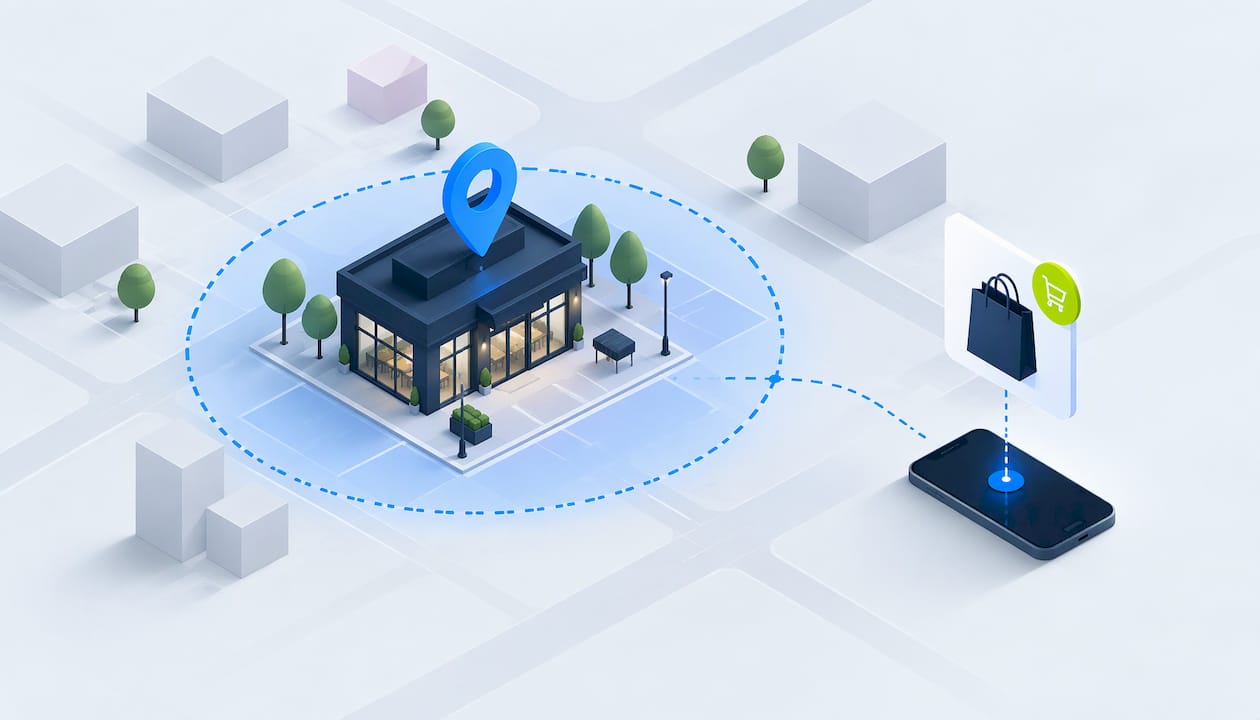
Geofencing advertising draws a virtual boundary around a real-world place, such as a store, a venue or a competitor’s parking lot, and serves ads or notifications to mobile devices that enter or leave it. It works best for businesses with a physical location or a clear place where buyers gather, and it works best when the offer, the boundary and the measurement are planned together. This guide explains the mechanics, the difference from geotargeting, the cost drivers, real examples, the US privacy rules, and a checklist you can use before you spend a dollar.
TL;DR
- Geofencing advertising uses a virtual boundary around a specific place to trigger ads or messages when a mobile device crosses it.
- Geotargeting selects people by broader areas (city, ZIP code, region) and often adds audience traits. Geofencing focuses on proximity to one location.
- Cost depends on audience density, the number and size of geofences, frequency, duration and location data quality. Confirm exact rates with any vendor in writing.
- Precise location data is sensitive. Plan for consent, data minimization, and state laws such as California’s restrictions on geofencing health care facilities.
- Measure with a control group and store-visit or conversion data, not impressions alone.
Table of Contents
- What geofencing advertising is and how it works
- Geofencing vs. geotargeting: which do you need?
- Real geofencing ad examples
- What geofenced ads look like to the customer
- How much does geofencing advertising cost?
- Is geofencing advertising legal in the US?
- How to plan a geofencing campaign
- Where geofencing fits in a wider marketing plan
- Our perspective
- Plan your location-based campaigns with Magic Logix
- FAQ
- Sources
What geofencing advertising is and how it works
A geofence is a boundary defined by coordinates and a radius, or by a drawn shape on a map. Geofencing uses GPS, Wi-Fi or cellular data to detect when a device enters or exits that boundary. When it does, the system fires a pre-programmed action. In advertising, that action is usually an ad, a push notification or an addition to an audience list.
There are two common ways this reaches a person.
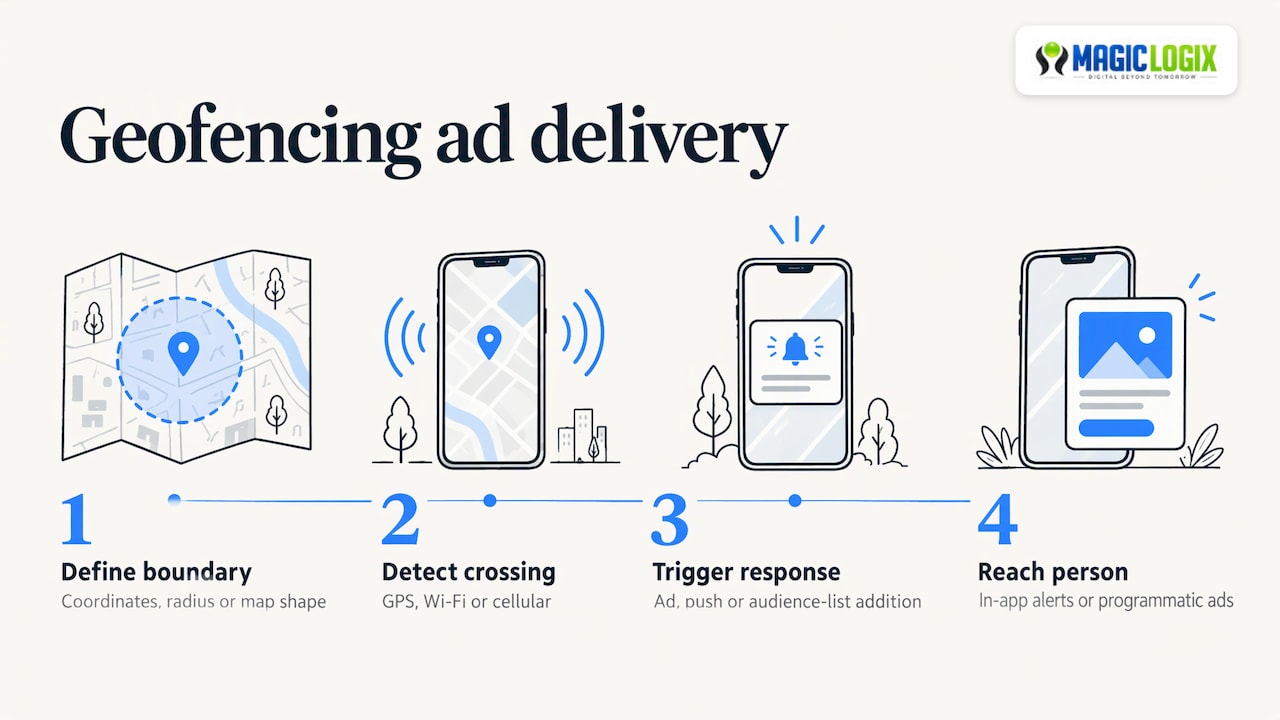
In-app notifications. For a brand’s own alerts, users must download the business’s app, allow location access and allow notifications. The phone’s operating system watches the registered locations and tells the app when a boundary is crossed. This is not a continuous GPS tracker: the app is only triggered when the operating system reports a registered boundary event.
Programmatic mobile ads. Advertisers buy display, video or other ad formats through ad platforms that use location signals from apps. The ad appears inside other apps or websites the person uses, not in a message from your brand. This is what most people mean by geofenced ads.
The same trigger idea powers other tools too. Vehicle and asset trackers, for example, send fleet geofencing alerts when equipment enters or leaves a defined area. The advertising version applies the same enter-and-exit logic to people’s phones and a marketing message.
The building blocks of a campaign
Every geofenced campaign has the same parts, whether you run it yourself or through an agency:
- Locations. The places you draw fences around: your own stores, event venues, trade show halls, campuses, shopping centers or categories of business.
- Boundary size. A small radius around a single storefront behaves very differently from a wide one around a mall.
- Audience rule. Who is eligible: anyone who enters, repeat visitors, or people who were there during a specific time window.
- Creative and offer. The ad and the reason to act now.
- Landing experience. A mobile-friendly page, a call button, a map, or an app screen.
- Measurement. How you will know whether the ad changed behavior.
Geofencing vs. geotargeting: which do you need?
People search this comparison constantly because the terms overlap. The short answer: geotargeting picks an area, geofencing picks a place.
Geotargeting selects an audience using location plus attributes such as demographics, interests or behavior, and can cover a whole city or region. Geofencing draws a boundary around a specific real-world location and targets devices that enter it, generally putting immediate proximity ahead of individual audience traits.
The Interactive Advertising Bureau draws the same line in its U.S. buyer’s guide: geotargeting can specify geographies such as TV markets, cities or people within 10 miles of an address, while geofencing can reach audiences passing by or inside particular stores, malls or venues at specified times. A Boston University business review describes it in similar terms: ZIP code, city or country for geotargeting, and a tighter radius or district for geofencing.
| Factor | Geotargeting | Geofencing |
|---|---|---|
| Unit of targeting | ZIP code, city, DMA, state, country | A specific place or radius around coordinates |
| Main question it answers | Who lives or works in this market? | Who is physically here right now, or was recently? |
| Typical goal | Regional awareness, local lead generation | Store visits, event traffic, timely offers |
| Audience layering | Often adds demographics, interests, behavior | Often adds time windows and visit history |
| Scale | Broad | Narrow, can be small |
| Best fit | Service-area businesses, multi-city brands | Retail, restaurants, events, venues, dealerships |
They are not rivals. A practical pattern is to use geotargeting to build regional awareness among the right audience, then use geofencing to prompt action when people are near a specific location. If you sell to a whole metro area from an office with no walk-in traffic, geotargeting is usually the better starting point. If a person’s physical presence near a place is the signal that matters, geofencing earns its place.
Real geofencing ad examples
Examples are useful because they show the offer and the geography working together. Both of the following are documented by industry bodies.
Whopper Detour
Burger King geofenced about 14,000 McDonald’s locations in the U.S. The 1¢ Whopper offer unlocked in the Burger King app when a customer was within 600 feet of one of those restaurants. The campaign recorded more than 1.5 million app downloads in nine days.
What to take from it: the fence, the offer and the call to action were one idea. The boundary was tight, the reward was clear, and the action happened in an app the brand controlled. Few small businesses can copy the scale, but any business can copy the structure: a small radius, a concrete incentive and a single next step.
Nordstrom Rack digital out-of-home
A 2018 campaign in Lancaster, Pennsylvania, ran from March to May and targeted women ages 18 to 54. According to the outdoor advertising industry’s case study, it produced a 9.17% overall lift in store visits. The measurement used test-and-control methods to attribute walk-ins to the campaign.
What to take from it: the result was credible because there was a comparison group. Those figures belong to those campaigns and those conditions. Treat them as illustrations of what is possible to measure, not as a forecast for your business.
Ideas that fit smaller businesses
These are illustrative scenarios, not client results:
- A home services company fences local home improvement store lots and serves a seasonal tune-up offer to people there on weekends.
- A restaurant fences the venue next door during event nights and promotes a pre-show or post-show special.
- A dealership fences its own lot and a few nearby competing lots and prompts a test-drive booking page.
- A trade show exhibitor fences the convention hall and serves ads that point to a booth number or demo sign-up.
- A university or training provider fences campus events or nearby community colleges during enrollment season.
What geofenced ads look like to the customer
The experience varies by channel. Inside the advertiser’s own app, it is a push notification or an in-app offer. Through ad platforms, it is a banner, native unit or video in another app or mobile site. Some campaigns extend to connected devices later, using the same audience.
Relevant messaging at the right moment is the core of it. A generic brand message shown near a store is a missed opportunity. A message that references the place, the time or the immediate need performs closer to what the technology promises. Keep the creative short, make the offer specific, and send people to a page that loads fast on a phone.
How much does geofencing advertising cost?
Published figures vary widely by vendor, format and market, and many come from vendor marketing pages, so we don’t quote a single number here. Ask any provider for rates, minimums and fees in writing. What does hold across campaigns is what moves the price:
- Audience density. A fence in a busy downtown draws more eligible devices than one in a rural area, which changes how quickly a budget is used.
- Number and size of geofences. More locations and larger radii mean more reach and more spend.
- Frequency. How often the same device sees the ad.
- Duration. Short event bursts versus always-on programs.
- Location data quality. Accuracy and the freshness of signals affect who actually gets targeted.
- Ad format. Static display, video and other formats are priced differently.
- Management. Self-serve tools cost less in fees but require expertise. Managed services add strategy, creative and reporting.
When you compare quotes, ask for the same things from each vendor: how the fences are verified, what the location data source is, how you will receive visit reporting, and whether the minimum spend is a platform fee or media spend that actually reaches people.
Is geofencing advertising legal in the US?
Yes, in general, but the rules are tightening around precise location data, and some uses are restricted outright. There is no single federal geofencing statute. Instead, you work with consumer protection law, state privacy laws and platform policies. This is general information, not legal advice: have counsel review your plan, especially if you operate in several states or near sensitive places.
Sensitive locations
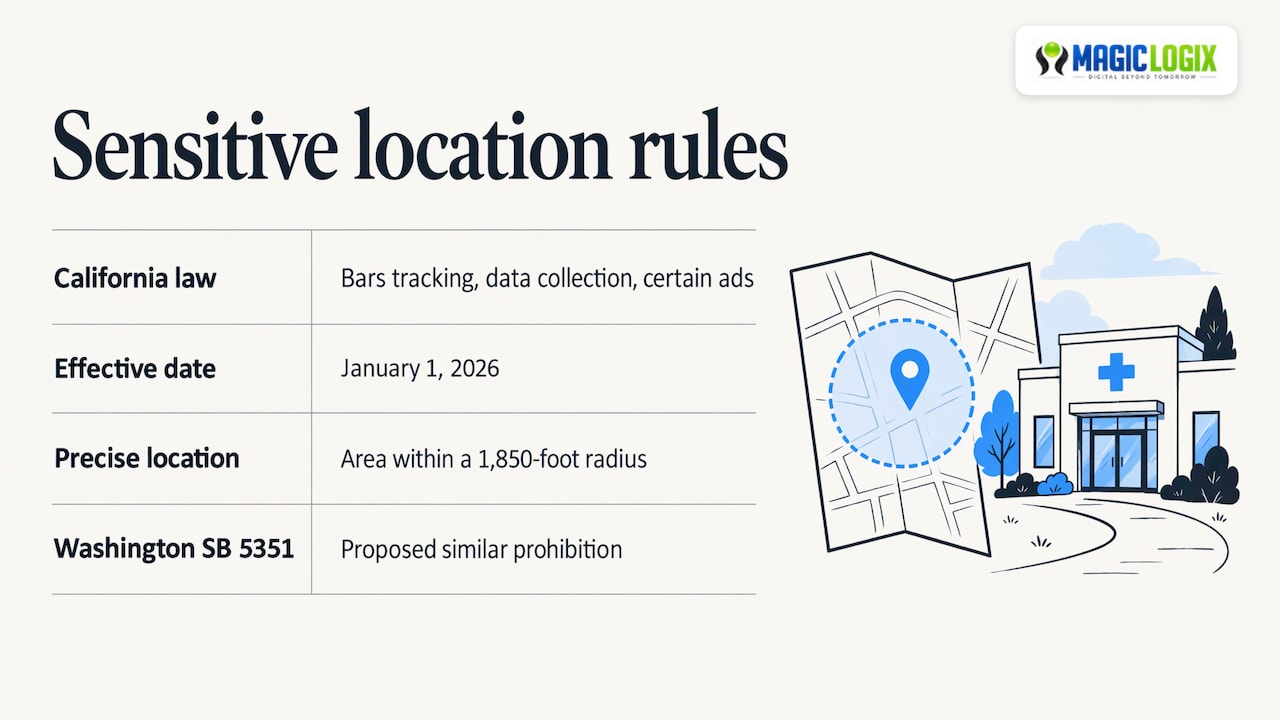
California law now makes it unlawful to geofence an entity that provides in-person health care services to identify or track people, collect their personal information, or send them certain notifications or advertisements. The statute took effect January 1, 2026. It also defines precise geolocation as an area equal to or smaller than a circle with a radius of 1,850 feet. Washington lawmakers proposed a similar prohibition in Senate Bill 5351 covering geofences around in-person health care providers. Check the current status of that bill and any similar law in states where you advertise.
If you are a healthcare marketer, the practical takeaway is simple: do not fence clinics, and look at other compliant ways to reach patients. Our guide to healthcare B2B marketing covers channels that don’t depend on this kind of location data.
Federal enforcement
The Federal Trade Commission treats precise location as sensitive. In its Gravy Analytics order, the FTC states that precise mobile geolocation can reveal medical conditions, religious worship, political activity and sexual orientation. Its Mobilewalla complaint notes that raw location data commonly includes a mobile advertising ID and latitude and longitude, so it can link activity to an individual device. Separately, the FTC’s order against X-Mode and Outlogic required assessing suppliers’ informed-consent practices and maintaining safeguards for sensitive location data.
The lesson for advertisers who buy through intermediaries: you are expected to care where the data came from and whether people agreed to its use.
What responsible use looks like
- Get clear, informed opt-in consent for location use, and make it easy to withdraw.
- Use aggregated or de-identified data wherever your goal allows.
- Avoid sensitive places and sensitive inferences entirely.
- Ask vendors in writing about data sources, consent and deletion.
- Keep a record of your decisions, so you can answer questions from customers or regulators.
For a wider view, see our privacy-first marketing guide for US teams and our CCPA compliance guide for marketing teams. If you plan to follow geofenced audiences with later ads, the retargeting checklist covers privacy controls, QA and holdouts.
How to plan a geofencing campaign
Use this sequence. It keeps the work focused on a business outcome rather than on the technology.
- Define one goal. Store visits, event sign-ups, calls, test drives or app installs. Pick one primary measure.
- Choose places with a reason. Every fence needs a hypothesis: people here are more likely to buy because of X.
- Screen for sensitivity. Remove health care facilities, places of worship, shelters and anything that could reveal sensitive information.
- Set boundary sizes. Start tight around single locations. Wider fences collect more irrelevant devices.
- Write the offer for the moment. Reference the place, the time or the problem the person has right now.
- Build the landing step. Fast mobile page, click-to-call, directions, or a booking form. Test it on a phone.
- Set up measurement before launch. Define a control group or holdout, and agree on how visits or conversions will be counted.
- Run a small test. One or two locations for a few weeks, then compare against the control.
- Review and scale. Expand fences that deliver, drop those that don’t, and refresh creative.
How to evaluate results
Impressions and clicks tell you whether the ad ran, not whether it worked. Use a layered scorecard:
| Layer | What to track | Why it matters |
|---|---|---|
| Delivery | Impressions, reach, frequency | Confirms the fence is producing eligible traffic |
| Engagement | Click-through rate, call taps, direction requests | Shows whether the message fits the moment |
| Visits | Store-visit lift versus a control group | Closest measure to the real goal |
| Business outcome | Sales, bookings, leads, cost per acquisition | Ties spend to revenue |
Visit-lift methods are estimates built on modeled location data, so read them as directional. If the numbers matter to a budget decision, cross-check against your own point-of-sale or booking data. Our guide to predictive analytics in digital marketing shows how to turn these results into forecasts you can test.
Where geofencing fits in a wider marketing plan
Geofencing is a tactic, not a strategy. It performs best when it supports something already working: a clear offer, a strong local presence and a landing experience that converts. Search is often the next step after a nearby ad, because someone who sees your message in the parking lot may look you up on their phone. Your listing, reviews and site need to be ready. Our SEO services cover the local and national search side of that journey.
For retail and online sellers, geofenced ads can also feed an ecommerce funnel, with location as one signal among many. See our ecommerce marketing strategies for how to connect these pieces, and our customer engagement strategy template for deciding what happens after the first click.
Our perspective
Many owners come to us asking about geofencing because a competitor seems to be “following” customers around. The better question is what you want a nearby person to do next, and whether you can make that easy.
We see geofencing as one input in a connected system. The fence finds a moment; the offer, the page, the follow-up and the measurement decide whether that moment pays off. That is why we look at paid media, search, website experience and analytics together, under the idea we call Digital Beyond Tomorrow.
We also treat privacy as part of the design, not a legal footnote. Location is among the most sensitive data a customer shares. Campaigns that respect consent and avoid sensitive places protect your brand as well as your customers, and they hold up when rules change.
Start small, measure against a control group, and let the evidence decide what grows.
Hassan Bawab
Plan your location-based campaigns with Magic Logix
If you want help deciding whether geofencing, geotargeting or a search-led approach fits your goals, our team can review your locations, offers and measurement plan. Explore our digital marketing and paid media services, or look at how marketing and growth systems connect paid media to results you can track.
FAQ
What is an example of geofencing in advertising?
The best-documented example is Burger King’s Whopper Detour, which geofenced about 14,000 McDonald’s locations and unlocked a 1¢ Whopper in the app within 600 feet. On a smaller scale, a local business might fence an event venue and promote a special to people attending. The common thread is a tight boundary tied to a specific offer.
What is the difference between geofencing and geotargeting?
Geotargeting reaches people in a broad area, like a city or ZIP code, and often layers on interests or demographics. Geofencing draws a boundary around a particular place and triggers ads when a device enters it. Many campaigns use both: geotargeting for regional reach, geofencing for proximity prompts.
How much does a geofence ad cost?
Cost depends on audience density, how many fences you draw and how large they are, ad frequency, campaign length and the quality of the location data. Pricing models and minimums differ by provider, so request a written quote that separates platform fees from media spend. Run a small test before committing to a larger budget.
Is geofencing advertising legal in the US?
Generally yes, with conditions. There is no single federal geofencing law, but the FTC has acted against companies over sensitive location data, and some states restrict specific uses. California, for example, prohibits geofencing in-person health care facilities for tracking or advertising. Get informed consent, avoid sensitive places and have counsel review your plan.
Do people have to opt in to see geofenced ads?
For a brand’s own app notifications, yes: people must allow location access and notifications on their phone. Ads served through ad platforms depend on the location permissions people grant to the apps they use. Either way, build your campaign around clear consent and ask vendors how it is collected.
Sources
- What is geofencing and how is it used? (TechTarget)
- What Is Geofencing? Uses and How It Works (Shopify)
- Geofencing vs Geotargeting: Differences and Accuracy (Viant)
- Local Buyer’s Guide (Interactive Advertising Bureau)
- The Power of Geo-Targeting (Boston University Business Horizons Review)
- Burger King, The Whopper Detour (The One Club)
- Nordstrom Rack OOH case study (OAAA)
- California Civil Code, geofencing of health care facilities
- Washington Senate Bill 5351
- FTC Gravy Analytics order, Docket No. C-4810
- FTC Mobilewalla complaint
- FTC order on X-Mode Social and Outlogic