

You launch a paid search campaign, add budget, and expect the math to improve. Instead, the dashboard gets noisier. Click costs creep up. ROAS looks acceptable in one view and questionable in another. Sales teams say lead quality is uneven. Finance asks a harder question than marketing platforms usually answer: “Are these campaigns making money?”
That tension makes paid search management a discipline, not a channel task.
A lot of teams still treat search like a vending machine. Pick keywords, load spend, collect conversions. That worked better when competition was lighter and attribution models were simpler. Today, the teams that win do not just buy traffic. They build a system that connects bids to margin, query intent to customer value, and reporting to business decisions.
The Paid Search Dilemma Bigger Budgets No Longer Fix
Many marketing managers have seen the same pattern. Performance softens, so the team raises bids or expands budget. Visibility improves for a while, but efficiency does not. You pay more to stand still.
That is not a local problem inside your account. It reflects the shape of the market. The global paid search advertising market is projected to reach $351.55 billion in 2025, and CPC rates have risen across 86% of industries in 2024, according to Digital Silk’s PPC statistics roundup. When more advertisers compete for the same commercial searches, brute force stops working.
The old playbook assumed spend was the main lever. Put in more budget, get more volume. That logic breaks when click costs rise faster than the value you create after the click.
A useful way to think about it is this: buying ads is like paying for seats at an auction. Paid search management is deciding which auctions are worth entering, how much a customer is worth to your business, and when you should walk away.
Why teams misread the problem
Many teams focus on platform metrics first and economics second. They ask:
- Did clicks increase
- Did conversions grow
- Did ROAS clear the target
Those are fair questions, but they are incomplete. A campaign can hit a ROAS target and still underperform if fulfillment costs, low repeat purchase behavior, or poor lead quality erase the apparent gain.
Key takeaway: Rising CPCs punish lazy budget increases. Good paid search management protects profit by getting more selective, not just more aggressive.
This is also why basic efficiency formulas matter. If your team needs a clean baseline before changing bids, start by aligning on acquisition economics with a simple cost per acquisition framework. Without that, budget decisions quickly become guesswork dressed up as optimization.
Defining Paid Search Management Beyond Buying Clicks
Paid search management looks simple from the outside. You choose keywords, write ads, set bids, and monitor results. In practice, it behaves more like portfolio management than media buying.
A portfolio manager does not judge success by whether an asset generated activity. They judge it by whether the mix of assets supports the investor’s objectives with acceptable risk. Paid search works the same way. A keyword, audience, or campaign can generate volume and still be the wrong investment.
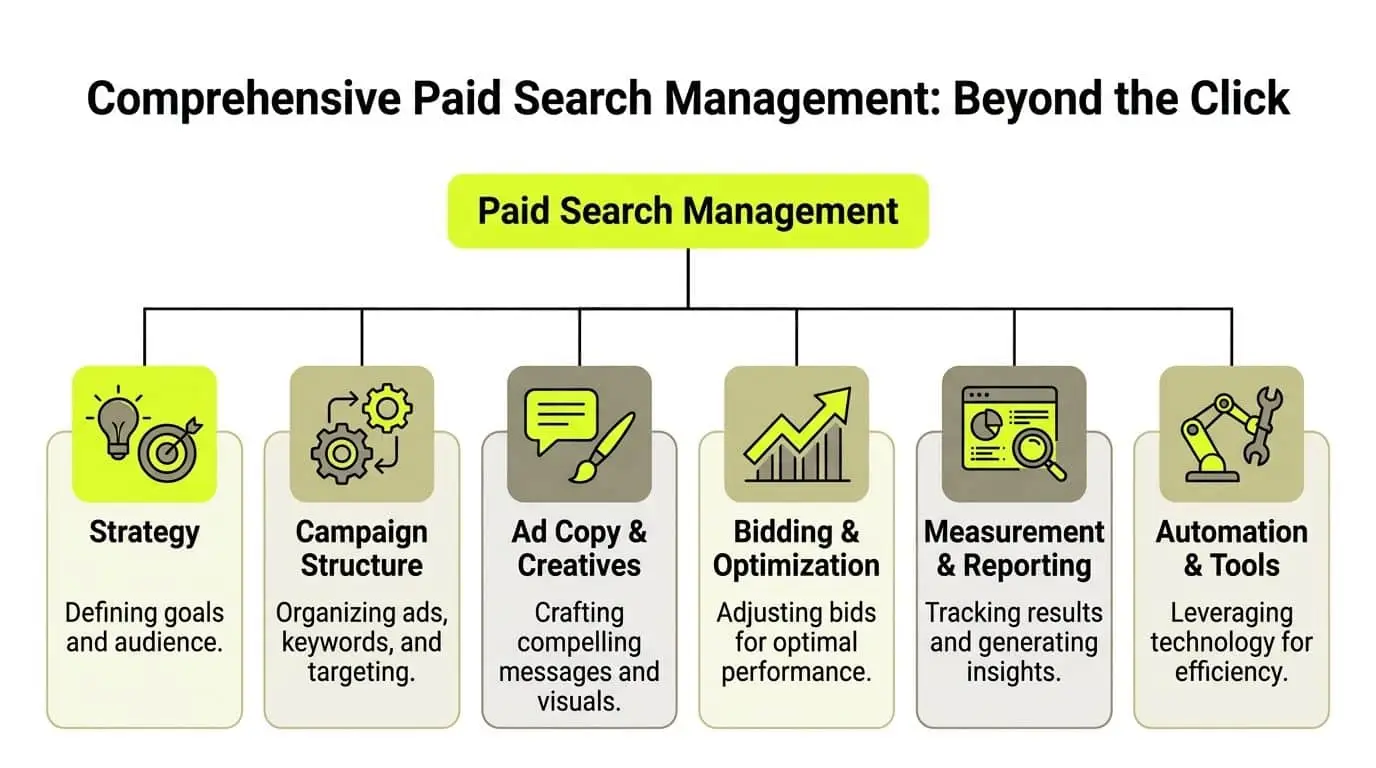
The four-part management cycle
Planning comes first. Here, teams define the business goal. Not “more traffic.” Not even “more conversions.” The sharper question is whether the campaign needs to drive qualified pipeline, profitable first orders, repeat-prone customers, or inventory movement.
Execution translates strategy into structure. That includes campaign architecture, keyword grouping, audience targeting, geo settings, device controls, ad copy, and landing page alignment. Many accounts become messy during execution. If the structure does not reflect how the business makes money, the data cannot guide smart decisions later.
Measurement tells you what happened. Good measurement is not a dashboard with many widgets. It is a reporting system that connects search behavior to meaningful outcomes. That can include lead quality, revenue mix, margin sensitivity, and customer segment value.
Optimization closes the loop. This involves ongoing refinement of bids, waste exclusion, ad rewriting, landing page relevance tightening, budget adjustments, and response to market shifts.
What buying clicks misses
Buying clicks is a transaction. Management is a system.
Here is the difference in plain terms:
| Activity | Buying clicks | Paid search management |
|---|---|---|
| Goal | Get traffic | Generate profitable business outcomes |
| Time horizon | Short | Ongoing |
| Main lever | Budget | Strategy, structure, measurement, optimization |
| Success signal | Clicks and conversions | Profitability, customer quality, incremental growth |
A smart manager also knows that different searches deserve different treatment. A branded exact-match term, a broad discovery term, and a product-specific query may all belong in search, but they should not be judged by the same standard.
Where confusion usually starts
People often assume the ad platform already knows their business goal. It does not. Google Ads and Microsoft Ads can optimize toward the signals you send, but they cannot infer your margin structure, sales bottlenecks, or which customer types create downstream value unless you feed those signals into the system.
Practical tip: If your campaigns are optimized only for what the platform can see, they will usually optimize for volume faster than they optimize for business quality.
That is why paid search management should be treated as a recurring operating function. Not a launch checklist. Not a set-it-and-forget-it channel. A managed program learns, reallocates, and gets stricter over time.
Core Strategies for Profitable Campaign Architecture
The most common flaw in paid search accounts is not poor effort. It is poor objective design. Teams build campaigns to maximize visible platform performance, then wonder why the finance team stays skeptical.
The core fix is simple to describe and harder to execute: structure campaigns around business economics, not just ad platform metrics.
Search Engine Land highlighted the problem clearly. Traditional campaign structures that fixate on ROAS can mislead teams, and 30-40% of “high-ROAS” campaigns lose money after fulfillment costs in one cited study. Their takeaway is the right one: profit optimization requires integrating business economics such as margins and LTV into bidding decisions, as discussed in this analysis on undervalued PPC skills.
Start with intent, not keyword volume
A keyword list is not a strategy. Intent mapping is.
If you sell software, “best enterprise CRM” and “CRM login” are both related to your category. They are not equally useful. One signals commercial research. The other may reflect existing users. If you bid on both without distinction, your reporting mixes acquisition with navigation.
A cleaner architecture groups search terms by intent:
- High-intent commercial terms bring shoppers or buyers close to a decision
- Problem-aware terms capture earlier research behavior
- Brand terms often protect demand you already created elsewhere
- Low-value support or navigational terms may belong in exclusions, not growth campaigns
That separation matters because each bucket deserves different bids, messaging, and profit expectations.
Segment audiences by value, not just demographics
Many accounts segment by geography, device, or campaign type. Those are useful controls, but they are not enough.
A stronger model asks which users are more likely to produce profitable outcomes. That could mean:
- Customers with stronger repeat purchase patterns
- Lead sources that sales closes faster
- Product categories with healthier margins
- Regions where shipping or service costs are lower
If your account treats every conversion as equal, the bidding system can over-invest in cheap conversions that underdeliver after the sale.
Build bids around margin reality
Many teams resist this approach because ROAS feels clean. Spend goes in. Revenue comes out. However, revenue is not profit.
Consider two products. One generates strong top-line revenue but has tight margins and high return rates. The other has lower average order value but stronger margin and better repeat behavior. A ROAS-only system tends to favor whichever product makes the dashboard look better, even if the business earns less.
A profit-aware bidding model asks tougher questions:
- What margin do we keep after fulfillment
- Do repeat purchases justify a higher first-order acquisition cost
- Should inventory constraints reduce visibility on certain products
- Which campaigns create customers we want more of
That last point matters more than many teams realize. Search should not just acquire demand. It should acquire the right kind of demand.
Campaign architecture that supports profit
A profitable account often includes clearer separation than average accounts do:
| Campaign layer | What it controls | Why it matters |
|---|---|---|
| Intent-based campaigns | Query purpose | Prevents mixed signals in optimization |
| Margin-aware product or service groups | Profitability differences | Keeps bidding aligned with real economics |
| Audience overlays | Customer quality | Helps prioritize high-value segments |
| Geo and device segmentation | Cost and performance variation | Supports finer bid control |
One more point often gets missed. Traffic quality and post-click performance are connected. If you are investing heavily in paid search for ecommerce, it helps to pair media optimization with practical work to improve ecommerce conversion rate and boost sales. Better landing flow, better product messaging, and better checkout behavior make bid decisions more reliable because the post-click system is less leaky.
Key takeaway: ROAS is a useful indicator. It is a poor operating philosophy when used alone.
What this changes in day-to-day management
When teams adopt profit-first architecture, they usually make different choices:
- They pause terms that drive revenue but weak contribution margin.
- They protect high-value campaigns even when click costs look uncomfortable.
- They lower bids on inventory-constrained products.
- They stop celebrating conversions that sales teams do not want.
That is what mature paid search management looks like. It stops asking, “Can we buy more?” and starts asking, “Should we buy this click at all?”
Measuring What Matters Advanced Paid Search Metrics
The easiest way to lose control of paid search is to look at one metric in isolation. CTR can rise while lead quality falls. ROAS can look healthy while new-customer mix weakens. CPA can improve because the account is harvesting branded demand rather than creating fresh growth.
A stronger measurement model uses layers.
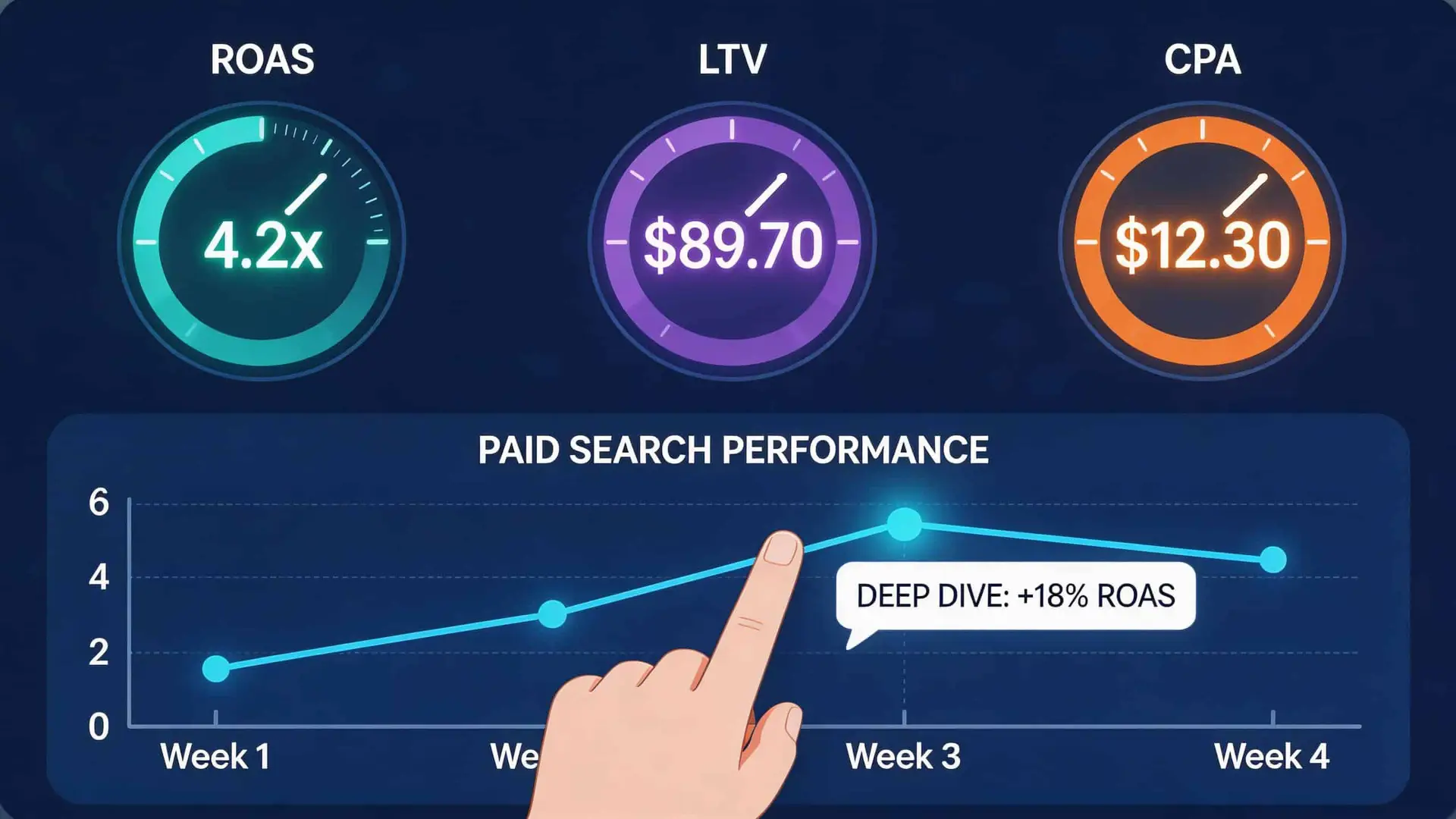
Active Marketing’s guide to PPC analysis describes this well. Expert-level paid search management uses hierarchical KPI frameworks, tracks assisting keywords, and segments metrics by user intent. It also moves beyond CPA and ROAS to metrics such as Conversion Share and Revenue Mix from high-value customer segments, enabling more disciplined budget allocation, as outlined in their PPC analysis guide.
Think in layers, not single-score performance
A useful KPI hierarchy has three levels.
Leading indicators
These are early signals. They do not prove business impact on their own, but they tell you whether the engine is healthy.
Examples include:
- Impression Share on priority terms
- Top Impression Share for high-value queries
- Quality Score subscore movement, especially ad relevance
- Click-through patterns by intent bucket
If these weaken, efficiency problems often show up later in CPC, conversion rate, or revenue quality.
Performance metrics
Many teams stop here. They matter, but they need context.
Useful performance metrics include:
- Conversion rate by ad group
- CPA by match type
- Query-level cost concentration
- Device and location performance split
The important shift is granularity. Looking at campaign averages can hide major differences between ad groups and intent categories.
Business outcome metrics
This layer answers whether search is helping the business, not just the ad account.
That can include:
| Metric | What it tells you |
|---|---|
| Conversion Share | Which campaigns contribute meaningful portions of total converting activity |
| Revenue Mix | Whether valuable customer segments are growing or shrinking |
| Lead quality by ad group | Which structures produce sales-worthy outcomes |
| Customer value trends | Whether the account is acquiring durable customers |
Why assisting keywords matter
Many buyers do not convert on their first search. They research, compare, leave, come back, and then convert on a different query.
If you only reward the final keyword, you can accidentally cut off earlier searches that shaped the decision. Broad and discovery-oriented terms may not close the sale directly, but they can influence the path.
That is why clean conversion tracking practices matter. Without them, the account often overvalues the last visible touch and undervalues the searches that introduced or educated the buyer.
Tip: Review conversion paths by intent bucket. If upper-funnel queries assist profitable sales, do not judge them by last-click CPA alone.
A short explainer can help teams align on what the dashboard is saying:
A better reporting conversation
Instead of asking, “Which campaign has the best ROAS,” ask:
- Which campaigns bring in the best customers?
- Which keywords assist revenue even when they do not close it?
- Where are rising costs tied to weaker ad relevance versus market pressure?
- Which segments deserve more budget because they improve overall revenue mix?
Those questions produce better actions. They also create reporting that finance, sales, and marketing can use together, instead of separate dashboards defending separate narratives.
Enterprise Grade Tooling and Automation Workflows
At small scale, a skilled specialist can manage a lot from native ad platforms and spreadsheets. At larger scale, that setup breaks. Data fragments. Reporting lags. Bid changes happen in one interface while revenue data lives somewhere else.
That is why enterprise paid search management depends on infrastructure, not just talent.

According to Magic Logix’s overview of paid search intelligence, enterprise-scale programs rely on a multi-layer data infrastructure with a central warehouse such as Google BigQuery or Snowflake, connected to BI tools and third-party bid platforms for cross-account optimization, as described in their paid search intelligence framework.
What the stack does
The jargon can sound more intimidating than it is.
Data warehouse
Think of the warehouse as a central library. Instead of keeping Google Ads data in one room, CRM data in another, and analytics data in a third, the business stores them in one governed environment.
That matters because profit decisions require joined-up data. Ad platforms know clicks and conversions. Your CRM knows lead status. Your order system knows margin realities.
ETL pipelines
ETL stands for extract, transform, load. In plain language, these tools pull data from different systems, clean it, standardize naming, and move it into the warehouse on a schedule.
Without ETL, teams waste time reconciling inconsistent labels and exporting CSV files instead of making decisions.
BI dashboards
Platforms like Tableau or Power BI turn the warehouse into something marketing, finance, and leadership can use. Good BI is not cosmetic. It gives one source of truth for budget, revenue quality, and cross-channel contribution.
Why native platform automation is not enough
Google Ads and Microsoft Ads automate many bidding tasks well. But native automation usually optimizes from the data inside that platform’s line of sight.
Large advertisers often need more control than that. They may want to:
- Apply custom bidding logic across accounts
- Blend CRM status into optimization decisions
- Compare forecast versions before major budget changes
- Respond to seasonality, promotions, or product changes quickly
Third-party tools can help there. Some teams also explore creative and workflow utilities such as the Magicads AI tool when they want faster ideation around ad concepts or asset production. Those tools are useful when plugged into a disciplined workflow, not used as a substitute for strategy.
Practical tip: Automation works best when the underlying account structure, naming conventions, and business signals are clean. Bad inputs scale bad decisions.
A workable enterprise workflow
A strong setup often follows this pattern:
- Collect raw data from ad platforms, analytics, and CRM systems.
- Normalize and load the data into a warehouse.
- Visualize performance in BI dashboards for marketers and executives.
- Push decisions back into campaigns through bid tools, rules, or scripts.
- Review exceptions where humans should override automation.
This is also one place where productized paid search intelligence platforms can fit as one option among many. A system like the Magic Logix approach to paid search intelligence focuses on connecting those layers so teams can manage bidding, audience signals, and cross-account decisions from a more unified base.
The point is not to build a more complicated stack for its own sake. The point is to give paid search management the operating system it needs when the account becomes too valuable and too complex for manual patchwork.
The Magic Logix Approach Predictive Analytics in Action
A lot of paid search advice becomes abstract because it stops at principles. The more revealing question is how a team applies those principles when budgets are under pressure, leadership wants clearer accountability, and platform signals are imperfect.
That is where predictive thinking matters.

What predictive analytics changes
Many PPC routines are reactive. Costs rise, then the team cuts bids. Conversion rate drops, then the team rewrites ads. Attribution gets messy, then the team debates reports.
Predictive analytics tries to act earlier. It uses historical performance, market behavior, and business signals to estimate where pressure or opportunity is likely to appear next. That can shape budget planning, audience prioritization, and scenario modeling before the account drifts.
For a useful overview of that mindset, see Magic Logix’s explanation of digital marketing predictive analytics.
How this plays out in real management decisions
Consider a few common situations.
Scenario one
A regional business sees solid search conversion volume but uneven sales quality across locations. A predictive approach would not just compare CPA by region. It would look for patterns tied to lead acceptance, customer value, and seasonal shifts, then tighten bids and budget priorities around the locations most likely to generate profitable outcomes.
Scenario two
An ecommerce brand runs profitable campaigns at the category level but struggles when product costs, return behavior, and promotional timing shift. Predictive modeling helps the team avoid blunt, account-wide bid moves. Instead, it can support category-level decisions that reflect business realities more closely.
Scenario three
An enterprise advertiser wants search, social, and other performance channels to feel less siloed. Search data can reveal active demand. Social and business intelligence can add context about audience behavior, timing, and message resonance. That creates a more complete picture than keyword data alone.
Why this approach fits modern paid search management
Predictive work is valuable because modern paid search has more moving parts than the interface shows:
- Market competition changes quickly
- Customer value differs across segments
- Platform attribution misses part of the story
- Operations constraints affect what should be promoted
A team that only reacts to surface metrics often discovers problems late. A team that models likely outcomes can make calmer decisions.
Key takeaway: Predictive analytics does not replace PPC fundamentals. It improves the timing and quality of decisions built on those fundamentals.
The practical benefit is less about flashy AI language and more about operational clarity. Which campaigns deserve protection. Which segments should be deprioritized. Which forecasts are credible enough to use in planning. That is where advanced paid search management becomes easier to defend inside the business.
Common Paid Search Pitfalls and How to Fix Them
Some paid search waste is obvious. Irrelevant queries. Weak ad copy. Landing pages that do not match intent. The more expensive waste is quieter. It shows up in bad attribution logic, duplicated credit across channels, and budget decisions based on incomplete causality.
GrowthCurve’s analysis of modern paid search strategy argues that old attribution models can overstate paid search impact by 20-50% after 2025, and that teams need incrementality holdout tests to measure net-new sales and reduce double-counting across platforms such as Google and Bing, as discussed in their guide to modern paid search marketing strategies.
Pitfall one underestimating overlap
A user sees an ad on one platform, clicks another later, and converts after a branded search. If each platform claims strong performance, the business may think growth is bigger than it is.
Fix: Run holdout tests and compare exposed versus unexposed groups wherever possible. The goal is not perfect measurement. It is a more honest estimate of what would not have happened without the ads.
Pitfall two treating all conversions as equal
Many accounts still optimize toward raw conversion count. That can push spend toward actions that are cheap to generate but weak in downstream value.
Fix: Feed better conversion definitions into the account. If sales-qualified leads matter more than form fills, or profitable orders matter more than all orders, the system needs that signal.
Pitfall three ignoring cannibalization
Branded campaigns, remarketing-heavy structures, and overlapping search strategies can all capture demand that other channels already created.
Fix: Separate acquisition-focused campaigns from demand-capture campaigns in reporting. That keeps decision-makers from confusing protection with growth.
Pitfall four letting budget drift without intent rules
Some accounts leak spend because broad campaigns absorb budget by default, even when tighter campaigns produce better business outcomes.
A quick audit usually helps:
- Check search term concentration for expensive queries with weak business value
- Review brand and non-brand separately so one does not hide the other
- Audit device and geo splits for pockets of low-quality traffic
- Revisit negatives often to reduce recurring waste
Pitfall five overtrusting automation
Automation is powerful. It is not all-knowing. If the account sends flawed conversion signals or mixes intent too broadly, automated bidding scales the wrong pattern efficiently.
Tip: When performance changes suddenly, first ask whether measurement, attribution, or conversion definitions changed. Do not assume the market is the only cause.
The general rule is simple. Paid search management improves when you stop asking who got credit and start asking what caused new business.
Deciding Your Path In House Team vs Agency Partner
By this point, the decision is usually not whether paid search matters. It is whether your organization can manage it at the level modern competition requires.
An in-house team makes sense when you have close access to product, sales, finance, and analytics, plus the time to build structured workflows around measurement and optimization. It works especially well when paid search is tightly connected to inventory, pricing, or complex lead qualification.
An agency partner makes sense when speed, specialized expertise, and cross-account pattern recognition matter more than building every capability internally. Good agencies also help when attribution is messy, reporting needs to satisfy multiple stakeholders, or the business lacks the technical setup for joined-up decision-making.
A useful way to decide is to score your situation against four criteria:
| Question | In-house fit | Agency fit |
|---|---|---|
| Do you have strong internal PPC expertise | Better | Possible but less necessary |
| Do you need fast implementation across many moving parts | Harder | Better |
| Do you already have clean data infrastructure | Better | Helpful but not required |
| Do you need outside perspective on profit and attribution issues | Sometimes | Often better |
The deeper point is that paid search management is no longer a narrow ad-buying task. It combines economics, analytics, operations, creative testing, and platform fluency. If your team can support that internally, build it well. If not, partnering is a strategic choice, not a compromise.
If your team needs help connecting paid search performance to actual business outcomes, Magic Logix works at the intersection of data, technology, and marketing strategy to support more informed decisions around measurement, automation, and profit-focused growth.