
B2B marketing segmentation is simply the art of breaking down your massive business audience into smaller, more focused groups. It’s about recognizing that not all customers are the same and then tailoring your message to resonate with each specific group. This is how you stop shouting into the void and start having meaningful conversations.
It’s the bedrock of any smart marketing strategy, ensuring you point your resources exactly where they’ll make the biggest splash.
Why Traditional Segmentation Is Broken
For years, B2B marketing had a simple, well-worn playbook. We’d slice up our customer lists using broad categories—things like industry, employee count, or annual revenue. This was traditional segmentation. And for a while, it worked well enough.
Think of it like a school cafeteria. It's efficient at feeding everyone the same meal, but you're not going to get any rave reviews.
Today, that cafeteria model is officially broken. The way businesses buy has changed completely. Those static, one-dimensional labels just don't cut it anymore. Knowing a company is in the "manufacturing" sector with "500 employees" tells you next to nothing about what they actually need, how they use technology, or if they're even thinking about buying.
The New B2B Buyer Has Arrived
The biggest change? The buyers themselves. Today's B2B world has been transformed, with nearly half of all buyers now being millennials. This is a digital-native generation that grew up on research and expects you to have done your homework. They don't pick up cold calls or open generic email blasts. They do their own deep-dive research, trust peer reviews, and expect you to understand their problems before you even say hello.
As B2B marketing segmentation trends show, this shift is forcing a major rethink. In fact, 58.2% of marketers are now dedicating at least half their budget to artificial intelligence, a clear sign that the old ways are being replaced.
Sending a one-size-fits-all message to a broad "industry" segment is a direct flight to the trash folder. You could be targeting two companies that look identical on paper but have completely different priorities:
- Company A: A forward-thinking firm that’s all-in on cloud infrastructure and is hunting for advanced API integrations.
- Company B: A more traditional business in the same industry, still using on-premise servers and needing a simple, plug-and-play solution.
Old-school firmographic data groups them together, but their needs are a world apart. Trying to sell them the same product is like offering a high-performance electric race car to someone just learning to drive. It's a total mismatch.
The real failure of old-school segmentation is its blindness to behavior and intent. It tells you what a company is, but it gives you zero clues about what it does, what it needs, or what it’s about to do.
From Guesswork to a Science
This is where modern B2B marketing segmentation changes the game. It moves past static data points and starts layering in dynamic information. By understanding the technology a company uses (technographics), how they engage with your website and content (behavioral), and the core problems they're trying to solve (needs-based), you can build a rich, multi-dimensional picture of your ideal customer.
This approach lets you build a smarter strategy from the ground up, using powerful customer profiles built on high-quality first-party data. Suddenly, marketing isn't a guessing game anymore. It becomes a precise science, making sure every message you send is relevant, timely, and hits the mark.
Building Your Segmentation Foundation
To get segmentation right, you have to build from a solid base. Think of it like a set of different lenses for a camera—each one gives you a unique way to see your market. When you start layering these views on top of each other, you get a sharp, detailed picture of your ideal customer.
This isn't about using old, flimsy labels anymore. The goal is to understand not just what a company is, but how it works, what its people are doing, and most critically, why they would ever need you. A strong start always involves gathering the right data; using advanced market research is a great way to pin down those initial firmographic details and behavioral clues.
The old ways of segmenting just don't cut it in 2026. This infographic really drives home the shift from rigid, outdated models to the dynamic reality we face today.
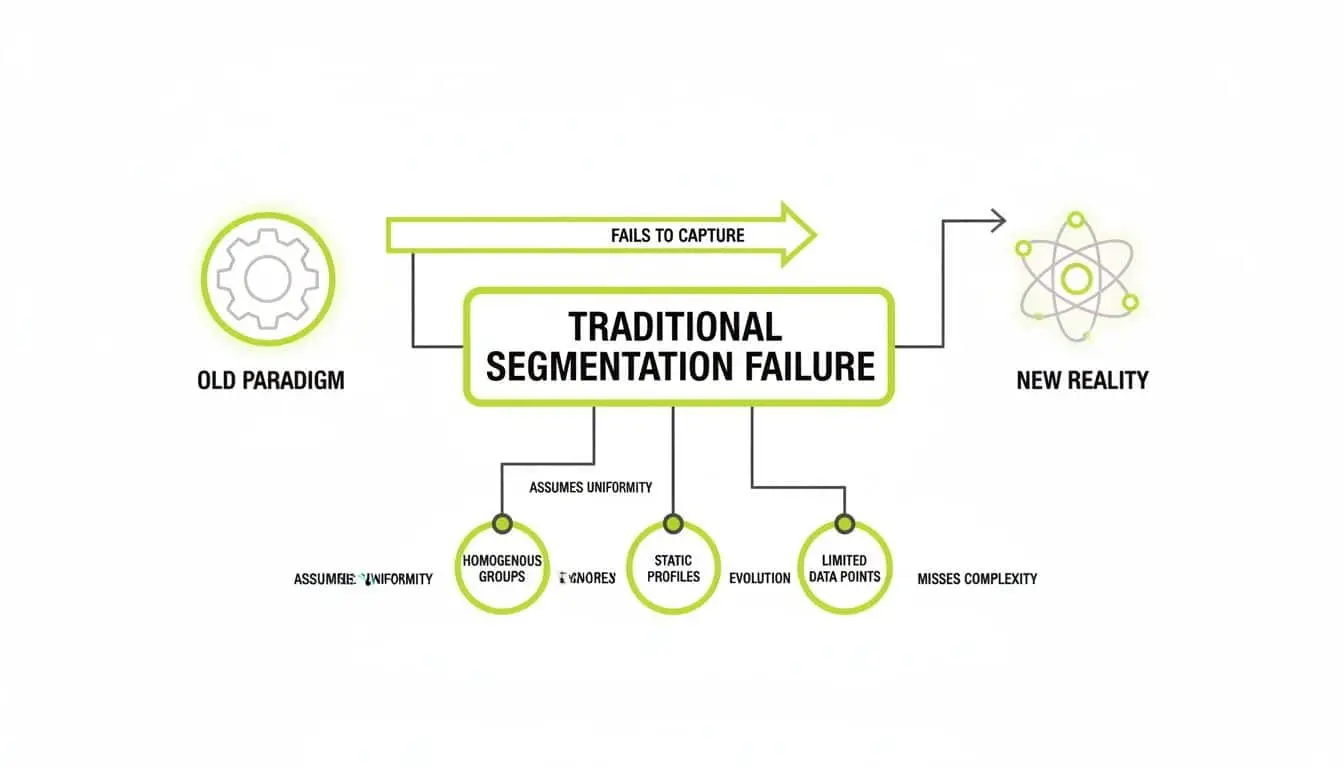
As you can see, we've moved past clunky, gear-like thinking. Modern buyers are far more complex, and our approach has to reflect that.
Firmographic Segmentation: The Who and What
Let’s start with the basics. Firmographic segmentation is the most traditional approach, and it’s probably the one you're already familiar with. It’s all about grouping companies by objective, easy-to-find attributes. This is your blueprint.
Common firmographic data points include:
- Industry: Grouping businesses by their sector, like healthcare, finance, or logistics.
- Company Size: Segmenting by the number of employees or annual revenue.
- Geographic Location: Targeting companies based on their city, state, country, or region.
- Company Structure: Differentiating between public corporations, private firms, and nonprofits.
Firmographics are essential, but relying on them alone is a fast track to missed opportunities. It tells you what a company is but gives you zero clues about the why. For example, two manufacturing firms with 500 employees might look identical on paper, but one could be a tech-savvy innovator while the other is struggling with legacy systems. They have completely different needs.
Technographic Segmentation: The How
This is where things get much more interesting. Technographic segmentation looks at the specific technologies a company uses. In our digital-first world, a company’s tech stack reveals a ton about its priorities, budget, and overall maturity.
Think about it. If you sell a marketing automation tool that integrates perfectly with Salesforce, why waste time on everyone? You can target companies that already use Salesforce. Right away, your pitch becomes ten times more relevant.
By understanding a company's technology adoption, you gain insight into their operational sophistication. A business investing in advanced analytics tools is fundamentally different from one still relying on manual spreadsheets.
Behavioral Segmentation: The When and Where
While firmographics and technographics describe the company itself, behavioral segmentation zooms in on the actions of the people inside those companies. It’s all about tracking how they interact with your brand, which tells you a lot about their interest and intent. This is how you find the prospects who are ready to talk.
You need to be tracking critical behavioral signals, such as:
- Website Activity: Which pages are they looking at? Did they hit your pricing page or download a specific case study?
- Content Engagement: Did they sign up for a webinar, download a whitepaper, or watch a product demo?
- Email Interaction: Are they opening your newsletters? Clicking on links to certain features?
These actions are powerful signals. Someone who read a single blog post is just starting to look around. But a prospect who visited your pricing page three times this week? They’re showing serious buying intent. This is where you get true data-driven customer insights.
Needs-Based Segmentation: The Ultimate Why
This is the most sophisticated—and most powerful—framework of all. Needs-based segmentation cuts through the noise and groups customers based on the specific problem they're trying to solve. It gets right to the heart of their motivation for buying anything.
Unlike B2C, B2B buyers operate on logic. They’re focused on ROI, efficiency, and scalability. Your segmentation has to match that mindset.
For instance, two companies could be in the market for the exact same project management software but for totally different reasons:
- Segment 1 (The Efficiency Seekers): Their main goal is to cut down on project delays and make their team more productive.
- Segment 2 (The Scalability Planners): They need a tool that can grow with their business as they expand into new markets.
When you understand these distinct needs, you can tailor your message to speak directly to each group’s biggest pain point. That’s how you make your solution feel less like an option and more like a necessity.
Using AI To Find Your Best Customers
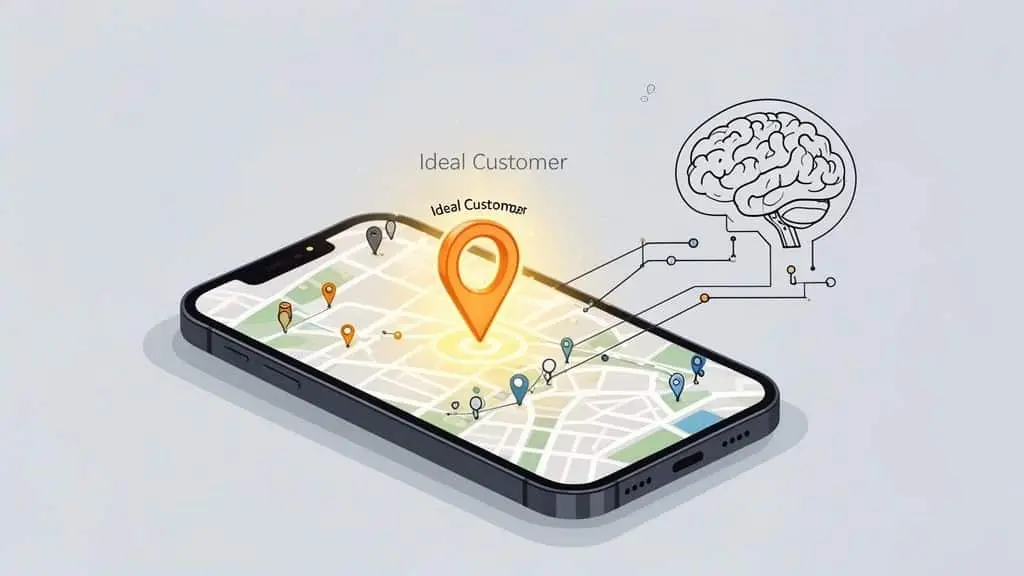
Laying out your firmographic, technographic, and behavioral data gives you a solid map of your market. But what if you could add real-time, predictive intelligence to that map? This is where B2B segmentation gets its real power—through Artificial Intelligence (AI).
Think of your basic segmentation strategy as a traditional road atlas. It shows you the cities (industries) and major highways (company sizes). AI, on the other hand, is like a smart GPS that not only has the map but also sees traffic, predicts jams before they happen, and finds the fastest, most efficient route to your best customers.
This elevates your strategy from a manual, list-building chore to an automated, intelligent system. You stop just reacting to what customers have done and start predicting what they will do.
Moving Beyond Manual Analysis
Let's be honest, manually sifting through mountains of data for patterns is a slow, painful process. Worse, it often misses the subtle connections that unlock the biggest opportunities. AI algorithms, however, can chew through enormous datasets in seconds, uncovering hidden correlations a human analyst might never find.
This is the core value of AI in B2B marketing segmentation. It finds the "unknown unknowns." It might discover, for instance, that companies visiting your blog at night from a specific region who also use a niche software are 300% more likely to convert. Good luck finding that micro-segment on your own.
AI transforms segmentation from a descriptive tool (what our customers look like) into a predictive powerhouse (who will become our best customer). It's the difference between looking in the rearview mirror and having a clear view of the road ahead.
This shift is already happening. Artificial intelligence has made B2B market segmentation far more precise, with a staggering 74% of B2B marketers now using AI models for customer segmentation. One-third have already deployed AI tools specifically for this, and they're seeing much higher engagement as a result. You can find more B2B marketing stats and discover how teams are getting results on seoprofy.com.
Practical AI Applications For Segmentation
So, how does this work in the real world? AI isn't just a buzzword; it has tangible applications that can directly sharpen your marketing performance. It’s about using technology to make smarter decisions, faster and at scale.
Here are a few ways it’s being put to work:
- Predictive Lead Scoring: Traditional lead scoring is based on rules you set (e.g., +10 points for visiting the pricing page). AI scoring is different. It analyzes all your past customer behavior to build a dynamic model of what a "great lead" actually looks like. It then scores new leads based on how well they fit that profile, giving your sales team a far more accurate list to prioritize.
- Churn Prediction: AI can analyze usage patterns, support ticket history, and engagement data to flag customers who are at risk of leaving. This allows you to create a "high-risk" segment and proactively reach out with support or special offers, saving revenue you might have otherwise lost.
- Identifying Upsell and Cross-sell Opportunities: By analyzing your current customer data, AI models can predict which accounts are ripe for an upsell or cross-sell. It might identify a segment using a specific feature set that signals they're ready for a higher-tier plan. You can then hit that exact group with a highly relevant campaign.
By turning raw data into concrete predictions, you give yourself a serious competitive advantage. You can check out our detailed guide and learn more about how digital marketing predictive analytics can be a game-changer for your business.
AI-driven segmentation lets you focus your resources with surgical precision. Instead of marketing to a broad industry, you can market to "manufacturing companies in the Midwest with declining software engagement and a high likelihood to churn in the next 90 days." That level of specificity is what separates good marketing from great marketing.
How To Build Your Segmentation Strategy
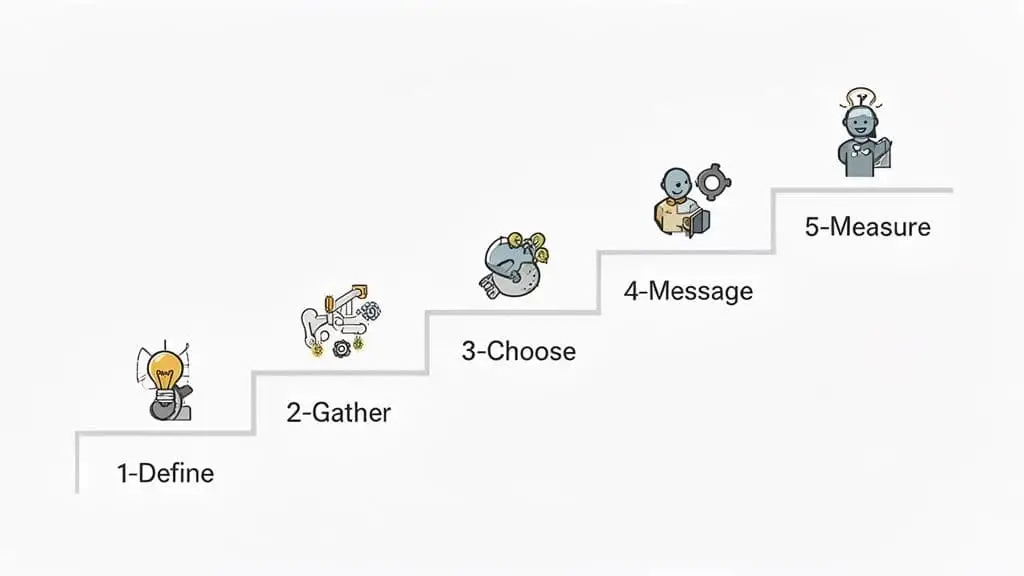
Knowing the different frameworks is one thing, but the real magic happens when you roll up your sleeves and put them to work. Building a smart B2B marketing segmentation strategy isn't some mystical art form; it's a methodical process. It’s how you move from interesting ideas to a solid plan that actually grows your business.
Think of it like an architect designing a building. You wouldn't just start throwing up walls. You'd start with a purpose (an office building or a home?), gather your materials (steel, glass, concrete), follow a detailed blueprint, and then construct it step-by-step. Your segmentation strategy needs that same disciplined approach.
Step 1: Start With Clear Objectives
Before you even think about data, stop and ask: what are we actually trying to accomplish? Without a clear "why," your segmentation project is just a fishing expedition with no map. Are you trying to crack a new industry? Stop valuable customers from leaving? Get existing clients to buy more?
Your goals are the North Star for this entire journey. They'll tell you what data to collect, which models to use, and how you’ll know if you’ve succeeded.
A few common objectives we see with B2B segmentation include:
- Driving new customer acquisition by targeting high-value lookalike accounts.
- Boosting customer lifetime value (LTV) by finding the perfect upsell and cross-sell moments.
- Improving lead quality so your sales team can focus on prospects ready to convert.
- Increasing customer retention by spotting at-risk accounts before they start looking elsewhere.
Step 2: Gather and Centralize Your Data
With your goals set, it’s time to gather your raw materials—the data. Great segmentation is built on a rich, 360-degree view of your market. This means pulling information from all corners of your business and beyond.
Your CRM is the obvious place to start, but that's just the beginning. The best strategies today unify data from sales tools, marketing automation platforms, and customer support systems. This is where a Customer Data Platform (CDP) really shines, acting as the central nervous system for all your customer intelligence.
The real aim here is to tear down data silos. When sales, marketing, and service data can all talk to each other, you finally get a complete picture of the customer journey and uncover insights that were invisible before.
For a bit of inspiration on how other businesses pull this off, our guide on customer segmentation examples is packed with different ways to structure and apply your data.
A good segmentation strategy relies on pulling data from multiple places. Below is a quick breakdown of where you can find the most valuable information.
Data Sources For Effective Segmentation
| Data Type | Source Examples | Primary Use |
|---|---|---|
| Internal Data | CRM (e.g., Salesforce), ERP Systems, Website Analytics (e.g., Google Analytics), Customer Support Tickets, Billing Information | Understanding current customer behavior, purchase history, engagement levels, and product usage. |
| External Data | Third-party data providers (e.g., ZoomInfo, Clearbit), Industry reports, Government databases, Social media analytics, Public financial filings | Enriching internal profiles with firmographic, technographic, and market-level details you don't own. |
By combining these sources, you move from a flat, one-dimensional view of your customers to a rich, multi-layered understanding that powers truly effective segmentation.
Step 3: Choose and Apply Segmentation Models
Now for the fun part. It’s time to analyze your unified data through the different lenses we talked about—firmographic, technographic, behavioral, and needs-based. The secret here is not to just pick one. The most powerful strategies layer these models on top of each other to create incredibly specific micro-segments.
For instance, you might start with a broad firmographic segment like, "SaaS companies with 50-200 employees." From there, you can start layering to get more specific:
- Technographic Layer: Filter for companies that use a specific competitor’s software.
- Behavioral Layer: Narrow it down to accounts that have visited your pricing page in the last 30 days.
- Needs-Based Layer: From that group, pinpoint those who have read blog posts about API integrations.
Just like that, you’ve gone from a generic bucket to a hyper-targeted segment: "Mid-sized SaaS companies using a competitor's tool, actively evaluating solutions, and specifically interested in integration capabilities." Now that's a segment your sales team can run with.
Step 4: Craft and Deploy Segment-Specific Messaging
You’ve done the hard work of identifying your most valuable segments. Now, it's time to actually talk to them. This is where all your effort pays off. Instead of one-size-fits-all marketing, you can create personalized campaigns that speak directly to each segment's problems, goals, and language.
Knowing how to apply these insights across your marketing channels is critical. For practical ideas, exploring these 10 B2B social media marketing strategies can give you a solid framework for reaching your new target segments where they are most active.
Step 5: Measure, Analyze, and Iterate
Segmentation is never a "set it and forget it" task. Markets shift, customer needs evolve, and your business goals will change. This last step is a continuous feedback loop: measure performance, analyze what the results are telling you, and refine your segments accordingly.
Keep a close eye on key performance indicators (KPIs) for each segment. Track things like conversion rates, customer acquisition cost (CAC), LTV, and sales cycle length. Are some segments outperforming others? Why? Use those answers to double down on what works and rethink what doesn't.
Real-World B2B Segmentation Success Stories
It’s easy to get lost in the theory behind B2B marketing segmentation. While the frameworks are essential, nothing makes the concept click quite like seeing it in action. It’s one thing to discuss data models; it’s another to see how those models directly create revenue and carve out a competitive edge.
Let's move from the whiteboard to the real world. The stories below show how two completely different companies used smart segmentation to solve their unique challenges and achieve incredible results. These aren't just hypotheticals—they're practical blueprints for success.
How a SaaS Company Slashed Its Sales Cycle in Half
Imagine a mid-sized SaaS company that sells logistics software. Their sales team was stuck in a frustrating loop. They were casting a massive net, spending months talking to leads that, in the end, were never going to buy. The sales cycle dragged on, conversion rates were flat, and the marketing budget felt like it was disappearing into thin air.
Their problem? They were using a single, blunt instrument: firmographics. They targeted any company in the "transportation and warehousing" industry with more than 250 employees. This meant they were wasting time on businesses that were a terrible fit for their technology and had no real interest in buying.
The marketing team knew something had to change. They decided to get surgical, layering two more segmentation models on top of their basic firmographic data. The goal was to build a laser-focused Ideal Customer Profile (ICP).
Technographic Segmentation: First, they brought in data enrichment tools. Their mission was to find companies already using a specific, complementary ERP system. This simple filter guaranteed their software would integrate seamlessly, knocking down a huge sales objection before it even came up.
Behavioral Segmentation: Next, they put their website engagement under a microscope. They created a special, high-intent segment for accounts that had not only viewed the pricing page but had also downloaded a specific case study on "reducing shipping delays."
By stacking these three layers, they created a powerful new target: Transportation companies with 250+ employees, using a specific ERP, who had recently shown active interest in solving shipping delays.
The shift in results was immediate and dramatic. The sales team stopped chasing ghosts and poured all their energy into this high-potential group. Marketing followed suit, crafting personalized ads and email campaigns that spoke directly to this niche audience's biggest headaches.
Within six months, the company saw a 45% reduction in their average sales cycle and a 30% increase in their lead-to-customer conversion rate. They weren't just closing deals faster; they were closing better, more profitable deals.
A Manufacturer’s Smart Entry Into a Crowded Market
Now for a different kind of challenge. A major industrial manufacturer was launching a new line of high-efficiency commercial HVAC units. The problem was that the market was already packed with established players. A big, splashy, and expensive marketing campaign would have been a surefire way to lose money.
They decided to play smarter, not louder. Instead of trying to out-shout the competition, they used segmentation to find a profitable corner of the market that everyone else was ignoring. Their strategy was a brilliant mix of firmographics and needs-based analysis.
Their research uncovered a specific, unaddressed pain point. Most competitors were focused on shiny new construction projects. But there was a massive, overlooked group of businesses stuck with aging, inefficient HVAC systems in older buildings, bleeding money on high energy costs.
This single insight became the foundation for a highly specific customer segment:
- Firmographics: Facility managers of commercial properties built between 1980 and 2000, with over 50,000 square feet of office space.
- Needs-Based: Their core need wasn't just a new HVAC unit. It was a solution that could deliver a measurable reduction in energy costs and a clear return on investment (ROI) within five years.
Armed with this precise profile, the manufacturer launched a sniper-like campaign. They skipped the generic industry ads and instead invested in content marketing. They created whitepapers, ROI calculators, and webinars all focused on the theme of "The Hidden Costs of Aging HVAC Systems."
Their sales team was retrained to speak the language of facility managers—talking about operational efficiency and long-term value instead of just product specs.
This precise B2B marketing segmentation allowed them to completely sidestep the competition. They became the go-to experts for a specific, high-value problem, carving out a dominant position in a niche their bigger rivals had never even noticed. Within two years, they had captured significant market share.
Common Questions About B2B Segmentation
Moving from the theory of B2B segmentation to actually putting it into practice can bring up a lot of tricky questions. It's one thing to understand the concept, but it's another thing entirely to make it work for your business.
Let's walk through some of the most common questions our clients ask. We'll clear up the confusion so you can build your strategy with confidence, sidestep the usual mistakes, and prove the value of your work.
How Is B2B Different From B2C Segmentation?
This is easily the most frequent point of confusion. While both B2B and B2C are about grouping audiences to market more effectively, the game is played on a completely different field. It’s like comparing selling a single family home to brokering a complex commercial real estate deal—the players, motivations, and timelines are worlds apart.
B2C Segmentation: This is all about the individual. Marketers focus on personal needs, lifestyle choices, and emotional triggers. The sales cycle is usually short, and the decision-maker is just one person. Think demographics (age, location) and psychographics (interests, values).
B2B Segmentation: Here, you’re selling to an organization, not a person. Decisions are almost always made by a buying committee, a group of people with different roles and priorities—like IT, finance, and the actual end-users. Sales cycles are much longer, stretching over months or even years, because the decision hinges on logic, ROI, and business-wide impact.
The biggest mental shift you need to make is from a single buyer to a complex buying committee. In B2B, you're not just selling to one person. You're selling to a finance manager who scrutinizes cost, a technical lead who worries about integration, and an executive who needs to see the strategic value—all at the same time.
What Are The Most Frequent Mistakes To Avoid?
Even with a solid plan, it’s remarkably easy to get segmentation wrong. Most of the time, it isn't from a lack of effort, but from a misstep in strategy. Knowing the common pitfalls is the best way to steer clear of them.
The first major error we see is over-segmenting. It's tempting to keep slicing your audience into dozens of tiny micro-segments. But this often creates groups so small that they’re impossible to target effectively. If a segment only has a handful of companies, the effort to create custom messaging simply won't pay off.
Another critical mistake is building your strategy on stale data. In the B2B world, data decays at an incredible rate. People switch jobs, companies get acquired, and tech stacks are swapped out constantly. A segmentation model built on year-old data is already broken. Regular data hygiene isn't just a "nice-to-have"; it's the foundation of any successful program.
How Do I Measure The ROI Of Segmentation?
Every marketing leader needs to justify their budget, and segmentation is no different. To get real buy-in from leadership, you have to connect your segmentation efforts directly to business results. This goes way beyond tracking clicks—it’s about showing a real impact on the bottom line.
The trick is to stop tracking performance in the aggregate and start tracking it per segment. This is how you'll discover which customer groups are truly the most profitable and, more importantly, why.
Build your ROI framework around these key metrics:
- Customer Acquisition Cost (CAC) per Segment: How much does it cost to land a new customer from each segment? You might be surprised to find that some of your highest-value segments are actually cheaper to acquire because your message just clicks.
- Customer Lifetime Value (LTV) per Segment: This is the North Star metric. Track the total revenue a customer generates throughout their relationship with you. The whole point of segmentation is to find the segments with the highest LTV.
- Sales Cycle Length per Segment: Measure the time from first touch to closed-won for each group. A shorter sales cycle is a direct signal of efficiency and a strong product-market fit for that segment.
- Win Rate per Segment: What percentage of your opportunities in each segment turn into deals? A high win rate is proof that you're targeting the right audience with the right message.
When you can walk into a meeting and show a clear report where the LTV for your top segments dwarfs the CAC, you've built an undeniable case for your strategy's ROI.
At Magic Logix, we specialize in turning complex data into clear, actionable segmentation strategies that drive growth. See how our expertise can help you find and win your most valuable customers. Learn more about our solutions.