
It's impossible to talk about great marketing without talking about great copywriting. They aren't just related; one simply cannot succeed without the other.
Think of it this way: marketing builds the strategy to find and attract an audience, but it's the copywriting that provides the message that gets them to listen and, more importantly, to act. A brilliant marketing plan without powerful copy is like a state-of-the-art race car with no fuel in the tank—it might look impressive, but it’s not going anywhere.
The Unbreakable Link Between Copywriting and Marketing
Let's stick with that race car analogy for a moment. Marketing is the entire race team. They’re the ones researching the track (your market), designing the car (your product or service), and mapping out the whole race strategy, pit stops and all. It’s the full-scale plan to get your solution in front of the people who truly need it.
Copywriting, then, is the skilled driver sitting behind the wheel. It is the art and science of using words to connect with your audience and steer them toward a specific action. That's the persuasive headline on your website, the clever caption on your social media, and the can't-ignore subject line in your email. Without a good driver, the whole machine just stalls on the starting line.
This powerful combination is what turns a potential customer’s mild interest into real, measurable business growth. Your marketing strategy gets the message seen by the right people, but it’s the words—the copy—that convince them to click, buy, or subscribe.
To see just how copywriting and marketing function, let's break down their distinct roles and shared goals.
Copywriting vs. Marketing Roles and Shared Objectives
| Dimension | Copywriting (The Engine) | Marketing (The Vehicle) |
|---|---|---|
| Primary Focus | The message—crafting words that persuade and convert. | The strategy—planning how to reach and engage the target audience. |
| Core Function | Communication. Articulating value, benefits, and calls to action. | Distribution. Selecting channels, managing campaigns, and analyzing data. |
| Key Deliverables | Website content, ad copy, email campaigns, landing pages, social media posts. | Market research reports, campaign plans, channel strategies, analytics dashboards. |
| Measurement | Conversion rates, click-through rates (CTR), engagement metrics, lead quality. | ROI, customer acquisition cost (CAC), market share, brand awareness. |
| Shared Goal | Driving profitable customer action and fostering brand loyalty. | Driving profitable customer action and fostering brand loyalty. |
As you can see, while their tasks are different, their ultimate destination is exactly the same: growing the business.
Why Persuasive Words Are More Important Than Ever
This isn't just a hunch; major market trends are proving the value of this partnership. The global copywriting services market is expected to skyrocket to $42.22 billion by 2030, growing at a compound annual rate (CAGR) of 7.6%. This explosion shows that businesses are finally getting it: they need sharp, persuasive writing to make their digital strategies work. You can find more details on copywriting market growth here.
This growth sends a clear message. In a marketplace that gets more crowded by the day, your words are the currency of connection and conversion. The ability to communicate with clarity and persuasion is what lifts successful brands above all the noise.
Copywriting isn’t just a part of marketing—it's the voice of your marketing. It’s what translates your high-level business goals into a language your customers actually understand and connect with.
Whether you're a local business here in Dallas trying to win over the neighborhood or a massive enterprise competing on a global stage, mastering this relationship is non-negotiable. It's how you:
- Build Your Brand's Perception: The words you choose directly shape how people feel about you.
- Fuel Real Customer Engagement: Good copy doesn't just talk at people; it invites them into a conversation.
- Drive Tangible Results: At the end of the day, strong copy is what asks for the sale and gets it, impacting your bottom line.
This guide is all about breaking down how to align these two critical functions to build campaigns that don't just reach people, but truly move them.
Understanding Words That Sell and Strategies That Win
If marketing designs the race car and plans the entire race, where does copywriting fit in? The classic definition is simple: copywriting is “salesmanship in print.” It’s the art and science of using words—written or spoken—to convince someone to take a specific action.
That action could be anything from clicking a "Buy Now" button, to signing up for a newsletter, or even booking a consultation call. It's the persuasive spark behind an email subject line you just have to open or the product description that makes you finally add an item to your cart. Truly great copywriting taps into a reader’s needs and emotions, making your desired action feel like their most logical next step.
While copywriting zooms in on that immediate call to action, marketing covers the entire strategic journey. Marketing is the whole process of figuring out who your ideal audience is, what problems keep them up at night, and positioning your product or service as the ultimate solution.
The Game Plan and The Playbook
Think of marketing as the team's general manager. It’s responsible for the high-level game plan, which means diving deep into things like:
- Audience Research: Who are your actual customers? What are their biggest struggles?
- Channel Selection: Where do they hang out online? Is it social media, search engines, or niche industry forums?
- Strategic Planning: What’s the main goal of this campaign? Is it brand awareness, lead generation, or driving direct sales?
Marketing maps out the entire customer journey from a 30,000-foot view. Copywriting then gets on the ground to craft the specific messages for every single touchpoint along that path.
If marketing builds the roadmap to get a customer from Point A (unaware of your brand) to Point B (a loyal fan), then copywriting writes the street signs, billboards, and personalized invitations that guide them at every turn.
Let’s say marketing research identifies that small business owners in Dallas are struggling with local lead generation. The strategy team decides the best way to reach them is through targeted search ads and a detailed blog post. Copywriting is what brings that strategy to life, writing the ad that says, "Tired of Unqualified Leads? Dallas Businesses Trust Us," and authoring the in-depth blog post that solves their specific problem. You can explore how to create these kinds of valuable resources in our guide on the power of long-form content.
Connecting the Dots for Conversion
The most powerful campaigns are born when these two disciplines work in perfect sync. A brilliant marketing strategy will fall flat if the ad copy is dull and uninspired. In the same way, the most persuasive copy on earth is completely useless if the marketing strategy puts it in front of the wrong people.
This synergy is absolutely crucial for your online presence. For example, understanding which words sell also means optimizing your search engine listings. The quality of your page titles and meta descriptions—a core copywriting task—is a huge factor in why SERP clicks impact SEO, which in turn directly affects your overall marketing visibility and website traffic.
At the end of the day, marketing answers the "who, what, where, and when." Copywriting delivers the "why"—why should this customer care, why should they trust you, and why on earth should they act right now? One provides the strategy, the other provides the soul.
Integrating SEO for Maximum Visibility and Impact
In the digital world, copywriting and search engine optimization (SEO) don't just work alongside each other anymore—they're completely intertwined. The old days of "keyword stuffing," where you could just jam a bunch of phrases onto a page and hope for the best, are long gone.
Today, real SEO success is all about understanding what your audience is really asking. It’s about answering their questions with content that is genuinely valuable, well-written, and persuasive.
This means your SEO work starts way before you even think about writing. It begins with deep keyword research, which is less about search terms and more about understanding people. This process shows you the exact words your potential customers use when they're looking for solutions, revealing their biggest frustrations, needs, and hopes.
When you grasp this search intent, your copywriting can go from just describing a product to building a real connection. You can take those insights and weave them into brand stories, product pages, and blog posts that truly click with your audience.
From Keywords to Compelling Copy
The first step is to stop thinking of keywords as just search queries. Think of them as a direct line into your audience’s mind. A search for “best CRM for small business” isn't just about software; it’s a business owner looking for a way to get organized, be more efficient, and finally grow.
Your job as a copywriter is to speak to that deeper need. This is where the magic happens between copywriting and marketing. Your marketing strategy points you to the right keyword, and the copywriting crafts an empathetic, benefit-focused message that says, "We get the struggle, and this is exactly how we help."
SEO provides the raw material—the search queries—while copywriting refines it into a finished product: a message that not only ranks high but also converts that hard-won traffic into loyal customers.
This integration is so crucial that businesses are making it a top priority. In fact, it's projected that by 2026, over 92% of marketers will be actively using SEO for both traditional and AI-powered search engines. This focus makes perfect sense, as website, blog, and SEO efforts were the #1 channel for generating ROI for B2B brands in 2024. You can find more of these critical marketing statistics on HubSpot.com.
Structuring Content for People and Search Engines
Once you have your keyword insights and your core message ready, the next move is to structure your content so it satisfies both human readers and search engine algorithms. This is where technical SEO meets the art of persuasion.
A well-organized article is essential for both readability and ranking. You can get a better sense of how these foundational elements work together by learning more about SEO site architecture. The key pieces include:
- H1 Tag: This is your main headline. It has to grab attention and include your primary keyword, instantly telling visitors and search engines what your page is all about.
- H2 and H3 Subheadings: Use these to break your content into smaller, scannable sections. Weave in related keywords and questions to cover the user’s intent from all angles.
- Meta Description: Think of this as your 160-character sales pitch on the search results page. It's pure copywriting, written to convince someone to click your link instead of a competitor’s.
- Internal Linking: Linking to other relevant pages on your own website helps search engines understand the context of your content and keeps visitors on your site longer.
Ultimately, weaving SEO into your copywriting and marketing isn't a final task to check off a list; it's a fundamental mindset. It ensures every word you write does two jobs: attracting organic traffic through search and turning that traffic into real business results. It’s the key to getting seen and making an impact.
Using Data to Craft Audience-First Messaging
Effective copywriting and marketing is no longer a guessing game. The days of shouting generic promises into the void are over. The most successful campaigns are built on a solid foundation of data, turning creative intuition into something far more predictable.
This is the very heart of audience-first messaging. It’s a strategy where you use customer insights and analytics to build a deep, genuine understanding of who you’re talking to. Instead of relying on vague assumptions, you dig into real data to uncover their true motivations, specific pain points, and what really makes them hesitate before buying. This is how you craft copy that connects on a personal level.
From Demographics to Deep Personas
Basic demographic data—like age, location, and job title—is a start, but it’s just the tip of the iceberg. Truly powerful messaging comes from building rich, detailed audience personas that feel like real people.
To get there, you need to look at both quantitative and qualitative data:
- Quantitative Data: This is the "what." It includes website analytics (which pages they visit), purchase history, and email engagement rates (which links they click).
- Qualitative Data: This is the "why." You find it in customer surveys, interview transcripts, support tickets, and online reviews. This is where you uncover the emotions and stories behind the numbers.
This approach helps you see beyond a simple customer profile. For instance, a Dallas-based marketing manager isn't just a job title. Data might reveal she’s overwhelmed by manual reporting, struggles to prove ROI to her boss, and is actively searching for automation tools. Now you have a real story to work with.
Translating Data into Resonant Copy
Once you have this rich understanding, the next step is to translate it directly into powerful copy. The goal is to shift from talking about your features to articulating their benefits in your customer's own language.
Instead of a generic promise like, "Our software is efficient," data-driven copy says, "Our software saves SaaS marketing teams 10 hours a week on reporting."
That kind of specificity does two critical things: it shows you understand their exact problem, and it makes your promise tangible and believable. You’re no longer just another vendor; you’re a problem-solver who gets it. This process of using data-driven customer insights is what separates copy that gets ignored from copy that gets results.
This strategic alignment of research, writing, and ranking is fundamental to how modern marketing works. The flow is pretty straightforward.
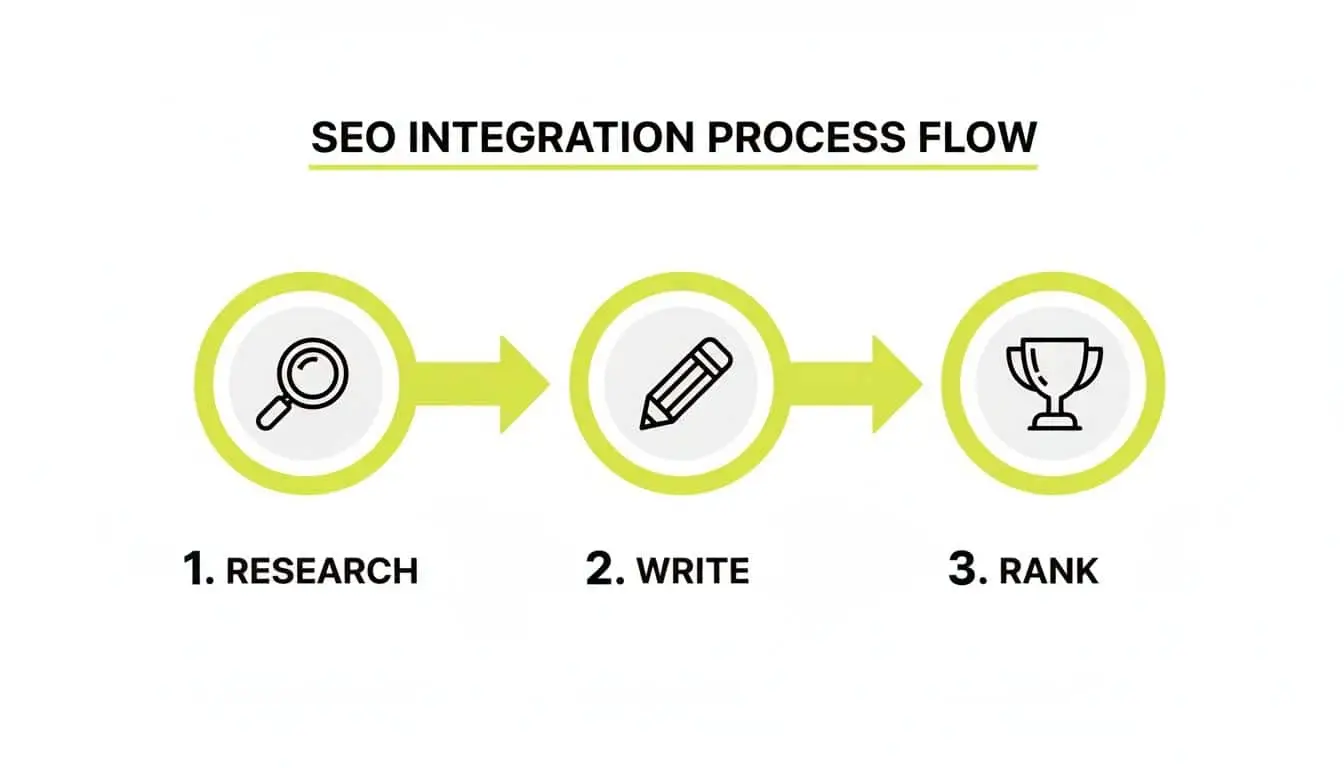
This simple model shows that success isn't random. It’s a repeatable system where solid research directly informs the writing, which in turn leads to better ranking and visibility.
The Financial Impact of Targeted Content
This data-first approach isn't just about making customers feel understood; it delivers serious financial returns. The global content marketing industry—powered by great copy—is on track to generate $107 billion in revenue by 2026.
Data from 2025 shows that blog posts were a top-5 performer for ROI, and small businesses that used targeted content saw returns that were 23% higher than their less-focused competitors. If you want to dive deeper into the numbers, you can discover more insights about content marketing statistics on DesignRush.com.
These numbers prove a simple truth: the more relevant your message, the more likely your audience is to convert. By using data to guide your copywriting, you build trust, improve conversion rates, and create a powerful competitive advantage. You stop selling and start solving—and that's the most effective way to win customers for life.
Proven Blueprints for SMBs and Enterprises
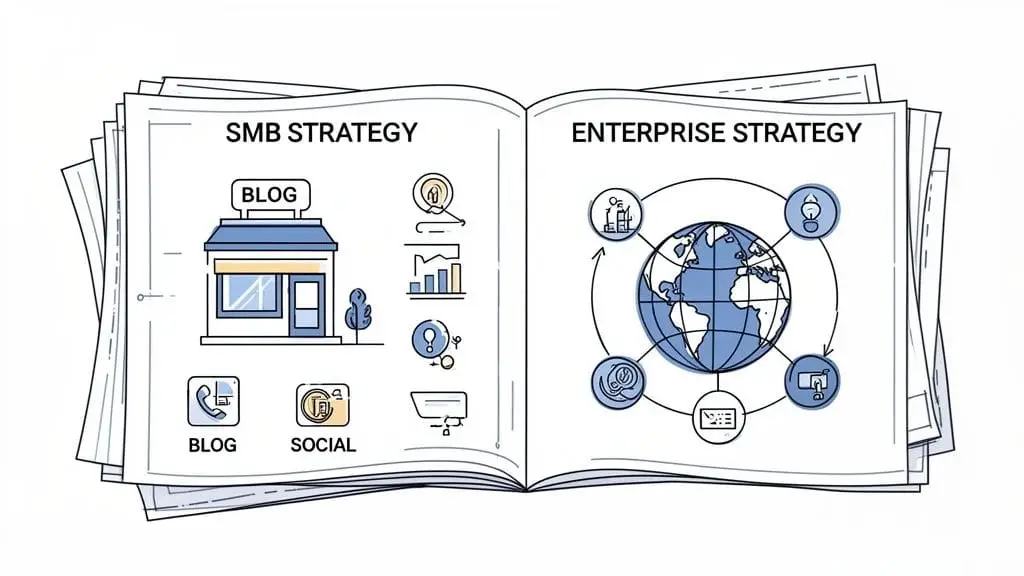
It’s one thing to talk about theory, but it’s another to see how these strategies actually play out in the real world. While the core principles of great marketing and copywriting are universal, the way you apply them shifts dramatically depending on your company's size, budget, and ambitions.
Let's break down two different blueprints. We’ll look at how a small local business can use smart, targeted copy to dominate its neighborhood, and then we'll see how a major corporation approaches a global launch.
The SMB Blueprint: Local Market Domination
Imagine a local plumbing company right here in Dallas. Their goal is straightforward: get more calls from homeowners who need a reliable plumber within a 20-mile radius. They don't have a bottomless budget, so their marketing has to be sharp, focused, and build immediate trust.
The marketing team knows their customers aren't just looking for a plumber; they're searching for answers to urgent problems. Think searches like "how to fix a leaky faucet" or "emergency plumber in Dallas." A quick client survey backs this up, revealing that 33% of people read blog posts to learn something new. This makes a content-first strategy the perfect path forward.
The plan is to create a series of genuinely helpful blog posts that tackle these exact questions, positioning the company as a local expert, not just another service on a list.
Copywriting in Action:
- Blog Post Copy: The articles are written in a friendly, no-nonsense tone. They ditch the technical jargon for clear, step-by-step guides. A post on fixing a leaky faucet empowers the homeowner to try a simple fix but also clearly explains when it’s time to call in a professional.
- Local SEO Copy: Every corner of the website—from the homepage to the blog—is infused with local keywords like "Dallas plumber" and "emergency plumbing service." The "About Us" page isn't a generic corporate statement; it tells the story of a family-owned business with deep roots in the Dallas community.
- Social Media Copy: The team shares quick tips from their blog in local Dallas Facebook groups. The copy is direct and valuable: "Dealing with a constant drip? Here are 3 quick things you can check before calling a pro. #DallasHomeowner"
The result is a perfect partnership. The marketing strategy targets real customer problems, and the copywriting delivers the solution with helpful, trustworthy language. This synergy drives organic search traffic, builds a loyal local following, and, most importantly, makes the phone ring with high-quality leads.
The Enterprise Blueprint: Global Product Launch
Now, let's shift to a massive tech corporation rolling out new project management software across the globe. The audience here is huge and varied—from nimble startups to entire departments at Fortune 500 companies. The objective is market leadership and mass adoption.
Their research shows that business leaders use platforms like LinkedIn to find insights from trusted experts in their field. So, a major part of the strategy is to partner with industry influencers. The campaign is a full-scale assault, including hyper-targeted ads, a high-value webinar, and a polished email nurture sequence.
Copywriting in Action:
- Ad Copy: The ads are not one-size-fits-all. For startups, the headline screams, "Stop Juggling Tasks. Start Shipping Products." For the enterprise audience, it’s more refined: "The OS for Modern Work. Scalable. Secure. Seamless." Each ad hits a very specific nerve.
- Landing Page Copy: The main landing page is a masterclass in persuasion. It uses powerful, benefit-driven headlines and is loaded with social proof—logos of early adopters and glowing testimonials. The copy doesn't just list features; it sells outcomes like boosted productivity and faster project delivery.
- Email Nurture Copy: The moment someone signs up for the webinar, they enter a carefully crafted email sequence. The copy is designed to build anticipation. The first email confirms their spot, the second offers a "sneak peek" of the software, and the third features a powerful testimonial from a beta tester.
This entire campaign is a textbook example of copywriting and marketing working in lockstep. Marketing orchestrates the grand plan to capture attention, while copywriters create precise, compelling messages for every single touchpoint. The result is a blockbuster global launch that achieves instant market traction and generates thousands of sign-ups.
Copywriting Application Across Business Scales
To really see the difference, it helps to compare the two approaches side-by-side. The table below illustrates how the same strategic element is adapted for a local SMB versus a global enterprise.
| Strategic Element | SMB Application (e.g., Local Service Business) | Enterprise Application (Global Corporation) |
|---|---|---|
| Primary Goal | Generate local leads; build community trust. | Capture market share; establish global brand leadership. |
| Audience | Geographically-defined local homeowners or businesses. | Diverse segments (startups, mid-market, enterprise) across multiple countries. |
| Tone of Voice | Personal, neighborly, trustworthy, and helpful. | Authoritative, polished, innovative, and aspirational. |
| Key Channels | Local SEO, Google Business Profile, community social media, targeted local ads. | Multi-channel: LinkedIn, global PR, content syndication, large-scale paid ads, influencer marketing. |
| Core Message | "We're the reliable, expert choice in your neighborhood." | "We provide the definitive solution for productivity at scale." |
| Call to Action | "Call now for a free estimate." "Schedule your service today." | "Request a demo." "Start your free trial." "Watch the webinar." |
As you can see, the scale and language change, but the fundamental job of the copywriter remains the same: to connect with a specific audience and inspire them to take a specific action.
Measuring Success and Proving Your ROI
In marketing, every single dollar needs to be accounted for. You can have the most brilliant copy and a killer marketing strategy, but at the end of the day, they’re judged by the results they deliver. That means we have to look past feel-good "vanity metrics" like likes or shares and get serious about what actually drives business growth.
To really prove your work’s value, you need to measure its financial impact. This is where Key Performance Indicators (KPIs) come into play. These aren’t just random numbers on a dashboard; they're the direct link showing how your words are turning into revenue. KPIs give you the hard data you need to justify your budget, guide your next move, and show everyone the powerful connection between copywriting and marketing.
Focusing on Business-Critical KPIs
If you want to truly understand how your copy is performing, you have to track the metrics that tie directly to your bottom line. These KPIs tell a story about your customer’s journey and show you just how effective your message is at every single step.
Here are the essential metrics every business, from a Dallas startup to a global enterprise, should be watching:
- Conversion Rate: This is the ultimate test of persuasive copy. It's the percentage of people who take the action you want them to—whether that’s buying a product, signing up for a demo, or downloading a resource. A low conversion rate is a huge red flag that your message isn't connecting with your audience's needs.
- Click-Through Rate (CTR): This metric tells you if your headlines and calls to action are doing their job. It measures how many people actually clicked your ad, email link, or search result versus how many just saw it. A high CTR means your copy grabbed their attention and made them curious enough to learn more.
- Cost Per Acquisition (CPA): This one is simple: how much did it cost to get that new customer? By tracking CPA, you can see if your marketing spend is actually efficient and pinpoint which channels and messages are giving you the best bang for your buck.
- Customer Lifetime Value (CLV): Great copywriting doesn’t just land the first sale; it starts a relationship. CLV tracks the total revenue you can expect from a single customer over time. When you build loyalty with your words, you encourage repeat business, which drives up CLV and long-term profitability.
For businesses looking to quantify how well their social media copy is working, understanding how to measure social media ROI adds another crucial layer of data to prove its value.
Connecting Copywriting Changes to Performance
The most powerful way to prove the ROI of great copywriting? Directly connecting a change in your message to a change in your numbers. This is where A/B testing becomes your best friend.
A/B testing, or split testing, allows you to compare two versions of a single piece of content—like a headline, an email subject line, or a button—to see which one performs better. It removes the guesswork and provides concrete evidence of what works.
Let's say you're running an ad campaign. You can test two completely different headlines against each other:
- Headline A: "High-Quality Project Management Software"
- Headline B: "Finish Projects 20% Faster With Our Software"
After running the test, you might discover Headline B gets a 35% higher click-through rate and leads to a 15% higher conversion rate. Now you have undeniable proof that a benefit-focused headline delivers a much better return. You can dig deeper into what makes certain messages connect by exploring our guide on measuring digital marketing effectiveness.
When you consistently test and measure, you create a powerful feedback loop. The data from your KPIs tells you what to adjust in your copy, and those adjustments lead to even better performance. This methodical approach turns copywriting from a purely creative art into a predictable, data-driven engine for business growth.
Your Questions on Copywriting and Marketing Answered
Even with a solid grasp of the fundamentals, putting copywriting and marketing into practice always brings up a few real-world questions. Let's tackle some of the most common ones we hear from businesses just like yours.
What Is the Single Most Important Difference Between Copywriting and Content Writing?
The simplest way to think about it comes down to their immediate goal. Copywriting aims to persuade a reader to take a very specific, immediate action—buy now, sign up, or book a call. Its success is tied directly to conversion rates.
Content writing, on the other hand, plays the long game. It focuses on informing, educating, or entertaining your audience to build brand awareness and establish trust over time. You could say copywriting is the "closer," while content writing is the "relationship builder."
How Can a Small Business with a Limited Budget Improve Its Copywriting?
You don't need a massive budget to see real results; you just need to focus your efforts on high-impact areas. First, get crystal clear on your Unique Value Proposition (UVP). What makes you the absolute best choice for a customer? Make sure that message is front and center on your homepage.
Next, go through your main product or service pages. Rewrite them to focus on the customer's benefits, not just your list of features. Finally, make sure every single page has a clear and compelling Call-to-Action (CTA). Getting these fundamentals right delivers a powerful punch without breaking the bank.
With the Rise of AI, Is Learning Copywriting Still Valuable?
Absolutely, and it's arguably more valuable than ever before. While AI tools are fantastic for generating text quickly, they simply can't replicate the empathy, strategic insight, and deep brand understanding a skilled human copywriter brings to the table.
As the internet becomes flooded with generic, machine-generated content, copy that is genuinely strategic and speaks to human emotion stands out even more. The future isn't about AI replacing humans; it’s about skilled copywriters using AI as a powerful assistant to boost their own creativity and efficiency.
At Magic Logix, we build marketing strategies that blend creative copywriting with data-driven insights to deliver tangible results. See how our approach can work for you at https://www.magiclogix.com.