
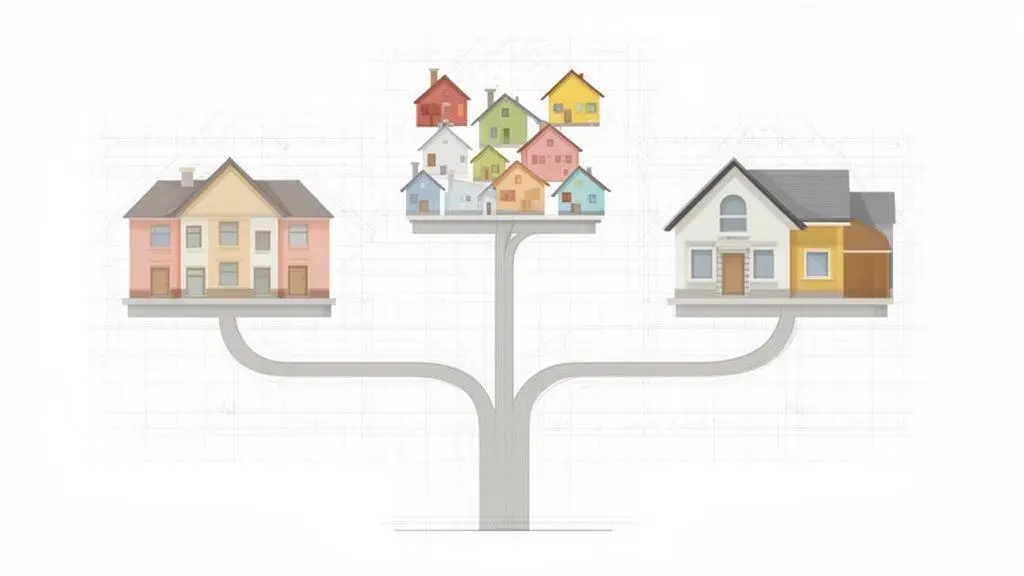
Brand architecture is simply the blueprint that organizes your company's brands, services, and products. Think of it as a family tree for your business—it maps out the relationships between the parent company and all its different ventures, making sure the entire system makes sense to your customers.
The Foundation of a Strong Brand Portfolio
Have you ever tried to build a house without a blueprint? You’d probably end up with doors leading nowhere and windows in closets. It would be a confusing mess for anyone trying to navigate it. The same thing happens when a company grows without a clear brand architecture. New products launch, acquisitions happen, and before you know it, your brand portfolio is a tangled web.
A strong brand architecture is the strategic framework that prevents this chaos. It clearly defines how your main corporate brand, your sub-brands, and even your individual product lines connect to one another. This structure is absolutely essential for guiding marketing decisions, shaping how customers see you, and paving a clear path for future growth.
Without it, you’re just asking for trouble. You risk confusing your customers, weakening your brand’s overall power, and even sparking internal competition where your own products are fighting for the same audience.
Brand architecture isn't just about organizing logos on a chart; it's about building a system that creates clarity, synergy, and strategic advantage. It ensures that the whole of your brand portfolio is greater than the sum of its parts.
Why Brand Architecture Is Non-Negotiable
A well-defined architecture turns your brand from a loose collection of assets into a powerful, unified force. It has a direct impact on your bottom line by making your marketing far more efficient and your brands more memorable. In fact, research shows that organizations with a clear architecture achieve 3.5 times more visibility than those without one.
This isn't just theory. Here are the key strategic advantages you gain:
- Enhanced Customer Clarity: It helps customers easily figure out what you offer and how everything connects. This builds trust and makes their buying decisions a whole lot simpler.
- Improved Marketing Efficiency: When your brands are logically linked, you can create powerful marketing synergies. This reduces costs and guarantees a consistent message, no matter where customers interact with you.
- Stronger Brand Equity: A structured portfolio lets each brand build on the strengths of the others, transferring positive associations and credibility from one to the next. This is a vital piece of building a valuable brand, and you can learn more by exploring the fundamentals of brand positioning.
- Strategic Growth and Flexibility: It gives you a clear roadmap for adding new products or acquiring other companies without creating brand confusion or hurting your core identity.
Ultimately, brand architecture isn't about creating restrictive rules. It’s an enabling framework that brings order to complexity, giving you the power to manage your portfolio with intention.
Here’s a quick summary of the core benefits.
Core Benefits of a Strategic Brand Architecture
| Benefit | Impact on Your Business |
|---|---|
| Clarity and Cohesion | Customers understand your offerings and navigate your brand with ease. |
| Marketing Synergy | Marketing efforts for one brand can positively impact others, increasing ROI. |
| Targeted Segmentation | You can effectively target different market segments without diluting the parent brand. |
| Protected Brand Equity | Establishes clear roles for each brand, preventing cannibalization and preserving value. |
As you can see, the impact is felt across the entire business, from customer perception all the way to your financial returns.
Alright, we've established that brand architecture is far more than just a fancy flowchart—it’s a strategic backbone for your entire business. But what does it actually look like in the wild?
Most companies rely on one of three core playbooks to organize their brands. Each one offers a totally different way to manage the relationship between a parent company and its products, influencing everything from customer perception to marketing budgets.
Getting this right is a make-or-break decision. It dictates how you present your offerings to the world, how they share (or don't share) brand equity, and how much room your company has to grow.

As you can see, this isn't just a theoretical exercise. The structure flows from the very top of the company right down to the products people pull off the shelf.
Let's break down the three models you'll encounter.
The Branded House Model
The Branded House model is the simplest and most unified approach out there. Think of it as a powerful family name where every single product and service proudly carries that same name. The master brand is the undisputed star of the show.
This approach creates incredible clarity and consistency. Every new launch doesn't just stand on its own; it reinforces the power and recognition of the master brand. It’s all about synergy, where the parent company’s reputation gives every individual product a leg up.
Apple is the textbook example. The iPhone, iPad, and MacBook all live under the mighty Apple brand. This creates a seamless ecosystem where the trust customers have for Apple automatically extends to any new product they drop. It's a strategy that has helped fuel Apple's climb past a $3 trillion market cap. In fact, research shows that a well-executed branded house can slash marketing costs by 20-30% thanks to these efficiencies.
What to like about a Branded House:
- Marketing Efficiency: You're promoting one brand, not a dozen. This cuts down on spending and creates massive brand recognition.
- Strong Brand Equity: Every product hit strengthens the master brand, creating a powerful, self-reinforcing cycle.
- Customer Trust: New products launch with instant credibility, inheriting the reputation you've already built.
What to watch out for:
- High Risk: The downside of unity. One bad product or PR scandal can tarnish the entire brand family.
- Limited Flexibility: A single, strong brand identity can make it tough to stretch into new markets or serve completely different audiences.
The Branded House strategy is a big bet on the power of a single, unified story. It’s a perfect fit when your products all share a common purpose and target audience.
The House of Brands Model
On the complete opposite end of the spectrum, you have the House of Brands. This model is all about managing a portfolio of distinct, individual brands, while the parent company often stays completely invisible to the public.
Think of it like a quiet, behind-the-scenes owner of a championship sports team. Each star player has their own persona, fanbase, and endorsement deals, and nobody really knows or cares who signs their checks. The parent company manages the portfolio, but the individual brands are the heroes.
Procter & Gamble (P&G) wrote the book on this. Most of us buy Tide, Gillette, and Pampers without ever connecting them back to P&G. This separation is intentional. It lets each brand absolutely dominate its niche without getting in the way of the others. A killer brand and positioning strategy is absolutely essential for every single product in this kind of setup.
What to like about a House of Brands:
- Targeted Marketing: Each brand can be perfectly crafted for a specific audience, allowing for razor-sharp positioning.
- Risk Containment: If one brand stumbles, the damage is isolated. It won’t bring down the parent company or the rest of the portfolio.
- Market Dominance: A company can own several competing brands in the same category, gobbling up a much larger slice of the market.
What to watch out for:
- High Cost: This is an expensive game to play. Every brand needs its own dedicated budget for marketing, R&D, and staffing.
- No Synergy: The individual brands are on their own. They don't get to borrow any reputation or equity from the parent or sibling brands.
The Hybrid Model
What if you want the best of both worlds? That’s where the Hybrid Model comes in. Also known as an endorsed or sub-branding strategy, it’s a smart blend of the first two approaches.
Here, the master brand gives a clear "stamp of approval" to its sub-brands, lending them credibility while still letting them have their own unique identities. The connection is obvious, but the sub-brands have enough room to breathe and connect with their specific audiences.
Marriott Bonvoy is a perfect example. The Marriott name endorses a whole range of hotel brands, from The Ritz-Carlton to Courtyard. Each hotel has its own vibe and price point, but the Marriott name behind them all signals a consistent promise of quality. This model offers the flexibility to cater to different markets without diluting the power of the core brand.
Brand Architecture Models at a Glance
Choosing between these models is a major strategic decision. This table breaks down the core differences to help you see which playbook might be the best fit for your business.
| Model | Core Concept | Best For | Key Risk |
|---|---|---|---|
| Branded House | A single master brand across all offerings. | Companies with a strong, focused value proposition and shared audience. | A single product failure can damage the entire master brand. |
| House of Brands | A portfolio of independent, standalone brands. | Companies targeting diverse markets with different needs and price points. | Extremely high marketing costs and a lack of brand synergy. |
| Hybrid | Sub-brands endorsed by a master brand. | Complex businesses needing both corporate credibility and niche targeting. | Can create confusion if the relationship between brands isn't clear. |
Ultimately, there's no single "right" answer. The best architecture is the one that supports your business goals, clarifies your offerings for customers, and sets you up for sustainable growth.
How to Choose the Right Brand Architecture
Picking a brand architecture isn't just a creative exercise of shuffling logos around on a PowerPoint slide. It’s a core business decision, one with massive, long-term consequences. Get it right, and you can build tremendous brand equity and fast-track growth. Get it wrong, and you’re looking at customer confusion, drained marketing budgets, and a hard ceiling on your potential.
This is where the theoretical models we've talked about meet the messy, practical reality of running a business. A model that looks perfect on paper is worthless if it doesn't mesh with your company’s real-world operations and future plans. It’s all about looking inward first.
Start with Strategic Questions
Before you can decide which path to take, you have to know exactly where you're standing. The answers to these questions create the foundation for your entire strategy, guiding you to the architecture that actually fits your business. Don't gloss over this part; the honest truth here is what makes the whole thing work.
Start by asking the tough questions:
- Who are our customers? Are we selling to one big happy family, or are our products aimed at completely different tribes that never interact?
- What is our brand promise? Does everything we offer ladder up to a single, powerful value proposition, or does each product have its own unique story to tell?
- What are our financial realities? Let's be honest—can we actually afford to build and market several distinct brands from scratch, or do our resources need to be pooled for maximum impact?
- How much risk can we tolerate? If one of our new ventures goes down in flames, can our main brand take the hit, or do we need a firewall to protect its reputation?
These questions aren't just branding fluff. They force you to get to the heart of your business strategy and make choices based on what's real, not just what looks good.
Aligning Architecture with Business Goals
Your brand architecture absolutely must support your larger business strategy. It’s a tool, not a decoration. Whether your five-year plan is all about rapid diversification or dominating a single, focused niche, your brand structure has to help you get there.
A brand architecture is a strategic tool, not a decorative one. Its primary job is to help the business achieve its objectives. If the structure and the strategy are not in sync, both will eventually fail.
Think about where you're headed. If your company’s growth plan involves acquiring competitors in totally different industries, you'll probably lean toward a House of Brands model. This keeps each new business distinct, insulates the parent company from risk, and lets each acquired brand keep its hard-won customer base. It’s the ultimate playbook for a portfolio-driven strategy.
On the other hand, a startup that’s trying to build a powerful name around a single, game-changing idea will get way more mileage from a Branded House model. Every new product or feature reinforces the master brand, creating a halo effect that builds recognition and trust with incredible speed. This approach is tailor-made for focused growth and market domination.
Consider Your Culture and Equity
Finally, the structure you choose has to feel right for your internal culture and your long-term goals for brand equity. A decentralized, entrepreneurial company culture might completely suffocate under the strict, top-down command of a monolithic Branded House. But a highly collaborative, integrated organization would thrive in that same environment.
Don't forget to weigh these critical factors:
- Company Culture: If your culture celebrates autonomy and specialization, a House of Brands can be a perfect fit, allowing GMs to run their brands almost like independent startups.
- Future Flexibility: Do you see your company entering markets that have nothing to do with your current business? A Hybrid or House of Brands model gives you the freedom to launch new, unrelated brands without stretching your core identity until it breaks.
- Brand Equity Transfer: How vital is it that your master brand’s reputation and trust flow down to new products? If that's a top priority, then an Endorsed or Branded House structure is non-negotiable.
By working through these layers—self-assessment, business alignment, and cultural fit—you stop just "picking a model." Instead, you start designing a brand architecture that will actively work to build and secure your company's future.
Your Guide to Designing a Brand Architecture

Alright, you've picked a model. Now comes the real work: turning that theory into a living, breathing system for your business. This isn’t something you can knock out in a quick meeting. It’s a serious project that unfolds in two main phases: the Audit and the Design.
Think of it like renovating an old house. You wouldn’t just start swinging a sledgehammer. First, you need to survey the property, check the foundation, and see which walls are solid and which are about to crumble. That’s your Audit. Only after you understand what you're working with can you draw up the blueprints for what it will become. That’s your Design.
This two-step process makes sure your final architecture is actually built to solve real problems and stand the test of time, not just look good on a PowerPoint slide.
Phase 1: The Brand Architecture Audit
The Audit is your diagnostic phase. It’s all about getting an objective, data-backed picture of where your brands stand today. This isn't the time for gut feelings or office politics. It’s about gathering cold, hard evidence.
First thing's first: map out your entire brand portfolio. I mean everything. Create a visual chart of every single brand, sub-brand, and product line your company owns. Just seeing it all laid out in one place often uncovers shocking overlaps and messy connections that have been hiding in plain sight for years.
From there, you dig deeper to uncover what’s really going on.
Key Audit Activities:
- Mapping the Portfolio: Visually chart every brand and product. Who owns what? How are they currently linked? This map is your ground zero.
- Pinpointing Confusion: Where are customers getting mixed signals? Do two products have similar names but totally different functions? Is the link between a sub-brand and the parent company a total mystery to the outside world?
- Assessing Internal Overlap: Look for "brand cannibalization"—where your own products are fighting each other for the same customers and marketing dollars. It’s a classic symptom of a portfolio that grew without a plan.
- Understanding Perceptions: Ditch the guesswork. Use surveys, social media sentiment analysis, and customer reviews to find out how people actually see the relationships between your brands.
The whole point of an audit is to replace assumptions with facts. It gives you the unvarnished truth about your brand structure, which is the only solid foundation to build on.
A solid audit gives you the "why" for this entire project. It's the evidence you need to build a business case, get leaders on board, and secure the resources to do it right. You may also want to check this against your bigger-picture strategy; this guide on how to write a marketing plan can be a great place to start.
Phase 2: The Brand Architecture Design
With your audit done, you have the data you need to start the creative and strategic work of the Design phase. You know what's broken, so now you can architect the solution. This is where you build the future, defining everything from the high-level structure to the nitty-gritty rules of engagement.
This is all about making intentional choices that support your business goals and the architecture model you've chosen. The goal is to produce a crystal-clear, documented system that anyone in the company can pick up and use.
Your design process should tackle a few core components, one by one.
Core Design Components:
- Model Finalization: Based on your audit, lock in your choice: a Branded House, House of Brands, or Hybrid model.
- Hierarchy Definition: Clearly define the pecking order. What’s the corporate brand’s job? What are the roles for sub-brands and endorsed brands?
- Naming Convention Rules: Create simple, unbreakable rules for naming new products. A Branded House, for example, might require all new products to follow the "Master Brand + Descriptor" format (like Apple Watch).
- Visual System Guidelines: Define how logos, colors, and fonts will signal relationships. Do all brands share one look and feel, or do they get their own distinct identities?
It is absolutely critical that you don't do this in a vacuum. The design process has to involve key players from marketing, sales, product, and operations. Without their input, even the most brilliant architecture will be dead on arrival. Their involvement makes sure the final plan is not just smart, but practical.
Critical Tips for a Successful Process
Starting a brand architecture project is a major undertaking. To make sure you get to the finish line with a result that works, keep these tips in your back pocket.
- Secure Executive Sponsorship: This isn’t just a marketing project. You need a champion in the C-suite who gets the strategic value and can help you clear roadblocks.
- Build a Cross-Functional Team: Get people from different departments in the room from day one. Their different viewpoints will make the architecture stronger and more grounded in reality.
- Communicate Throughout the Process: Don’t go dark for six months and then emerge with a finished plan. Share regular updates with the whole company to build understanding and get people excited.
- Plan for the Transition: A new architecture doesn’t just happen. You need a phased rollout plan that details how and when old assets get updated to the new system.
By following this structured Audit and Design process, you move brand architecture from a lofty idea to a powerful, strategic tool that will pay dividends for years.
Implementing Your Naming and Visual Systems

A great brand architecture is just a blueprint until you give it a face and a voice. This is where your strategy gets real, brought to life through carefully crafted naming and visual systems. These are the elements customers actually interact with, whether on your website, in an app, or on product packaging.
Think of your naming system as the verbal glue that holds your entire portfolio together. The goal is to build a logical structure that tells customers—almost instantly—how a product or service fits into your brand family. When naming is done haphazardly, it just creates a confusing mess that actively works against your strategy.
Your visual identity is the other half of the story. It’s a silent storyteller, using logos, colors, and fonts to signal the relationships between your different brands. A consistent visual language makes your portfolio easy to recognize and navigate at a single glance.
Designing a Coherent Naming System
Building a naming system isn't about brainstorming cool-sounding names over a long lunch. It’s about creating a framework that can grow with your business. The approach you take will depend on your architecture model, but the end goal is always clarity and consistency.
You’ll generally find names fall into one of three buckets:
- Descriptive Names: These tell you exactly what the product is or does. Think "Microsoft Windows." It's straightforward, great for SEO, but can sometimes feel a bit dry.
- Associative Names: These names hint at a benefit or feeling without being so literal. "Amazon Kindle" is a perfect example. It suggests cozying up with a book, sparking a little curiosity.
- Evocative Names: These are more abstract and creative, designed to forge a powerful emotional bond. A name like "Nike" doesn't describe shoes, but it has come to represent victory and determination through years of brilliant marketing.
The key is consistency. For a Branded House, using a formula like Master Brand + Descriptor (think FedEx Express, FedEx Ground) creates immediate clarity and reinforces the power of the parent brand.
This kind of systematic approach pays dividends online. Clear, predictable naming makes it far easier for people to find what they're looking for on your website. In fact, a well-organized navigation that mirrors your naming system is a key part of a strong SEO site architecture.
Building a Flexible Visual Identity
Your visual system is what translates your brand architecture into a universal language of color, shape, and style. For a Branded House, the mission is unity. The master brand's logo and color palette are stamped on everything, creating a powerful, monolithic presence.
A House of Brands, on the other hand, needs a whole closet of different outfits. Each brand gets its own distinct logo, colors, and design style to connect with its unique audience. The parent company’s branding stays completely behind the scenes.
The Hybrid model is the most complex to manage visually. It demands a flexible system where sub-brands have their own look but also share specific visual cues—like a common logo lockup or a signature color—that tie them back to the parent brand. As you build out your visual toolkit, don't forget to explore modern techniques like animating your logo to give your digital presence an immediate lift.
At the end of the day, whether you're creating a unified army of brands or a diverse portfolio, the goal is a seamless customer experience. A smart naming and visual strategy is what makes your architecture tangible, memorable, and—most importantly—effective.
Common Questions About Brand Architecture
Even the most well-thought-out strategy comes with questions. As you shift from understanding brand architecture theory to putting one in place, you’re bound to hit some practical hurdles. This section gives you straightforward answers to the questions we hear most from businesses just like yours.
Think of this as your go-to guide for the real-world challenges of building and managing a solid brand structure.
How Often Should a Company Review Its Brand Architecture?
A brand architecture is never a "set it and forget it" kind of deal. You have to treat it like a strategic asset that needs regular check-ups to stay healthy. We recommend a formal, deep-dive review every 3 to 5 years.
That said, some events should trigger an immediate review, no matter where you are in that cycle. These include:
- A major acquisition or merger that suddenly adds new brands to your family.
- A significant pivot in your core business strategy or the market you serve.
- The launch of a new product or service that doesn’t quite fit your current setup.
- Clear signs of customer confusion or, worse, your own teams competing against each other.
The goal here is agility. If your architecture is no longer making your offerings clear or supporting your business goals, it’s time for a tune-up.
Can a Small Business Have a Brand Architecture?
Absolutely. In fact, a clear brand architecture is arguably more important for a small business than for a huge corporation. When resources are tight, every single marketing dollar has to pull its weight. A defined structure makes sure every new service or product you launch builds on your main brand’s strength, rather than accidentally watering it down.
For most small and medium-sized businesses, the Branded House model is the smartest and most powerful path. It lets you pour all your resources into building one strong market name, which creates a halo effect that lifts up everything you do. It’s the simplest way to create a unified presence right from the start.
The biggest mistake companies make is creating the architecture in a vacuum, disconnected from the overall business strategy. Your architecture must be a tool that enables your business, not just a branding exercise.
What Is the Biggest Mistake Companies Make?
The most common—and costly—mistake is treating brand architecture like a purely creative exercise, completely detached from the company's financial reality and strategic goals. A structure that looks brilliant in a slide deck but doesn't support your growth plans or budget is just destined to fail.
A classic misstep we see is a company adopting a House of Brands model to contain risk, but without the budget to actually market each brand on its own. The result? A portfolio of weak, underfunded brands that can’t get any real traction in the market.
Your architecture has to be a practical tool that serves your business strategy. It must be built on the foundation of what your company wants to achieve and what it can realistically support. When brand architecture and business strategy aren't in sync, both will ultimately fail.
At Magic Logix, we specialize in turning strategic insights into real-world growth. If you're ready to build a brand architecture that strengthens your market position and drives results, explore our expert digital marketing solutions.