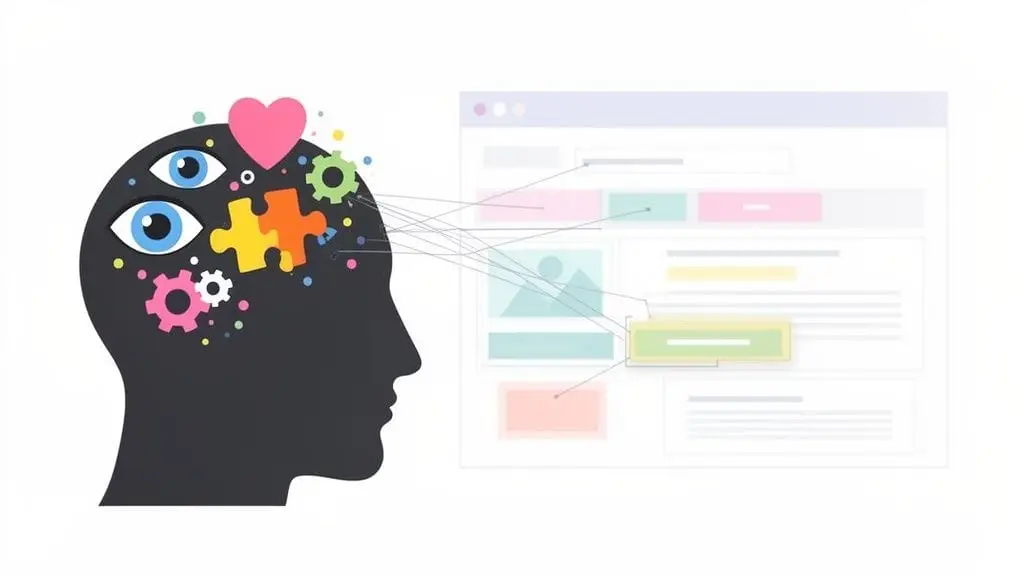
Psychology in design is all about applying core psychological principles to the way we build products, websites, and user experiences. It’s about digging into the why behind user behavior—what grabs their attention, what motivates them, and ultimately, what builds their trust. This insight allows you to create designs that aren't just easy on the eyes, but are genuinely effective and a pleasure to use.
Your Secret Weapon for Business Growth

Imagine trying to have a meaningful conversation with someone when you don't speak their language. That's exactly what designing a digital product is like when you ignore human psychology. You might have a stunning website, but if it doesn’t mesh with how people actually think and feel, it’s going to fall flat. It simply won't connect or convert.
Every single design choice you make, from the color of a button to the spacing on a page, triggers a psychological response. By understanding and deliberately shaping these responses, you can move past just making things look good and start engineering experiences that actively guide user behavior.
Why It’s More Than Just Theory
This isn't some abstract concept for academics; it's a powerful, hands-on tool for real business growth. In fact, applying psychology in design is the secret ingredient behind the world's most dominant brands. It’s the reason Amazon’s “one-click” ordering feels so dangerously easy and why social media notifications are so tough to ignore.
The most effective designs are those that speak to our subconscious. They reduce mental friction, build emotional connections, and make decision-making easier for the user, which directly translates into better business outcomes.
When you grasp these mental shortcuts and emotional triggers, you can build far more intuitive products. When an interface just feels "right," it's usually because it respects the user's cognitive limits and emotional needs. A clean layout with lots of white space, for instance, isn't just a style choice—it lowers cognitive load, helping people process information and find what they need without getting overwhelmed. This leads directly to better user satisfaction and lower bounce rates. You can see how these kinds of improvements pay off by reading our guide on what a conversion rate is and why it matters.
The Tangible Business Benefits
At the end of the day, weaving psychology into your design process is all about driving results. It's the foundation for creating digital experiences that don't just work, but thrive. By truly understanding the mind of your user, you unlock the power to:
- Boost Engagement: Create interfaces that capture and hold attention, encouraging people to interact more deeply with your content and features.
- Increase Conversions: Strategically guide users toward the actions you want them to take, whether that’s making a purchase, signing up for a newsletter, or filling out a form.
- Build Brand Loyalty: Foster genuinely positive emotional connections with your brand, turning first-time visitors into long-term, loyal advocates.
This guide will give you the actionable strategies you need to turn these psychological insights into real-world design improvements, helping you build more intuitive and profitable digital products.
Guiding User Attention with Visual Psychology

Have you ever landed on a website and felt you instantly knew where to click? That’s not a happy accident. It’s the direct result of carefully applied visual psychology, a set of principles that taps into how our brains naturally process information.
Smart design works with these built-in tendencies, not against them. It’s all about using psychology to direct a user's attention exactly where you want it to go, making an interface feel completely intuitive. This is where the powerful Gestalt principles enter the picture.
Creating Order with Gestalt Principles
Think of these principles less as complex theories and more as simple rules for how we perceive a whole design from its individual parts. They are the invisible hand that makes sense of the visual world for us.
For example, when you look at a product listing on an e-commerce site, all the information for one item—the image, price, and "Add to Cart" button—are grouped closely together. This is the Principle of Proximity. Our brains are wired to assume that elements placed near each other belong together.
Likewise, on a dashboard, all the clickable buttons might be the same color, while all the data labels are a different font. That’s the Principle of Similarity at work. We instinctively group objects that share visual properties like color, shape, or size. Applying these rules creates a subconscious sense of organization, which dramatically reduces the mental effort needed to use a site.
The core idea behind visual psychology in design is to make users feel capable and comfortable. When you organize information in a way that aligns with natural human perception, you lower their cognitive load and prevent the kind of frustration that makes them leave.
Once you grasp these concepts, you can start building an intentional visual hierarchy. This is simply the art of arranging elements to communicate their order of importance. A big, bold headline naturally feels more significant than the smaller text below it—a powerful psychological cue that tells users exactly what to focus on first.
Directing the Eye with Contrast and Space
One of the most effective tools for building that hierarchy is contrast. It’s the secret to making important elements pop. You can achieve this in several ways:
- Color Contrast: A bright “Get Started” button on a muted background immediately draws the eye, signaling it as the main call to action.
- Size Contrast: Making the most critical element—like a hero image on a homepage—significantly larger than anything else ensures it commands attention.
- Typographic Contrast: Using different font weights (bold vs. regular) or styles helps users instantly distinguish between headlines, subheadings, and body paragraphs.
A huge part of this is understanding how color theory in web design shapes what users see and feel. The colors you select can make elements stand out or blend in, and they also carry distinct emotional associations, a topic we cover in our guide to color psychology in social media marketing.
Just as important as what you put on the page is what you leave out. This is negative space, often called white space. A cluttered, dense interface overwhelms the brain and makes it impossible to focus.
Giving elements breathing room separates distinct sections and helps funnel attention toward your most critical content. In fact, research shows that generous use of white space can improve user comprehension by up to 20% by making the content easier to scan and digest. By mastering these visual cues, you create a clear, predictable path for users to follow, guiding them smoothly toward your most important goals.
How Emotional Design Builds Lasting Brand Loyalty
Logic and clear navigation might get a user to your website, but it’s the emotion you evoke that makes them want to stay. While people think they make rational decisions based on features and price, the truth is that feelings are what forge a real connection. This is the heart of emotional design, a critical piece of psychology in design that can turn a merely functional product into a memorable experience.
Think about it. We don't just process information when we look at brands; we use our personal feelings and past experiences to evaluate them. We give brands personality traits just like we do with people. One brand might feel trustworthy, another exciting, and a third sophisticated—all based on subtle design cues that talk directly to our subconscious.
This connection isn't just one big feeling; it’s built on three distinct but connected layers, a framework first laid out by cognitive scientist Don Norman. If you can get a handle on these levels, you can design experiences that resonate with users on a much, much deeper level.
The Visceral Level: The First Impression
The visceral level is all about that immediate, gut reaction. It’s what a user feels in the first few seconds of laying eyes on your product. This isn't a conscious thought; it's an automatic response driven purely by aesthetics. Does it look professional? Does it feel trustworthy?
A sleek interface with a pleasing color scheme and crisp, clean typography creates an instant positive vibe. This isn't just about looking pretty. It’s a powerful signal of quality. A high-quality look primes the user to believe the product itself is also high-quality, long before they’ve clicked a single button.
Beautiful design isn't a luxury; it's a strategic tool. The positive emotions triggered by strong aesthetics make users more tolerant of minor usability issues and more open to exploring what you have to offer.
In fact, research shows that high-aesthetic designs do more than just feel better—they dramatically increase the intent to buy. Studies have found that beautiful designs capture stronger initial attention and trigger more positive emotions, which in turn makes people more willing to pay a premium. You can dig into the full findings on how aesthetics influence consumer behavior to see the data for yourself.
The Behavioral Level: The Joy of Use
Once a user gets past that first impression, they move to the behavioral level. This is all about the actual experience of using the product. Is it easy? Does it work well? Most importantly, does it feel satisfying to use?
Behavioral design is where we focus on usability, performance, and function. Think of a smooth, intuitive user flow, buttons that give clear feedback when you click them, and animations that just make sense. When a product works flawlessly and makes a task feel effortless, it creates a sense of empowerment and satisfaction. This is where a strong customer engagement strategy template can help you map out these critical interaction points.
The Reflective Level: The Long-Term Story
The final and most powerful layer is the reflective one. This is where users step back and consciously think about the experience. It’s where they rationalize their feelings and decide what the product, and your brand, really means to them.
This level is all about storytelling and self-image. Does using your product make the user feel smart, capable, or part of an exclusive community? A brand that lines up with a user's personal values or goals creates a powerful, lasting bond. This is what turns a one-time buyer into a true brand advocate who tells everyone they know about you.
When you design for all three levels, you’re creating a complete emotional journey:
- Visceral: It looks amazing and I trust it.
- Behavioral: It’s a delight to use and works perfectly.
- Reflective: It makes me feel good about myself and who I am.
This holistic approach is how emotional design goes beyond simple usability to build lasting brand loyalty—the kind that stands up to competition and drives real, sustainable growth.
Using Cognitive Biases in Persuasive Design
To get through the day, our brains rely on thousands of mental shortcuts. These hardwired thinking patterns, known as cognitive biases, quietly shape how we behave online—influencing everything from the products we decide to buy to the services we put our trust in.
Getting a handle on these biases is fundamental to applying psychology in design. It's not about manipulation. Instead, it’s about smoothing out the decision-making process and making the best choice feel like the most obvious one.
The Power of Anchoring and The Decoy Effect
One of the most common biases you'll see in the wild is anchoring. It’s our natural tendency to latch onto the very first piece of information we see when making a choice. In design, this "anchor" sets the stage for everything else a user sees.
A classic example comes from software-as-a-service (SaaS) pricing pages. A company might deliberately show its most expensive enterprise plan first. Even if a user would never buy it, that high price becomes the anchor. Suddenly, every other plan looks far more reasonable in comparison, making the mid-tier option—often the one they want most people to pick—feel like a steal.
These psychological principles often target the three levels of emotional design, which are all about how we experience a product.

As you can see, these biases can hit our initial gut reaction (Visceral), our experience using the product (Behavioral), and even our long-term feelings about the brand (Reflective).
Anchoring works especially well when paired with the Decoy Effect. This is where you introduce a third, slightly worse option to make one of the other choices look dramatically better.
Let's say a pricing page has just two options:
- Basic Plan: $10/month
- Pro Plan: $25/month
The choice here is pretty straightforward and depends entirely on the user's needs. But watch what happens when we slide a decoy in between them.
- Basic Plan: $10/month
- Standard Plan (Decoy): $22/month
- Pro Plan: $25/month
All of a sudden, the Pro Plan looks like an unbelievable deal. For just $3 more than the nearly-as-expensive Standard plan, you unlock so much more value. The decoy isn't meant to be chosen; its only job is to make the target option an absolute no-brainer.
The goal of persuasive design isn't to trick users, but to frame choices in a way that highlights genuine value. By understanding how the human mind compares options, you can present your offerings more effectively.
Applying Cognitive Biases in Ethical Design
Understanding these mental shortcuts allows you to design experiences that are more intuitive and compelling. The key is to apply them ethically, guiding users toward choices that genuinely benefit them while also achieving business goals. It's a win-win.
Here’s a look at some common biases and how they can be used responsibly in design.
| Cognitive Bias | Psychological Trigger | Ethical Design Application |
|---|---|---|
| Anchoring | Relying on the first piece of information offered. | Display a premium option first on a pricing page to make other tiers seem more affordable and valuable by comparison. |
| Decoy Effect | A third, asymmetrically dominated option makes a target option look better. | Introduce a slightly inferior "decoy" plan to make your preferred "target" plan appear significantly more attractive. |
| Loss Aversion | The pain of losing is psychologically twice as powerful as the pleasure of gaining. | Offer a full-featured free trial. The thought of losing access to those features motivates users to subscribe. |
| Scarcity | Limited availability increases perceived value and urgency. | Use clear, honest labels like "Only 3 left in stock" or "Offer ends in 24 hours" to encourage decisive action. |
| Social Proof | People assume the actions of others reflect correct behavior. | Display testimonials, user counts ("Join 10,000+ happy customers"), and partner logos to build trust and credibility. |
| Bandwagon Effect | The tendency to do or believe things because many other people do. | Show trending products or "most popular" plan badges to signal that an option is a safe, widely-accepted choice. |
When used with transparency and a focus on user value, these principles can dramatically reduce friction and hesitation. The aim is to build trust by making good decisions easier, not to create regret by forcing a bad one.
Tapping into Loss Aversion and Scarcity
Another powerful trigger is loss aversion. We are fundamentally wired to feel the sting of losing something about twice as much as we feel the joy of gaining something of equal value. Designers can tap into this by framing offers around what a user stands to lose if they don't act.
The free trial is the perfect example. Once someone has spent 30 days weaving a tool into their daily workflow, the idea of having it taken away feels like a real loss. The motivation to pay is no longer just about gaining a new tool; it's about not losing the one they now depend on.
This effect is often magnified by scarcity—the idea that an opportunity might disappear. When we think something is in short supply, our brain automatically marks it as more valuable.
Here are a few ethical ways to apply scarcity in your design:
- Time-Limited Offers: "Flash Sale: 40% off ends at midnight!" This creates a firm deadline, pushing users who are on the fence to finally make a choice.
- Stock Scarcity: "Only 3 left in stock!" Booking.com is famous for this, showing how many rooms are left at a specific price to create a healthy sense of urgency.
- Access Scarcity: "Join the waitlist for exclusive access." This tactic frames a product as a high-demand, exclusive item, boosting its perceived worth before it even goes live.
When you use them responsibly, these techniques are incredibly effective. They help users get past indecision by gently nudging them toward a decision that provides real value. The key is to always ensure these nudges build trust, rather than wear it down.
Building Unshakable Trust with Social Proof

When you're not sure what to do, what's your first instinct? If you’re like most people, you look around to see what everyone else is doing. This is a deeply human reflex, and it’s the powerful idea behind social proof.
At its heart, social proof is just our natural assumption that other people’s actions are the right ones for a situation. You see a long line for a food truck and immediately think, "Wow, that place must be good." This same exact logic applies to your website, your app, and your product.
Why Social Proof Works
Social proof is really a mental shortcut. It helps us make decisions faster and with more confidence. Instead of doing hours of research on every single purchase, we lean on the wisdom of the crowd. It’s a powerful way to cut through a new user's hesitation, especially if they haven't heard of your brand before.
And this isn't just a minor nudge; it's a huge driver of our choices. Robert Cialdini's groundbreaking work from 1984 found that up to 95% of our decisions are influenced by what others are doing. Seeing testimonials, star ratings, or a simple "1,000+ customers served" can boost conversions by 10-20% on average.
The Different Forms of Social Proof in Design
Social proof isn't a one-size-fits-all deal. It shows up in a bunch of different ways, and the trick is to use the right kind at the right moment in the user’s journey.
Here are the most effective types to build into your designs:
- User Testimonials and Reviews: Nothing beats a real story from a happy customer. Placing a strong quote right next to a call-to-action button can be the final push someone needs to convert.
- Star Ratings: These are instantly recognizable. They give a quick visual summary of customer satisfaction, making them perfect for product pages or search results.
- Case Studies: For bigger decisions, like B2B software or high-ticket items, detailed success stories are invaluable. They don't just prove your product works—they show how it gets results.
- "Wisdom of the Crowd" Numbers: Displaying metrics like "Over 50,000 downloads" or "Join 10,000+ subscribers" creates a sense of popularity and reliability. It tells people they’re in good company.
- Expert Endorsements: A thumbs-up from a respected industry figure or publication can give your product instant credibility.
- Social Media Proof: Follower counts, shares, and positive comments show that you have an active and engaged community, which builds brand trust.
The most impactful social proof feels authentic and specific. A detailed review that mentions a specific problem and how your product solved it is far more persuasive than a generic "Great product!" comment.
Strategic Placement for Maximum Impact
Just having social proof isn’t enough. You have to put it where it counts. The goal is to anticipate and answer your user's unspoken questions the moment they pop into their head.
Think about it: a first-time visitor on your homepage is subconsciously asking, "Can I trust this company?" That's the perfect spot to show off logos of well-known clients or a short, punchy testimonial. On a pricing page, where the question is, "Is this worth the money?", showing how many customers chose a particular plan can be incredibly persuasive. You can also use elements like conversion pop-ups to show real-time activity from other buyers, which builds immediate trust.
Look at Airbnb. The company’s entire empire was built on a foundation of social proof. The two-way review system for both hosts and guests created a circle of trust that made people feel safe staying in a complete stranger's home. By putting reviews front and center on every listing, they overcame a massive psychological barrier and built a global phenomenon.
Your Action Plan for Psychological Design
Knowing the theory is one thing, but putting that knowledge to work is where the real magic happens. Let’s take all these principles of psychology in design and build a straightforward plan you can put into practice today. Think of this as your roadmap, guiding you from abstract ideas to concrete execution.
This isn't about guesswork. It’s about making deliberate, psychologically-backed design choices. By following a clear process, you can create experiences that not only feel better to users but also deliver measurable results for your business.
Define Your User Personas and Their Triggers
First things first: you have to know exactly who you're designing for. A one-size-fits-all approach is a recipe for failure. You need to create detailed user personas that dig much deeper than simple demographics.
What truly motivates them? What are their biggest anxieties or points of hesitation? Pinpointing these psychological triggers is the whole game. For example, is your ideal user driven by a desire for status, or are they more concerned with security and trust?
Understanding your user’s core psychological drivers is the foundation of effective design. It allows you to choose the right emotional and persuasive levers to pull, ensuring your message resonates on a subconscious level.
Map the User Journey
Once you know your users inside and out, it's time to map their journey with your brand. A user journey map is a visual representation of every single touchpoint, from the second they first hear about you all the way to becoming a loyal advocate.
At each step of this path, you need to ask some hard questions:
- What is the user thinking or feeling right now? Are they curious? Anxious? Excited? Maybe just plain confused?
- What is their main goal at this stage? Are they just looking for information, trying to compare their options, or ready to pull out their credit card?
- Which psychological principles can smooth things over here? Could a dash of social proof build confidence? Would a little scarcity create the right kind of urgency?
This process shines a spotlight on those make-or-break moments where a well-placed psychological hook can make all the difference. For a much deeper dive on this, check out our guide on website conversion optimization, which covers many of these tactics in detail.
Test and Measure Everything
Applying psychology in design isn’t a one-and-done task. It's a cycle of constant improvement that's fueled by data. The only way to know for sure if your new, psychologically-informed design is actually working is to test it.
A/B testing is your best friend. But don't waste time testing random button colors. Instead, form a hypothesis and test a specific psychological principle.
- Test 1 (Scarcity vs. Abundance): Does a "Limited Time Offer" headline really convert better than a standard "Special Offer"? Let's find out.
- Test 2 (Social Proof vs. Authority): On your landing page, what's more powerful—a glowing customer testimonial or a stamp of approval from an expert?
By measuring the results, you’re gathering hard evidence about what makes your specific audience tick. This data-first approach transforms psychological principles from interesting theories into a repeatable system for building more profitable and engaging experiences.
Frequently Asked Questions About Psychology in Design
Even with a solid grasp of the concepts, you probably still have some practical questions about putting it all into practice. Let's dig into some of the most common questions we hear about using psychology in design and get you some clear answers.
How Can Small Businesses Apply These Principles?
You don't need a huge budget or a dedicated research team to get started. Many of the most powerful psychological principles are about smart strategy, not expensive software. Small businesses can see a massive impact by focusing on low-cost, high-leverage changes.
Refine Your Copy: Frame your offers around loss aversion. Instead of simply saying "Get 10% off," a slight tweak to "Don't miss out on 10% off" can be surprisingly effective.
Leverage Social Proof: Make it a habit to ask for customer reviews and feature them right on your homepage and product pages. Even a few genuine testimonials can build instant trust with new visitors.
Improve Visual Hierarchy: This is one of the most powerful, zero-cost changes you can make. Use contrast, size, and whitespace to pull your user's eye directly to your most important call-to-action.
What Is the Biggest Mistake in Psychological Design?
The single biggest mistake we see is people focusing on tactics without a real, genuine understanding of their users. Plenty of companies just slap on a scarcity timer or some social proof widgets and call it a day, but this often creates an experience that feels manipulative and cheap.
Using psychology in design should never be about tricking people. It’s about reducing their mental effort and making their decisions feel easier and more confident. The second a user feels played, you’ve lost their trust for good.
Real psychological design always starts with empathy. You have to first understand your user's deep-seated needs, goals, and anxieties. Only then can you ethically apply these principles to guide them toward a solution that truly helps them.
How Do You Ensure Design Stays Ethical?
Keeping your work on the right side of the ethical line is absolutely critical. The difference between persuasion and manipulation is simple: persuasion helps the user, while manipulation benefits the business at the user's expense, often by preying on vulnerabilities.
To keep it ethical, your North Star should always be transparency and the user's well-being. Ask yourself: does this design choice help the user make a better, more informed decision? Or does it just pressure them into an action they might regret later? If a tactic feels even a little bit deceptive, it probably is. Ethical design empowers users, it never exploits them.
At Magic Logix, we build these ethical and effective psychological principles into every digital strategy we create. Explore our solutions today and discover how we can help you build more engaging and profitable user experiences.