A conversion funnel is essentially a visual map of a customer's journey with your business. It tracks the path they take, starting from the very first time they hear about you, all the way to the final step you want them to take—like making a purchase. It's a foundational model that helps you understand and fine-tune how people move from being strangers to becoming paying customers.
Understanding the Customer Journey
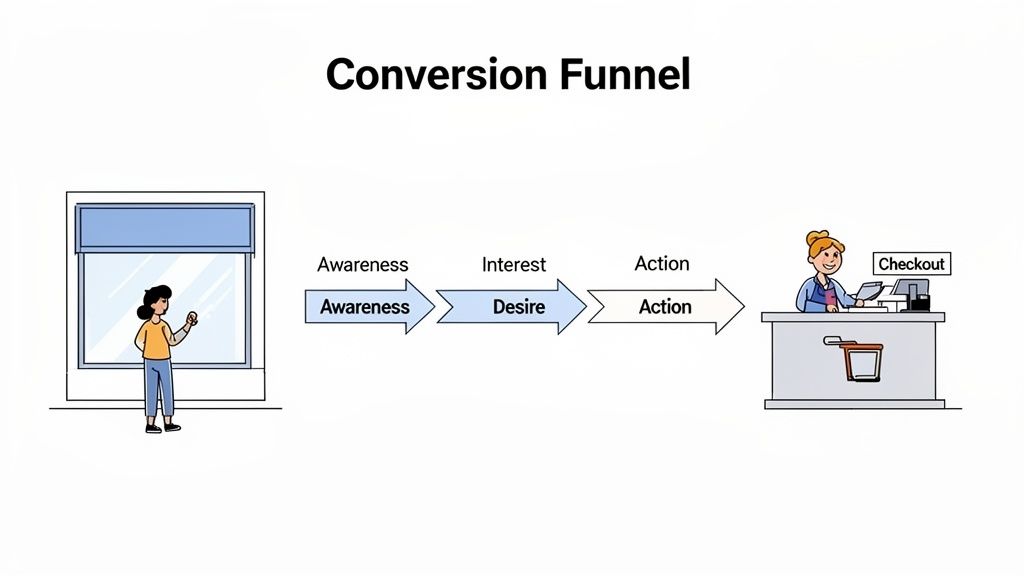
Think of it like shopping in a real store. Someone first notices an eye-catching shirt in the window display (awareness). They're intrigued, so they step inside to get a closer look (interest). After comparing it to a few other options, they decide they really want it (desire). Finally, they head to the register to buy it (action). Each one of these steps is a mini-commitment that moves them closer to the sale.
This idea isn’t new. It actually dates all the way back to 1898, when Elias St. Elmo Lewis created the 'sales funnel.' His AIDA model (Attention, Interest, Desire, Action) laid out a powerful blueprint for understanding the customer's mindset, and it’s just as relevant today. If you want to see how this classic model still shapes modern marketing, you can discover more about innovative client strategies that build on these core principles.
The Four Core Stages of a Conversion Funnel
The AIDA model provides a simple yet powerful framework for understanding your customer's mindset at each step of their journey. Here’s a quick breakdown of what each stage means for your business.
| Stage | Primary Goal | Key Customer Question |
|---|---|---|
| Attention (Awareness) | Attract new prospects and make them aware of a problem or your brand. | "What is this? How does it solve my problem?" |
| Interest | Engage prospects with valuable content and showcase your solution's benefits. | "I'm interested. How does this work? Is it right for me?" |
| Desire | Nurture leads by building trust and demonstrating why your solution is the best choice. | "I want this. Why should I choose this brand over others?" |
| Action | Compel the prospect to make a purchase or complete the desired conversion. | "How do I get it? What's the next step?" |
Understanding these stages allows you to meet your customers where they are, providing the right information at the right time to guide them smoothly to the next step.
Why Is a Conversion Funnel So Important?
Mapping out this customer journey is way more than just a theoretical exercise. It gives you a clear, measurable way to spot problems and jump on opportunities. When you know exactly where people are dropping off, you can make targeted fixes to keep them moving through the funnel.
A conversion funnel transforms marketing from a guessing game into a strategic science. It allows you to visualize the customer path, identify leaks, and systematically improve your process to turn more prospects into loyal customers.
In short, it helps you answer the big questions that drive real growth:
- Where are we losing potential customers? By looking at the drop-off rates between stages, you can pinpoint the exact points of friction. Is your landing page confusing? Is the checkout process too long?
- Which marketing channels are actually working? A funnel helps you trace conversions back to their source, whether it’s a social media ad, a search engine result, or an email campaign.
- How can we get more people to convert? Armed with clear data, you can stop guessing and start making smart optimizations—like rewriting a headline, simplifying a form, or adding a testimonial—that directly boost your numbers.
Ultimately, a well-defined funnel is the backbone of a persuasive customer experience. It ensures that all your marketing efforts work together to produce tangible, measurable results for your business.
Breaking Down Each Stage of the Modern Funnel
The classic AIDA model was a great starting point, but let’s be honest—the modern customer journey is anything but a straight line. Today's conversion funnel is far more dynamic, accounting for a looping, twisting path that keeps going long after someone clicks "buy." To really get a handle on how a conversion funnel works today, we need to walk through its expanded stages: Awareness, Consideration, Conversion, and Loyalty.
Each stage represents a completely different customer mindset. If you can figure out what your audience is thinking, feeling, and looking for at each point, you can hit them with the right message, on the right channel, at the perfect time. Getting this alignment right is the secret to guiding them smoothly from one stage to the next.
Stage 1: Awareness
Every journey starts here, at the very top and widest part of the funnel. The goal in the Awareness stage is simple: get on your ideal customer's radar. They’ve got a problem or a need, but they might not know your brand exists—or that a solution like yours is even an option.
Right now, their mindset is purely exploratory. They’re typing broad questions into Google like, "How do I solve X?" or "What are the best ways to achieve Y?" They aren't looking for a sales pitch; they just want information. Your job is to be the helpful, trusted resource that gives them answers.
To grab their attention, you need to focus on high-visibility channels and content that provides immediate value.
- Search Engine Optimization (SEO): Think blog posts, articles, and how-to guides that rank for those informational keywords. A coffee company, for instance, might publish a post titled, "A Beginner's Guide to Brewing the Perfect Espresso at Home."
- Social Media Marketing: Short videos, shareable infographics, and useful tips on platforms like Instagram, TikTok, or LinkedIn are perfect for introducing your brand to a massive, scrolling audience.
- Paid Advertising: Targeted ad campaigns on search engines or social media can create that initial spark of recognition and drive curious visitors to your educational content.
Stage 2: Consideration
Okay, they know who you are. Now they’ve entered the Consideration stage. At this point, they're actively weighing their options to solve that problem we mentioned. They’ve gone from asking "what is it?" to "is this the right fit for me?"
Their mindset is now comparative and much more analytical. They’re digging into pros and cons, reading every review they can find, and looking for proof that you’re the best choice out there. This is where you have to build trust and show them what makes you different. This entire process is a huge part of understanding the full scope of customer journey analytics and seeing how each touchpoint nudges them closer to a decision.
Content in this phase needs to be more persuasive and detailed, giving them all the reasons they need to pick you.
- Case Studies and Testimonials: Nothing beats real-world proof. Showcasing success stories from happy customers provides powerful social proof and helps prospects imagine what you could do for them.
- Webinars and Product Demos: These formats let you go deep, showing off features and benefits while answering questions and knocking down objections in real-time.
- In-Depth Guides and Comparison Sheets: Don't be afraid to create content that stacks your offering up against the competition. It shows you're transparent and confident in what you provide.
Stage 3: Conversion
We've reached the narrowest point of the funnel. Here, a prospect is well-informed and ready to make a move. The desire and intent are there; they just need a clear, easy path to purchase or sign up.
Their mindset is decisive. They’re looking for a simple, secure process and one last compelling reason to finalize their choice. Any friction at all—a clunky checkout, surprise fees, or a slow-loading page—can send them running. In fact, over 70% of online shopping carts are abandoned, and it’s often because of a frustrating experience at this critical moment.
Your goal is to make this final step as easy and reassuring as possible. The offer has to be irresistible, and the process must be seamless.
- Free Trials and Demos: Letting someone actually experience your product can be the final nudge they need to commit.
- Limited-Time Offers and Discounts: A little urgency can motivate prospects who are still sitting on the fence to take action now.
- Optimized Landing Pages: A clean landing page with a single, unmissable call-to-action (CTA) cuts out all the noise and points the user exactly where you want them to go.
Stage 4: Loyalty
The funnel doesn't stop once the payment goes through. The smartest businesses know that the Loyalty stage is where real, sustainable growth happens. This final loop is all about keeping the customers you have and turning them into repeat buyers and raving fans.
The customer’s mindset shifts from transactional to relational. They trusted you once, and now they're looking for continued value and a reason to stick around. Delighting them here is absolutely essential, especially when you consider that acquiring a new customer can cost five times more than retaining an existing one.
- Email Marketing: Well-crafted nurture campaigns, exclusive offers for existing customers, and genuinely helpful content will keep your brand top-of-mind.
- Community Building: A dedicated Facebook group, Slack channel, or online forum gives customers a place to connect with you and, just as importantly, with each other.
- Loyalty Programs: Rewarding repeat business with points, special discounts, or exclusive access gives customers a tangible reason to keep coming back.
Measuring What Matters at Every Funnel Stage
A conversion funnel provides a powerful map of the customer journey, but without data, it’s just a pretty diagram. To turn your funnel into a true growth engine, you have to measure what’s happening at every single step.
Think of Key Performance Indicators (KPIs) as your funnel’s health report. They tell you where your strategy is strong and, more importantly, where you're losing potential customers. Instead of guessing why sales are down, you can pinpoint the exact stage where people are dropping off and take targeted action.
This is what makes the funnel so powerful—it visualizes the customer's journey from initial awareness all the way through to loyalty, showing exactly how the audience narrows at each step.
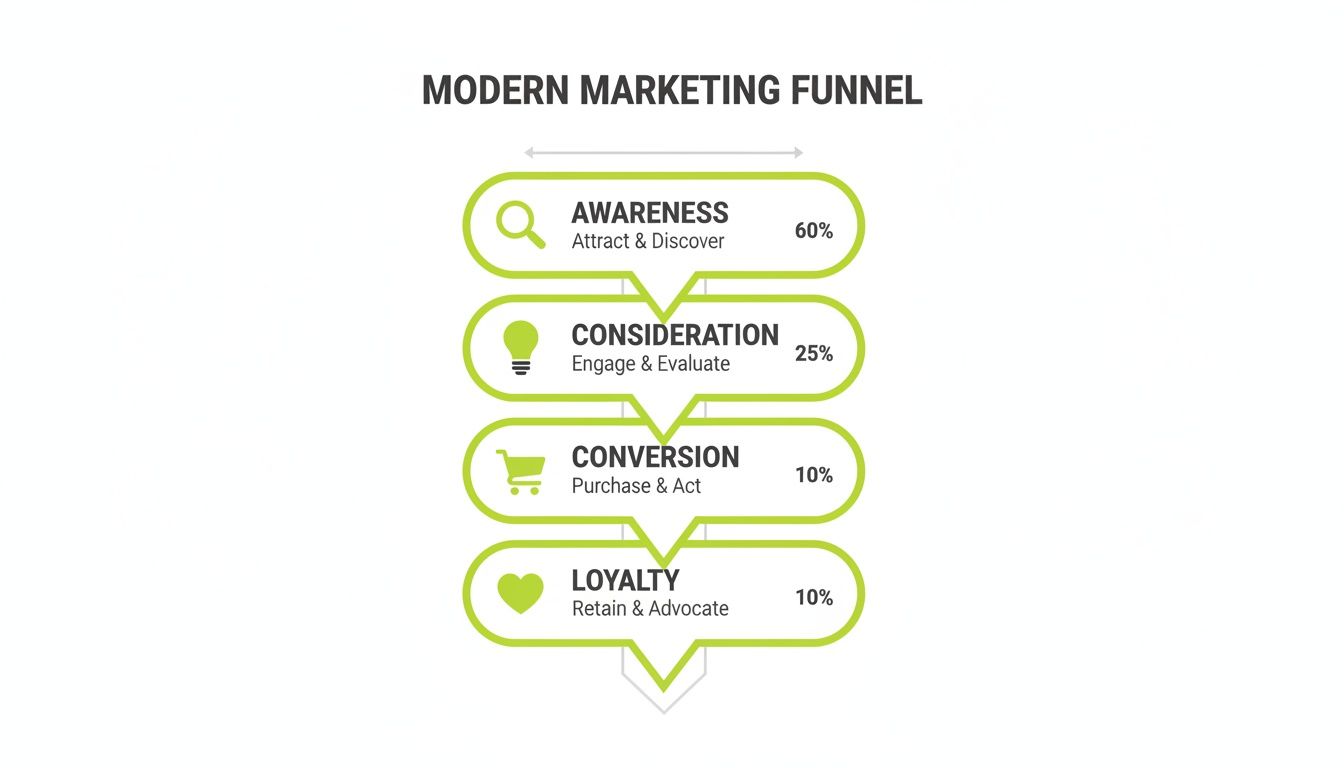
This visual highlights the critical drop-offs between stages, underscoring why tracking stage-specific metrics is non-negotiable for optimizing the path to purchase.
Top-of-Funnel (ToFu) Awareness Metrics
At the top, your goal is to cast a wide net and simply attract attention. Your metrics here should reflect how effectively you’re reaching your target audience and making them aware that you even exist. Success isn't about sales yet; it's about visibility and making a first impression.
Key metrics for the Awareness stage include:
- Impressions: This is the total number of times your content (like an ad or a social media post) was displayed. It’s a raw measure of your reach.
- Website Traffic: How many users are visiting your site? Pay close attention to traffic from key channels like organic search, social media, and paid ads to see which sources are pulling their weight.
- New vs. Returning Visitors: A high number of new visitors is a great sign that your awareness campaigns are successfully bringing fresh eyes to your brand.
Middle-of-Funnel (MoFu) Consideration Metrics
Once you have their attention, the focus shifts to engagement. In the middle of the funnel, you need to know if your content is actually building trust and encouraging prospects to learn more. These metrics reveal how deeply users are interacting with your brand.
For the Consideration stage, monitor these KPIs:
- Time on Page / Average Session Duration: Are people sticking around to consume your content? Longer engagement times suggest your material is valuable and relevant to their needs.
- Lead Magnet Downloads: If you offer resources like e-books or whitepapers, tracking downloads shows how many people are willing to exchange their contact information for your expertise. That’s a huge step.
- Email Subscribers: The number of new sign-ups to your newsletter is a strong indicator of interest and a direct measure of your lead generation efforts.
Tracking these engagement signals is crucial because they represent the bridge between casual interest and serious purchase intent. A prospect who downloads a guide is far more likely to convert than one who simply glances at your homepage.
Bottom-of-Funnel (BoFu) Conversion Metrics
At the bottom of the funnel, everything comes down to action. This is where your marketing efforts translate into tangible business results. The metrics here are the ones that most directly impact your revenue and tell you if your funnel is successfully turning prospects into customers. For a deeper dive, check out our guide on essential digital marketing performance metrics.
Focus on these critical BoFu metrics:
- Conversion Rate: This is the ultimate measure of your funnel's success. It’s the percentage of visitors who complete your desired action, whether that’s making a purchase, booking a demo, or signing up for a trial.
- Average Order Value (AOV): How much does the average customer spend per transaction? Increasing AOV is a powerful way to boost revenue without needing more traffic.
- Cart Abandonment Rate: For e-commerce, this metric is vital. It tells you the percentage of shoppers who add items to their cart but leave without buying.
The drop-offs at each funnel stage can be dramatic. In e-commerce, the global average conversion rate is just 2.5-3%. While around 7.52% of shoppers might add an item to their cart, a staggering 70% will abandon it before purchase. This highlights just how critical BoFu optimization really is.
Seeing the Funnel in Action with Real-World Examples
Knowing the stages of a conversion funnel is one thing, but seeing how they actually work together in the wild is what makes the concept really click.
The strategies and touchpoints can look wildly different depending on the business model. Still, the core idea—guiding someone from "who are you?" to "take my money!"—is always the same. Let's break down two classic scenarios: a B2B software company and a B2C e-commerce brand.
B2B SaaS Funnel Example
Imagine a company selling project management software. Their ideal customer is a marketing manager at a mid-sized tech company who's pulling their hair out over messy workflows. This sales process isn't going to be a one-click affair; their funnel is designed to educate, build trust, and prove its value over weeks, not minutes.
Here’s a look at that customer’s journey:
Awareness: The marketing manager is feeling the pain of a chaotic project, so they Google "how to improve team collaboration." They stumble upon a super helpful blog post from our software company: "10 Strategies to Streamline Your Marketing Workflow." It’s packed with actionable advice, no hard sell in sight.
Consideration: After reading the article, they see a call-to-action for a free whitepaper, "The Ultimate Guide to Agile Project Management." It looks promising, so they trade their work email for the download. Boom—they're officially a lead.
Conversion: Over the next two weeks, an automated email sequence kicks in. They get case studies, testimonials from similar companies, and an invite to a live webinar showing the software in action. By the final email, they're convinced enough to click the link and book a one-on-one demo.
E-commerce Funnel Example
Now, let's switch gears to an online store that sells beautiful, sustainable leather bags. Their target audience? Environmentally conscious millennials who appreciate quality craftsmanship. This funnel needs to be fast, visual, and incredibly smooth.
Here, the path to purchase is much shorter:
- Awareness: A potential customer is scrolling Instagram when a slick video ad of one of the bags pops up in their feed. The ad is perfectly targeted to users who follow sustainable fashion brands.
- Consideration: They tap "Shop Now" and land directly on the product page. They're greeted with gorgeous, high-res photos, a compelling description, and dozens of glowing 5-star reviews that instantly build social proof.
- Conversion: The bag goes into the cart. The checkout process is a breeze, offering express options like Apple Pay. The customer buys their new bag in under a minute, without ever having to hunt for their credit card.
A great funnel feels less like a sales process and more like a helpful guide. It anticipates the user's needs at every step, removes friction, and makes it easy for them to say "yes."
While these examples are worlds apart in complexity, they both work because they deliver the right message at the right moment. The B2B funnel builds relationships, while the e-commerce funnel sparks inspiration. To see how critical the final steps are, check out these high-converting form examples that nail the art of capturing leads and closing sales.
Sample Funnel Strategies by Business Type
To make this even clearer, let’s compare the different tactics a B2B SaaS company and a B2C e-commerce brand might use at each stage of the funnel. You'll notice how the core goal remains the same, but the execution is tailored to the audience's buying behavior.
| Funnel Stage | B2B SaaS Tactic | B2C E-commerce Tactic |
|---|---|---|
| Awareness | SEO-optimized blog posts, industry reports, LinkedIn articles, podcast appearances. | Instagram video ads, influencer collaborations, TikTok trends, Pinterest boards. |
| Consideration | Gated whitepapers, free webinars, email nurture sequences, case studies. | Product page reviews, user-generated content, email newsletters with new arrivals. |
| Decision | Personalized demo calls, free trials, detailed pricing pages, customer testimonials. | Limited-time discount codes, abandoned cart emails, free shipping offers. |
| Retention | Onboarding emails, customer success check-ins, new feature announcements. | Loyalty programs, exclusive member sales, personalized product recommendations. |
As you can see, the B2B journey is all about providing deep, educational value to justify a significant investment. On the flip side, the B2C journey is designed to create desire and make the buying process as effortless as possible. Both are effective because they understand what their specific customer needs to see next.
How to Optimize Your Funnel for Maximum Growth
Just building a conversion funnel is step one. The real magic—and the real growth—happens when you start tuning it up. It’s not enough to just have a funnel; you need to turn it into a well-oiled machine that reliably converts visitors into loyal customers.
This is where Conversion Rate Optimization (CRO) comes in. Think of it as the art and science of tweaking your user experience to get more people to take the action you want. It's not about guessing games. It’s about making smart, data-driven improvements that tie directly back to the metrics that matter.
Embrace the Power of A/B Testing
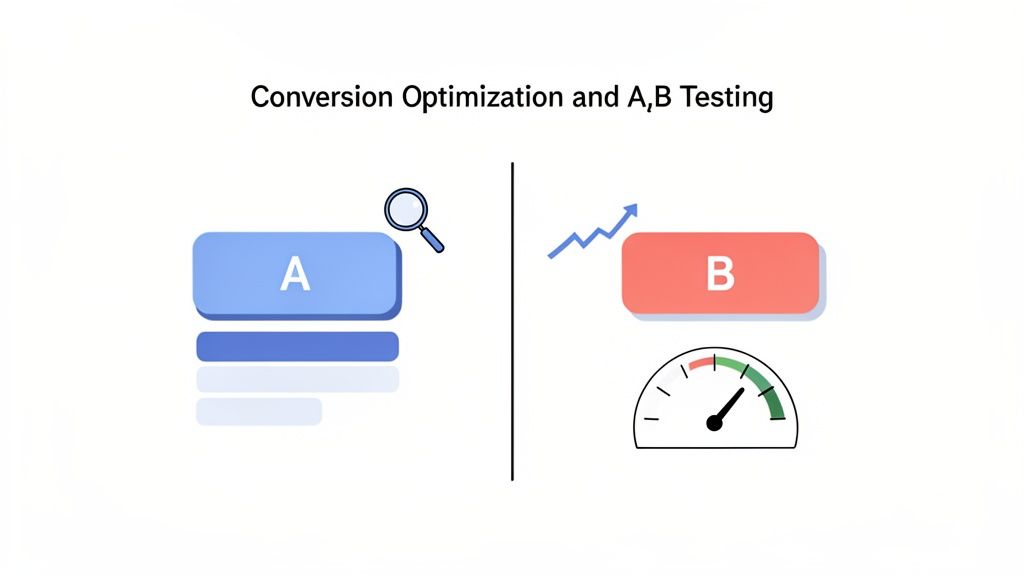
One of the most fundamental tools in any CRO toolkit is A/B testing, sometimes called split testing. It’s a straightforward concept: create two versions of a single element—a webpage headline, an email subject line, a button color—and see which one performs better. You show Version A to half your audience and Version B to the other half, then let the numbers tell you which one won.
The beauty of A/B testing is how simple yet powerful it can be. You’d be amazed at how small, consistent changes can stack up into massive gains over time.
- Headline Variations: Does a headline that highlights a benefit outperform one that asks a question?
- Call-to-Action (CTA) Color: Will a green "Buy Now" button get more clicks than a blue one? You won't know until you test.
- Image Choices: Try testing a clean product shot against a lifestyle photo of someone actually using it.
By constantly testing, you stop making decisions based on assumptions and start relying on hard data. If you're looking for more advanced strategies, you might want to check out our deep dive on website conversion optimization.
Go Beyond Testing with Key Optimization Tactics
While A/B testing is essential, it’s just one piece of the puzzle. A truly optimized funnel uses a range of tactics to remove friction, build trust, and make it as easy as possible for people to move forward.
The core principle of funnel optimization is to make the desired path the easiest path. Every barrier you remove, no matter how small, increases the likelihood of conversion.
Here are a few high-impact tactics to get you started:
Simplify Forms: Nothing kills conversions faster than a long, complicated form. Be ruthless. Ask only for the information you absolutely need right now. Every field you cut can give your sign-up rate a little boost.
Leverage Social Proof: People trust other people more than they trust brands. Make sure you’re showcasing customer reviews, testimonials, star ratings, and logos from clients they recognize. This builds instant credibility and eases anxiety at the critical decision stage.
Use Personalization: Simple touches go a long way. Greet returning visitors by name. Recommend products based on their past browsing. Tailor your landing page content to their industry. Personalization makes your audience feel seen, strengthening their connection to your brand.
Don't underestimate the impact of these efforts. Well-optimized sales funnels have been shown to deliver up to 3x higher conversion rates and 30% boosts in average order value compared to standard e-commerce checkouts.
To really kick things into high gear, you have to continually find ways to improve website conversion rates. When you combine rigorous A/B testing with smart, user-focused enhancements, your funnel transforms from a simple map into a powerful engine for sustainable growth.
The Essential Toolkit for Building and Tracking Your Funnel
Building a high-performing conversion funnel isn't just about strategy; it's about having the right tools in your belt. A solid tech stack is what brings that strategy to life, automating the grunt work, collecting vital data, and giving you the insights to optimize every single step.
Think of it like a mechanic's garage. You wouldn't try to tune a high-performance engine with just a single wrench. You need a full set of specialized instruments—some for diagnostics, others for fine-tuning—to get everything running perfectly. Your marketing toolkit works the same way, giving you the precision to build, measure, and improve every stage of the customer journey.
Analytics and Behavior Tracking
Before you can fix your funnel, you have to see it in action. Analytics platforms are your eyes and ears, showing you exactly how people are interacting with your website. They answer the crucial "what" and "where" questions about user behavior.
- Google Analytics: This is the bedrock of web analytics. It’s the go-to for tracking website traffic, understanding user demographics, and setting up conversion goals. It tells you which channels are bringing people in and, more importantly, where they're dropping off.
- Hotjar: While Google Analytics gives you the numbers, Hotjar shows you the story behind them. With heatmaps, session recordings, and on-page surveys, you can literally watch how users click, scroll, and navigate your site, giving you a clear "why" for their actions.
A quick glance at a dashboard like this one in Google Analytics can tell you a story about your traffic and engagement at a moment's notice.
This snapshot view reveals key metrics like user counts, session times, and top pages, making it easy to spot trends as they happen.
Landing Page and Lead Capture Tools
The very start of your funnel—your landing pages and forms—needs to be compelling and incredibly easy to use. These tools are built specifically to create high-converting experiences, often without needing to write a single line of code.
- Leadpages: A popular choice for a reason. Leadpages lets you spin up and launch optimized landing pages fast. They're perfect for focused goals like capturing email sign-ups or getting people to register for a webinar.
Automation and Nurturing Platforms
Once you’ve captured a lead, the real work begins. You have to nurture that relationship and guide them toward making a decision. Marketing automation platforms handle this delicate process at scale, sending the right message to the right person at exactly the right time.
And if you want to get really granular with measuring the success of these campaigns, check out our guide on how to use UTM parameters.
A well-chosen tech stack doesn't just collect data; it turns that data into actionable intelligence. It automates the repetitive work so you can focus on the strategic decisions that drive real growth.
By layering tools for analytics, page building, and automation, you create a powerful, interconnected system for managing and growing your entire conversion funnel.
Common Questions About Conversion Funnels
As you start mapping out your own customer journeys, a few questions tend to pop up again and again. Getting solid answers to these common hurdles is key to using conversion funnels effectively, whether you're a one-person shop or part of a huge marketing team.
Let's dive into some of the most frequent questions that come up when putting these powerful frameworks into action.
What Is the Difference Between a Sales Funnel and a Marketing Funnel?
People often use these terms interchangeably, but there's a small yet crucial difference.
Think of it this way: the marketing funnel is the entire stadium, built to attract a massive crowd and get them buzzing with excitement. The sales funnel is the specific gate and ticket line that turns those excited fans into paying attendees.
- A marketing funnel is the big picture. It covers the whole customer journey, from someone first hearing your name all the way to becoming a qualified lead. Its main job is to attract and educate.
- A sales funnel is a focused part of that journey. It deals with the specific steps needed to turn that interested lead into a paying customer. Its job is to close the deal.
Modern strategies see these two funnels as deeply intertwined. Great marketing feeds high-quality leads directly into the sales process, making the handoff seamless.
How Long Does It Take to Build an Effective Conversion Funnel?
There's really no single answer here—it all comes down to complexity. A simple lead generation funnel, maybe just a landing page offering an e-book download with a basic email follow-up, could be live in just a few days.
On the other hand, a more sophisticated funnel for an e-commerce brand or a B2B service is a much bigger undertaking. If you're creating multiple pieces of content, setting up complex automation, and tying together different software, it could easily take several weeks or even a couple of months to build, test, and get right.
The most important thing to remember is that a funnel is never really "done." The initial build is just the start. The real magic happens in the ongoing process of analyzing the data and constantly optimizing for better results.
What Is a Leaky Funnel and How Do I Fix It?
A "leaky funnel" is exactly what it sounds like: a point in your process where you're losing a huge number of potential customers. Imagine a pipe with a crack in it. Water is getting in, but a lot of it is escaping before it ever reaches the end.
For example, if you see that 80% of users add a product to their cart but only 10% actually complete the purchase, you've got a massive leak right at the checkout stage.
Fixing it is a two-step process:
- Find the Leak: Dive into your analytics to pinpoint exactly where people are dropping off. Don't guess; let the data show you the problem area.
- Hypothesize and Test: Why are they leaving? Are shipping costs a nasty surprise? Is the checkout form too long? Is the page painfully slow? Come up with a few theories, and then use A/B testing to try out a solution. Maybe you test a version with free shipping or a simplified form to see if you can plug that leak for good.
At Magic Logix, we specialize in turning leaky funnels into high-performance growth engines. Our experts blend data, technology, and creative strategy to build and optimize digital marketing funnels that convert prospects into loyal customers.
Discover how we can enhance your customer engagement by visiting our website.