
For agencies, marketing automation is all about using smart software to handle repetitive marketing jobs. Think of it as the key to streamlining workflows, boosting client campaign results, and unlocking real, scalable growth. It’s a move away from manual, soul-crushing processes toward efficient, repeatable systems that can manage everything from lead nurturing to client reporting.
This shift lets your best people step away from the tedious execution and focus on high-value strategy.
Why Marketing Automation Is Your Agency's New Engine for Growth
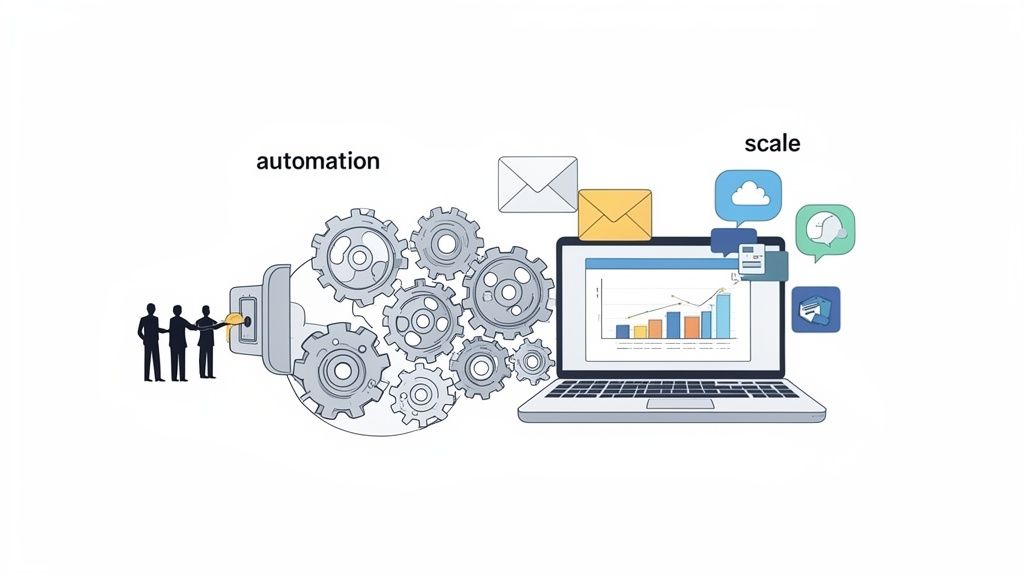
Let’s be real—the agency world is more cutthroat than ever. It's not enough to just deliver great work anymore. You have to do it efficiently, profitably, and at scale. This constant pressure is exactly why marketing automation has gone from a "nice-to-have" novelty to an agency's core operational engine.
The push to get beyond manual tasks is about more than just saving time. It’s about delivering the kind of sophisticated, hyper-personalized campaigns clients now expect, all while taming your own internal chaos. To really get how this can change your agency, it helps to first understand what is marketing automation at its heart. It’s about building intelligent, data-driven client journeys that prove undeniable value and lock in those long-term retainers.
The Strategic Shift from Doing to Orchestrating
The biggest change here is moving from doing the marketing to orchestrating it. Instead of your team manually sending follow-up emails for one client and scheduling social posts for another, an automated system handles the grunt work. This frees up your top talent to focus on what actually moves the needle: strategy, creative thinking, and building client relationships.
This single operational shift creates a massive ripple effect on both your service delivery and your bottom line. For agencies, this really means:
- Scaling without burnout: You can take on more clients and run more complex campaigns without having to proportionally increase your headcount.
- Delivering consistent quality: Core processes are systematized, ensuring every client gets a high-quality experience, every single time.
- Proving undeniable ROI: With automated tracking and reporting, it becomes much easier to draw a straight line from your activities to your client's revenue.
This isn't just a hunch; the market data is screaming it. The global marketing automation industry was valued at a massive $6.65 billion in 2024 and is on track to explode to over $15 billion by 2030. That kind of rapid growth shows a fundamental change in how businesses connect with customers. For agencies, this trend underscores the urgent need to adopt these systems just to stay in the game.
Key Takeaway: Bringing marketing automation into your agency is less about the tech and more about a core business decision. It's how you build a profitable, scalable service model that relies less on billable hours and more on delivering measurable, repeatable outcomes.
How Automation Powers Both You and Your Clients
The benefits flow in two directions. First, you get to automate your own agency's internal marketing and sales. Imagine a system that automatically nurtures your new business leads, helps schedule discovery calls, and sends follow-up materials without anyone on your team lifting a finger. You can find tons of business process automation examples to see how this works in the real world.
Then, there's the client-facing side. You can package and sell these automated services directly. Instead of just "managing their social media," you can now offer a complete lead nurturing system that turns their website traffic into a pipeline of sales-ready leads. This elevates your agency from a simple service provider to a strategic growth partner—making you that much harder to replace.
Building Your Agency's Automation Strategy and Service Tiers
Jumping into a powerful automation platform without a clear strategy is like buying a race car with no idea how to drive. It's a surefire way to burn through cash and end up right where you started. Before you even think about booking a demo, the first real step is defining precisely what you want to achieve for your agency and your clients.
Your strategy is the blueprint for everything else. It tells you which processes to automate, what services you can offer, and how you’ll prove the value of your work. The best way to start is by looking inward at your own agency's operations and then outward at your clients' biggest headaches.
The goal isn't to automate everything all at once. It’s about finding the low-hanging fruit—those repetitive, time-sucking tasks that have a direct line to revenue or client retention.
Identify Your Most Impactful Automation Opportunities
Before you can package up your services, you have to know what you’re actually selling. A quick audit of your team's day-to-day processes will almost always reveal immediate opportunities for automation that can deliver some quick wins.
For most agencies, these are the most common (and impactful) starting points:
- Lead Nurturing: This is often the biggest win, right out of the gate. You can automate the follow-up for every new lead with an email sequence designed to educate, build trust, and qualify them for a sales chat. This alone ensures no lead ever goes cold just because your team got busy.
- Sales Handoffs: Smooth out that critical transition from marketing to sales. You can automatically create a task for a salesperson, send them the lead's full contact details, and ping them the moment a lead hits a specific engagement score. No more manual Crtl+C, Crtl+V.
- Client Onboarding: A standardized, professional welcome experience can be a game-changer for client perception. An automated workflow can send out welcome emails, links to discovery questionnaires, and meeting schedulers, making your agency look incredibly buttoned-up from day one.
- Automated Reporting: Ditch the soul-crushing process of pulling metrics into a spreadsheet every month. You can set up automated dashboards and email reports that send key performance indicators straight to clients, saving you dozens of admin hours. A well-structured plan is essential here; using a comprehensive marketing campaign planning template helps keep all your efforts aligned and measurable.
Expert Tip: Don't automate a broken process. If your current lead follow-up is a mess, automating it just helps you fail faster. Fix the process first, then apply automation to make it efficient and scalable.
Packaging Automation into Profitable Service Tiers
Once you've identified your core automation capabilities, it's time to package them into clear, profitable service tiers. This is how you shift from trading hours for dollars to selling high-value, productized services. It makes your offerings much easier for clients to understand and for your sales team to sell.
The key is to think in terms of client maturity. A small business just getting its feet wet doesn't need the same complex system as an enterprise with a seasoned sales team.
Example Service Tiers
Here’s a practical framework you can adapt for your own agency:
| Tier Name | Ideal Client | Core Services Included |
|---|---|---|
| Foundation Package | Businesses new to automation or with a small marketing budget. | • Basic lead capture forms • 5-part automated email welcome series • Monthly performance snapshot report |
| Growth Package | Companies with consistent lead flow needing better nurturing. | • Everything in Foundation • Advanced lead scoring • Multi-step nurturing workflows • Automated sales team notifications |
| Scale Package | Established businesses looking to optimize their entire customer journey. | • Everything in Growth • Multi-channel journey building (email, SMS) • CRM integration and data sync • A/B testing and optimization |
This tiered structure creates a natural upgrade path. A client can start with the Foundation package, see real results, and then grow into the more advanced tiers as their needs evolve. When you're setting prices, focus on the value delivered, not the hours it takes to set up. An automated system that closes just one extra deal for a client could be worth thousands, making your monthly fee an easy investment for them to make.
Choosing the Right Marketing Automation Platform for Your Agency
Picking your agency's marketing automation platform is a genuinely high-stakes decision. If you get it right, you unlock serious efficiency and open up brand new revenue streams. But if you get it wrong? You're stuck with an expensive, clunky system that collects digital dust while your team actively avoids it.
This choice isn’t about finding the software with the longest feature list. It’s about finding a real partner for your agency’s growth—one that works for your internal team and the incredibly diverse needs of your clients. This is where an agency-first mindset is non-negotiable.
Core Agency-Centric Features to Demand
So many platforms out there are built for a single, in-house marketing team. Agencies are different. We're the command center for multiple businesses, each with its own brand, tech stack, and goals. That completely changes what your "must-have" feature list should look like.
You have to prioritize platforms that were clearly built with agencies in mind. These aren't just nice-to-haves; they're foundational to your ability to operate without pulling your hair out.
- Multi-Client Management: Can you flip between client accounts from a single dashboard? This is the number one feature for sanity and efficiency. It saves you from the nightmare of juggling a dozen different logins and siloed data.
- White-Labeling Options: Being able to slap your agency’s logo (or your client's) on reports, dashboards, and even the platform interface is huge. It constantly reinforces your value and makes everything look polished and professional.
- Granular User Permissions: You need total control over who sees what. A junior team member might only need access to one client's email campaigns, while an account director needs a portfolio-wide view. Strong permission settings are a must for security and simple workflow management.
These features are the bedrock of a good agency-platform relationship. Without them, you'll spend more time fighting your software than you do getting results for your clients.
Integration: The Unsung Hero of Automation
A marketing automation platform can't live on an island. It has to connect seamlessly with the tools your clients already use every single day. If your chosen platform doesn't play nice with a client’s preferred CRM, the entire project is dead before it even starts.
When you’re looking at integrations, think beyond just the big names. Dig into the quality of those connections. A "native" integration is almost always more stable and powerful than one patched together with a third-party tool like Zapier. Consulting a detailed Marketing Automation Tools Comparison Guide can be a massive help here, streamlining your whole selection process.
Key Insight: Don’t just ask, “Does it integrate with Salesforce?” Instead, you should be asking, “How deep is the integration? Can it sync custom fields? How often does the data sync? What actions in one system can trigger workflows in the other?”
The quality of these connections is what allows you to build the intelligent, data-driven journeys your clients are paying you to create.
Matching the Platform to Your Client Tiers
The software that’s perfect for a local SMB client is going to fall flat for an enterprise account, and vice versa. Your choice of platform—or platforms—should directly align with the service tiers you offer.
This simple decision tree shows how you can map client needs to different levels of automation services, from basic lead generation to a full-blown strategic suite.
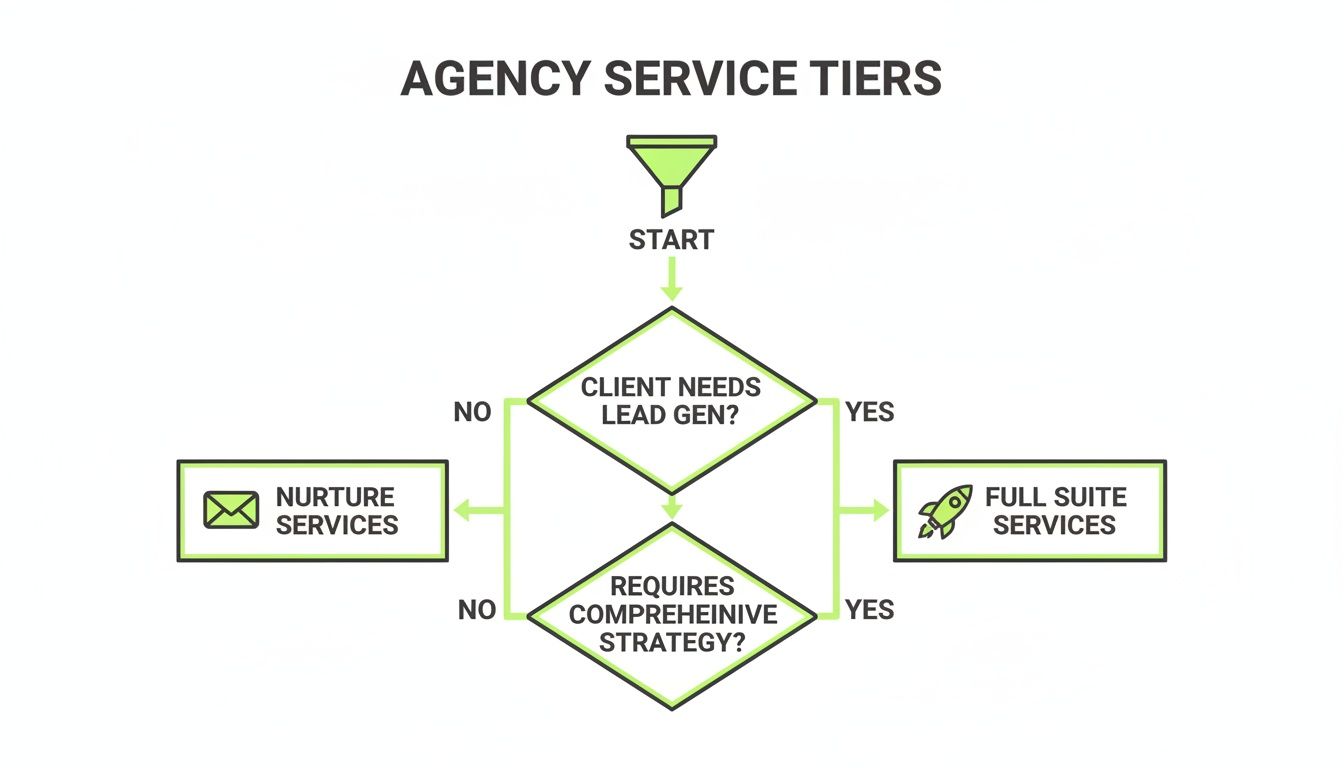
This just highlights how important it is to match the tool's complexity to the client's actual needs. You don't want to be over-investing for simple tasks or find yourself under-equipped for the complex ones.
For your "Foundation" tier clients, a user-friendly platform focused on email and simple workflows is probably the perfect fit. For your "Scale" tier clients, you'll need something with enterprise-grade power, multi-channel capabilities, and deep analytics. The goal is to build a small, curated tech stack that can serve your entire client spectrum. You can also dive deeper into the world of platforms by exploring our guide on the best customer engagement platforms.
The current market shows this is the norm, with 79% of marketers already automating their customer journeys in some way. The overwhelming preference is for cloud-based tools, with over 70% of users choosing them for better flexibility and less IT overhead—a critical factor for agile agencies. Your platform choice has to reflect this modern, cloud-first approach.
Agency-Focused Marketing Automation Platform Comparison
To help narrow it down, we've put together a quick comparison of top platforms that are well-suited for agency life. This isn't an exhaustive list, but it highlights the key players and what they bring to the table specifically for managing multiple clients.
| Platform | Best For | Key Agency Features | Integration Strength | Pricing Model |
|---|---|---|---|---|
| HubSpot | Agencies wanting an all-in-one CRM & automation solution with strong support. | Robust multi-account management, partner program, co-brandable assets. | Excellent. Extensive native marketplace and API. | Tiered, based on contacts and feature sets. |
| ActiveCampaign | Agencies focused on sophisticated email automation and CRM for SMBs. | Agency Partner Program, account switching, client permissions. | Very strong, especially with e-commerce and small business tools. | Per-contact, tiered by features. |
| GoHighLevel | Agencies looking for a white-label, all-in-one sales & marketing platform. | Full white-labeling, sub-accounts, built-in agency tools. | Good, but more focused on its own ecosystem. Zapier is key. | Flat fee SaaS model for agencies. |
| SharpSpring (Constant Contact) | Agencies needing a flexible, affordable solution with strong multi-client features. | Agency-first design, client dashboards, rebranding, single sign-on. | Solid native integrations with major CRMs and tools. | Tiered based on contacts, with agency-friendly pricing. |
Ultimately, the right platform feels less like software and more like an extension of your team. It should make your life easier, your services more valuable, and your clients happier. Use these criteria as your guide, and you'll find the perfect fit.
Designing Repeatable Workflows and Onboarding Templates
Here's a hard-earned truth: the real power of marketing automation for agencies isn't in some massive, overly complex workflow that takes your team weeks to build. The magic—and the profit—is in creating a library of proven, repeatable systems you can deploy quickly across your client portfolio.
This is the shift from one-off projects to a truly scalable service model. Building these core assets means you can deliver consistent, high-quality results from day one. It absolutely slashes setup time, wows new clients with your speed, and sets a performance baseline you can then iterate on. It's all about working smarter, not harder, for every client on your roster.
Crafting Your Core Client-Facing Workflows
Before you start dreaming up sophisticated, multi-channel journeys, you need a rock-solid foundation. We're talking about the essential workflows that tackle the most common marketing problems and deliver immediate, tangible value to almost any client, no matter their industry. Think of these as your agency's "greatest hits."
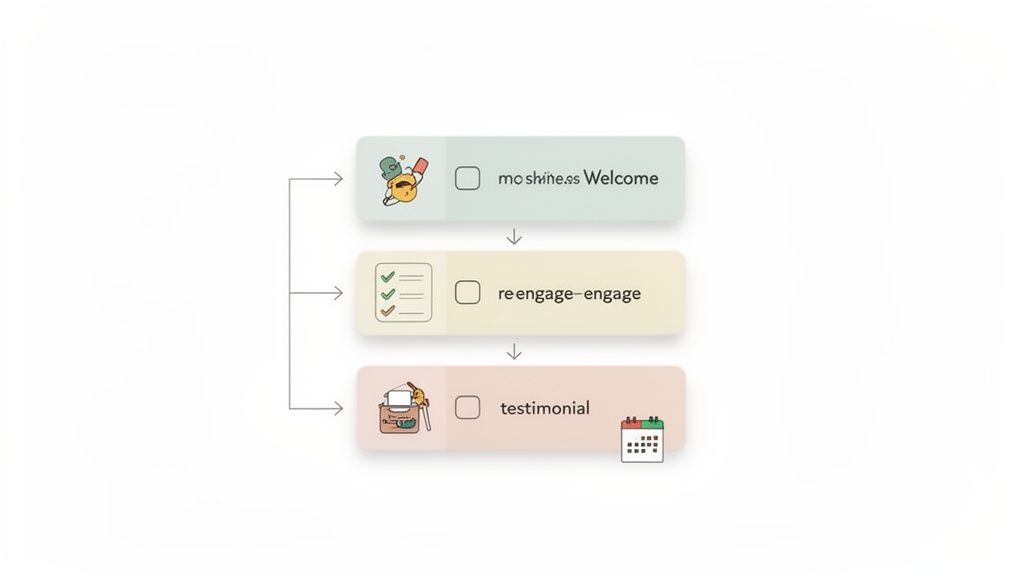
Start by building out these three foundational sequences:
- The 5-Touch Welcome Series: This one is non-negotiable. As soon as a client gets a new lead, this automated sequence kicks in, delivering five emails over 7-10 days. The goal? Introduce the brand, serve up value, answer common questions, and gently nudge the lead toward that next step—be it a demo, a purchase, or a discovery call.
- The Cold Contact Re-Engagement Campaign: Every single client has a list of contacts that's gone completely silent. This simple 3-part email workflow is designed to wake them up. You could offer a compelling new resource, announce a product update, or just ask if they're still interested (with an easy opt-out). Re-engaging even 5% of a cold list is a massive win.
- The Post-Purchase Testimonial Request: After a customer buys something or a client closes a deal, this workflow waits for a set period (say, 14 days) and then sends a polite request for a review. You can even get clever and route happy customers to Google or Capterra, while sending the less-than-thrilled ones to a private feedback form.
These workflows are your bread and butter. Once you've got them perfected, you can customize and launch them for a new client in a matter of hours, not weeks.
Systematizing Your Client Onboarding Process
Your agency's internal efficiency is just as crucial as the results you get for clients. A clunky, manual onboarding process creates a terrible first impression and burns through billable hours. Applying automation to your own processes is a game-changer for both perception and profitability.
A smooth onboarding experience shows clients you’re organized and professional from the moment they sign. It ensures nothing slips through the cracks and is a critical, often overlooked, part of client retention.
Key Takeaway: The goal of an automated onboarding process is to make the client feel guided and cared for while minimizing the administrative burden on your team. It sets the tone for the entire relationship.
The first step is creating templates for each stage of that new client journey.
Essential Onboarding Templates
- The "Welcome to the Agency" Sequence: The second that contract is signed, trigger an automated email series. The first email should confirm the partnership, outline what happens next, and introduce their main point of contact. Follow-up emails can share links to book a kickoff call, a secure form for submitting account credentials, and an invite to your project management tool.
- The Discovery & Strategy Checklist: Use a standardized form or project template in your PM tool to gather all the intel you need. This should cover everything from their target audience and top competitors to brand guidelines and analytics access. Automating this means you get the same critical data, every single time, without fail.
- The Workflow Kickoff Template: Create a standard agenda for that first automation strategy call. This keeps the conversation on track, ensuring you cover key goals, define the triggers and actions for the first workflow, and agree on what success looks like.
By turning these crucial interactions into templates, you build a repeatable system for success. Your team knows exactly what to do, and new clients are impressed by a seamless process that moves quickly from signing a contract to actually getting things done. That's the mark of a truly efficient agency.
Measuring Success and Proving ROI to Clients
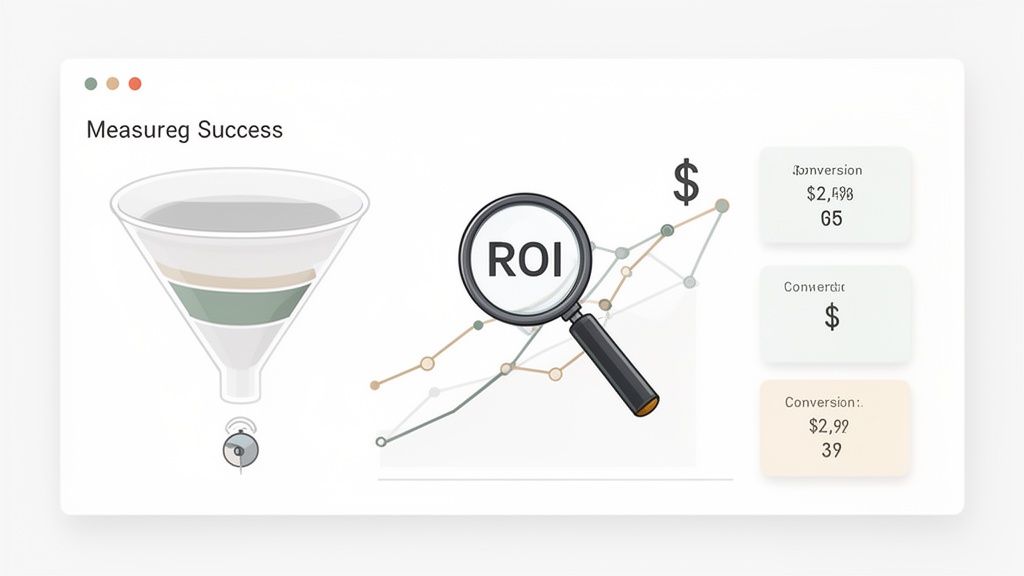
For any agency, proving your worth is everything. While efficient workflows are great for your team's sanity, clients ultimately care about one thing above all else: revenue.
This is where your marketing automation efforts shift from a simple operational tool into a value-proving machine. It's how you connect every single automated email and nurture sequence directly to the client's bottom line.
Forget about just reporting on vanity metrics like opens and clicks. Those numbers might feel good, but they don't pay the bills. The real goal is to build dashboards that track what truly matters—the full journey from a curious lead to a paying customer.
Shifting the Conversation to Revenue
The entire dynamic with your client changes when you can walk into a meeting and say, "That automated welcome series we launched generated $15,000 in new sales last quarter." It’s a world away from, "We hit a 25% open rate."
To make this happen, your reporting has to be laser-focused on bottom-of-the-funnel metrics. These are the KPIs that actually resonate with business owners:
- Lead-to-Customer Conversion Rate: What percentage of leads nurtured by your automation campaigns actually made a purchase? This is the ultimate proof that your strategy is working.
- Customer Lifetime Value (CLV): How are your automated campaigns impacting the long-term value of each customer? Smart up-sell, cross-sell, and loyalty sequences can directly boost this number.
- Campaign ROI: For every dollar the client invests in your services, how much are they getting back? This is the single most powerful metric you can track.
This focus on business outcomes is precisely why automation has such a strong financial case. Research shows that for every dollar spent on marketing automation, organizations earn an average of $5.44 back—a massive 544% return on investment.
Companies also report average revenue increases of 34% thanks to the higher engagement and loyalty these systems drive. When you can present numbers like these, the investment becomes a no-brainer for clients.
Building Attribution Models That Tell a Story
Attribution is how you prove your work is, well, working. It’s the process of connecting a specific marketing touchpoint—like an email from an automated sequence—to a tangible result, like a closed deal. Without it, you’re just taking credit. With it, you're proving value with hard data.
Your marketing automation platform is the key here. By integrating it tightly with your client's CRM, you gain visibility into a lead's entire journey. When a lead who went through your re-engagement campaign finally makes a purchase six weeks later, your system can connect the dots and give your campaign the credit it deserves.
Expert Tip: Don't overcomplicate things at the start. Begin with a simple "First Touch" or "Last Touch" attribution model. As you get more sophisticated, you can graduate to multi-touch models that give partial credit to every automated interaction a lead has. This paints a much more accurate picture of your total impact.
For your tracking to be airtight, you have to be meticulous. Consistent use of tracking parameters is non-negotiable. If you need a refresher, it's worth reading up on how to use UTM parameters to ensure every campaign is measured correctly.
Automating Your Client Reporting
Now for the final piece of the puzzle: automating the reporting process itself. The very same system running your client campaigns can be configured to pull the data, populate a dashboard, and email a performance summary every month. No more spending hours building slide decks.
This creates a powerful, positive feedback loop. Your client gets regular reports focused on revenue and ROI, reinforcing the value of your partnership without you having to lift a finger. This level of transparent, data-backed communication transforms your agency from a vendor into an indispensable growth partner. You become so ingrained in their success, they won't be able to imagine life without you.
Answering Your Toughest Questions About Agency Automation
Even with a solid plan, jumping into marketing automation for your agency can bring up some tough questions. It’s one thing to get the theory, but it's something else entirely to deal with the messy, real-world problems that pop up during implementation. We’ve been there.
This isn’t about high-level concepts. It’s about practical advice for when you’re in the trenches, trying to convince a skeptical client or untangle a nightmare of a contact list. Let’s get into it.
How Can a Small Agency Start Offering Automation Without a Huge Investment?
The fear of a massive upfront cost stops a lot of smaller agencies in their tracks. But you don’t need a huge, enterprise-level tech stack on day one. The trick is to start lean, stay focused, and prove the concept with a single, profitable service.
Instead of trying to offer every automation feature imaginable, just master one core offering first. A fantastic starting point is an automated lead nurturing sequence for new contacts.
- Pick scalable software: Look for a platform with a flexible, contact-based pricing model. This way, your costs grow as your clients succeed, not before.
- Package one core service: Build out a repeatable, high-value offering like a "5-Touch Lead Welcome Series." Lock down the scope, price it to be profitable, and create a simple one-pager to sell it.
- Sell it to your current clients: These clients already trust you. Go to them with this new, low-risk service that solves one of their specific pain points.
Use the revenue and the case studies from these first wins to fund your next move. You don't need a massive budget to get going; you just need a single, well-executed service that proves the value of marketing automation for agencies.
What Is the Best Way to Handle a New Client's Messy Data?
Few things will kill an automation project faster than bad data. Walking into a new client’s messy CRM is a common—and frustrating—reality. The urge to dive right in and start building workflows is strong, but that's a huge mistake. You absolutely have to start with a thorough data audit.
Never start building until you've mapped out their entire data flow. Taking this step upfront saves you from the constant headaches and broken workflows that plague so many automation projects down the road.
Our Proactive Approach: We insist on a "data and systems audit" as the very first step of any new automation engagement. It’s a non-negotiable part of our process because it sets the entire project up for success and prevents scope creep later on.
Create a standard checklist to go through their CRM, contact lists, and any other data sources they have. Figure out what needs cleaning, which fields are missing, and exactly how data is going to move between systems. Always prioritize native integrations for stability and map everything out visually before you connect a single tool.
How Do You Convince a Skeptical Client Automation Is Worth It?
To win over a skeptical client, you have to speak their language: results and revenue. Forget trying to sell them on "drip campaigns" or "workflows." They don't care about the jargon; they care about fixing their business problems.
Find a clear pain point in their current sales or marketing process. Then, propose a small, low-risk pilot project with a specific, measurable goal.
For example, you could say: "We see you're getting about 50 demo requests a month, but your team only has time to follow up with half. Let's run a 30-day automated follow-up campaign for the other half. Our goal is to book just three extra demos—that alone would pay for this project."
A small, tangible win is your most powerful tool. It builds trust, proves the concept, and makes it way easier to justify a larger, long-term investment in your automation services.
What Are the Most Common Mistakes Agencies Make?
The single biggest mistake is buying a powerful tool without a clear strategy to guide it. The platform becomes an expensive email blaster instead of a smart growth engine. Another major pitfall is the "set it and forget it" mindset—agencies launch workflows without any plan for ongoing testing and optimization, which quickly leads to stale messaging and poor performance.
Finally, failing to properly train both your own team and your client on the new system leads to massive underutilization. The key is to always put strategy first, test everything relentlessly, and commit to continuous education for everyone involved.
At Magic Logix, we build the strategies and systems that connect automation directly to revenue. Discover how our digital marketing solutions can drive growth for your clients.