

Structured data gives search engines and AI systems a clear, machine-readable statement of who you are, what you offer and how your pages relate to each other. It does not need special AI-only markup, and it does not replace strong content. It is the clarity layer that sits under the rest of your visibility work. At Magic Logix, we treat it as part of a wider search and AI visibility program, and this guide shows you how to put it in place and how to judge whether it is working.
TL;DR
- Structured data (usually JSON-LD, a block of code in your page that labels its content) helps systems identify your business, people, products and content.
- Google’s documentation says no special markup is needed for AI features. Standard, accurate schema.org markup supports rich-result eligibility and clear entity definitions.
- Start with Organization, then page-level types such as Article, WebSite and BreadcrumbList, then Product, LocalBusiness or FAQPage only where the page really contains them.
- Markup must match what visitors see on the page. Validate it, deploy it where crawlers can read it, and measure with prompt-level tracking, not a single before-and-after chart.
- Pair it with original, people-first content and consistent brand information across the web.
Table of Contents
- What structured data does for a business website
- What Google says about AI features and schema
- Which schema types to add first
- Entity SEO and the knowledge graph, in plain terms
- Brand authority signals beyond markup
- How to implement structured data step by step
- A pre-launch checklist
- How to measure the impact honestly
- Where Magic Logix fits
- Our perspective
- FAQ
- Sources
What structured data does for a business website
Structured data is a standardized format for describing a page and classifying its content. Google uses it to understand page content and to gather information about the people, books and companies named in the markup. The common vocabulary is schema.org, and the common format is JSON-LD, a script block you place in the page’s HTML.
For AI search, the useful way to think about it is as a set of labels. Your page says, in plain sentences, that you are a roofing company in Ohio. The markup states the same thing in a format a machine does not have to interpret: this is an Organization, this is its name, this is its logo, these are its official profiles.
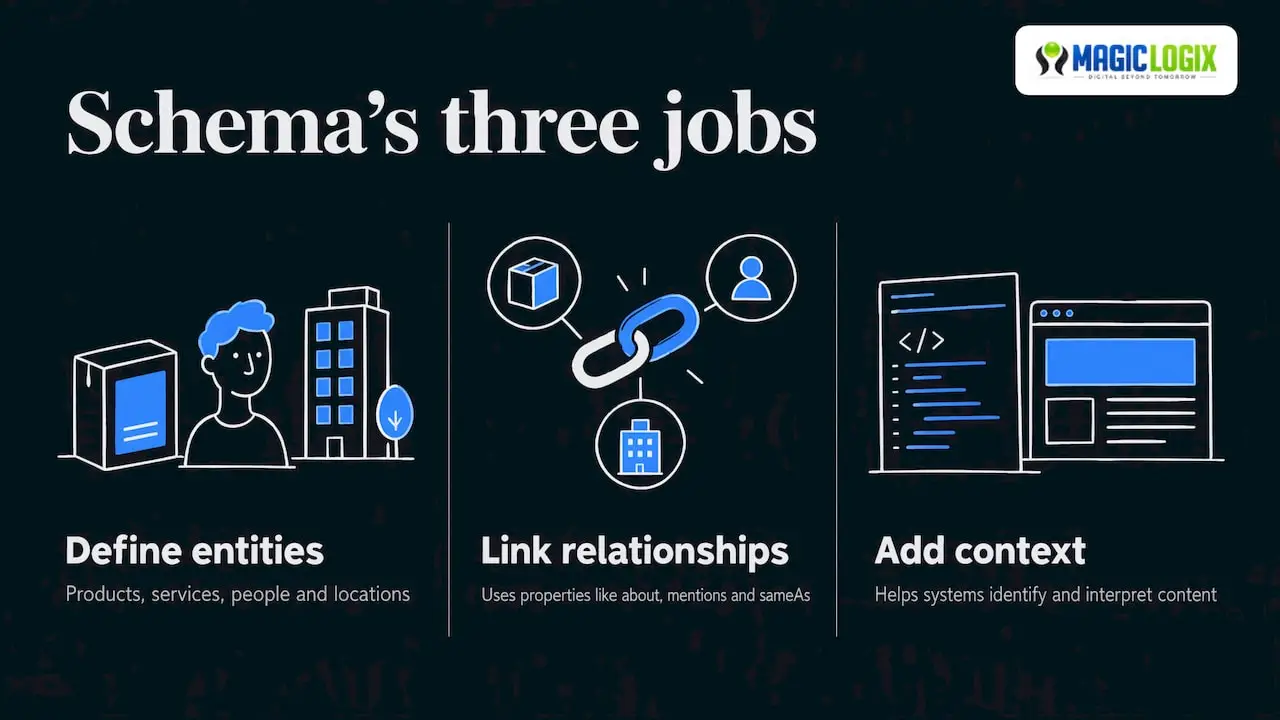
A Search Engine Journal analysis describes three jobs schema does for a brand. It defines entities such as products, services, people and locations. It establishes relationships between them with properties like about, mentions and sameAs. And it supplies machine-readable context so systems can identify and interpret your content with more confidence.
What Google says about AI features and schema
Before you plan any work, know the official position. Google’s AI features documentation says a page must be indexed and eligible to show in Search with a snippet to appear as a supporting link in AI Overviews or AI Mode. There are no additional technical requirements. It also says no new machine-readable files, AI text files or special schema.org markup are needed, and it lists making sure structured data matches visible text as a best practice.
Google’s guide to optimizing for generative AI features (updated July 2026) goes further. It says AEO and GEO are, from Google’s perspective, still SEO. It says structured data is not required for generative AI search, though it stays useful for rich-result eligibility. It also says that unique, people-first content will likely shape your presence in generative AI search more over time than any technical step in the guide.
What this means for you:
- Treat structured data as accurate labeling, not a trick.
- Do not expect schema alone to earn AI citations. Eligibility is not a promise of display.
- Put the markup in the context of crawlable pages, clear copy and credible brand information.
This is how we approach AI search visibility: the technical foundation and the content work move together. Platform behavior changes, so check Google’s documentation for the current wording before you commit a budget.
Which schema types to add first
You do not need every type. Work in layers, starting with the identity of the business and moving outward only as far as your pages justify.
| Layer | Schema types | Use it when |
|---|---|---|
| Business identity | Organization, Person, sameAs, @id | Every site, usually on the home page and About page |
| Page typing | Article, WebSite, BreadcrumbList | Blog posts, guides and any site with a clear hierarchy |
| Content formats | FAQPage, HowTo, ImageObject, VideoObject | The page genuinely contains that format |
| Commerce and local | Product, LocalBusiness, Event | You sell products, serve a location or host events |
The tiering above follows a GEO implementation playbook, but the logic is simple enough to apply anywhere: define who you are first, describe your pages second, and add specialty types only where a real asset exists.
Start with Organization markup
Google’s Organization structured data guide says there are no required properties and recommends adding as many relevant ones as you can. A logo can influence your knowledge panel, and identifiers such as iso6523 and naics help disambiguate an organization behind the scenes. Include your legal name, URL, logo, contact details, address where relevant and links to your official profiles.
Connect entities with @id and sameAs
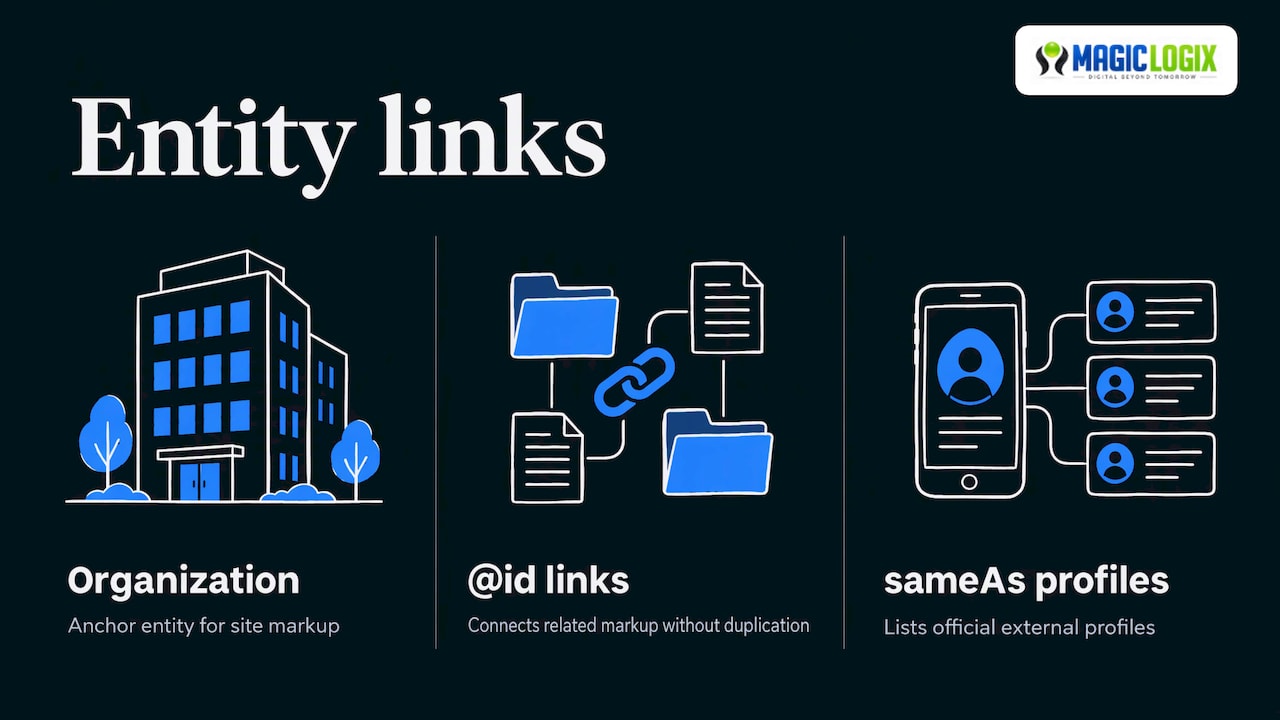
Organization markup works best as an anchor. As HubSpot’s marketing blog explains, Article, Person, Product and Service markup can point back to it, and the @id property links them without duplication. The sameAs property lists your official external profiles so your on-site entity can be matched to the same brand elsewhere.
Here is a simplified example of the pattern. Replace the placeholder values with your own:
{
  "@context": "https://schema.org",
  "@type": "Organization",
  "@id": "https://www.example.com/#organization",
  "name": "Example Roofing Co.",
  "url": "https://www.example.com/",
  "logo": "https://www.example.com/logo.png",
  "sameAs": [
    "https://www.linkedin.com/company/example-roofing"
  ]
}
Then reference https://www.example.com/#organization as the publisher of each Article, so every page ties back to the same entity.
Be careful with Person markup
A byline with a Person block only helps if the author has a real, public footprint that can be matched. Otherwise you have created an identity nothing can corroborate. If an author has no public profile, attribute the content to the Organization instead. If the author does have one, such as a bio page and professional profiles, reflect it in sameAs.
Entity SEO and the knowledge graph, in plain terms
A knowledge graph is a map of things (companies, products, people, places) and the relationships between them. Search engines and AI systems use this kind of map to work out that the Acme on your website, the Acme on your social profile and the Acme in a trade directory are the same business.
Entity SEO is the practice of making that match easy. For a business it comes down to a short list:
- Use one consistent name, address and description everywhere you appear.
- Give each important service, product and person its own page with a clear label.
- Mark up the relationships: who publishes the page, who wrote it, what the page is about.
- Keep your official profiles current and link to them from your site.
As Adobe’s business blog describes, a knowledge graph helps crawlers and language models connect information across several steps of retrieval. Schema is one way to feed that map. Clear writing, consistent naming and credible mentions feed it too.
Brand authority signals beyond markup
Markup states facts about you. Authority signals give those facts weight. The ones within your control are:
- Original content: guides, data, examples and explanations that are not available in the same form elsewhere.
- Named, accountable authors: real people with visible bios and credentials you can document.
- Evidence on the page: sourced numbers, definitions and quotable statements that are easy to attribute.
- Consistent brand information: the same name, description and contact details across your site and profiles.
- Technical health: crawlable, indexable pages that load quickly. Our guide to server-side rendering and LCP covers the performance side.
We cover the content side of this in how to get cited by AI and in our guide to AI Overviews optimization.
How to implement structured data step by step
Google’s workflow, described in its Organization markup guide, is a good base. Here it is expanded for a business team.
1. Inventory your pages and pick the types
List your page templates: home, About, service pages, blog posts, product pages, location pages. Assign one primary schema type to each. If a page does not contain a format (no FAQ, no video), do not mark it up as one.
2. Write the markup from visible content
Google’s intro documentation is firm on three points. Markup must sit on the page the information applies to. Do not add structured data about information users cannot see, even if it is accurate. And fewer, complete and accurate properties beat many incomplete or inaccurate ones. A common failure is a template that outputs the same generic values on every page. Each page’s markup should reflect that page.
3. Choose how it is delivered
JSON-LD added by client-side JavaScript, for example through a tag manager, is rendered by Googlebot. According to the GEO implementation playbook, other AI crawlers such as GPTBot, ClaudeBot and PerplexityBot have not been observed rendering JavaScript, so that markup may be invisible to them. Putting the JSON-LD in the server-rendered HTML is the safer route, and it is a decision best made when the site is built or rebuilt. Our website design and development work includes that kind of template-level decision.
4. Validate in order
Run these checks, in this sequence:
- A schema validator, to confirm the vocabulary is correct.
- Google’s Rich Results Test, to confirm eligibility for rich results and fix critical errors.
- A fetch of the page without JavaScript, to confirm the markup is in the raw HTML.
- URL Inspection in Search Console on a few deployed pages, to confirm they are not blocked by robots.txt, noindex or a login wall.
- A manual comparison of the markup against the visible page, which no tool does for you.
Google notes that recrawling and reindexing can take several days, so give changes time before you judge them.
5. Roll out, then monitor
Deploy to a handful of pages first, confirm they validate and index, then extend to the template. Watch the rich result reports in Search Console for new errors after each site update.
If your team wants to run language models in-house to review its own content and markup at scale, some businesses look at on-premise AI workstations for that kind of private workload.
A pre-launch checklist
- Every marked-up fact is visible on the page.
- Organization markup includes name, URL, logo and official profiles.
- Each page has one clear primary type.
- Authors in Person markup have a public presence, or the Organization is credited.
- Markup appears in the server-rendered HTML.
- Validation passes and Search Console shows no critical errors.
- A process exists to update markup when prices, hours, people or services change.
How to measure the impact honestly
AI search measurement is still imperfect, and a careful plan beats a bold claim. Search Engine Journal’s review of attribution notes that teams can use existing SEO metrics, such as clicks from rich results and non-branded clicks tied to stronger entity linking. It also notes that direct visibility into how structured data influences language-model answers is not yet available.
A peer-reviewed paper in MDPI Electronics explains why: generative search providers do not expose public APIs for tracking when a source is cited, so measures such as share of model (the proportion of AI answers that reference a brand) and brand mention frequency have to be collected by proxy. In zero-click answers there is often no referrer or landing-page visit, so attribution shifts toward impressions, citations and influence.
A practical measurement plan:
- Build a prompt set. Write 25 to 50 questions your buyers actually ask, grouped by service and funnel stage.
- Record a baseline. For each prompt, note whether your brand is mentioned, whether your site is cited and whether the description is accurate. Log the date, the engine and the settings.
- Change one thing at a time. Answer Engine Land argues that schema rarely ships alone. It arrives with new copy, author details and template fixes, so a later citation increase is hard to attribute. Isolating a narrow markup change and comparing against similar pages that did not change gives you a cleaner read.
- Track classic metrics too. Impressions, rich-result clicks, branded search and non-branded clicks in Search Console still tell you whether your pages are understood and chosen.
- Report numerators and denominators. Say “cited in 12 of 40 prompts on one engine in one week,” not “visibility up 30%.”
Treat any AI-lift claim as a hypothesis to test, including ours.
Where Magic Logix fits
Structured data touches your templates, your content, your site speed and your brand information at once. That is why it tends to work best as part of a joined-up program instead of a one-off plugin install. Magic Logix offers Search & AI Visibility services, including SEO, Answer Engine Optimization (AEO), Generative Engine Optimization (GEO) and AI search visibility and intelligence, alongside web design and development. If you want your markup, content and site build planned together, you can look at our GEO optimization service or start with a conversation through magiclogix.com.
Our perspective
Many owners ask us which schema type will get them into AI answers. We think that is the wrong first question. The better one is whether a machine can tell, without guessing, who you are, what you do and why your pages deserve to be trusted.
Structured data answers part of that. It states your identity and the shape of your content in a form every crawler can read. The rest comes from the work around it: pages worth citing, authors who can be verified, and a site that renders cleanly for any crawler.
That is how we plan Digital Beyond Tomorrow engagements. We connect search, AI visibility and site build so the markup is a true description of a well-built site and not a patch over a weak one. Because platform behavior is still evolving, we also set expectations early: we test, measure at the prompt level and report what changed, without promising citations or rankings.
Hassan Bawab
FAQ
Is structured data required to appear in AI Overviews or AI Mode?
No. Google’s documentation says a page needs to be indexed and eligible to show in Search with a snippet, with no additional technical requirements or special markup. Structured data remains useful for rich-result eligibility and for stating facts about your business clearly.
Which schema type should a small business add first?
Organization markup on the home page, with your name, URL, logo and official profiles. If you serve a specific area, add LocalBusiness details. Then add Article markup to your blog posts, and Product markup only if you sell products on the page.
Does FAQ markup help with AI search?
Use FAQPage markup when a page genuinely contains visible questions and answers. Google’s guidance requires that markup match visible content, so the questions must appear on the page. Treat it as accurate labeling of a real format, not as a shortcut.
Where should the JSON-LD live: tag manager or the page HTML?
The page’s server-rendered HTML is the more dependable choice. Markup injected by JavaScript is rendered by Googlebot, but other AI crawlers have not been observed rendering it, so they may not see it. Whichever you use, run a no-JavaScript fetch to check what a basic crawler receives.
How do I know if structured data is working?
Track rich-result clicks and non-branded clicks in Search Console, then run a fixed set of buyer prompts across AI engines and log mentions, citations and accuracy over time. Change one element at a time so you can tell what caused any movement.
Sources
- Intro to How Structured Data Markup Works, Google Search Central
- AI Features and Your Website, Google Search Central
- Google’s Guide to Optimizing for Generative AI Features on Search
- Organization Schema Markup, Google Search Central
- Merging SEO And Content Using Your Knowledge Graph, Search Engine Journal
- The Knowns And Unknowns Of Structured Data Attribution, Search Engine Journal
- Does Structured Data Improve AI Search Visibility? Answer Engine Land
- The Evolution of SEO in the Era of Generative AI, MDPI Electronics