

SEO (search engine optimization) earns your pages a position in a list of search results. AEO (answer engine optimization) makes your content the direct answer to a question. GEO (generative engine optimization) aims to get your brand cited or mentioned inside AI-written responses. For most businesses the practical answer is not to choose one: SEO is the foundation, and AEO and GEO are layers you add on top of it.
The labels are new and the boundaries are blurry, so this guide separates what is established from what is still emerging. You will see how each discipline is defined, how success is measured, where they overlap and what to do first.
TL;DR
- SEO targets a ranking position and is measured by rankings, clicks and traffic.
- AEO targets being the direct answer: featured snippets, AI Overviews and voice results.
- GEO targets citations and mentions in AI answers from tools such as ChatGPT, Gemini, Perplexity and Claude.
- AEO and GEO overlap heavily, and Google says optimizing for its generative AI features is still SEO. Build on solid SEO first.
- Nobody can promise AI citations. Plan, test and measure instead.
Table of Contents
- The three terms at a glance
- What SEO does
- What AEO does
- What GEO does
- Where AEO and GEO blur together
- What Google says
- How the metrics differ
- A practical way to combine all three
- How to split a budget
- Which one should you start with?
- Our perspective
- Where Magic Logix fits
- FAQ
- Sources
The three terms at a glance
Think of search as a library. SEO gets your book onto the right shelf. AEO gets a page of your book read aloud as the answer. GEO gets your book recommended when someone asks the librarian a broad question. All three depend on the book being good.
| SEO | AEO | GEO | |
|---|---|---|---|
| Goal | Rank in a list of links | Be the direct answer | Be cited or mentioned in an AI-generated response |
| Where it shows up | Google, Bing and other traditional results pages | Featured snippets, People Also Ask, AI Overviews, voice answers | ChatGPT, Gemini, Perplexity, Claude, AI Mode |
| Typical success measure | Rankings, clicks, traffic | Snippet wins, answer impressions | Citations, brand mentions, share of voice |
| Maturity | Established, with official guidance | Partly established (snippets), partly emerging | Emerging, with fast-changing platform behavior |
What SEO does
SEO is the work of making a website easy for search engines to crawl, understand and rank. It covers technical health, content that matches what people search for, and the authority signals that tell a search engine your site deserves a position. If you want a deeper look at how we approach it, see our SEO optimization service.
The output is a results page of ranked links. TechTarget describes SEO as targeting traditional engines such as Google, Bing and Yahoo to rank content in lists of links, and notes that it still drives significant web traffic. That is why SEO remains the channel most businesses measure revenue against.
What AEO does
AEO starts from a simple observation: many searchers want an answer, not ten links. Answer engines and answer features pull a specific passage from a page and present it directly. In practice, AEO work means:
- Leading a section with a short, direct answer to the question in its heading.
- Writing headings the way people phrase questions.
- Making each passage understandable on its own, so it can be lifted without the surrounding page.
- Using clear entities (the people, products and organizations you discuss) and structured data where it fits.
Search Engine Land’s guide to SEO versus GEO makes the same point about passages: content written for AI works best as self-contained chunks where each paragraph makes sense alone. Our AEO optimization page covers how we apply this to client content.
What GEO does
GEO is about visibility inside text that a generative AI system writes. The term was formalized in a Princeton-affiliated research paper presented at KDD 2024, which proposed it as a framework for improving how content is surfaced in generative-engine responses. Search Engine Land’s GEO guide, updated in October 2026, defines it as optimizing your brand and content to be cited, recommended or mentioned in AI answers on platforms like ChatGPT, Google AI and Claude.
Two things make GEO different in daily practice:
- It is about the brand, not only the page. An AI system forms an impression of your company from many places: your site, reviews, industry coverage, directories and community discussions. Keeping that picture accurate and consistent matters as much as any single page.
- It is less predictable. EMARKETER’s principal analyst Nate Elliott told EMARKETER that almost every GEO response differs from the next, unlike Google, where repeating a query gives a good sense of the answer.
Our GEO optimization page explains how we approach it for businesses.
Where AEO and GEO blur together
If you read five articles on this topic, you will see AEO and GEO used for nearly the same thing. EMARKETER’s 2026 FAQ on the topic says that in practice they describe the same underlying approach, that no common taxonomy exists, and that agencies use GEO, AEO, GSO, LLMO and AIO interchangeably.
A useful way to separate them without arguing over vocabulary:
- AEO leans toward questions and the formats that answer them: snippets, People Also Ask, voice and AI Overviews.
- GEO leans toward brand presence across generative tools, including broader recommendation-style prompts such as “which providers should I consider?”
The work for both is largely shared: clear answers, trustworthy sourcing, well-defined entities and fresh content. So when a vendor sells them as separate programs, ask what tasks differ in practice.
What Google says
Google’s own documentation is the most reliable anchor in a noisy field. Its guide to optimizing for generative AI features says SEO best practices remain relevant because the generative features are rooted in core Search ranking and quality systems. From Google’s perspective, optimizing for generative AI search is still SEO. The same page also tells businesses how to approach third-party AEO or GEO services, pointing to Google’s guidance on evaluating SEO advice.
That has a practical consequence. Any plan that skips crawlability, helpful content and site quality in favor of AI-specific tricks is building on sand. Our overview of AI Overviews optimization goes deeper on the Google side.
How the metrics differ
The clearest practical split is in measurement. Search Engine Land frames it this way: SEO is measured by rankings, clicks and traffic, while GEO is measured by citations, mentions and share of voice.
| Question you want answered | SEO signal | AEO signal | GEO signal |
|---|---|---|---|
| Are we visible? | Keyword rankings, impressions | Snippet and People Also Ask appearances | Whether AI tools name us for our key prompts |
| Are people arriving? | Organic sessions | Clicks from answer features | Referral visits from AI tools |
| Is it worth it? | Leads and revenue from organic | Leads from answer-led pages | Conversions from AI-referred visitors |
| Is the message right? | Titles and snippets | Accuracy of the quoted passage | Accuracy of how AI describes the brand |
A caution on traffic: TechTarget notes that GEO generates limited direct web traffic because AI tools give users answers rather than link lists, so brands may treat GEO as awareness and SEO as the traffic driver. Set expectations with your team accordingly, and do not judge AEO or GEO on clicks alone.
A practical way to combine all three
EMARKETER’s FAQ recommends starting with SEO fundamentals, then adding AI-specific layers. Here is a sequence a small team can actually run.
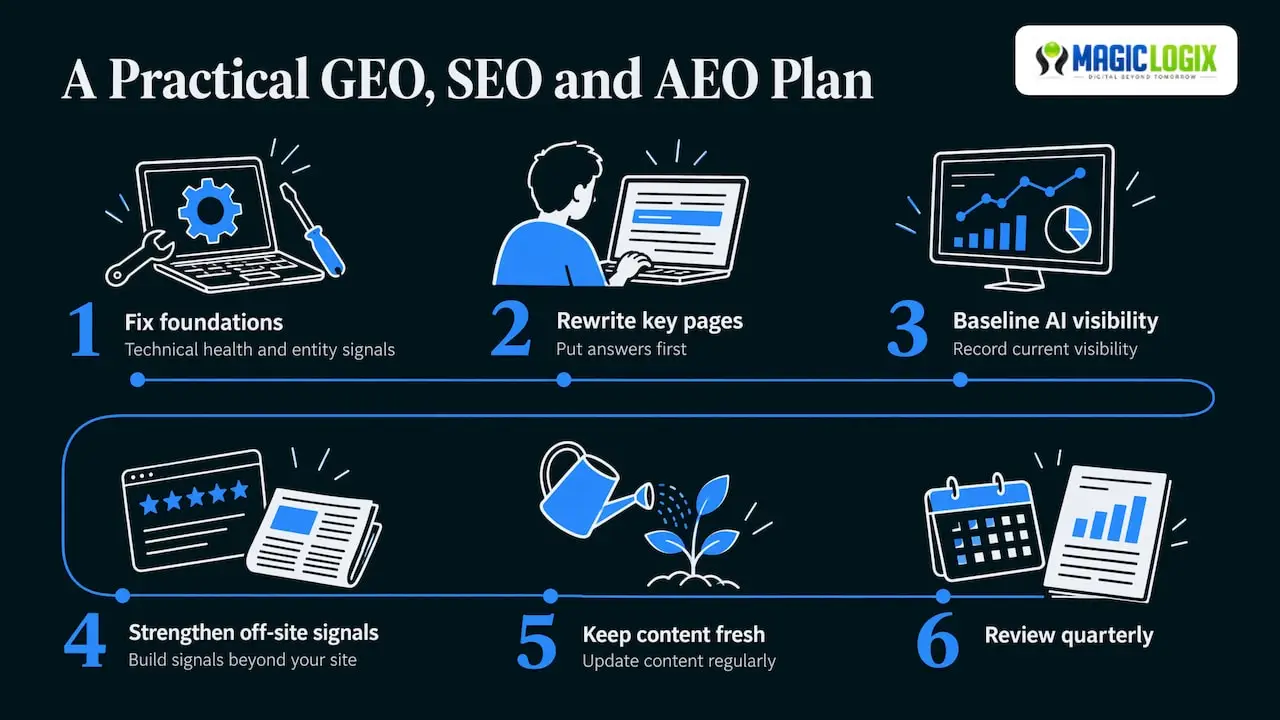
Step 1: Fix the foundation
Confirm your site can be crawled, loads quickly and has pages that match what customers search for. Make sure your company, products and locations are described consistently, because that is the entity clarity both AEO and GEO depend on. A website design and development project is often where these basics get settled.
Step 2: Rewrite key pages answer-first
Pick your ten most important pages. Under each question-style heading, put a short direct answer first, then the detail. Keep passages self-contained. Our guide to SEO content briefs that scale to SEO, AEO and GEO shows a repeatable way to specify this for writers.
Step 3: Take a baseline of AI visibility
EMARKETER suggests auditing your current AI visibility by asking ChatGPT, Gemini and Perplexity the questions your customers ask. Write down 20 to 30 prompts, run them, and record whether you are named, how you are described and which sources are cited. Because AI answers vary from run to run, repeat each prompt several times and look at patterns, not single results.
Step 4: Strengthen the signals off your site
AI systems draw on more than your domain. EMARKETER points to community platforms such as Reddit and YouTube, and to digital PR, as places where brand conversations form. Reviews, industry coverage and accurate directory listings all help the picture of your business stay consistent.
Step 5: Keep content fresh
AI answers favor current material. Set a review calendar for your most important pages and update facts, prices and dates when they change.
Step 6: Review quarterly
Compare your baseline against new runs of the same prompts, and set it next to rankings, conversions and revenue. Adjust the mix based on what moves the business, not on what the latest article claims.
How to split a budget
There is no universal ratio. As one reference point, EMARKETER describes a conservative framework: 40% core SEO, 25% digital PR, 20% data and reporting, 10% training and 5% experimentation. Treat it as an example to adapt, not a rule. A local service business may put almost everything into SEO and answer-first content, while a company with a broad product line and many competitors may invest more in off-site presence.
TechnologyAdvice makes a similar point: SEO stays the foundation of an organic strategy, and AEO is an added visibility layer measured by mentions, citations and share of voice.
Which one should you start with?
| Your situation | Start here |
|---|---|
| New site or weak technical basics | SEO foundations first |
| Solid rankings, content is long and hard to scan | AEO: restructure pages answer-first |
| Strong content, but AI tools do not name you or describe you wrongly | GEO: entity clarity and off-site presence |
| Limited budget and a small team | SEO plus answer-first rewrites; add a light GEO audit |
| Enterprise with many products and regions | All three, with shared reporting |
Our perspective
We treat SEO, AEO and GEO as one system with three outcomes: being found, being answered with and being recommended. The mistake we see businesses risk is splitting them into separate projects with separate vocabularies, then wondering why nothing compounds.
Our view is that content built for people who ask real questions serves all three. A page with a direct answer, clear entities and trustworthy detail can rank, be quoted and be remembered by an AI system. That is why we plan search and AI visibility together, from strategy through site, content and measurement.
We also think honesty matters here. Platform behavior is evolving, and no one can promise a citation or a ranking. What a good partner can do is build the foundations, test against real prompts, measure honestly and adjust as the platforms change. That is how we think about Digital Beyond Tomorrow: preparing your business for the search experience that is arriving, without abandoning the one that pays the bills today.
Hassan Bawab
Where Magic Logix fits
If you want one team to cover the full picture, our Search & AI Visibility offering brings together SEO, AEO, GEO and AI search visibility and intelligence, alongside web development, paid media and marketing automation. You can read more about our AI search visibility work, or explore the full range on our services page. If you would like to talk through where your business stands, we are happy to start with a consultation.
FAQ
What is the main difference between SEO and GEO?
SEO aims to rank your pages in a list of links on engines like Google and Bing. GEO aims to have your brand cited or mentioned inside answers that AI tools generate. SEO is usually judged by rankings and traffic, GEO by citations, mentions and share of voice.
Is AEO the same as GEO?
Often, yes. EMARKETER reports that in practice they describe the same underlying approach and that agencies use the terms interchangeably. If you need a distinction, AEO leans toward direct answers and snippets, and GEO toward brand presence in generative responses.
Do I still need SEO if AI search is growing?
Yes. Google’s documentation says its generative AI features are rooted in core Search ranking and quality systems, so SEO best practices remain relevant. SEO also remains the main traffic driver, while AEO and GEO add visibility in answers.
Can anyone guarantee that AI tools will cite my business?
No. AI answers vary from one response to the next and platform behavior changes. What you can do is publish clear, accurate, well-sourced content, keep your brand information consistent across the web and track your visibility over time.
What should a small business do first?
Fix the SEO basics, then rewrite your most important pages with a direct answer under each question-style heading. After that, run a set of customer prompts through the major AI tools and record the results as your baseline.
Sources
- Google Search Central: Optimizing for generative AI features
- Princeton: GEO, Generative Engine Optimization (KDD 2024)
- Search Engine Land: Generative Engine Optimization (GEO)
- Search Engine Land: SEO vs. GEO, AIO, LLMO
- TechTarget: GEO vs. SEO
- EMARKETER: FAQ on GEO and AEO
- TechnologyAdvice: AEO vs SEO