
Marketing Operations, or MarOps, isn't just another buzzword—it's the strategic backbone holding up your entire marketing department. Think of it as the central nervous system that aligns your people, fine-tunes your processes, manages your tech stack, and makes sense of your data.
At its core, MarOps is what turns marketing from a purely creative pursuit into a predictable engine for business growth. It ensures every initiative is executed efficiently, measured accurately, and built to scale.
The Engine Room of Modern Marketing
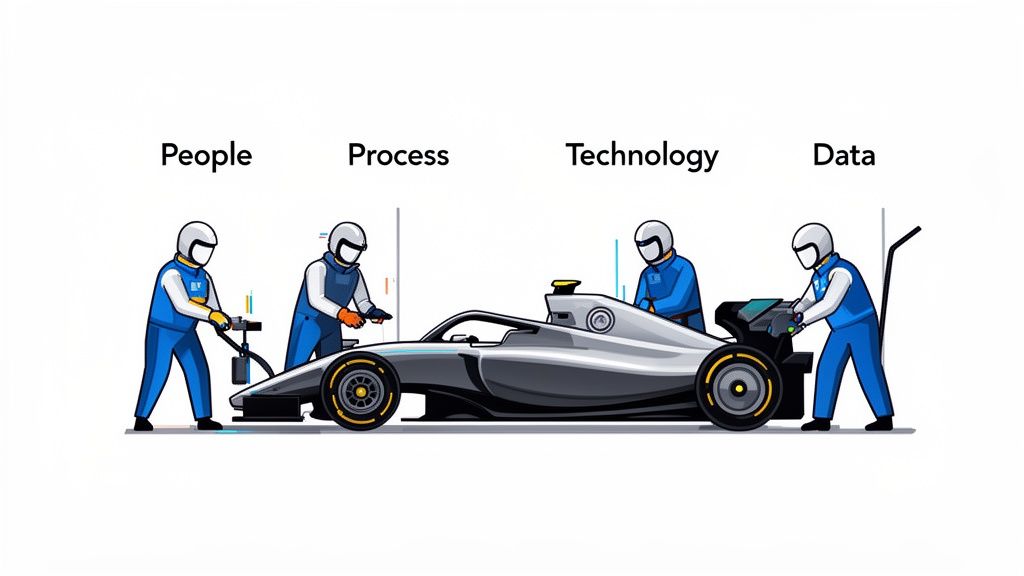
If your marketing campaigns are a high-performance race car, then your MarOps team is the expert engineering crew in the pit. They're the ones working behind the scenes, constantly optimizing the car's performance, managing the onboard technology, and analyzing the data from every single lap.
Without that crew, even the most talented driver would sputter out before the finish line.
MarOps pushes marketing beyond just crafting clever ads or beautiful content. It builds the operational framework that allows those creative efforts to connect with the right audience and, more importantly, prove their value. It's the function that answers mission-critical questions, like:
- Are we using the right tools and tech to reach our customers?
- How can we automate the tedious, repetitive tasks bogging down our team?
- Is our customer data clean, accessible, and actually usable?
- How do we draw a straight line from our marketing spend to sales revenue?
The Four Pillars of Marketing Operations
To really get what MarOps is all about, it helps to break it down into four fundamental pillars. These are the key areas that an effective MarOps function manages to build a stable, scalable marketing machine. A crucial part of this is achieving "Integrated Marketing Communications (IMC)," which ensures a consistent message across every channel and touches on each of these pillars.
The map below shows how MarOps connects these four essential components into one cohesive strategy.
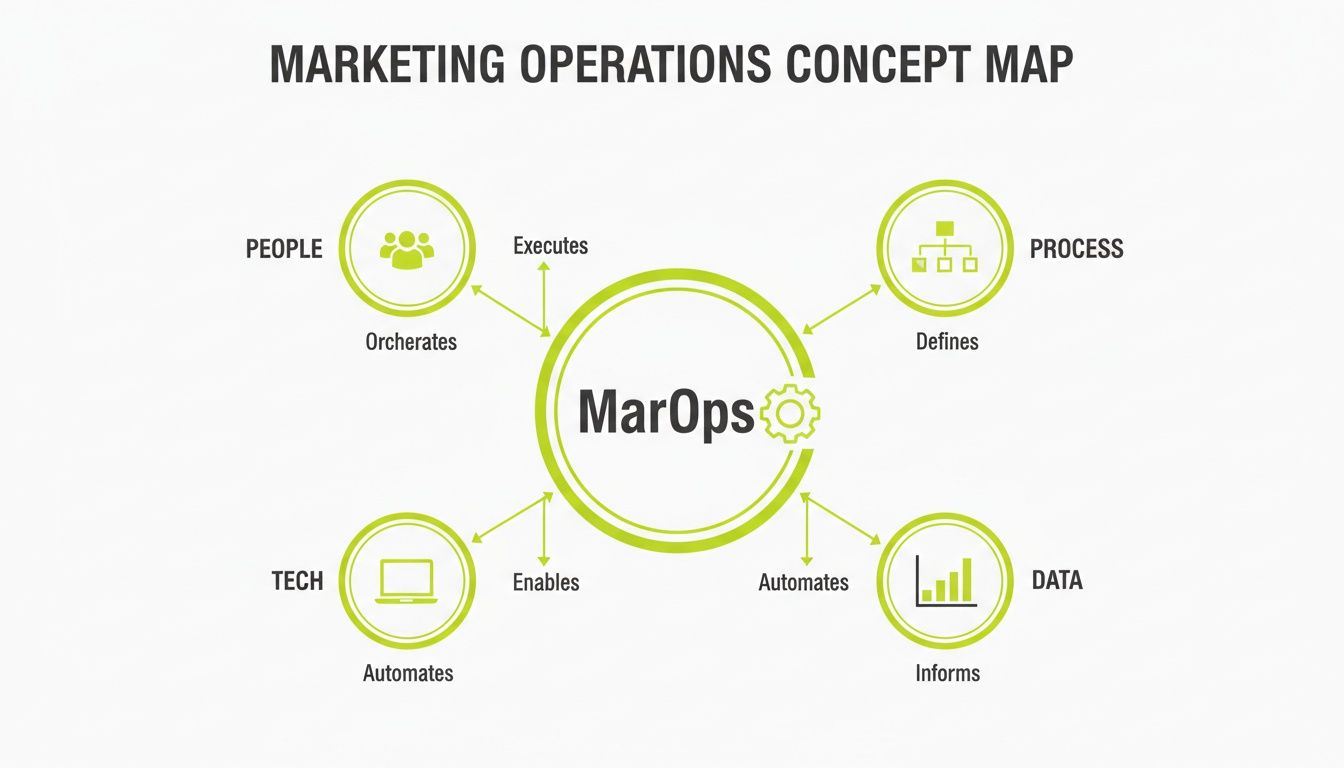
This setup makes it clear that MarOps isn’t just about one thing. It lives at the intersection where people, process, technology, and data all meet to drive real performance.
To provide a clearer framework, let's look at what each pillar focuses on and the questions it aims to answer.
The Four Pillars of Modern Marketing Operations
| Pillar | Core Focus | Key Questions Addressed |
|---|---|---|
| People | Skills, Roles, & Collaboration | Do we have the right talent? Are roles clearly defined? How do teams work together effectively? |
| Process | Workflows & Best Practices | How does work get done? Are our processes efficient and repeatable? Where are the bottlenecks? |
| Technology | MarTech Stack Management | Are our tools integrated? Are we getting ROI from our tech spend? What new tools do we need? |
| Data | Analytics & Reporting | How do we measure success? Is our data accurate? How do we turn insights into action? |
By focusing on these pillars, MarOps creates a seamless flow between different parts of the marketing organization, cutting out friction and maximizing what the team can achieve.
This strategic alignment is non-negotiable today. With the sheer complexity of modern marketing and the need to keep up with fast-moving digital marketing trends, you absolutely need a solid operational foundation. When these pillars work together, marketing stops being about guesswork and becomes a system for creating data-driven, repeatable success. That's the real power of a well-run MarOps function.
The Journey from Tactical Support to Strategic Partner
Marketing operations didn't just show up one day as a strategic powerhouse. Its evolution is really a story of adaptation, pushed forward by huge shifts in technology and what businesses started to expect from their marketing teams. If you want to get why MarOps is so critical today, you have to understand how it grew from a background administrative role into a core driver of business strategy.
In the beginning, the role was purely tactical. Think of early marketing operations as an assistant juggling spreadsheets, manually pulling lists for email blasts, and handling the logistics for trade shows. The job was all about execution support—doing the necessary, often repetitive, tasks that let marketers get campaigns out the door.
The Rise of MarTech and Accountability
The real change kicked in during the early 2000s with the explosion of digital marketing tools. All of a sudden, marketers had automation platforms, analytics software, and CRMs at their fingertips. This tech boom created a brand-new problem: who was going to manage all this complexity?
This is where the modern idea of marketing operations was truly born. Someone had to own the "stack" and make sure all these new tools actually worked together. The role started shifting from simple task-running to technical management and system integration.
At the same time, the economic pressure after the 2008 financial crisis put marketing under a microscope. CEOs and CFOs weren't happy with fuzzy brand awareness metrics anymore; they wanted to see a clear return on investment (ROI). This demand for accountability was a massive turning point.
Marketing could no longer operate as a creative cost center. It had to prove its direct contribution to revenue, and marketing operations became the function responsible for building the measurement framework to do just that.
From Cost Center to Revenue Engine
This new demand for hard numbers pushed MarOps into a much more strategic seat. The team was now on the hook for tracking every dollar spent and connecting it to leads, pipeline, and closed deals. That required a deep understanding of data, process, and technology—the three pillars of MarOps.
The growth has been staggering. After emerging as a distinct field in the early 2000s, MarOps saw a major uptick in investment by 2010 as forward-thinking companies scrambled to manage their tech stacks. By 2015, adoption rates had jumped to over 60% in Fortune 500 enterprises. The real proof came when recent research revealed that 74% of high-performing marketing teams now see MarOps as critical to their success.
This evolution highlights a few key shifts:
- From Task Manager to Process Architect: Instead of just doing tasks, MarOps started designing the efficient, repeatable workflows for the entire department.
- From List Puller to Data Steward: The job went from managing simple contact lists to ensuring the integrity, governance, and strategic use of all marketing data.
- From Tech Support to Stack Strategist: MarOps now selects, integrates, and optimizes the entire marketing technology ecosystem to line up with business goals.
By taking on these bigger responsibilities, the function cemented its role as an essential partner to marketing leadership and the C-suite. You can learn more about how modern strategic capabilities can drive business growth. Today, a mature MarOps team isn’t just supporting the marketing strategy—they are actively shaping it.
What a Marketing Operations Team Actually Does
So, what does a marketing operations team actually do all day? If marketing is a high-performance race car, MarOps is the engineering crew in the pit and back at the factory. They’re not just changing the tires; they are the architects, mechanics, and data scientists making sure the entire machine runs at peak performance.
Their work boils down to four core functions that transform marketing from a collection of random activities into a cohesive, measurable system. These areas are deeply connected—a well-managed tech stack, for example, is critical for gathering the clean data needed to fine-tune processes and inform strategy.
Managing the MarTech Stack
Today’s marketer has a garage full of tools: CRMs, marketing automation platforms, analytics software, content systems, you name it. The MarOps team is the master architect of this entire marketing technology (MarTech) stack.
But their job isn't just about buying shiny new software. It’s a continuous cycle of:
- Evaluation and Selection: Finding operational gaps and identifying the right tools to fill them. They ensure any new software not only fits the budget but also plays nice with the systems already in place.
- Integration and Implementation: Making sure all the different platforms can talk to each other. For instance, they set up the connections so a new lead from the website automatically lands in the CRM and gets enrolled in the right email sequence without a hitch.
- Optimization and Governance: Keeping a close eye on tool usage, managing who has access to what, and making sure the company gets a solid return on its tech investments. In fact, businesses that get this right can see a 15-25% improvement in marketing efficiency.
Ensuring Data Integrity and Management
Data is the fuel for any modern marketing engine, but dirty data is like pumping sludge into a Ferrari. MarOps acts as the steward of all marketing data, making sure it’s clean, accurate, accessible, and compliant.
This is a massive, ongoing responsibility that directly affects every campaign. Think about it: a personalized email campaign is worthless if half the names are misspelled or the purchase history is wrong.
A strong MarOps function ensures that data isn't just collected, but becomes a reliable asset. They build the systems that cleanse, segment, and enrich data, turning raw information into the strategic insights that drive smarter marketing decisions.
Their day-to-day tasks include things like standardizing data entry fields across systems, hunting down and merging duplicate records, and making sure everything is compliant with privacy rules like GDPR or CCPA.
Optimizing Internal Processes and Workflows
How does a campaign go from a great idea to a full-blown launch? Who needs to sign off on the copy? How are results tracked and shared? MarOps answers these questions by designing and refining the internal processes that dictate how work gets done.
They are the efficiency experts, always on the lookout for bottlenecks and opportunities to make workflows smoother. This often involves:
- Creating Standard Operating Procedures (SOPs): Documenting the exact steps for common tasks, like how to build a landing page or launch a webinar, so everyone is on the same page.
- Implementing Project Management Systems: Setting up tools like Asana or Monday.com with templates to ensure campaigns are delivered on time and on budget, with clear ownership at every step.
- Automating Repetitive Tasks: Finding all the manual, time-sucking activities and using technology to automate them. This frees up the creative and strategic minds on the team to focus on what they do best.
Supporting Strategic Planning and Performance Measurement
Finally, MarOps provides the data-driven backbone for strategic planning and performance analysis. They build and maintain the dashboards that tell leadership what’s working, what isn’t, and where to invest the budget next.
They’re responsible for tracking the metrics that matter and connecting marketing activities directly to business outcomes like pipeline and revenue. This makes them an essential partner to marketing leadership, translating campaign data into a clear story about marketing’s impact on the bottom line.
How to Measure the Real Impact of MarOps
So, you've invested in marketing operations. How do you actually know if it's paying off? Beyond just feeling more organized, a solid MarOps function has to deliver tangible, measurable results.
The key is to look at two different but equally important buckets of metrics: one that tracks your internal efficiency, and another that ties directly to business growth.
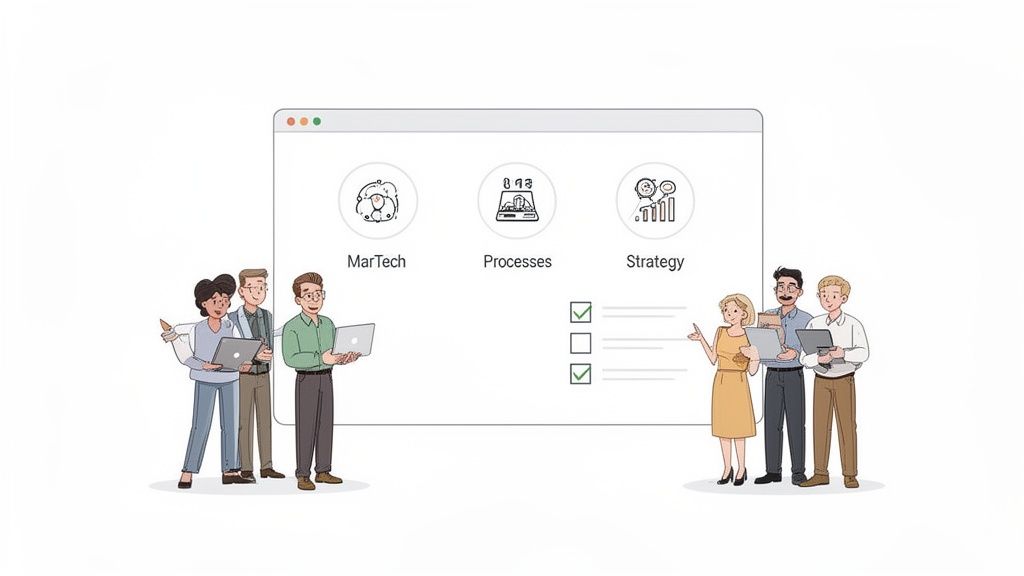
This dual approach gives you the full picture. It shows how the operational tune-ups from the MarOps team—the "pit crew" work—translate into faster speeds and bigger wins on the market racetrack. Let’s break down the key performance indicators (KPIs) you should be watching.
Gauging Operational Efficiency
Before you can really move the needle on revenue, you have to get your own house in order. Operational efficiency metrics are all about how effectively the marketing machine is running. They’re the leading indicators that tell you MarOps is successfully getting rid of friction, automating tedious tasks, and freeing up the rest of the team to do their best work.
Think of these as the health stats for your engine. A healthy engine runs smoothly, responds instantly, and doesn't guzzle fuel.
Key efficiency metrics to keep an eye on include:
- Campaign Launch Time: This tracks the average time it takes to get a campaign from an idea to live in the market. A big drop here is a clear sign that your processes are tighter and bottlenecks are gone.
- Marketing Team Productivity: This can feel a bit harder to nail down, but you can track things like the number of campaigns managed per team member or the hours saved by cutting out manual, repetitive tasks.
- MarTech ROI: Is your tech stack actually making you money? This measures the value generated by your technology against what it costs. A positive ROI means your tools are well-integrated and people are actually using them to hit goals.
- Database Health Score: This KPI looks at the percentage of clean, complete, and usable records in your CRM or marketing automation platform. A high score means your targeting is built on a solid foundation, not quicksand.
Proving Business Impact
While efficiency is fantastic, the C-suite wants to know how marketing operations helps the bottom line. Business impact metrics draw a straight line from MarOps activities to revenue and growth. These are the numbers that prove MarOps isn't a cost center—it's a powerful revenue driver.
This is where the rubber truly meets the road. These KPIs show that your well-oiled marketing engine is actually winning races and bringing home trophies in the form of sales and happy customers. You can explore more on tying strategy to results in our extensive digital marketing resources.
The real power of marketing operations is its ability to make marketing's contribution undeniable. By building the systems for accurate tracking and attribution, MarOps turns marketing performance from a matter of opinion into a statement of fact.
Top-tier business metrics include:
- Lead Velocity Rate (LVR): This tracks the month-over-month growth in qualified leads. A steady climb in your LVR is a great sign that your demand generation engine is healthy and scalable.
- Customer Acquisition Cost (CAC): A fundamental metric for any business, CAC tells you exactly how much you spend to land a new customer. Smart MarOps helps push this number down by improving targeting, automating workflows, and optimizing spend.
- Marketing-Sourced Pipeline: This is the total dollar value of sales opportunities generated directly from marketing’s efforts. It’s a critical number that shows how well marketing is teeing up quality prospects for the sales team.
- Customer Lifetime Value (CLV): MarOps plays a big role here by enabling better segmentation and personalization for customer retention campaigns. That leads to more repeat business and higher overall value from each customer.
The data consistently shows that mature marketing operations teams generate incredible returns. They can hit a positive ROI within 6-12 months and often slash operational waste by 40%. Even better, high-performing teams with strong MarOps generate 2.5x more sales opportunities than their peers, as shown in stats from Agile Sherpas, proving the direct link between a smooth operation and a growing pipeline.
Building Your Modern Marketing Operations Toolkit
Technology is the engine of any modern marketing operations team. Without the right tools working in harmony, even the best strategies will sputter and fail. Think of your MarTech stack like a professional chef's kitchen—you can't create a gourmet meal with just a single pot. You need a full array of specialized, high-quality tools that work together seamlessly to produce something amazing.
This toolkit is what powers everything MarOps does, from automating tedious work to uncovering deep insights that guide the business. The goal isn't just to accumulate software licenses; it's to build a cohesive ‘stack’ where every single piece has a distinct and valuable role.
The Core of Your Stack
At the heart of nearly every marketing operations setup are three foundational technologies. These are the non-negotiables that manage the fundamental activities of attracting, engaging, and understanding your customers. Getting these right is the first, most critical step toward building a system that can scale with your business.
Marketing Automation Platforms (MAP): This is your command center for campaign execution. A MAP, like HubSpot or Marketo, handles the heavy lifting of repetitive tasks—sending emails, nurturing leads through complex journeys, and managing multi-channel campaigns. It's what allows you to deliver personalized experiences at scale.
Customer Relationship Management (CRM): The CRM is your single source of truth for every customer and prospect. Systems like Salesforce track every touchpoint, from the first website visit to the final sales call, creating a complete history of the relationship. For MarOps, the CRM is indispensable for segmenting audiences, managing the lead lifecycle, and keeping marketing and sales perfectly aligned.
Data and Analytics Tools: This category is the brains of the operation. It covers everything from web analytics platforms like Google Analytics to sophisticated business intelligence (BI) dashboards powered by tools like Tableau. These are the tools that let you measure what matters, track KPIs, and turn mountains of raw data into clear, actionable insights. They answer the ultimate question: “Is what we’re doing actually working?”
Essential Supporting Tools
Once the core is solid, a mature MarOps function layers in specialized tools to handle specific jobs. These supporting players help refine processes, boost collaboration, and make your entire marketing machine run smoother. Integrating them properly is what separates a basic, functional stack from a truly high-performance one.
A well-built MarTech stack isn’t just a collection of logos on a slide. It's an interconnected ecosystem. The real magic happens when these tools share data and trigger workflows between each other, creating a system that’s far more powerful than the sum of its parts.
Consider adding these platforms to round out your capabilities:
Project Management Tools: Keeping the chaos of campaign planning and execution under control is impossible without a good project management tool. Platforms like Asana or Monday.com bring order, clarity, and accountability to your team’s workflows.
Content Management Systems (CMS): Your CMS is the foundation of your digital presence. It’s where you create, manage, and publish all the content for your website and blog. It’s a central piece of the customer experience puzzle and needs to integrate smoothly with the rest of your stack.
Customer Data Platforms (CDP): A CDP is the ultimate data unifier. It pulls customer information from all your disparate sources—your CRM, email platform, website, support tickets—and stitches it all together into a single, unified customer profile. This gives you that coveted 360-degree view of each person, unlocking next-level personalization.
Choosing the right technology is a huge responsibility for any marketing operations leader. The right stack can be a massive competitive advantage, while the wrong one can create endless friction and wasted effort. To help clarify these essential categories, the table below breaks down their primary functions and gives a few examples of leading platforms.
Core MarOps Technology Categories and Their Functions
| Tool Category | Primary Function in MarOps | Example Platforms |
|---|---|---|
| Marketing Automation | Automates and scales campaign execution and lead nurturing. | HubSpot, Marketo, Pardot |
| CRM | Manages all customer data and sales interactions. | Salesforce, Zoho CRM, HubSpot |
| Data & Analytics | Tracks performance, measures KPIs, and generates insights. | Google Analytics, Tableau, Looker |
| Project Management | Organizes workflows, tasks, and team collaboration. | Asana, Monday.com, Trello |
Ultimately, the specific tools you choose will depend on your company's size, budget, and strategic goals. The key is to select platforms that not only excel at their individual functions but also play well with others, creating a truly integrated and powerful marketing engine.
Integrating AI to Future-Proof Your Marketing Operations
If marketing operations built the engine, then Artificial Intelligence (AI) is the supercharger that finally unlocks its real power. Far from being some far-off concept, AI is a practical tool that’s actively reshaping just about every corner of MarOps. It's how you shift the entire function from a reactive support crew to a predictive growth machine.
This isn’t just about getting things done faster; it’s about getting them done smarter. AI gives your marketing operations the ability to anticipate what customers need, optimize campaigns in the moment, and make decisions with a level of precision we couldn't have imagined a few years ago. It truly elevates the entire marketing department.
From Automation to Intelligence
For years, the big push was for automation—getting all those repetitive, manual tasks off your team's plate. AI takes that a massive leap forward by injecting intelligent decision-making right into those automated workflows. The result is a system that's far more dynamic and responsive.
Here are a few ways AI is transforming core MarOps responsibilities right now:
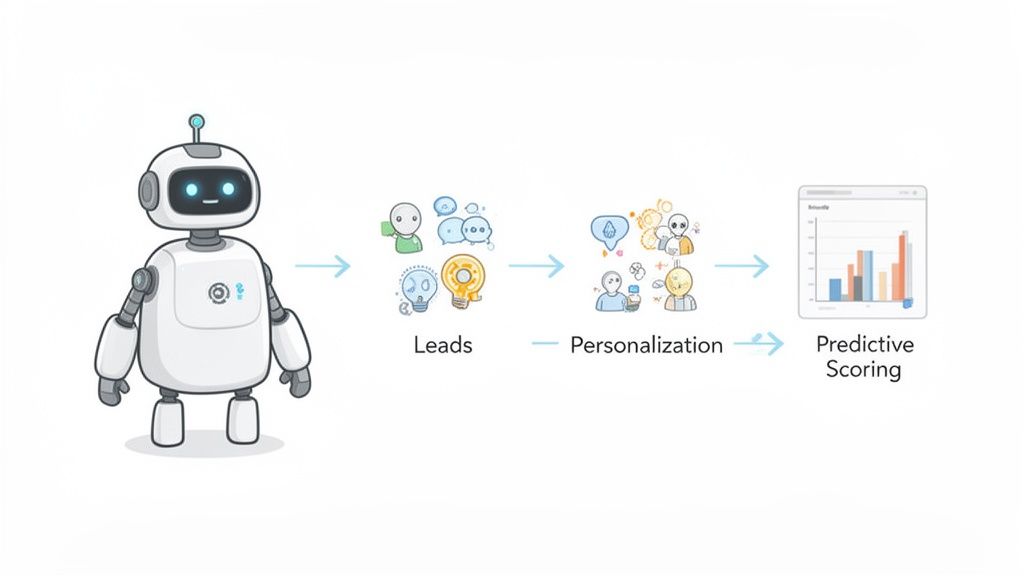
- Predictive Lead Scoring: Instead of relying on static, rule-based models that treat everyone the same, AI dives into thousands of data points to predict which leads are actually most likely to convert. This lets your sales team focus their valuable time on opportunities with the highest potential.
- Hyper-Personalization at Scale: Forget just dropping a name into an email. AI algorithms can analyze individual user behavior to serve up uniquely tailored content, product recommendations, and offers to millions of people simultaneously. This is what true one-to-one marketing looks like.
- Real-Time Campaign Optimization: AI can watch your campaign performance like a hawk, automatically shifting budget, tweaking ad creative, or changing the channel mix on the fly to get you the best possible ROI. It spots trends and makes adjustments faster than any human ever could.
To really get ahead, you can start future-proofing your operations with specialized tools like an AI Reel Generator that helps you efficiently churn out engaging video content.
Building an AI-Ready Operational Framework
Here's the thing: bringing AI into the fold isn't just about plugging in a shiny new tool. It demands a strategic shift in how your MarOps team approaches data, processes, and technology. You need an operational framework that’s agile enough to handle constant learning and adaptation.
AI thrives on clean, structured, and accessible data. A core function of modern marketing operations is to build and maintain the pristine data ecosystem that AI models need to deliver accurate and powerful insights.
In this new AI-powered world, marketing operations is being completely re-engineered. In fact, 80% of leading brands are now embedding AI to better align their operations with clear business goals. The numbers back it up: teams with AI-integrated MOps report 40% higher operational efficiency and 55% better personalization at scale. This is how marketing becomes a predictable revenue machine.
For Magic Logix clients—from local Dallas businesses to global enterprises—this means using predictive analytics to achieve a 35% lower customer acquisition cost (CAC) and a 2x increase in their marketing-influenced pipeline value.
Ultimately, integrating AI is the logical next step in the evolution of MarOps. By embracing these capabilities, you’re building a marketing engine that isn't just efficient today, but is also intelligent and resilient enough to win tomorrow. You can learn more about unlocking the power of AI for modern marketers in our detailed guide.
Answering Your Key Questions About Marketing Operations
Even when you get the concept, actually picturing how marketing operations fits into your team can bring up a lot of practical questions. How does it work with your existing people? Where do you even start? Let’s tackle some of the most common queries head-on to give you a clear path forward.
We've found that these points of confusion come up again and again, whether you're running a massive enterprise or a small, scrappy business.
How Does Marketing Operations Differ from General Marketing?
Think of it this way: general marketing is the "what," and marketing operations is the "how." A general marketer is focused on creating the campaign, writing the copy, and shaping the brand message. Their goal is to connect with an audience creatively and strategically.
So, what is marketing operations then? It's the architecture and engineering function humming along behind the scenes. MarOps builds and maintains the infrastructure that lets marketers execute their vision efficiently and, just as importantly, measure what’s working.
While a marketer creates the ad, the MarOps professional ensures the right system deploys it to the correct audience segment, tracks its performance with precision, and feeds that data back into the system to make the next campaign even smarter.
One team creates the art; the other builds the gallery, manages the lighting, and counts the visitors.
What Is the First Step to Building a MarOps Function?
It’s tempting to jump straight into shopping for shiny new software, but the real first step is much more grounded: conduct an audit. Before you spend a dime, you have to get a clear picture of where you are right now.
This process involves a few key activities:
- Map Your Current Processes: Get it all down on paper. Document how work actually gets done, from idea to execution. Where are the handoffs? Who is responsible for each step?
- Identify Bottlenecks: This is where you find the gold. Pinpoint the areas where work slows down, gets stuck, or just falls apart. Is it the campaign approval process? Is it pulling data for reports?
- Evaluate Your Existing Tech: Take a hard look at the tools you already pay for. Are they being used to their full potential? Are they even talking to each other correctly?
This audit will reveal your most painful, high-priority problems. The insights you gain will help you build a roadmap that actually solves things. More often than not, the biggest wins come from optimizing the people, processes, and technology you already have, not from a massive new investment. You have to fix the foundation before you can build a skyscraper.
Can a Small Business Benefit from Marketing Operations?
Absolutely. Marketing operations is a mindset and a set of functions, not necessarily a huge, dedicated department. For a small business, MarOps can start with just one person dedicating a slice of their time to bringing order to the chaos.
This might look like:
- Streamlining workflows for things like content creation and social media scheduling.
- Cleaning up the CRM database to make sure lead data is actually accurate and usable.
- Creating a simple performance dashboard to track the few metrics that truly matter.
The core goals are always efficiency and scalability. By putting basic MarOps principles in place early, even the smallest businesses can build a strong, stable foundation. This operational discipline is what allows your marketing efforts to scale smoothly as the company grows, instead of eventually breaking under the pressure.
Ready to build a marketing engine that delivers predictable growth? Magic Logix specializes in creating the operational frameworks that align your people, processes, and technology for maximum impact. Discover how we can transform your marketing function at https://www.magiclogix.com.